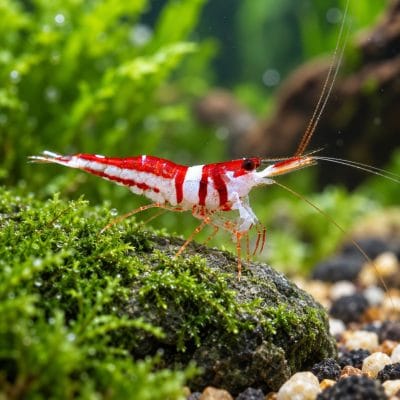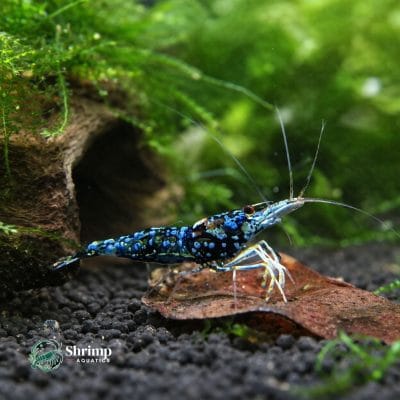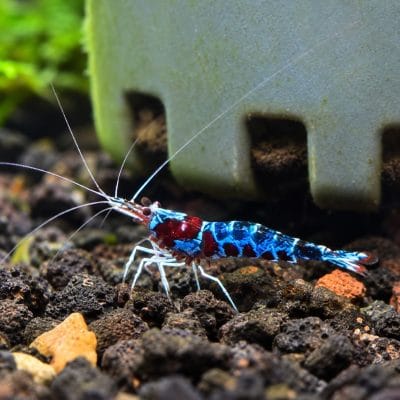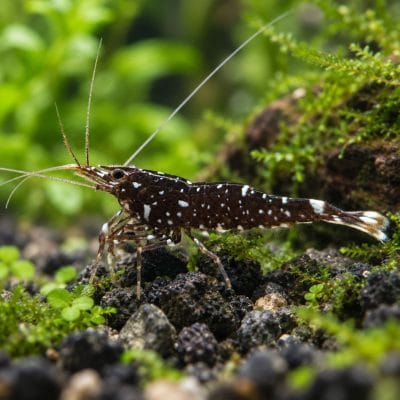
If a Sulawesi tank is reading above the typical pH range of 7.5-8.5, the answer isn’t an acid. This is a system built on carbonate hardness. Anything that drags the reading down by adding acid takes the buffer down with it, and the same minerals that hold that buffer are what the shrimp draw on to harden a new shell. Lowering pH here means three things. Stop whatever is concentrating minerals in the tank. Remake the replacement water on a mineral salt that settles lower. Then let a run of small water changes carry the system there over weeks. Everything below is scoped to the lake Caridina kept as Sulawesi shrimp.
Is your Sulawesi tank’s pH actually too high?
Start by checking the reading against the range the group is kept in. Most freshwater shrimp advice is written for soft, acidic water, and applying it here is how tanks get taken apart.
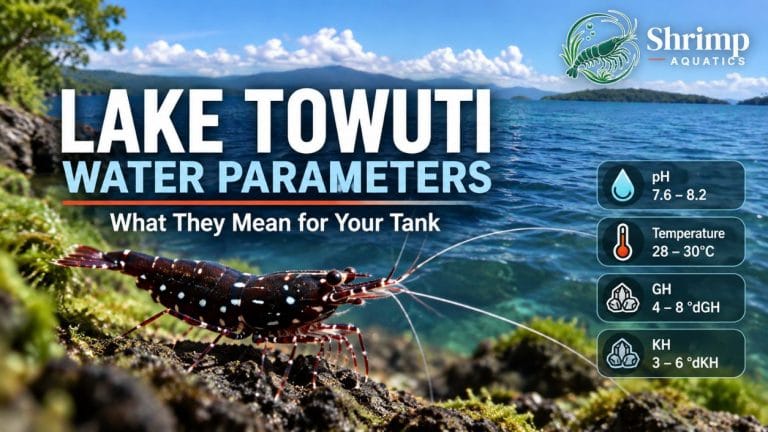
| pH | 7.5-8.5 |
|---|---|
| Carbonate hardness | 3-6 dKH |
| General hardness | 4-8 dGH |
| TDS | 150-250 ppm |
| Temperature | 79-86°F (26-30°C) |
| Nitrate | Aim for under 10 ppm |
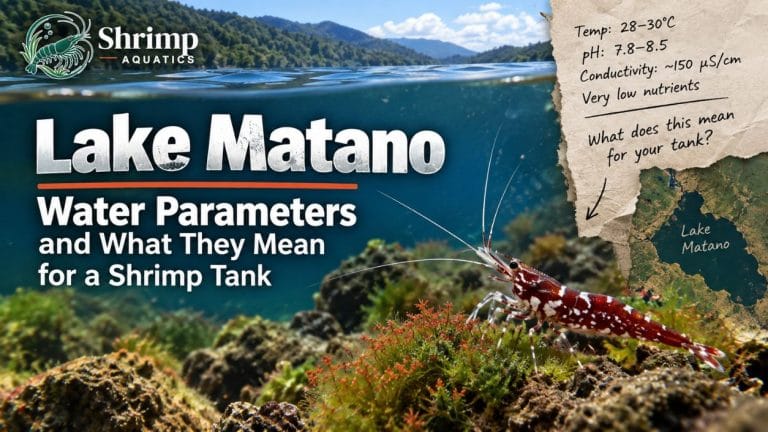
A single reading at the top of that range isn’t an emergency. What matters more is whether the number is moving. Lake Matano, one of the Malili lakes, has been examined specifically for how its minimal seasonal temperature variability shapes the chemistry of the water column.1 These are animals from a system that barely changes. A tank whose pH has climbed from 7.8 to above the range over three months is telling you something is accumulating. That’s a different problem from a tank that has sat at 8.4 since the day it was filled.
So what do you do first? Take two readings a week apart before deciding. If the number is stable and inside the range, the honest answer is to leave it alone and spend the effort on stability instead. If it has drifted upward, or it’s above the range, the sections below are the order to work in.
Why pH-down products and active soil break a Sulawesi tank
Alkalinity is the buffering capacity of the water, the measure of its ability to neutralize acids and hold a fairly stable pH.2 It depends on dissolved bicarbonates, carbonates and hydroxides. Water with high alkalinity changes very little in pH when acid enters it, while low alkalinity water can’t keep pace and swings.2 That’s the whole reason a Sulawesi tank holds its numbers, and it’s also the reason acid doesn’t work as a control here. An acid dose large enough to actually move the reading has to consume the carbonate on its way. What it leaves behind is a tank with less capacity to resist the next change than it had before. KH is what keeps pH from swinging, the subject of Sulawesi shrimp KH and alkalinity.
The minerals aren’t decoration either. The major source of calcium a crustacean uses to calcify its exoskeleton is exogenous, meaning the water it lives in.3 Food, including a shrimp’s own shed shell, is a minor contribution to that calcification.3 A method that pulls minerals out to move a number is also a method that takes the shell material out of the water column.
Not appropriate in a Sulawesi system
Liquid pH down products, active pH lowering aquasoils, peat filtration and heavy botanical loads all lower pH by consuming or replacing carbonate. Shrimp Aquatics keeps Sulawesi systems on inert substrate and hardscape rather than an active substrate. None of these methods belongs in a tank you want to hold at pH 7.5-8.5 with 3-6 dKH.
Pressurized carbon dioxide is a separate case. It moves pH without permanently removing carbonate. But it introduces a daily rise and fall in the reading, in a tank whose animals came from water that doesn’t do that, and it competes with the oxygen problem covered further down. It isn’t a control method for an inhabited Sulawesi tank.
Find what’s pushing your Sulawesi tank’s pH up before you change anything
A pH correction that doesn’t remove the cause is a correction you’ll repeat every month. The most common cause is the least dramatic one. Evaporation concentrates dissolved solids in the water that remains.4 A Sulawesi tank runs warm enough at 79-86°F (26-30°C) to lose real volume between water changes. Topping that loss up with anything carrying minerals, including remineralized water and tap water, leaves the previous minerals in place and adds more on top. Over months the whole system concentrates, and the pH goes with it.
Work through these four before you touch the water chemistry.
- Compare your TDS reading now with what it was when the tank was filled. A climb here is the earliest sign of mineral buildup, and it usually appears well before the pH does.
- Check what you’ve been topping off with. Evaporation is replaced with pure RO water only, because the minerals that evaporated didn’t go anywhere.
- Look at the hardscape and substrate. Crushed coral, aragonite, shell grit and limestone are all carbonate materials that keep feeding the system. That’s why Sulawesi tanks are set up on inert rock and sand instead.
- Check which mineral salt you’re dosing and what it’s built to buffer at, because that choice sets the pH your replacement water arrives at.
Rebuild your Sulawesi replacement water on a mineral salt that buffers lower
Once the cause is out of the way, the water you add is the only real control you have. Two mineral salts, Sulawesi Mineral 7.5 and 8.5, are widely used for this group, and they aren’t interchangeable.
SaltyShrimp Sulawesi Mineral 7.5 is added to water outside the aquarium, where it dissolves almost totally within seconds with no carbon dioxide or special equipment.5 It buffers the pH at around 7.5 and raises carbonate and total hardness at a ratio of KH to degrees dH of 0.42 to 1.0. The manufacturer’s dosage is a slightly heaped measuring spoon, around 3.5 g, to 15 litres of water, for a hardness of around 6 degrees dH and a conductance of around 270 microsiemens.5 It names shrimp from lakes Matano, Poso and Towuti, including cardinal shrimp (Caridina dennerli) and harlequin shrimp (Caridina woltereckae).5
SaltyShrimp Sulawesi Mineral 8.5 behaves differently. It only dissolves almost totally if carbon dioxide is added for a few days, taking around 3-4 days at a regular quantity of one bubble per second.6 The manufacturer instructs you to aerate the water afterwards for at least three hours with an air stone to expel that carbon dioxide before use. It raises carbonate and total hardness at a ratio of KH to degrees dH of 0.78 to 1.0.6 The manufacturer states that less finicky Sulawesi shrimp such as the cardinal shrimp can be kept and bred with positive outcomes on both the 7.5 and the 8.5 salt.6
| Property | Sulawesi Mineral 7.5 | Sulawesi Mineral 8.5 |
|---|---|---|
| How it dissolves | Almost totally within seconds, outside the aquarium | Almost totally only with carbon dioxide added for around 3-4 days |
| Preparation before use | Ready immediately | At least three hours of aeration with an air stone to expel carbon dioxide |
| Stated buffer point | Around pH 7.5 | Not stated as a single buffer point on the product page |
| Carbonate to total hardness ratio | 0.42 to 1.0 | 0.78 to 1.0 |
Two things follow from that table. At the same general hardness the 8.5 salt puts noticeably more carbonate hardness into the water than the 7.5 salt does. That’s most of why a tank built on it sits higher. And because the 8.5 salt needs days of carbon dioxide to go into solution, anyone who has been dosing it dry or straight into the display has been adding undissolved carbonate to the tank. That carbonate keeps working long after the water change is over. Mineral salt is prepared in a separate container, tested, and only then used.
At Shrimp Aquatics, most of our Sulawesi systems currently run at TDS 150 ppm, GH 6-7 dGH and pH 7.5. We start those systems with RO water rather than tap water, then use Sulawesi Mineral 7.5 to prepare the water for our current tank targets before shrimp are introduced. We test the finished pH, GH and TDS before the water goes into a tank. If you’re aiming at the lower end of the group range, that’s a target these lines are already held at.
Matching your tank to the water the animals were raised in removes one variable from the move. Our tank-bred Sulawesi shrimp come out of systems held at those numbers.
Small water changes move a Sulawesi colony down, one correction doesn’t
With the cause removed and the replacement water rebuilt, the tank comes down on its own as the old water is replaced. That’s the point. You aren’t adjusting the tank, you’re diluting what it’s currently made of.
- Confirm ammonia and nitrite both read zero and the tank is otherwise stable. A pH correction on an unstable or incompletely cycled system compounds two problems instead of solving one.
- Switch top offs to pure RO water and keep them there permanently, so the baseline stops climbing while you work.
- Remove carbonate hardscape and substrate in stages over several weeks. That way the biofilter and the grazing surfaces the colony feeds on aren’t stripped at the same time as the chemistry moves.
- Mix each batch of replacement water outside the tank on the lower buffering salt, then test its pH, GH and TDS before it goes anywhere near the animals.
- Exchange a small volume at a time with the replacement water matched for temperature. Let successive changes carry the tank down gradually.
- Retest before the next change and stop if carbonate hardness is approaching the bottom of the 3-6 dKH range.
There’s no published safe rate of pH change for these species. Any article that gives you one to two decimal places is giving you a number nobody measured. The working rule is the conservative one: move less than you think you need to, wait several days, measure, and only then take the next step. If you find yourself deciding between a slower correction and a faster one, take the slower one. The failure mode of going too slowly is that the tank stays high for another two weeks. The failure mode of going too fast shows up as molt trouble in the colony.
Why ammonia is the real danger while your Sulawesi pH sits high
Many keepers arrive at this question because something went wrong, not because a number offended them. If ammonia is part of the picture, understand what the pH is doing to it. In fresh water, the ratio of unionized ammonia to ammonium ion increases by 10-fold for each rise of a single pH unit, and by approximately two-fold for each 10 degree Celsius rise in temperature between 0 and 30 degrees Celsius.7 High external unionized ammonia concentrations reduce or reverse diffusive gradients and cause the buildup of ammonia in internal tissues and blood.7
That relationship is water chemistry derived by the EPA for freshwater aquatic life in general. It sets no safe or tolerated concentration for any Caridina, and none should be read into it. What it does explain is why a warm alkaline tank has a narrower margin for the same total ammonia reading than a cool acidic Bee tank does. It also explains why keepers moving from soft water shrimp to this group find their usual tolerance for a little slack doesn’t carry over.
Don’t lower pH to answer an ammonia reading
Dropping the pH would reduce the unionized share, and it would also destabilize the one system holding the tank together while the animals are already under load. The waste and the biofilter are the problem to fix. Deal with the source, restore the cycle, and correct the pH afterwards on a stable tank.
Keep the aeration running in a warm Sulawesi tank while pH comes down
One method that circulates for warm alkaline tanks is to cut back the air and the surface movement so that dissolved carbon dioxide accumulates and shaves the reading down. Don’t use it here. Cold water can hold more dissolved oxygen than warm water.8 So a tank run at 79-86°F (26-30°C) is already working with less dissolved oxygen than a room temperature tank at the same level of aeration.
Whatever you gain on the pH reading by throttling gas exchange, you take off an oxygen margin that was thin to begin with, in a tank whose bioload hasn’t changed. Keep the aeration and the surface movement you have, aim the outlet so the shrimp aren’t pushed around while they graze, and let the replacement water do the work on the pH instead.
What a finished pH correction looks like in a Sulawesi tank
The correction is finished when the tank holds its own numbers without you intervening. Three things should be true across at least two or three weeks of ordinary maintenance. The pH sits inside 7.5-8.5 and stays there between water changes. Carbonate hardness holds inside 3-6 dKH. And TDS returns to the same place after each change instead of creeping upward.
Read the numbers with the right expectations. pH is reported in logarithmic units, and each whole number represents a 10-fold change in the acidity of the water.9 A shift that looks like a rounding error on a test strip isn’t one. That’s why a digital meter that resolves tenths is worth having for this group, and why a small persistent drift matters more than its size suggests.
Watch the colony rather than only the meter. Normal grazing across the rock, shrimp out in the open at the usual times of day and clean sheds appearing in the tank are what a settled correction looks like. Shrimp gathering at the surface, hiding for days at a stretch or failing to complete a molt are signs to stop changing anything further and recheck the basics.
If pH or carbonate hardness drops below the Sulawesi floor
Overshooting downward is the risk of doing this well. If pH is heading under 7.5 or carbonate hardness is approaching the bottom of 3-6 dKH, stop the water change schedule. Bring the next batch back up by preparing it on a higher buffering mix, then reintroduce it at the same slow pace you used coming down. Don’t dose a carbonate product directly into the display to catch it, and don’t make a second correction while the first one is still moving.
If shrimp are dying while any of this is going on, treat it as a system failure rather than a pH number to fix. Check ammonia, nitrite, temperature and TDS first, stop all further chemistry changes, and get the tank stable before resuming. A colony that has lost animals during a parameter move needs the tank left alone more than it needs the target hit on schedule.
References
9 Sources
- The biogeochemistry of tropical lakes: A case study from Lake Matano, Indonesia (repository record and abstract), Limnology and Oceanography 53(1), 2008.
- Alkalinity and Water, U.S. Geological Survey Water Science School, updated August 24, 2026.
- Biomineralizations: insights and prospects from crustaceans, ZooKeys 176, 2012.
- Chloride, Salinity, and Dissolved Solids, U.S. Geological Survey Water Resources Mission Area, March 1, 2019.
- Sulawesi Mineral 7,5, Minerals and trace elements, SaltyShrimp (Garnelenhaus), product technical page.
- Sulawesi Mineral 8,5, Minerals and trace elements, SaltyShrimp (Garnelenhaus), product technical page.
- Aquatic Life Ambient Water Quality Criteria for Ammonia, Freshwater, U.S. Environmental Protection Agency Office of Water, April 2013.
- Dissolved Oxygen and Water, U.S. Geological Survey Water Science School, updated August 24, 2026.
- pH and Water, U.S. Geological Survey Water Science School, updated August 24, 2026.
Ready to get started?
Shop our Sulawesi Shrimp collection
27 products available · Live Arrival Guarantee