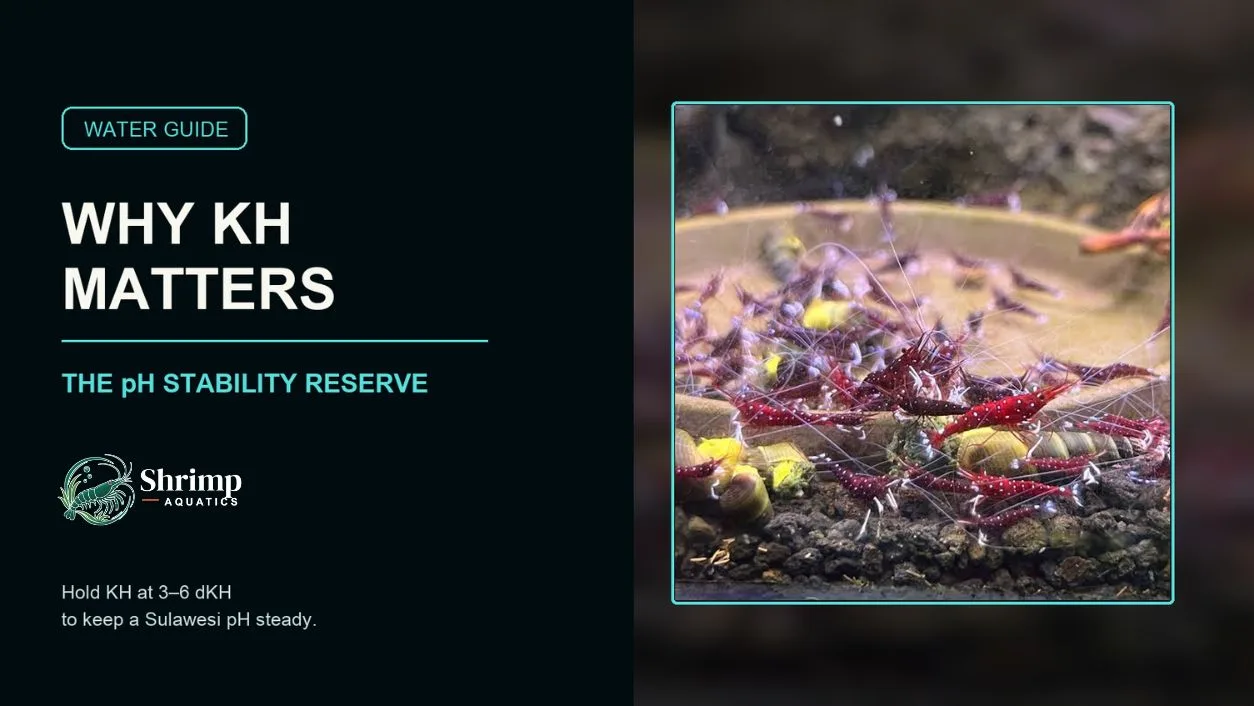
Your Sulawesi tank’s pH keeps wandering even though the GH reading looks fine. The number you’re missing is KH, the carbonate reserve that decides how far pH moves each day and where it settles when it stops moving. You’re asking the tank to hold pH 7.5-8.5, well above where most freshwater naturally sits, and nothing holds it there except KH. Test it, keep it at 3-6 dKH, treat it as a consumable, and pH stops being a number you chase.
What KH measures in a Sulawesi tank that pH and GH can’t tell you
pH tells you where the water is right now, and KH tells you whether it’ll still be there tomorrow morning. Alkalinity isn’t so much a substance dissolved in the water as a property of it. It’s produced by bicarbonates, carbonates and hydroxides, and it’s defined as the water’s capacity to neutralize acids and bases and hold a fairly stable pH.1 That’s what an aquarium KH kit is measuring.
Here’s where experienced keepers get caught out. Total alkalinity and hardness aren’t the same measurement. Bicarbonates and carbonates are responsible for alkalinity, while calcium and magnesium are responsible for hardness. A water can even carry high alkalinity without being hard, when the carbonates arrive as sodium or potassium carbonate instead of calcium carbonate.2 So a healthy GH reading tells you the shrimp have minerals available. It tells you nothing about whether the pH is anchored.
- KH, or carbonate hardness
- The aquarium name for total alkalinity: the bicarbonate and carbonate reserve that absorbs acid before pH can move. Usually read in dKH, where 1 dKH is about 17.9 mg/L as calcium carbonate.
- GH, or general hardness
- The calcium and magnesium content of the water. It supports molting and shell formation but doesn’t by itself hold pH in place.
- pH swing
- The difference between the lowest and highest pH your tank reaches across one day and night cycle. It’s a symptom, not a setting.
Alkalinity and hardness work as a pair. Together they form the buffering system that limits how far pH and dissolved carbon dioxide move over a day, as photosynthesis and respiration push in opposite directions. The higher both values are, the stronger that system is.3 That’s why KH sits beside pH and GH on your test list, not below them. GH feeds the animal. KH protects the water the animal lives in. Lose either one and you get a different failure, and only one of them shows up on a pH pen before it’s too late.
Why Bee and Neocaridina KH habits break a Sulawesi tank
The KH instinct most keepers bring from Bee or Neocaridina tanks is usually wrong for a Sulawesi tank, because the three groups don’t share a carbonate range. Most people arrive at Sulawesi shrimp from somewhere else, and the old habits come along with them.
| Group | Reference KH | Reference pH | What KH is doing there |
|---|---|---|---|
| Bee and Crystal Caridina | 0-2 dKH | 5.8-6.8 | Kept deliberately low so an active soil can pull pH down and hold it acidic |
| Neocaridina | 2-8 dKH | 6.5-8.0 | Wide and forgiving, because the pH target is wide and forgiving |
| Sulawesi lake Caridina | 3-6 dKH | 7.5-8.5 | Load-bearing, because an alkaline pH can’t be held without it |
A Bee keeper learns that KH near zero is correct and that buffering substrate is the enemy of a stable acidic tank. In that tank, it’s true. Carry it into a Sulawesi setup and you remove the only thing holding pH 7.5 up. A Neocaridina keeper learns that KH is something you glance at once and forget, which is fair enough when the acceptable pH band is a full 1.5 units wide.
So what makes Sulawesi different? You’re asking the water to sit at a pH it doesn’t naturally want to occupy. In aquaculture waters, ambient pH tends to rise from around 5 where there’s no alkalinity to 8 or above once alkalinity reaches roughly 100 mg/L as calcium carbonate, which is about 5.6 dKH.4 Read that the other way around and it’s the clearest single argument for this whole guide. You don’t set pH 8 and then prop it up with KH. You supply the carbonate, and pH 8 is where the water then chooses to sit. Build the carbonate first and let pH follow, which is the logic behind why Sulawesi shrimp need alkaline water.
Don’t reuse a Bee tank’s chemistry
Bee and Taiwan Bee Caridina need soft, acidic, cooler water and remain incompatible with a warm alkaline Sulawesi system on water. An active pH-lowering aquasoil left in place will strip carbonates and work against every number in this guide.
What KH should you hold for a Sulawesi pH of 7.5, 8.0 or 8.5?
Hold KH at 3-6 dKH. That’s the Shrimp Aquatics reference range for Sulawesi shrimp as a group, and inside it the practical rule is simple: a higher target pH needs a bigger carbonate reserve underneath it. For the full parameter set, including temperature, GH, TDS and nitrate, see our Sulawesi shrimp care parameters guide.
You can measure why the size of the reserve matters. In ponds with low alkalinity of 0-40 mg/L, roughly 0-2.2 dKH, pH commonly runs from 6-7 in the early morning up to 9-10 in the afternoon. In waters with naturally higher alkalinity, the same daily cycle moves pH only from 7-8 in the morning to 8-9.5 in the afternoon.4 Extension guidance shows the same pattern: low-alkalinity water may swing from 6 or below to 10 or above, while high-alkalinity water moves from about 7.5 to 8.5.2 Those figures come from aquaculture ponds, and a shaded 20 liter shrimp tank doesn’t have a phytoplankton bloom in it. Still, it’s the same chemistry, and the direction of the effect is what you should take from it.
In our Sulawesi tanks
At Shrimp Aquatics, most of our Sulawesi systems currently run at TDS 150 ppm, GH 6-7 dGH and pH 7.5. We build that water from RO with Sulawesi Mineral 7.5 and test the finished pH, GH and TDS before it goes near a tank.
Where to start
Start at 3-4 dKH for a first Sulawesi tank held at pH 7.5. If you’re holding 8.0 or above, the top half of the 3-6 dKH range gives the pH more to stand on. The evidence above is the reason: the smaller the carbonate reserve, the further pH travels between morning and evening. Start low and build up, following the method in how to raise pH for Sulawesi shrimp for a first tank.
Thinking of pushing higher? There’s a ceiling you should know about first. Free carbon dioxide exists in water only up to about pH 8.3, and once photosynthesis has stripped all of it out, pH sits at 8.3 until carbonate chemistry takes it further.4 That gives a bicarbonate-buffered tank a natural resting point near that figure. A stable 8.5 is a different job from a stable 8.0, and it isn’t one to attempt on a colony you’ve just settled. Pushing past that resting point is the trap to avoid if you ever need to lower pH in a Sulawesi shrimp tank.
Choosing between carbonate media and baking soda for Sulawesi KH
Both routes work. What separates them is what else they move while they’re moving KH, and that’s the whole basis for choosing.
Crushed coral and buffering media raise KH and GH together
Limestone and agricultural lime, which are calcium carbonate, are the most common way to raise alkalinity in managed water.2 It’s the same mechanism that makes limestone catchments produce hard alkaline lakes: runoff picks up calcium carbonate, and both pH and alkalinity rise.1 Crushed coral, aragonite and carbonate buffering media in a filter do exactly that in a tank. They dissolve slowly as acid is produced and release carbonate as they go.
The catch is that they raise alkalinity and hardness at the same time, and your TDS follows.3 In a tank already sitting at GH 6-7 dGH and TDS 150-250 ppm, that’s a real constraint, because you don’t have much headroom before TDS leaves the range. Control is the other trade-off. The tank’s own acid production drives the dissolving, so you don’t set the rate, and fixing an overshoot means physically pulling media out.
Sodium bicarbonate raises KH without moving GH
Sodium bicarbonate, ordinary baking soda, increases alkalinity only, while calcium-based additions raise hardness as well.3 It’s the standard choice where hardness is already adequate and only alkalinity needs lifting,3 and it’s the one used when alkalinity has to come up quickly.4 In a Sulawesi tank built from RO water with a Sulawesi mineral, that’s usually exactly where you are. GH and TDS have been set on purpose, and KH is the one number the mineral didn’t supply.
Two limits deserve a plain statement. Adding sodium bicarbonate to water that contains carbon dioxide produces a slight rise in pH but doesn’t remove the carbon dioxide,5 so it buffers the swing without eliminating its cause. And in water where alkalinity is high but calcium is low, strong photosynthesis can still drive afternoon pH to 10 or above. The working guidance is that calcium expressed as calcium carbonate should be roughly equal to or greater than total alkalinity.4 At Sulawesi ranges, GH 4-8 dGH against KH 3-6 dKH already fits that shape. It stops fitting if you keep raising KH while GH sits at the bottom of its range, or if you run bright light over a well planted tank.
Check what your inert substrate actually contains
Some low-cost silica sands are cut with crushed shell, which is calcium carbonate and will raise KH and calcium on its own schedule instead of yours. If you’re dosing KH deliberately, a substrate quietly doing the same thing makes the tank impossible to tune. Test a sample in a bucket before it goes in the tank.
How to buffer Sulawesi water outside the tank before it goes in
Build the water in a separate vessel, finish it there, and only then let it near shrimp. The order matters more than any recipe, because a KH reading taken on half-dissolved mineral means nothing.
- Start from RO water and a Sulawesi-specific mineral. Use the manufacturer’s current label for the dose, not a rule of thumb. The two SaltyShrimp salts, Sulawesi Mineral 7.5 and 8.5, are prepared very differently. Which one to buy, and how to remineralize RO water for Sulawesi shrimp with it, is a job of its own.
- Let the batch finish, then test. Give the mineral time to dissolve and settle before you read pH, GH, KH and TDS. An early pH reading on fresh mineral sends you chasing a number that hasn’t arrived yet.
- If KH is short, raise it in the vessel, never in the tank. Dissolve any carbonate in a cup of the mixed water first, add it gradually while testing, and stop at your target. No published dosing rate for sodium bicarbonate exists for Sulawesi lake Caridina, so the test kit is the dose. Raising KH in a tank that already holds shrimp is a slower job, and how to increase KH in a Sulawesi shrimp tank safely has its own page.
- Recheck before use. Stored water drifts. Read pH and KH again before every change.
Match the water, then add it slowly
Buffered water is only safe if it matches the tank it’s going into. Confirm temperature, pH, GH, KH and TDS against the tank before you start, and add it gradually. A correctly buffered water change delivered too fast is still a shock.
There’s a nice side effect of buffering the water yourself: the substrate no longer has to do the job. A tank run this way does perfectly well on inert lava rock, inert gravel or a clean silica sand substrate, with no premium buffering soil underneath. That also makes very lean setups workable, including bare glass grown over with algae, which some keepers prefer for lines that are slow to color up.
What drains KH from a warm Sulawesi tank between water changes
Your biofilter does, more than anything else, because KH isn’t a setting you apply once. It’s consumed, and the largest consumer runs nonstop in every cycled tank. Nitrification produces acid that destroys alkalinity, which is why bicarbonate has to be topped up periodically in recirculating systems, and why pH eventually falls to dangerous levels where it isn’t.5 The nitrifying bacteria also need bicarbonate directly to oxidize ammonia and nitrite through to nitrate.3 In other words, the filter is quietly spending the reserve you built.
On top of that sits the daily carbon dioxide cycle. Carbon dioxide dissolves to form carbonic acid, which releases hydrogen ions and lowers pH, and it builds up overnight from respiration to peak around dawn.3 During the day photosynthesis removes it again and pH climbs back.4 None of these movements is large on its own. They add up, though, and the tank with a thin carbonate reserve is the one where the total shows up as a swing the shrimp can feel.
- Assuming the mineral supplies KH. Test the finished mix.
- Filling the tank with fast-growing plants. Very few aquatic plants tolerate pH 7.5-8, and the ones that do, such as Taiwan moss, flame moss and water-form ferns, are the ones worth using. Heavy planting adds a daytime carbon dioxide drawdown that widens the swing you’re trying to close.
- Using a slow-dissolving buffering salt as the whole strategy. It leaves undissolved powder sitting on the substrate, and when that reserve finally runs out the pH falls fast and is awkward to recover. If you use one, plan on replacing minerals roughly monthly.
- Topping off evaporation with remineralized water. Only water evaporates. Replacing it with mineralized water pushes GH, KH and TDS up week after week.
- Testing KH once at setup and never again. The reserve starts being spent the day the filter matures.
That’s why the traditional Sulawesi setup looks the way it does, and it isn’t for looks. Minimal planting, with moss and algae as both decoration and food, plus airlift-driven biological filtration running constantly, keeps dissolved carbon dioxide close to even across day and night. It removes one of the larger sources of movement before it starts.
Reading a drifting pH as early KH loss in a Sulawesi tank
By the time pH has visibly moved, KH has usually been falling for a while. Test KH alongside pH and a confusing symptom turns into a specific, fixable cause. Catch that lag before pH moves, because sudden pH changes in a Sulawesi shrimp tank start with KH.
- Test KH and pH together, not pH alone. A KH reading that has dropped since last month explains a pH reading that has drifted down.
- Take pH twice in one day, once in the early morning before the light comes on and once in the late afternoon. The gap between the two is your swing.
- A swing wider than about 0.5 points, or a KH reading below your target, means the reserve is too thin for the pH you’re asking the tank to hold.
- Correct by raising KH in small increments over several days. The shrimp are more sensitive to the speed of the correction than to the size of the original error.
- Recheck TDS at the same time. If TDS has climbed while KH has fallen, evaporation top-offs and carbonate consumption are both running, and it’s the water change routine that needs adjusting.
Don’t fix a drifted tank with a large water change
A tank that has drifted to a low KH and a low pH is already stressed. Replacing a large volume with correctly buffered water applies a second, faster change on top of the first. Use small, matched, repeated changes and let the tank climb back over days.
If losses continue after KH, pH, TDS and temperature are all steady and inside range, stop adjusting chemistry and look elsewhere. Persistent losses in a tank whose water is verifiably correct are worth taking to an experienced Sulawesi keeper or a qualified aquatic specialist before you reach for another additive.
A tank that has held its KH for a month without correction is ready for tank-bred Sulawesi shrimp; one that needs a weekly fix isn’t, whatever the other numbers say.
References
5 Sources
- Alkalinity and Water, Water Science School, U.S. Geological Survey, August 7, 2018.
- Total Alkalinity, Publication 3776, Mississippi State University Extension Service, reviewed by Wes Neal, 2024.
- Water quality impacts on health and performance of fish and shrimp, Part 2: pH, carbon dioxide, alkalinity, hardness and the water buffering system, Fernando Kubitza, Responsible Seafood Advocate, Global Seafood Alliance, August 18, 2025.
- The inevitable pH fluctuations of aquaculture pond water, Claude E. Boyd, Responsible Seafood Advocate, Global Seafood Alliance, January 9, 2017.
- Misuses of sodium bicarbonate in pond aquaculture, Craig S. Tucker, Responsible Seafood Advocate, Global Seafood Alliance, July 1, 2008.
Ready to get started?
Shop our Sulawesi Shrimp collection
27 products available · Live Arrival Guarantee