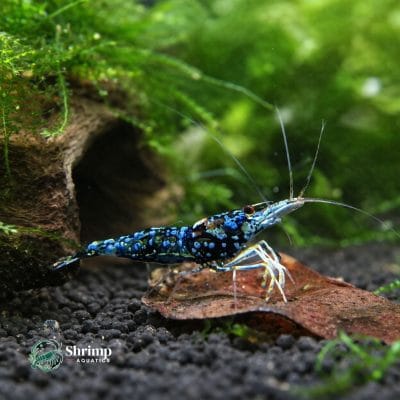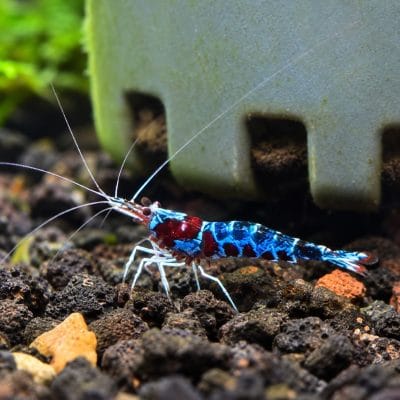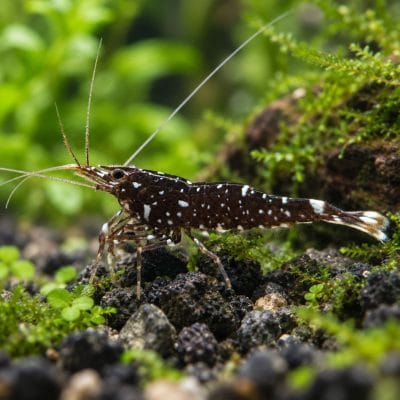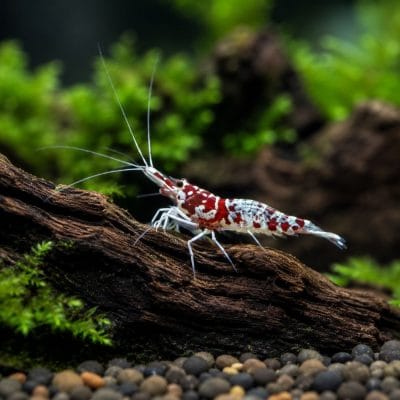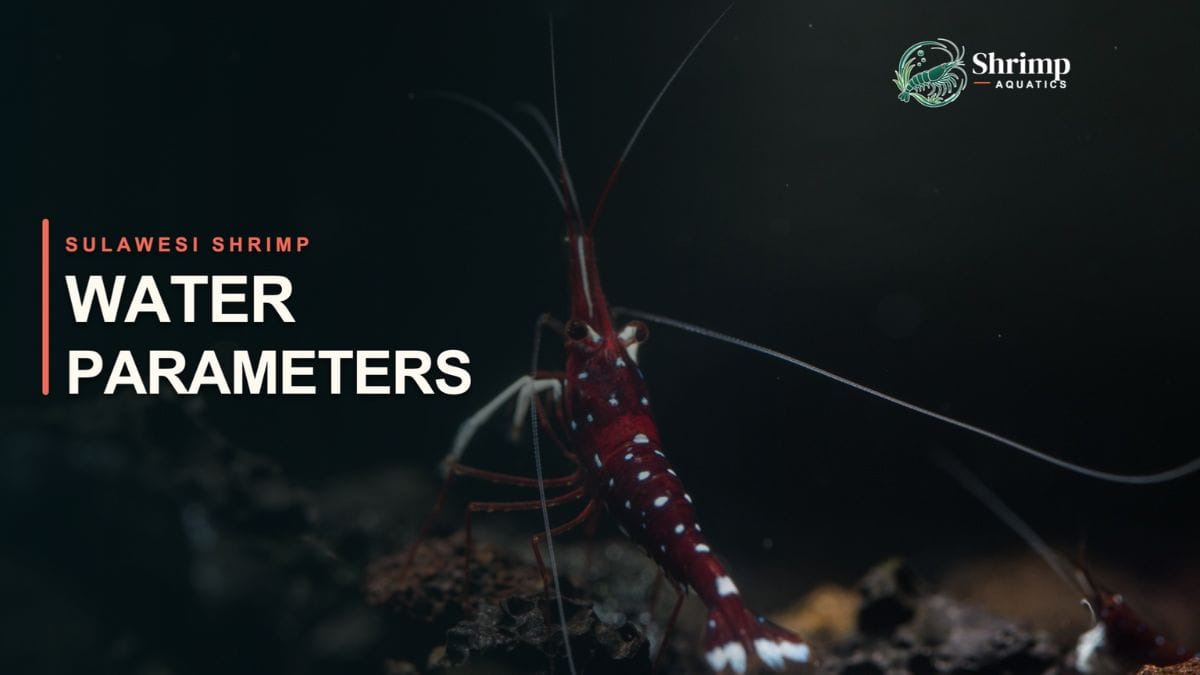
Sulawesi shrimp (lake Caridina species) are kept in warm, mildly alkaline water with a modest mineral load. The practical way to hit that is to start from RO or RO/DI water and build it back up with a mineral made for this group. The finished batch should sit inside pH 7.5-8.5, 4-8 dGH, 3-6 dKH and 150-250 ppm TDS, and it should be tested before it ever reaches the tank.
Why RO water has to be rebuilt before Sulawesi shrimp see it
Reverse osmosis strips almost everything out of the feed water, which is useful and also the reason the output isn’t something you can keep animals in. The minerals matter physically. Across crustaceans, the major source of calcium used for exoskeleton calcification is exogenous, meaning the water the animal lives in, with diet and stored reserves contributing less.1 That’s a crustacean-level mechanism that hasn’t been measured for Sulawesi shrimp, but it explains why the mineral content of the water is a husbandry decision and not a detail. Because the shell draws on dissolved calcium, Sulawesi shrimp mineral supplements matter more than diet.
Tap water is a different problem. It can be perfectly good water and still be the wrong tool here, because its hardness and alkalinity move with the season and the supply. This group is kept by holding a narrow band steady rather than by hitting a number once. Starting from RO water gives you a blank that behaves the same way every time, so a dose that produced a good batch last month produces the same batch today. The routine is easier to learn on an empty, cycled tank than on one that already holds tank-bred Sulawesi shrimp. That seasonal drift in tap water is the practical case for why Sulawesi shrimp need RO water.
What your finished Sulawesi batch should test at
These are the typical ranges for the group, not a promise about any one species or listing. Verify the requirement for the shrimp you actually have, since a specific line may come with a narrower record.
| Temperature | 79-86°F (26-30°C) |
|---|---|
| pH | 7.5-8.5 |
| GH | 4-8 dGH |
| KH | 3-6 dKH |
| TDS | 150-250 ppm |
Of those, carbonate hardness is the one doing the stabilizing work. Alkalinity is the buffering capacity of the water, a measure of its ability to neutralize acids and so maintain a fairly stable pH level. It comes chiefly from dissolved bicarbonates, carbonates and hydroxides.2 A batch mixed to the right pH with almost no KH won’t hold that pH for long once it’s in a running tank. That’s why the KH reading is worth as much attention as the pH reading.
Which point inside each range? That matters less than you’d think. Pick one and aim at the same point every time. A colony that sits steadily at one set of readings is in better shape than one that visits both ends of the published range. The ranges above exist to catch an error, not to be swept through.
Choosing between a stir-in Sulawesi mineral and a carbonate-heavy one
Sulawesi minerals split into two practical types, and the difference that will affect your week is how they dissolve. The table below records what each manufacturer product page states about its own salt.34
| Property | Sulawesi Mineral 7.5 | Sulawesi Mineral 8.5 |
|---|---|---|
| Dissolving | Almost totally dissolves within seconds outside the aquarium, and the water is ready for use immediately | Almost totally dissolves only if CO2 is added for a few days |
| Equipment needed | None beyond a mixing container | A CO2 source and an air stone for the degassing step |
| pH behavior | Buffers the pH at around 7.5 | Not stated as a buffered pH figure on the product page |
| Hardness ratio | Raises carbonate and total hardness at KH/dH = 0.42/1.0 | Raises carbonate and total hardness at KH/dH = 0.78/1.0 |
| Species the maker names | Recommends the 8.5 product for the more susceptible shrimp | States that less finicky Sulawesi shrimp such as the cardinal shrimp (Caridina dennerli) can be kept and bred with positive outcomes on either product |
Read practically, that means the stir-in product is the one most keepers should start with. The carbonate-heavy product is a deliberate choice for shrimp whose listing or supplier says the higher carbonate ratio is what they’re kept in. The carbonate route isn’t a stronger version of the same thing. It’s a several-day preparation that has to be run correctly every single time. A batch prepared badly is worse than a well-run stir-in batch. Decide once, then keep using the same product, because switching products mid-colony changes the ionic makeup of the water even when the GH and TDS readings look identical. Pick one salt and stay with it rather than alternating, and weigh Sulawesi Mineral 7.5 or 8.5 before you choose.
Mixing a batch with a stir-in Sulawesi mineral
- Fill a clean container that’s used only for this. Anything that has held soap, fertilizer or fish medication isn’t a mixing vessel any more.
- Read the TDS of the plain RO water first. If it isn’t near zero, the membrane or resin needs attention before the reading on the finished batch means anything.
- Add the mineral in small increments while stirring. Work toward the hardness and conductance target the manufacturer names for the product, and ignore any fixed spoon or scoop. Adding a little and testing is slower once and faster forever.
- Let the batch sit and stir again. A stir-in mineral should go clear almost at once. Anything still sitting on the bottom points at the dose, the water volume or the product.
- Bring the batch to the tank’s own temperature with a heater in the mixing vessel, so the water going in isn’t a temperature change as well as a water change.
- Test the finished batch before you use it.
How to dissolve a carbonate Sulawesi mineral that won’t stir in
A carbonate-heavy Sulawesi mineral doesn’t go into solution by stirring, and stirring harder isn’t the answer. The manufacturer’s own instruction for Sulawesi Mineral 8.5 is to add the salt to water outside the aquarium and then add CO2, at about one bubble per second, for roughly three to four days. At that point it’s almost totally dissolved.4 Plan the batch around that window rather than around your water change day.
Don’t substitute heat, longer stirring or a longer wait at room temperature for the CO2 step. The gas is what makes the carbonates soluble, and a batch that has been sitting cloudy for a week without CO2 hasn’t been slowly getting there.
Aerate the batch until the pH climbs back into range
Water that has just been saturated with CO2 to dissolve a carbonate salt isn’t the water you want in the tank. The manufacturer instructs you to aerate the water afterwards for at least three hours with an air stone in order to expel the CO2.4 Treat that as a minimum, and keep aerating until repeat pH readings stop climbing.
Don’t skip the degassing step
A freshly dissolved carbonate batch reads lower on pH than it will settle at, because the dissolved CO2 is still in the water. Adding it to a tank means the pH the shrimp meet isn’t the pH you measured, and it will then move as the gas leaves. Aerate first, test after, use last.
Check pH, GH and TDS before the batch goes near your shrimp
The dose is a starting point; the reading is the fact. Test the finished water every time, including on batches mixed exactly the way the last one was, because RO output, product age and measuring error all drift quietly.
- pH inside 7.5-8.5 and stable across repeat readings
- GH inside 4-8 dGH
- KH inside 3-6 dKH
- TDS inside 150-250 ppm
- Temperature matched to the display tank, inside 79-86°F (26-30°C)
- Don’t use a batch that’s still cloudy or has undissolved grit on the bottom
- Don’t correct a batch inside the tank; correct it in the mixing container
At Shrimp Aquatics, we start our Sulawesi systems with RO water rather than tap water. We then use Sulawesi Mineral 7.5 to prepare the water for our current tank targets before shrimp are introduced. We test the finished pH, GH and TDS before the water goes into a tank.
Adding the new water without swinging the tank
Mixed water is only as good as the way it goes in. Keep each change small enough that the tank’s pH, GH and TDS readings barely move between the test you take before and the one you take after. Add the water slowly. A drip line or a slow pour over a dish both work; the point is that the colony experiences a gradual change instead of a step.
The exact percentage and interval that suit your tank depend on its size, its stocking and how fast its readings actually drift. That’s something you can only learn by testing your own tank across a few weeks. A Sulawesi shrimp water change frequency copied from another keeper is a starting guess. Two matching readings either side of a change are the evidence that the schedule is right.
Top off evaporation with plain RO water, never with your mix
A tank held in the Sulawesi temperature band evaporates steadily. The water leaves as vapor and the dissolved minerals stay behind, which is the same concentrating effect USGS describes where evaporation acts on shallow groundwater.5 In a tank, that shows up as GH and TDS creeping upward week after week without anyone changing anything.
So top-offs use plain, unmineralized RO water. Replacing evaporation with your remineralized mix adds minerals to water that never lost any. The readings climb out of range over a month or two in a way that’s easy to miss, because no single top-off does much. Mark the water line on the glass, top off to that line with RO, and keep the remineralized batches for actual water changes.
Fixing a batch that stays cloudy or tests low
- The batch is still milky after a day
- With a carbonate-heavy mineral that’s expected, since the CO2 window described above runs for days. With a stir-in mineral it isn’t expected, and it points at the dose, the water volume or the product.
- pH reads low right after the carbonate salt dissolves
- Dissolved CO2 is still in the water. Keep the air stone running past the manufacturer minimum and retest until the reading stops moving.
- TDS is on target but GH and KH read low
- Something other than your mineral is contributing dissolved solids. Recheck the RO output on its own and check what the mixing container last held. TDS is a total, not a hardness measurement, so it can look right while the hardness that the shrimp actually use isn’t there.
- Tank TDS climbs between water changes
- Evaporation is being topped off with mineralized water, or not topped off at all. Switch to plain RO for top-offs and watch whether the climb stops.
- Two batches mixed the same way test differently
- Check the RO water first, then the test kit or meter, then the product. Meters drift and reagent kits expire, and a calibration check costs less than a colony.
Once you have a dose that reliably lands your own RO water inside the range, write it down along with the readings it produced. That written record is what makes the next batch a repeat of the last one, and repeatability is most of what keeps this group alive.
References
5 Sources
- Biomineralizations: insights and prospects from crustaceans, ZooKeys 176, 103-121, Gilles Luquet, 2012.
- Alkalinity and Water, U.S. Geological Survey Water Science School, updated August 24, 2026.
- Sulawesi Mineral 7,5, Minerals and trace elements, SaltyShrimp (Garnelenhaus), manufacturer product information page.
- Sulawesi Mineral 8,5, Minerals and trace elements, SaltyShrimp (Garnelenhaus), manufacturer product information page.
- Chloride, Salinity, and Dissolved Solids, U.S. Geological Survey Water Resources Mission Area, March 1, 2019.
Ready to get started?
Shop our Sulawesi Shrimp collection
27 products available · Live Arrival Guarantee