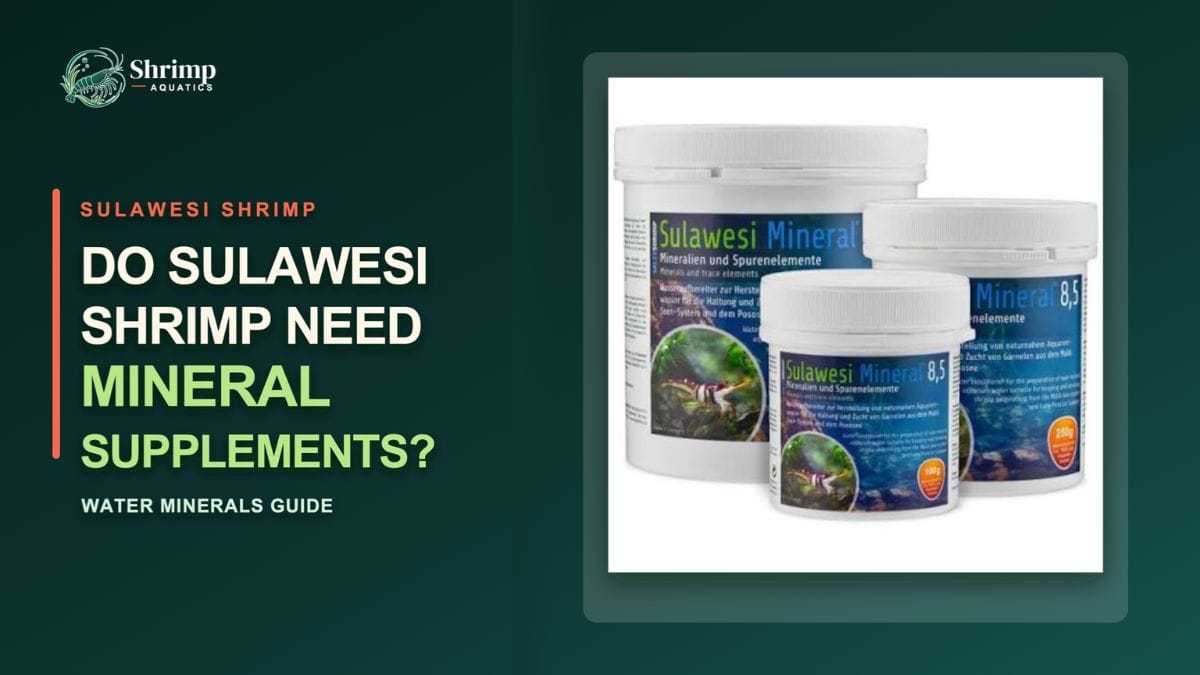
Yes. A Sulawesi tank is normally built from reverse osmosis water and a Sulawesi-specific mineral salt. So the supplement isn’t an extra you add on top of the water. It’s what turns pure water into water these shrimp can live in. What it doesn’t mean is dosing minerals into a tank that’s already running.
Is hard tap water enough for a Sulawesi shrimp tank?
Almost never, and the reason is repeatability rather than hardness on its own. A Sulawesi tank is a narrow, alkaline, mineral-moderate target that you have to hit again every time you mix change water. Tap water is a moving supply. Hardness and carbonate hardness shift with the season and the source, and treatment chemistry varies by utility. So the number you measured in March isn’t a number you can plan around in September.
Two other things push keepers off tap water for this group in particular. Copper reaches aquarium water through plumbing and through some treatments, and copper is harmful to shrimp and snails. So a supply you can’t characterize is a risk you can’t size. And even a tap supply that happens to land inside the range arrives with whatever else is dissolved in it, which makes a bad reading hard to trace later. Starting from RO water and building up is slower on day one and far easier for the next two years. The upfront mixing is set out step by step in how to remineralize RO water for Sulawesi shrimp.
If you’re on well water or a supply you know well and it genuinely sits in the range below, test it over several months before you trust it. And dechlorinate whatever you use. That’s a much bigger commitment than buying a bag of salt.
Can food or a cuttlebone replace a mineral supplement?
No, and this is the part that decides the whole question. Shrimp grow by casting the old shell and building a new one, which is a repeating event.1 The calcium that goes into that new shell comes mostly from outside the animal. The major source of calcium used for crustacean exoskeleton calcification is the water the animal lives in.2 Food, including a shed shell the animal eats, is a minor contribution.2
So a calcium block, a mineral-enriched food or a clay powder is at best working on the small share. If the water itself is thin, none of them fixes it. That’s why the answer to “do they need mineral supplements” is a water question and not a feeding question. It’s also why keepers who add a supplement food to a poorly mineralized tank usually see nothing change.
What a Sulawesi mineral has to put into the water
A Sulawesi mineral has one job: bring your change water into the range Sulawesi shrimp need and hold it there. These are the targets for Sulawesi shrimp. They’re what a finished mix should read on your own test kit before it goes anywhere near a tank.
| pH | 7.5-8.5 |
|---|---|
| GH | 4-8 dGH |
| KH | 3-6 dKH |
| TDS | 150-250 ppm |
The carbonate half of that’s the part people underrate. Alkalinity is the water’s capacity to neutralize acid and so hold a fairly stable pH.3 It comes from dissolved bicarbonates, carbonates and hydroxides.3 A Sulawesi salt has to supply that buffer at the same time as it supplies general hardness. Without it, the pH of the alkaline water Sulawesi shrimp need has nothing holding it up. And pH that moves is worse for a colony than pH that sits slightly off.
Difficulty is worth stating plainly here: this group is advanced to expert, and most of the difficulty is exactly this, holding a mixed-water target steady for months.
Why a Bee shrimp GH+ mineral is the wrong salt for a Sulawesi tank
A Bee shrimp GH+ mineral is built for soft, acidic water, so it lands a Sulawesi tank on the wrong target. A Bee shrimp tank runs pH 5.8-6.8, KH 0-2 dKH and TDS 100-150 ppm. So a salt made for that water is made to raise general hardness without building carbonate hardness, and the water it produces has almost no buffer in it. Put that in a Sulawesi tank and you have hardness with nothing holding the pH up, which is the one thing this group can’t tolerate. Sharing the genus Caridina doesn’t make Bee and Crystal Caridina and Sulawesi shrimp share the same water.
A general Neocaridina salt is closer, since that recipe does carry carbonate hardness. But it’s aimed at a cooler, near-neutral tank rather than an alkaline lake one, so it won’t land you where you need to be either. Crushed coral and aragonite are a different thing again. They’re a hardscape and substrate decision, not a measured dose you can mix, test and repeat. So they belong with choosing the best rocks for Sulawesi shrimp, not with this question.
Sulawesi Mineral 7.5 or 8.5: which one your setup can handle
Both of the widely available Sulawesi salts are made for remineralizing RO water, rainwater or fully desalinated water, and the real difference between them isn’t marketing. It’s how much equipment and how many days it takes to get the powder into solution.
| Property | Sulawesi Mineral 7.5 | Sulawesi Mineral 8.5 |
|---|---|---|
| Dissolving | Almost totally dissolves within seconds, and the water is ready for use immediately | Almost totally dissolves only if CO2 is added, roughly 3-4 days at about one bubble per second |
| Step before the water is used | None stated | Aerate for at least three hours with an air stone to expel the CO2 |
| Stated buffering | Buffers the pH at around 7.5 | Recommended in place of the 7.5 salt for the more susceptible Lake Towuti species |
| Carbonate to hardness ratio | KH/dH = 0.42/1.0 | KH/dH = 0.78/1.0 |
| Species named on the product page | Lake Matano, Poso and Towuti species including Caridina dennerli and Caridina woltereckae4 | Less finicky Sulawesi shrimp such as Caridina dennerli have been kept and bred with both salts5 |
Read the first two rows together and the decision usually makes itself. The 7.5 salt is mixed in a bucket and used the same hour, which is a routine you can keep up every week for years. The 8.5 salt gives more carbonate for the same total hardness, and it’s the one aimed at the touchier lake species. But it needs a CO2 source, a dedicated mixing vessel and most of a week of lead time before every water change, and then the aeration step on top. A keeper who can’t hold that routine will end up doing water changes late or not at all. That costs the colony more than the difference between the two salts ever gains it.
The 7.5 salt also buffers at the bottom of the group range of pH 7.5-8.5. If you’re keeping a line you want held higher in that band, that’s the argument for the 8.5 route and for the equipment that comes with it.
At Shrimp Aquatics, we start our Sulawesi systems with RO water rather than tap water, then use Sulawesi Mineral 7.5 to prepare the water for our current tank targets before shrimp are introduced. We test the finished pH, GH and TDS before the water goes into a tank.
Do you keep dosing minerals once the Sulawesi tank is running?
Not into the tank, no. In a running system the minerals go into the change water, which you mix to the same target every time. Nothing goes into the display except water that has already been measured.
Evaporation is the reason the two aren’t the same. As a matter of physical chemistry, evaporation concentrates the dissolved solids in the water that’s left behind.6 A warm, open aquarium loses water that way every day, so what remains is a smaller volume carrying the same minerals. Topping that up with mineralized water adds a second dose to water that’s already carrying a full one, and the reading climbs. A Sulawesi tank has to hold its hardness and TDS steady. So top off with plain RO water, and save the mineral mix for the volume you actually removed at a water change.
Don’t correct a stocked tank by adding salt to it
The un-ionized share of total ammonia, which is the form that drives toxicity in aquatic animals, rises about tenfold for each single pH unit and roughly twofold for each ten degrees Celsius of warming.7 A Sulawesi tank sits at the warm, alkaline end of both. So pushing pH or hardness in an aquarium whose biological filter isn’t fully established is a real risk to the animals. Correct the water outside the tank and bring the correction in slowly through changes.
The routine that keeps this stable is short:
- Mix every batch of change water to the same finished pH, GH and TDS reading, and test it before it goes in.
- Top off evaporation with plain RO water only, never with the mineralized mix.
- Log the tank reading, not the recipe, since the recipe is what you already know and the drift is what you don’t.
Once the tank has held the same readings through several water changes, it’s ready for stock. Tank-bred Sulawesi shrimp then go into water that already matches what they were raised in, not into water you’re still adjusting around them.
References
7 Sources
- Farming freshwater prawns, Chapter 1 Biology, Food and Agriculture Organization of the United Nations, FAO Fisheries Technical Papers No. T428.
- Biomineralizations: insights and prospects from crustaceans, ZooKeys 176, 2012.
- Alkalinity and Water, U.S. Geological Survey Water Science School, updated August 24, 2026.
- Sulawesi Mineral 7,5, Minerals and trace elements, SaltyShrimp (Garnelenhaus), manufacturer product information.
- Sulawesi Mineral 8,5, Minerals and trace elements, SaltyShrimp (Garnelenhaus), manufacturer product information.
- Chloride, Salinity, and Dissolved Solids, U.S. Geological Survey Water Resources Mission Area, March 1, 2019.
- Aquatic Life Ambient Water Quality Criteria for Ammonia, Freshwater, U.S. Environmental Protection Agency, Office of Water, April 2013.
Ready to get started?
Shop our Sulawesi Shrimp collection
27 products available · Live Arrival Guarantee