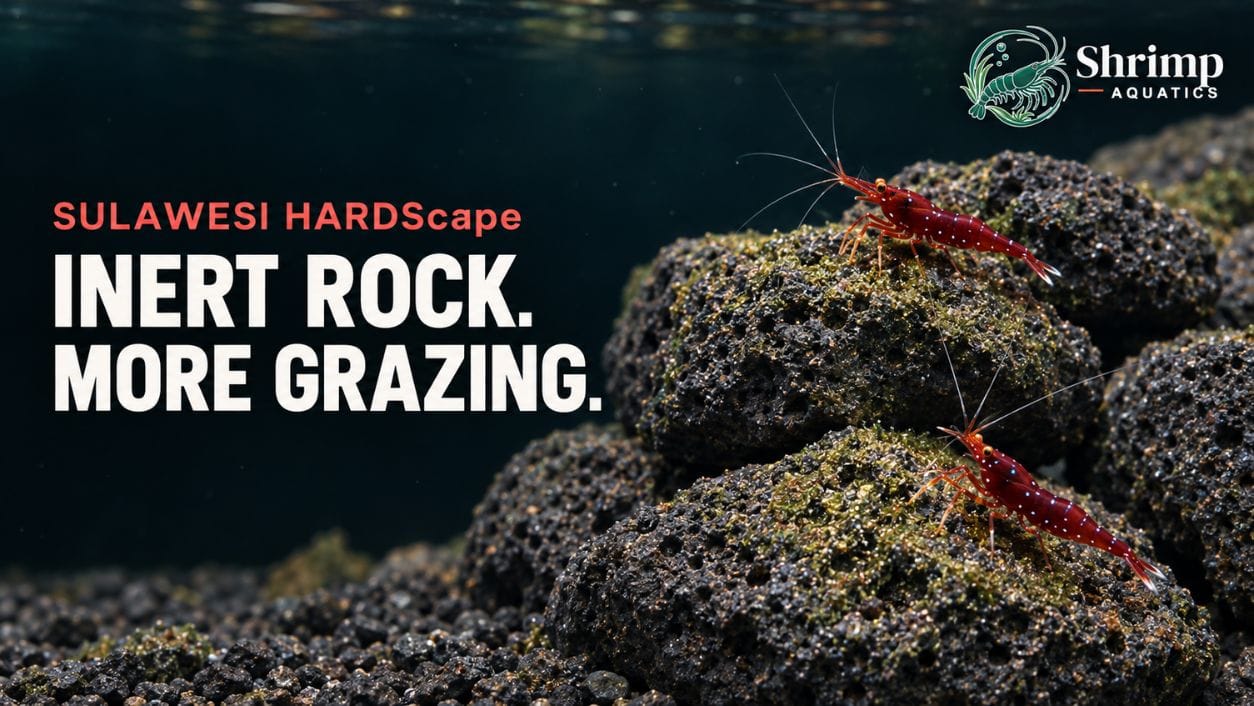
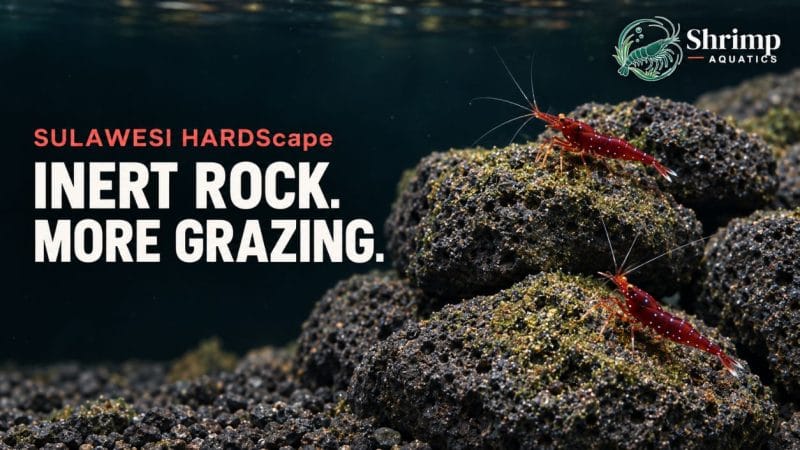
Choose Sulawesi hardscape on two questions. Does the rock change your water? Does it hold a film the shrimp can graze? Inert volcanic lava rock answers both, which is why it’s the working default in this tank. Carbonate rock fails the first question permanently, and any stone you can’t identify gets tested before it goes anywhere near the shrimp.
Which rocks dissolve into Sulawesi water and which ones leave it alone
Rock isn’t chemically neutral by default. As water moves through soil and rock it dissolves small amounts of naturally occurring minerals and carries them with it.1 Calcium and magnesium are the two that show up as hardness. Carbonate rock gives in fastest, because water carrying carbon dioxide becomes carbonic acid, and that acidic water dissolves carbonate rock such as marble, limestone and dolomite.2 In a closed aquarium the dissolved minerals have nowhere to go, so a carbonate rock is a slow, unmetered dose you didn’t choose.
That splits ordinary aquarium stone into three useful families, plus a fourth group that’s really a marketing category rather than a mineral one.
| Rock family | Effect on your water | Grazing surface | Use in a Sulawesi tank |
|---|---|---|---|
| Carbonate rock: limestone, marble, dolomite, travertine, crushed coral, aragonite and shell sand | Dissolves continuously and pushes KH, GH and TDS upward | Often rough and film friendly, but the chemistry cost decides it | Keep it out |
| Vesicular volcanic rock: basaltic lava rock, scoria, pumice | Passes the carbonate test, so the water stays where you set it | Open pores and sharp micro texture give the most grazing surface per piece | The working default |
| Dense silicate rock: granite, slate, quartz, tumbled river cobbles | Passes the carbonate test | Polished faces carry little surface and give shrimplets almost no cover | Structural filler at most |
| Trade-named aquascaping stone: Seiryu, dragon stone, elephant skin, ryuoh | Unknown until you test it, because the name describes appearance rather than mineralogy | Varies by piece | Test every piece before it goes in |
The fourth row is where most Sulawesi accidents start. Two stones sold under the same trade name can come out of different quarries. A single box can hold one piece that’s quiet in water and another with calcite running through it. Judge the piece in front of you, not the label on the bag.
Test an unknown rock for carbonate before it goes in the tank
Two tests answer the question, and they take a week between them. Run both on anything that didn’t arrive as plain lava rock.
- Dry a clean face of the stone and put a few drops of dilute hydrochloric acid on it. Distinctive effervescence is the definitive sign of carbonate.3 Fizzing anywhere on the piece, including a single seam or vein, is enough to reject it for this tank.
- Scrub the rock under running water and clear the deep hollows. Packed clay and silt inside a cratered stone will wash out later and settle over the grazing surfaces you’re trying to grow.
- Put the rinsed rock in a covered bucket of your finished Sulawesi water and record pH, GH, KH and TDS. Leave it a week at room temperature and read the same four values again.
- Compare the two readings. A rock that’s holding still reads the same. If the numbers climbed, the stone is dissolving, and it will keep doing that in the display tank at a rate you can’t predict.
Handle the acid test carefully
Test on a dry rock outside the aquarium, wear eye protection, and rinse the stone thoroughly before it goes anywhere near livestock. Household vinegar is a much weaker acid, so a rock that doesn’t react to vinegar hasn’t passed; treat that result as inconclusive and rely on the bucket test.
Why limestone is the wrong way to hold pH 7.5-8.5 in a Sulawesi tank
The alkaline half of Sulawesi water is what sends keepers toward calcareous rock in the first place. The reasoning sounds right and the mechanism is real, but it solves the problem in the one place you have the least control.
Alkalinity is the water’s capacity to neutralize acids and hold a fairly stable pH, and it comes from dissolved bicarbonates, carbonates and hydroxides.4 You already put that in the water deliberately when you mix it. A Sulawesi remineralizer added to RO water buffers around pH 7.5 and raises carbonate and total hardness together at a stated ratio.5 So the dose you measure into a mixing container is the buffer. A dissolving rock adds a second source on top of that, one with no dose, no schedule and no off switch. It works hardest exactly when organic load is pushing pH down and you’d rather know about it.
The calcium argument doesn’t survive either. Crustaceans take the calcium for a new exoskeleton mainly from the water around them, and food, including a shed shell, is a minor contributor.6 The mineral supplements for Sulawesi shrimp you dose are already the calcium supply. Hardscape doesn’t need to be a delivery mechanism, and using it as one costs you the ability to hold these four numbers still.
| pH | 7.5-8.5 |
|---|---|
| General hardness | 4-8 dGH |
| Carbonate hardness | 3-6 dKH |
| Total dissolved solids | TDS 150-250 ppm |
Accuracy in a Sulawesi biotope aquarium points the same way. Lake Towuti, one of the Malili lakes these shrimp come from, is a tectonic lake seated in ophiolitic rock and surrounded by lateritic soils.7 The water is alkaline, but the country around it isn’t limestone, so a calcareous scape isn’t the faithful choice either.
How much grazing texture Sulawesi shrimp need from their rockwork
In this group, mature biofilm, aufwuchs and algae are important grazing resources, and the rock is the surface they grow on. That makes surface area a husbandry number, not just an aesthetic one. A vesicular stone carries a great deal of texture per handful, in pores, ridges and shaded hollows. A tumbled cobble of the same size carries almost none, so an identical footprint of glass leaves the colony far less to graze.
Practically, buy more lava rock than the aquascape design needs, and favor pieces with visible open pores over dense, glassy ones. Loose rubble in the back corners and under the main structure isn’t wasted; it’s grazing surface. If you want a specific look from a smoother stone, use it as the visible feature and keep the porous rock as the working volume behind and beneath it.
One caution about planning. Acceptance of prepared food varies by species, system and food, so don’t design a low surface scape on the assumption that you can feed the difference. Supplemental food also can’t make up for a system that hasn’t matured.
Stack Sulawesi rockwork for shelter without trapping waste
Shy adults, first week shrimplets and any shrimp still hardening a new shell after a molt all use cover, so the stack has to have interior space. The cost of that space is that a sealed pile is also a detritus trap, and this tank is unusually unforgiving about trapped waste. At 79-86°F (26-30°C) and pH 7.5-8.5, more of whatever total ammonia is present sits in the un-ionized form that drives toxicity. The ratio of un-ionized ammonia to ammonium rises about ten-fold for each rise of a single pH unit, and roughly two-fold for each rise of ten degrees Celsius.8 A forgotten pocket of mulm behind a rock is worth more here than the same pocket in a cool, acidic Bee tank. It’s also one of the quieter reasons baby Sulawesi shrimp die, since the first-week shrimplets sheltering in that stack are the animals living closest to it.
That’s a design instruction, not a reason to use less rock.
- Leave a working gap between the rockwork and the glass so a siphon can reach behind and under the structure.
- Build open stacks with through paths and gaps at the base. Don’t push a solid wall against the back pane.
- Set the largest pieces directly on the base glass or a thin sand layer so nothing can be undermined and topple onto shrimp.
- Keep any sand or gravel substrate thin, so organic material sits where you can see and remove it.
- Don’t bed the stack into a deep substrate or seal its base, which puts the waste trap exactly where you can’t service it.
Put the rock in before the shrimp so the grazing film is already there
The hardscape is the food surface, so it belongs in the tank at the start of the cycle. Assemble the full structure and run the water at your target chemistry. Let light and time build algae and biofilm across the exposed faces while the biological filter establishes in the same pores.
Stock when the tank tells you it’s ready: ammonia and nitrite reading zero, temperature and chemistry steady across several days, and a visible, slightly slippery film on the rock. A calendar count of Sulawesi tank cycling time doesn’t prove a tank is cycled, and adding shrimp to a clean, bare scape asks them to graze a surface that has nothing on it yet.
Build a first Sulawesi scape from volcanic rock and test anything you add
For a first Sulawesi tank, the defensible choice is a scape built almost entirely from porous volcanic rock. Add a single tested feature stone if you want a different shape. That gives you a system where the only things moving your parameters are the ones you added on purpose.
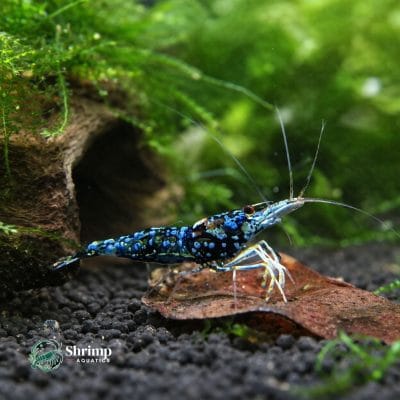
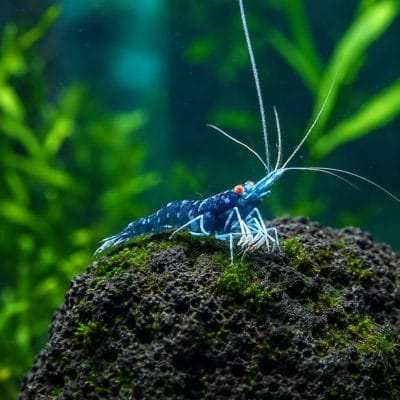
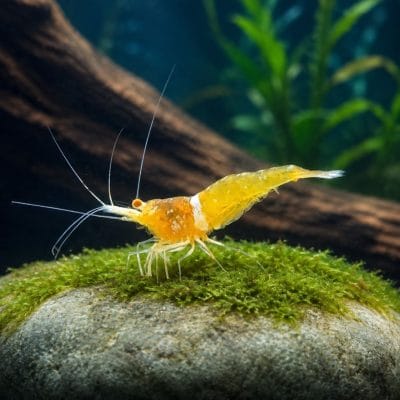
At Shrimp Aquatics, we commonly use Sula Sand Volcanic Rock in our Sulawesi systems. It’s inert and has worked well in tanks where we need pH to remain steady. In our Blue Ghost, Yellow Ghost, White Ghost and Oiran systems, we’ve also seen color remain more consistent as the shrimp mature.
Color also tracks lighting, genetics, nutrition, water chemistry, age and stress. Treat the rock as one input among several. What the stone reliably gives you is a fixed baseline and a large grazing surface. Those are the two things a warm, alkaline, low nutrient tank is hardest to run without. A stack of open volcanic rock with plenty of exposed faces is the setup the tank-bred Sulawesi shrimp lines we raise are already grazing on. The scape you build is the environment they’re moving from rather than a new one they have to adjust to.
References
8 Sources
- Hardness of Water, U.S. Geological Survey, Water Science School, updated August 24, 2026.
- Making a Cave, Caves and Karst, U.S. National Park Service, updated May 15, 2023.
- Limestones, Coal Exploration Core, Kentucky Geological Survey, University of Kentucky.
- Alkalinity and Water, U.S. Geological Survey, Water Science School, updated August 24, 2026.
- Sulawesi Mineral 7,5, Minerals and trace elements, SaltyShrimp, product information page.
- Biomineralizations: insights and prospects from crustaceans, ZooKeys 176, 2012.
- Geomicrobiological Features of Ferruginous Sediments from Lake Towuti, Indonesia, Frontiers in Microbiology 7, article 1007, 2016.
- Aquatic Life Ambient Water Quality Criteria for Ammonia, Freshwater, U.S. Environmental Protection Agency, Office of Water, April 2013.
Ready to get started?
Shop our Sulawesi Shrimp collection
27 products available · Live Arrival Guarantee
Featured Sulawesi Shrimp
Sulawesi Orange Eyes Yellow Ghost
Caridina dennerli
Advanced · 79–86°F · pH 7.5–8.5
$120.00View Product