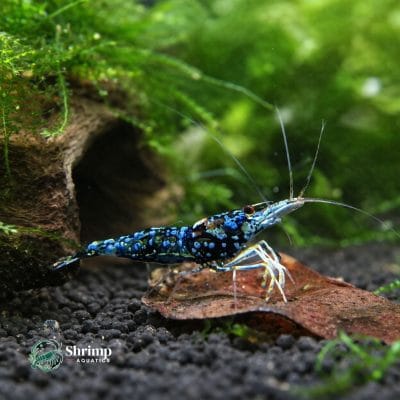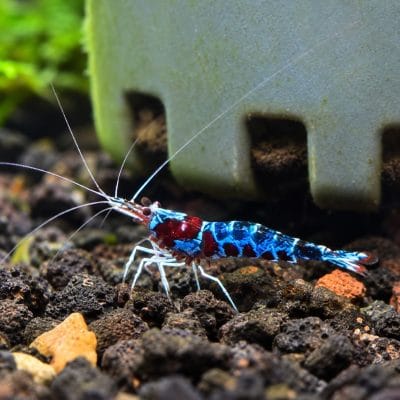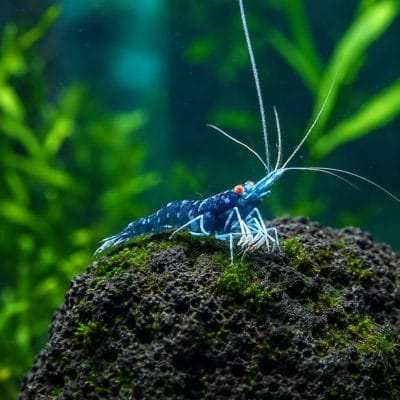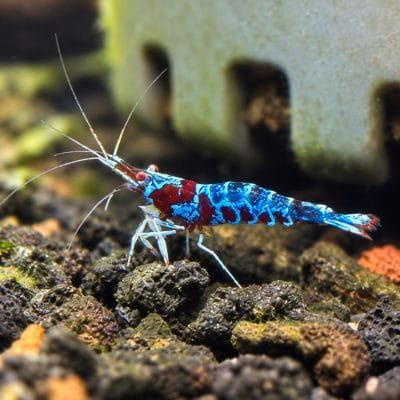
If the adults in your Sulawesi tank look normal and the shrimplets keep vanishing, the cause is rarely a disease you can treat. Newly released Sulawesi shrimp (lake Caridina spp.) die from problems that only reach an animal that small. A system that hasn’t yet grown enough film to graze on. Waste that turns more toxic in warm alkaline water than the same reading would in a cool acidic tank. Chemistry that moves while they’re molting. Removal by tankmates or a filter intake. All four are found with a test kit, a light and a close look at your rockwork, not with a medication bottle.
Are your Sulawesi shrimplets dying, or just too small to see?
Before you change anything, work out what you actually lost. Broods in this group are small. In the peer reviewed revision of the Sulawesi lake Caridina, egg carrying Caridina dennerli females carried 8-14 eggs across the seven females examined.1 Per species counts across the whole group ran from 8 eggs to about 80.1 A female who releases a brood of ten adds ten animals far smaller than the adults to a tank full of rock. So a quiet week proves very little on its own.
Two observations are worth more than a head count. The first is whether your females are still carrying and releasing at all. A colony of Sulawesi shrimp not breeding has a different problem from one that breeds and loses every brood. The second is whether the adults are showing anything: sluggish behavior, deaths, failed molts or a sudden loss of appetite. If the adults are affected too, treat this as a whole tank problem and start with the water. If only the young disappear, the tank is habitable but isn’t raising anything, which points at food, oxygen, chemistry at the molt, or something eating them.
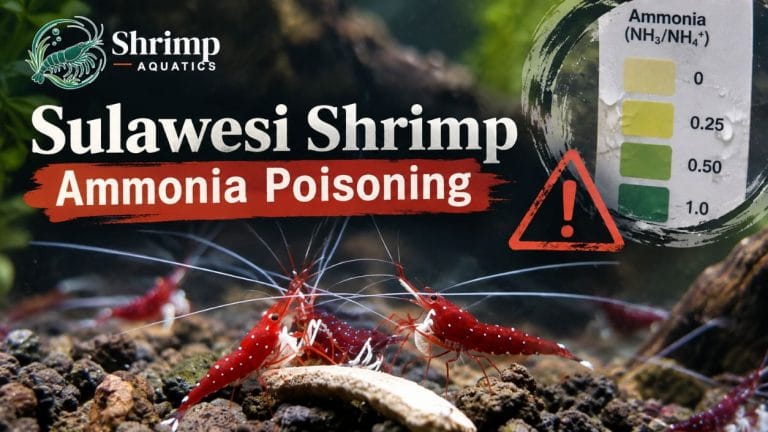
Test ammonia and nitrite first, because warm alkaline water changes what the reading means
Total ammonia in water sits in two forms, the ammonium ion and un-ionized ammonia, and it’s the un-ionized form that drives toxicity. The EPA’s freshwater ammonia criteria document states that the ratio of un-ionized ammonia to ammonium ion in fresh water increases by 10-fold for each rise of a single pH unit, and by approximately two-fold for each 10 degrees Celsius rise in temperature from 0-30 degrees Celsius.2 It also states that high external un-ionized ammonia concentrations reduce or reverse diffusive gradients and cause the buildup of ammonia in internal tissues and blood.2
That relationship is the reason a Sulawesi tank is less forgiving than the soft acidic tanks most shrimp advice is written for. A trace of ammonia that a Bee or Crystal keeper would shrug at sits at a much larger un-ionized share in your tank, at the top of the pH range and near 86°F (30°C). That’s simply where the equilibrium falls. Those criteria are written for the freshwater assemblage the EPA assessed, not for shrimp. So they give you a mechanism, not a shrimp safe number, and there’s no published safe ammonia concentration for these species to quote you.
Practically, that means any detectable ammonia or nitrite in a stocked Sulawesi tank is an action item rather than a tolerance question. Find the source first: uneaten food, a dead animal under the rock, a filter that was cleaned too thoroughly, a stalled cycle in a young tank. Remove the source, add aeration, retest the next day, and resist the urge to fix a chemistry reading with a large water change. That introduces a second problem on top of the first.
Check aeration, because a tank at 79-86°F (26-30°C) holds less oxygen
Cold water can hold more dissolved oxygen than warm water.3 A Sulawesi tank is run permanently at the warm end of the freshwater hobby, so it starts with a smaller oxygen reserve than a room temperature tank at the same surface agitation. Everything that consumes oxygen draws on that smaller reserve. A heavier feeding week, a bloom of bacteria after a powder feed, a warm spell in the room, or waste trapped in a dense rock pile all pull in the same direction.
The correction is cheap. Increase surface movement or add an air stone, then check that the flow is still gentle where the shrimp graze. If you feed and the tank clouds, oxygen demand rose at the same moment you raised the waste load. That’s the worst combination for the smallest animals in the tank.
Can your Sulawesi tank feed a shrimplet yet?
Mature biofilm, aufwuchs and algae on rock and glass are the grazing base in these systems, and a tank can be fully cycled without having grown much of one. The only published rearing trial on a Sulawesi lake species gives a sense of how much what the tank offers matters. Working with Caridina dennerli that started at an average total length of 1.445 cm, four treatments combined feed with shelter.4 Survival was 72.727 percent with commercial pellets and Hydrilla, 40.909 percent with pellets and stone, 31.818 percent with a bacterial starter and stone and 22.727 percent with a starter and Hydrilla.4 The pellet groups ran 30 days and the starter groups 37 days.4 Those shrimp were already well past release size and the trial wasn’t a home aquarium. Read it as evidence that feed and structure move survival a long way over a month, not as a feeding schedule for your tank.
At Shrimp Aquatics, we don’t rush a new Sulawesi tank. With a powdered bacterial starter our normal minimum is 3-4 weeks, and with a liquid or live culture the process may reach the same checkpoint in 2-3 weeks. The calendar doesn’t decide when shrimp go in. We wait for 0 ammonia and nitrite, stable temperature and chemistry, an established biological filter and visible grazing surfaces before stocking. During the early cycle we normally run the light for 8-10 hours a day so algae and biofilm can establish on the rock and glass.
Hold your own tank against that last checkpoint rather than against its age. If the rockwork still looks clean under a light instead of dulled and filmed, the grazing base hasn’t arrived yet. A brood released into that tank has very little to work with. Give it a steady photoperiod and time, and keep the hardscape textured and open enough to siphon around. What you shouldn’t do is conclude that Sulawesi shrimp eat only algae, or that a heavier prepared feeding can stand in for a young system. Acceptance of prepared food varies by species and tank, and no amount of it makes an immature system mature.
Why feeding more powder makes a Sulawesi shrimplet die-off worse
The instinct when babies disappear is to feed the tank more, and it’s usually the wrong move. Powdered foods are dosed for a colony you can see. They settle into exactly the crevices you can’t siphon, and whatever isn’t eaten breaks down into the ammonia your test kit reads. Put that through the speciation relationship above and the extra waste lands in the water chemistry least able to absorb it. The bacteria consuming it draw on an oxygen reserve that’s already small at this temperature.
If you feed prepared food at all while a die off is running, keep the portions small. Put them where you can find them again, and take out what’s left. The lasting fix is the grazing surface, which feeds continuously, needs no dosing and doesn’t rot.
When Sulawesi shrimplets die at the molt, check minerals before disease
All freshwater prawns, like other crustaceans, have to regularly cast their exoskeleton in order to grow.5 A shrimplet growing quickly passes that point often, and each molt is a moment when the water decides the outcome. The empty cast shell you find afterwards is a normal by-product of growth, so sheds in the tank are a good sign; bodies aren’t.
Two water values carry most of the load. The major source of calcium used for crustacean exoskeleton calcification is exogenous, the water in which most crustaceans live.6 Food, including consumed exuviae, is a minor contribution.6 That’s a crustacean level mechanism, not a measured Sulawesi requirement, but it explains why the mineral content of your water, not the food, is the practical calcium supply. Alkalinity is the second. It’s the buffering capacity of a water body, a measure of its ability to neutralize acids and maintain a fairly stable pH.7 It depends on dissolved bicarbonates, carbonates and hydroxides, so water with high alkalinity changes less in acidity when acid is introduced.7 In tank terms, KH is what stops your pH wandering between water changes.
Drift is the third factor, and it’s the one keepers create by accident. Evaporation concentrates dissolved solids in the water that’s left behind, a mechanism the USGS describes for shallow groundwater in arid regions.8 The aquarium version is the same physics. Every top off with remineralized water instead of pure water leaves more minerals in a tank that lost only water. TDS climbs over weeks until the colony is living somewhere it never moved to. Top off with pure RO or DI water, and keep a written log of TDS, pH, GH, KH and temperature. That way a slow climb is visible before a molt tells you about it.
| Temperature | 79-86°F (26-30°C) |
|---|---|
| pH | 7.5-8.5 |
| GH | 4-8 dGH |
| KH | 3-6 dKH |
| TDS | 150-250 ppm |
| Nitrate | Aim for under 10 ppm |
Verify the Sulawesi shrimp listing you actually bought, since a species or line can be narrower than the group range. What matters more than hitting a specific point inside these ranges is that your readings stay where they were last week.
How you mix and add Sulawesi mineral water can kill a brood
Replacement water is the one thing that arrives in the tank fully formed, and a brood is the part of the colony least able to absorb what comes with it. Match temperature and mineral content to the tank before the water goes in, add it slowly. Keep changes small and routine instead of large and corrective. Two of the products most commonly used to build that water behave very differently, and mixing them up is a real cause of sudden pH movement.
Sulawesi Mineral 8.5 needs CO2 and then at least three hours of aeration
The manufacturer states that this salt requires some additional measures for fully dissolving.9 On a regular CO2 quantity of one bubble per second it dissolves totally in approximately 3-4 days.9 If you use CO2 to dissolve the mineral salt, you must aerate the water afterwards for at least three hours with an air stone in order to expel the CO2. It raises carbonate and total hardness at a ratio of KH/dH = 0.78/1.0.9 Those are the manufacturer’s own preparation instructions, not a Shrimp Aquatics recommendation, and the aeration step is the one people skip. Water that goes into the tank before the CO2 is driven off carries an acid load with it. That’s exactly the kind of fast pH movement a molting shrimplet can’t absorb. Undissolved salt has the mirror problem: it settles out instead of raising hardness, so the tank reads soft even though the bucket looked full of minerals.
Sulawesi Mineral 7.5 dissolves without CO2
The same manufacturer’s 7.5 formulation almost totally dissolves within seconds, and the water is ready for use immediately.10 It buffers the pH at around 7.5 and raises carbonate and total hardness at a ratio of KH/dH = 0.42/1.0.10 That buffering point sits at the bottom of the 7.5-8.5 range above, so read it as one option inside the range rather than as the target. If your routine involves rushing water preparation, a product that needs no CO2 removes the failure mode entirely.
Tankmates and filter intakes take shrimplets out of a Sulawesi tank quietly
When the water checks out and the rock is grazed, look at what else lives in the tank. Fish described as generally shrimp safe still eat shrimplets, and some will take adults; low risk to a grown shrimp isn’t the same as safe for a brood. While you’re trying to raise Sulawesi shrimplets, a species only tank removes the variable completely, and it also removes the competition for the same grazing surfaces.
Mechanical intakes are the other quiet loss. Sponge filtration or a guarded intake reduces shrimplet loss in shrimp systems, with the caveat that the filter still has to move enough water for the bioload you’re running. A sponge surface has a second use here, because it becomes another grazing surface at a size a shrimplet can work.
What not to do while you’re still losing Sulawesi shrimplets
- Don’t raise the Sulawesi shrimp tank temperature to speed up growth or breeding. Temperature affects both intermolt period and growth per molt in many crustaceans.11 Lesser blue crabs reared at elevated temperatures showed a decreased intermolt period and decreased growth per molt, resulting in smaller sizes at each instar.11 The authors add that if the pattern continued through the pubertal molt, elevated temperatures would result in smaller size at maturity.11 That’s a crab study and gives the direction rather than a Caridina measurement, but a warmer tank also holds less oxygen, so there’s no upside to chase.
- Don’t medicate a die off you haven’t diagnosed. Copper and some fish medications can harm shrimp and snails. The risk depends on the exact active ingredients and concentration in the product, not on a label that says it’s safe.
- Don’t make a large corrective water change. A parameter that moved slowly isn’t fixed by moving it back quickly.
- Don’t restock into conditions you haven’t changed. Adding animals to a tank that’s already failing its young adds a bioload to the same water.
- Don’t tear the rockwork apart looking for bodies. You’ll find few, and you’ll remove the grazing film the survivors are living on.
Working these Sulawesi checks in order over the next two weeks
- Test ammonia, nitrite, pH, GH, KH, TDS and temperature, and write the numbers down with the date so the next reading means something.
- Cut prepared food back sharply and remove anything left after feeding.
- Add surface movement or an air stone, keeping the current gentle at rock level.
- Find and remove trapped waste and any dead animals, without dismantling the hardscape.
- Switch top offs to pure RO or DI water only.
- Fix the replacement water routine before the next change, including full aeration if you use a CO2 dissolved mineral.
- Exclude fish and guard or sponge the intake while you’re raising a brood.
- Leave the tank alone otherwise, hold a steady photoperiod, and let the grazing surface build.
- Retest after a week and compare against the first set of numbers before you change anything else.
When to get another opinion
If adults are dying alongside the young, if losses continue after the water has been stable for two weeks, or if you see the same signs across several animals at once, stop guessing. Ask for help rather than reaching for a treatment. A qualified aquatic veterinarian or an experienced keeper who can see your readings is the right next step. You can also email contact@shrimpaquatics.com with your pH, GH, KH, TDS, temperature, tank size, cycle status and current livestock. We’ll tell you what we’d check next.
References
11 Sources
- Radiation of endemic species flocks in ancient lakes: systematic revision of the freshwater shrimp Caridina from the ancient lakes of Sulawesi, Indonesia, with the description of eight new species, The Raffles Bulletin of Zoology 57(2): 343-452, 2009.
- Aquatic Life Ambient Water Quality Criteria for Ammonia, Freshwater 2013, U.S. Environmental Protection Agency, Office of Water, April 2013.
- Dissolved Oxygen and Water, U.S. Geological Survey, Water Science School, updated August 24, 2026.
- Effect of Using Different Shelter and Feed Types on Growth and Survival Rate of Sulawesi Endemic Ornamental Shrimps (Caridina dennerli), journal PDF, Jurnal Ilmiah PLATAX 13(1), 2025.
- Farming freshwater prawns: a manual for the culture of the giant river prawn, biology chapter, FAO Fisheries Technical Paper 428, Food and Agriculture Organization of the United Nations.
- Biomineralizations: insights and prospects from crustaceans, ZooKeys 176: 103-121, 2012.
- Alkalinity and Water, U.S. Geological Survey, Water Science School, updated August 24, 2026.
- Chloride, Salinity, and Dissolved Solids, U.S. Geological Survey, Water Resources Mission Area, March 1, 2019.
- Sulawesi Mineral 8,5, minerals and trace elements, SaltyShrimp (Garnelenhaus), manufacturer product information.
- Sulawesi Mineral 7,5, minerals and trace elements, SaltyShrimp (Garnelenhaus), manufacturer product information.
- Elevated temperature induces a decrease in intermolt period and growth per molt in the lesser blue crab Callinectes similis, abstract, Journal of Crustacean Biology 39(1), January 2019.
Ready to get started?
Shop our Sulawesi Shrimp collection
27 products available · Live Arrival Guarantee