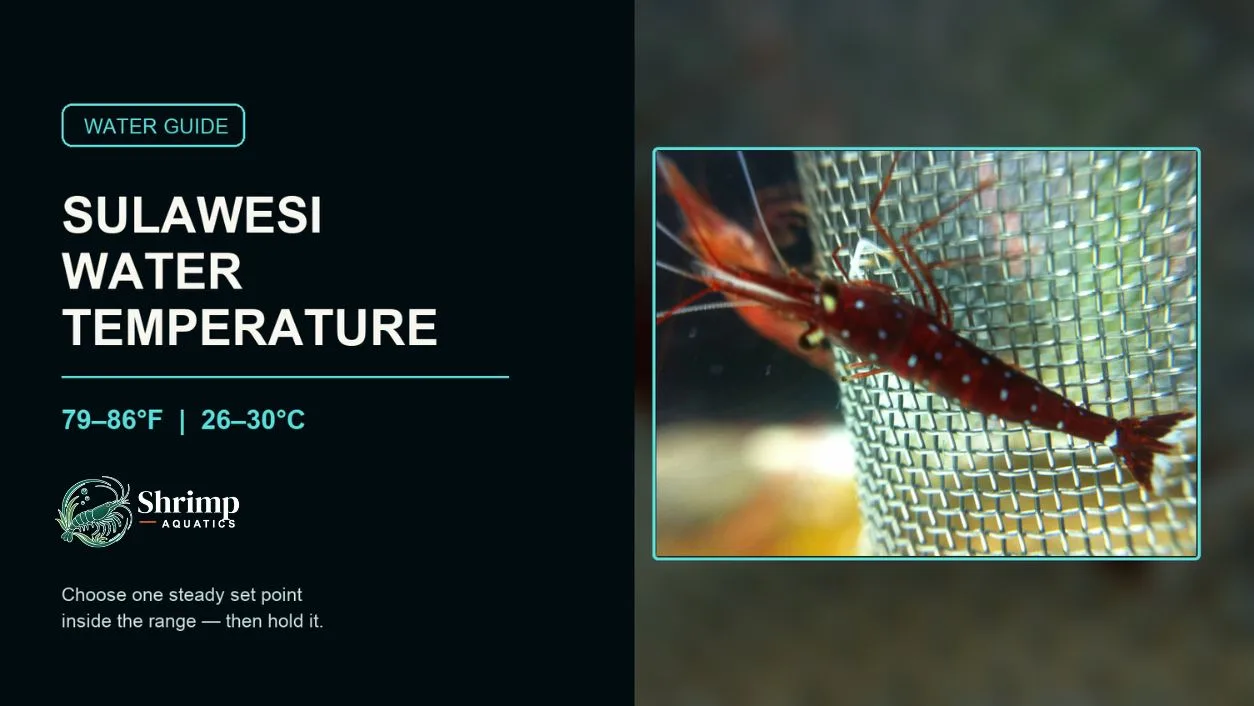
Not sure where to set the heater for your Sulawesi shrimp? Anywhere inside 79-86°F (26-30°C) works, because nothing in the published record singles out one point in that band as better than the rest. So pick the number your room will let you hold, set it once and leave it. Sulawesi shrimp are advanced animals, and temperature is one of the few parts of their care you can set exactly. The warmth is also why the rest of the tank is unforgiving. Heat and alkaline water together make ordinary mistakes cost more than they would in a cool, soft-water tank.
Where to set the heater inside the 79-86°F Sulawesi range
Set the heater anywhere inside 79-86°F (26-30°C) and leave it there. There’s no published thermal optimum for this group to aim at. So the useful question is which number your room will let you hold. If your room moves through the day, choose a set point with space above and below it inside the band, away from either end. That way a hot afternoon or a cold night doesn’t carry the tank out of range.
The one piece of measured work on these animals fits the band, not any point inside it. A 2025 rearing trial on Caridina dennerli recorded tank temperatures that stayed inside this range for its whole run.1 The treatments it compared varied feed and shelter, not heat.1 Those were simply the conditions that trial happened to run at, not a recommendation. No trial has yet compared temperatures against each other for any Sulawesi species.
Free to choose? Then the middle of the band, about 82°F (28°C), leaves you the most room in both directions. Don’t push the tank to the top of the band hoping to speed up growth or breeding. Cold water can hold more dissolved oxygen than warm water.2 So a tank parked near 86°F (30°C) has the least margin above the oxygen requirements of Sulawesi shrimp. If you do sit near the top, treat aeration as part of that choice.
A tank held this warm also loses water to evaporation, and evaporation takes the water while leaving the dissolved solids behind in a smaller volume.3 Over a week that shows up as TDS drifting upward between water changes, with nothing you’d notice in the shrimp. So if you run near the top of the band, test more often than you would lower down.
Does your Sulawesi species need its own temperature?
No, not on the evidence available. Sulawesi shrimp are a whole flock of species. The 2009 revision of the group recognizes 21 Caridina species in the ancient lakes of Sulawesi, 15 of them in the Malili lake system and 6 in Lake Poso.4 Nobody has published a separate thermal preference or tolerance figure for any of them, so the group range is what there is to work with.
Two of the species behind our Sulawesi shrimp lines at Shrimp Aquatics come from the Malili lakes and one from Lake Poso. That tells you where the animal comes from, and it doesn’t change what your heater does. The same revision records Caridina dennerli as endemic to Lake Matano, Caridina spinata as a Malili lake system endemic and Caridina longidigita as a Lake Poso endemic.4
| Species | Where it is endemic | Keeping temperature |
|---|---|---|
| Caridina dennerli | Lake Matano, Malili lake system | 79-86°F (26-30°C) |
| Caridina spinata | Malili lake system | 79-86°F (26-30°C) |
| Caridina longidigita | Lake Poso | 79-86°F (26-30°C) |
So what does that mean for your tank? Not much, and it’s worth saying plainly. Keeping two lines in one tank doesn’t create two temperature requirements, and a colder or warmer tank won’t suit one of them better than the other. If a listing gives you a narrower figure for a particular stock, that figure belongs to that stock, and the seller should say whose measurement it is. Treat anything unlabeled as the group range.
Is 79°F a safe Sulawesi set point or just the edge of the range?
It’s a valid set point, because it’s inside the range, but it’s the one with no margin below it. The bottom of the band is where the keeping range starts, not a tested floor. The lake data behind the whole range explain why Sulawesi shrimp need warm water held inside it, not parked at its edge.
The real risk at the bottom of the band is the room around it. A tank that reads 79°F in the evening can be lower at four in the morning, and a heater chosen for the daily average isn’t chosen for the coldest hour. Sulawesi shrimp need a heater set so the coldest hour of the night is still inside the band and the warmest hour of the afternoon is still under the ceiling. If your room travels further than the heater can cover, that’s a room problem, and no amount of nudging the set point will solve it.
Where to put the thermometer in a Sulawesi shrimp tank
Put it at the far end of the tank from the heater, about halfway down, where the shrimp actually graze. A set point is only as good as the reading behind it, and in most tanks the least reliable reading is the one printed on the heater.
Water right beside the heater, or in the stream coming off it, runs warmer than the rest of the tank while the heater is on. A thermometer there tells you what the heater is doing, not what your shrimp are sitting in. Keep it out of the filter return and out from under the light too, so the number you read belongs to the tank and not to one corner of it.
- Use a thermometer that’s independent of the heater, and check a new one against a second thermometer before you trust it.
- Mount it where you can read it without opening the lid, so you actually look at it every day.
- If you can, choose a digital one that keeps the day’s lowest and highest reading. It shows you the coldest hour without you getting up at four in the morning to find it.
- Don’t read the heater’s dial or indicator light as the tank temperature.
How to hold a Sulawesi tank steady at the number you set
Find out how far your tank moves in a day first, then fix what moves it, not the set point. Most of the movement comes from a few predictable places: the room cools at night, the lights go off, or a water change goes in colder than the water already in the tank.
- Check once when the room is at its coldest and once when it’s at its warmest, not only at feeding time.
- Bring replacement water to the tank’s temperature before it goes in, so a water change isn’t also a temperature change.
- Fix a room that swings hard between seasons before you stock, not after.
- Don’t correct a reading by moving the set point in large steps. A tank that’s inside the band and steady is in better shape than one being chased toward a number.
How much daily swing is too much? Any swing that takes the coldest or the warmest hour outside 79-86°F (26-30°C) is too much, and inside the band, smaller is better. You’re aiming for a tank that reads the same at dawn as it does in the late afternoon.
Choosing the number takes a minute. Holding it is the part you’ll still be doing next year, and it’s the half of this question that a number on its own can’t answer.
References
4 Sources
- Effect of Using Different Shelter and Feed Types on Growth and Survival Rate of Sulawesi Endemic Ornamental Shrimps (Caridina dennerli) (journal PDF), Abdullah, Hasim and Mulis, Jurnal Ilmiah PLATAX 13(1): 191-204, 2025.
- Dissolved Oxygen, U.S. Geological Survey, Water Science School, June 5, 2018.
- Chloride, Salinity, and Dissolved Solids, U.S. Geological Survey, Water Resources Mission Area, March 1, 2019.
- Radiation of endemic species flocks in ancient lakes: systematic revision of the freshwater shrimp Caridina from the ancient lakes of Sulawesi, Indonesia, with the description of eight new species, von Rintelen and Cai, The Raffles Bulletin of Zoology 57(2): 343-452, 2009.
Ready to get started?
Shop our Sulawesi Shrimp collection
27 products available · Live Arrival Guarantee