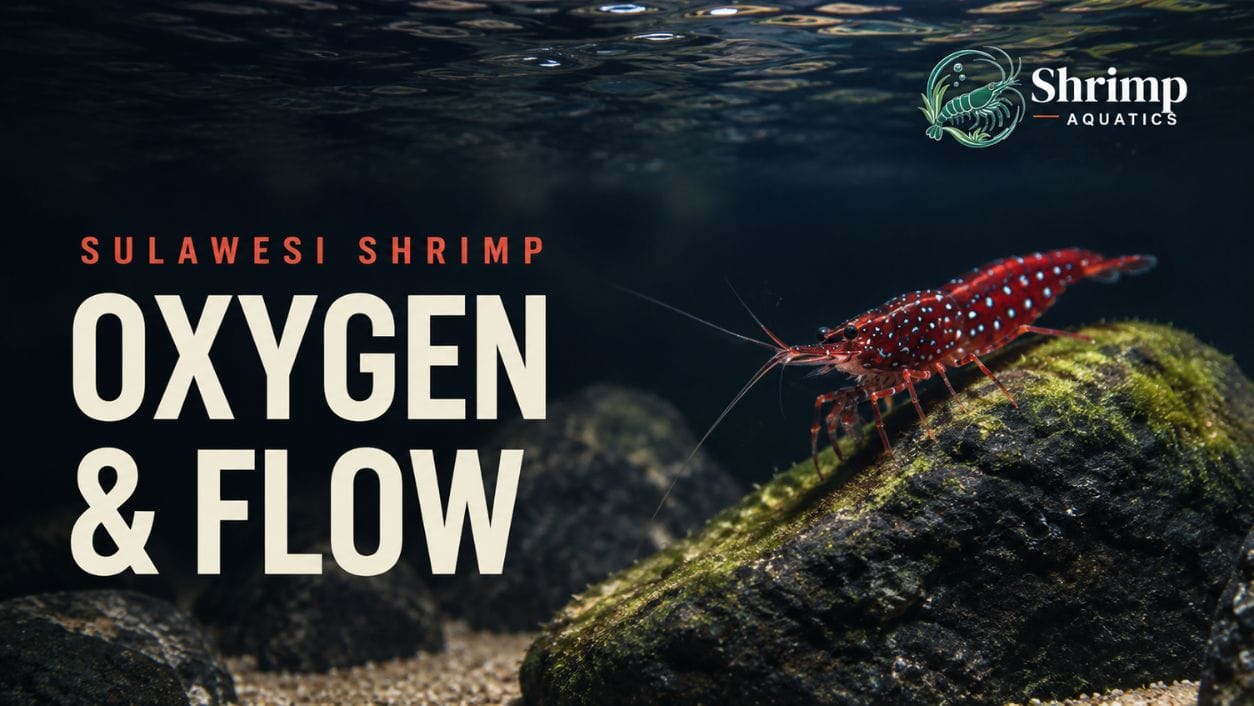
No dissolved oxygen requirement has ever been published for a Sulawesi shrimp, so there’s no target number that comes from the animals themselves. What was measured is the water they came from. In Lake Towuti, one of the Malili lakes, the water column is reported as fully oxic at 250 micromolar down to a depth of 60 m, which works out to roughly 8 mg/L.1 The oxygen decline only begins far below anywhere a shrimp grazes. The working answer for a home tank is that same condition in different words. Hold the water close to air saturation for whatever temperature you’re running inside 79-86°F (26-30°C). Get there through constant surface renewal rather than through a stronger pump.
Warm Sulawesi water holds less oxygen than a cool Neocaridina tank
The first thing to understand about oxygen in a Sulawesi tank is that the ceiling is lower before you do anything at all. Cold water can hold more dissolved oxygen than warm water.2 Sulawesi shrimp need warm water at 79-86°F (26-30°C), which is the warm end of freshwater aquarium keeping. So the maximum the water can carry when it’s fully saturated is lower than in the cooler tank most keepers learned on.
That has a practical consequence and not just a theoretical one. A saturated Sulawesi tank is fine. It’s simply near the top of what its temperature allows. It also means the margin between comfortable and marginal is thinner. An interruption that a cool tank would absorb quietly, such as an air pump that stops in the night or a sponge that clogs over a fortnight, arrives faster here. If you run at the top of the band you’ve chosen the thinnest margin of all. That’s a reason to be deliberate about redundancy, not a reason to run cooler.
The reading you should take from this is about judgement more than numbers. Don’t carry over a mg/L figure you remember from a cooler tank and treat it as a pass mark. Judge the tank on whether its surface is being renewed continuously and whether that renewal survives a single equipment failure.
What the one measured Caridina low oxygen result actually shows
The closest published measurement on the same genus is on Caridina nilotica, an atyid prawn from Lake Victoria in East Africa. In laboratory experiments, survivorship and body growth weren’t significantly different between animals reared at 3-4 mg/L and animals reared at 6-7 mg/L. Field populations were shown to occupy poorly oxygenated regions of the lake for extended periods of more than one week at a time.3
Read that carefully, because it cuts both ways. It’s a different species, in a different lake, at a different temperature, under laboratory conditions. None of that licenses running a Sulawesi tank down at 3-4 mg/L on purpose. What it does do is tell you how much weight the hobby’s threshold tables deserve. Those tables sort dissolved oxygen into optimal, stress and lethal bands and attach specific outcomes such as molting failure or death to each one. No published measurement supports those bands for any Caridina, and the single measurement that does exist points in the opposite direction from the stress band they describe.
So the honest position is this. Aim high because the native water is near saturation and because saturation costs you nothing to maintain. Don’t aim high because a number below it has been shown to harm these animals, since none has. And when a care sheet gives you a precise threshold with a precise consequence, treat it as unverified.
Why an oxygen dip in a Sulawesi tank becomes an ammonia problem
The reason to care about oxygen here isn’t only that the shrimp breathe it. The biological filter competes for the same oxygen. The EPA lists oxygen concentration among the factors that control the growth rates of nitrifying bacteria, and dissolved oxygen depletion among the water quality problems that accompany nitrification.4 A tank running short of oxygen is therefore also a tank whose waste processing is being slowed down.
That matters more in this group than in most because of the other half of Sulawesi water. At pH 7.5-8.5 and 79-86°F (26-30°C), a larger share of whatever total ammonia is present sits in its dangerous form. The EPA states that the ratio of un-ionized ammonia to ammonium ion in fresh water increases by 10-fold for each rise of a single pH unit. It rises by approximately two-fold for each 10 degree Celsius rise in temperature from 0-30 degrees Celsius. High external un-ionized ammonia concentrations reduce or reverse diffusive gradients and cause ammonia to build up in internal tissues and blood.5 Those criteria were derived for the freshwater assemblage the EPA studied, not for an aquarium, so they set no safe level for shrimp. What they do establish is the direction and the scale: the same total ammonia reading is a different proposition in a warm alkaline tank than in a cool acidic one.
Put the two together and the risk of an oxygen dip arrives twice. It reaches the shrimp through their gills. It reaches them again through a filter that’s doing less work in water where the waste it’s failing to process is already in its more toxic form. This is why aeration belongs in the same mental category as filtration. It’s also why ammonia and nitrite at zero remain the baseline before any Sulawesi shrimp goes into the tank.
How to hold oxygen near saturation without pushing Sulawesi shrimp around
Lake and tank agree on the mechanism. Oxygen arrives at the boundary between air and water. So the useful question is how often that boundary is replaced, not how hard the water is moving in the middle of the tank.
Where the gas exchange actually happens
An air driven sponge filter, an air stone tucked under a piece of hardscape, or a filter return aimed just below the surface all do the same job. They keep lifting fresh water to the surface and keep the surface skin from sitting still. In a Sulawesi tank the sponge has a second benefit, since the shrimp will graze the sponge surface as readily as they graze rock. What you’re looking for is a surface that’s visibly working, without a static oily film sitting across one corner.
Redundancy is worth more here than capacity. Two modest air sources on separate pumps, such as an air stone and an air driven sponge filter, protect the tank better than one strong one. The failure mode you’re guarding against is a stoppage rather than an under specification.
Keeping flow gentle where the shrimp graze
The constraint is that these are lake animals, and a tank pushed hard enough to guarantee gas exchange can also be a tank the shrimp won’t settle and graze in. That tension is real, and the way out of it is aim rather than volume.
At Shrimp Aquatics, our Sulawesi systems use biological filtration together with a Kaldnes moving bed filter. The combination gives us strong aeration and active biological media, but we tune the outlet so the shrimp aren’t pushed around while grazing. The goal is high oxygen with gentle movement at shrimp level.
If you find yourself choosing between turning the aeration down and redirecting it, redirect it. Baffle the outlet, angle it along the glass, or break it over a piece of hardscape. That spreads the energy before it reaches the substrate where the colony feeds. Get that arrangement running and settled before the tank holds any of the lake Sulawesi shrimp you plan to keep. Aeration is part of what the biological filter needs in order to establish, not a finishing touch added on stocking day.
Spotting low oxygen in a Sulawesi tank before you lose shrimp
Check the tank first, not the shrimp: no published list of hypoxia signs exists for Sulawesi shrimp, and behavior on its own doesn’t identify a cause in any case. A colony that stops grazing has told you that something is wrong. It hasn’t told you what. So the useful move when you suspect an oxygen problem is to check the tank before you try to read the shrimp.
- Confirm the air pump is still running and the airline isn’t kinked or crushed behind the tank.
- Look at the surface for a static film, and at the sponge or intake for a clog that has quietly reduced turnover.
- Test ammonia and nitrite, since a stalled biofilter and an oxygen shortage often travel together.
- Check the temperature against what you normally run, because a hot afternoon shifts the ceiling downward.
- List what changed in the last week, including a new filter arrangement, a heavier feeding, a large water change or anything added to the tank.
Don’t treat a suspected oxygen problem with chemistry
Raising the temperature, or dosing a product into a warm alkaline tank that’s already short of oxygen, adds a second variable to a situation you haven’t diagnosed yet. Restore gas exchange and confirm ammonia and nitrite first. If losses continue after the mechanical checks, treat it as a system problem and get qualified help before medicating a tank of invertebrates on a guess.
Is a dissolved oxygen meter worth buying for a Sulawesi tank?
For most keepers, probably not as a primary tool, and the reason is the same one this page opened with. There’s no species threshold to compare a reading against, so a number on a meter can’t tell you whether your shrimp are comfortable. It can only tell you what the water is doing.
That said, a meter earns its place when you have a specific question at a specific moment. Does the tank actually drop overnight when the lights and the plants are off? Is the far corner behind the hardscape stagnant compared with the front glass? Did the new outlet arrangement change anything measurable, or does it only look better? Used that way, you’re comparing your own tank against itself over time, which is a comparison the evidence supports. You aren’t comparing it against a figure from a care sheet, which the evidence doesn’t support.
If the budget only stretches to one purchase, the second air source on its own pump does more for the colony than the meter does. The meter tells you about a problem. The redundancy prevents the most common version of it.
References
5 Sources
- Geomicrobiological Features of Ferruginous Sediments from Lake Towuti, Indonesia, Frontiers in Microbiology 7, article 1007, 2016.
- Dissolved Oxygen and Water, U.S. Geological Survey, Water Science School, updated August 24, 2026.
- Low-Oxygen Tolerance of the Atyid Prawn, Caridina nilotica, in Lake Victoria (East Africa), chapter abstract in Environmental Change and Response in East African Lakes, Springer, 1998.
- Nitrification, U.S. Environmental Protection Agency, Office of Water, August 15, 2002.
- Aquatic Life Ambient Water Quality Criteria for Ammonia, Freshwater, U.S. Environmental Protection Agency, Office of Water, April 2013.
Ready to get started?
Shop our Sulawesi Shrimp collection
27 products available · Live Arrival Guarantee