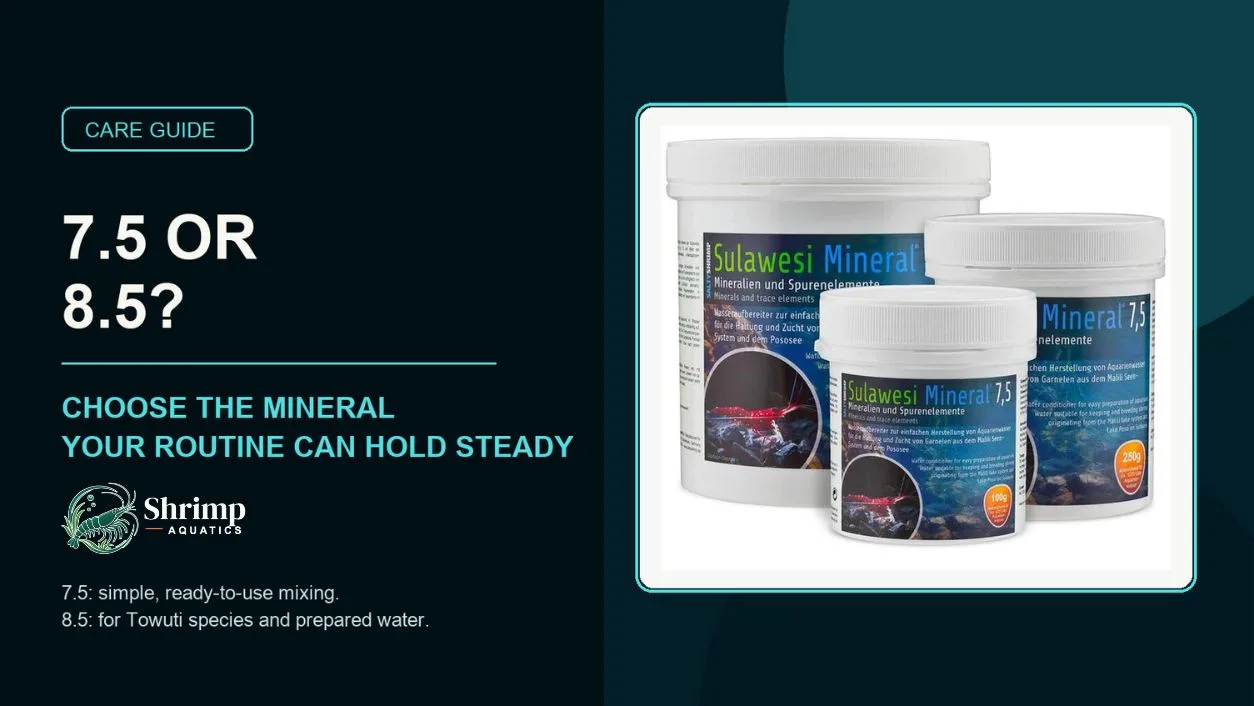
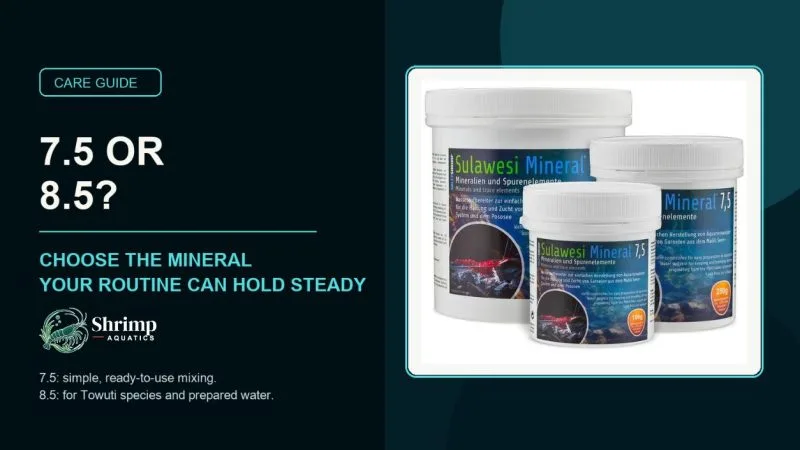
You’ve got RO water ready for a Sulawesi tank and two SaltyShrimp salts to choose between, Sulawesi Mineral 7.5 and Sulawesi Mineral 8.5. Neither is better in general: they land at opposite ends of the same pH 7.5-8.5 target, so pick the end your filter, equipment and weekly routine can hold steady. For a first Sulawesi tank, or for anyone mixing water by hand in a bucket, 7.5 is the sensible start. The 8.5 matches the Lake Towuti species it was formulated around, on a mature system where you already run carbon dioxide.
What each Sulawesi mineral mixes your RO water to
Both put back what pure water lacks. You start from RO water, rainwater or fully deionized water, which has almost nothing in it, and the mineral returns calcium, magnesium, carbonates and trace elements in one measured dose. Neither is something you tip into tap water to raise pH for Sulawesi shrimp.
Sulawesi Mineral 7.5 is the easily soluble one. SaltyShrimp buffers it to a pH of around 7.5, with a hardness of around 6 dGH and a conductivity of around 270 µS, plus or minus 40. That comes from roughly 3.5 g in 15 liters of water. It raises carbonate hardness against total hardness at a ratio of 0.42 to 1.0. Mixed outside the aquarium, it dissolves almost completely within seconds and the water’s ready to use straight away.1
| Property | Sulawesi Mineral 7.5 | Sulawesi Mineral 8.5 |
|---|---|---|
| Buffered pH | around 7.5 | 8.5 |
| Hardness it mixes to | around 6 dGH | around 7 dGH |
| Carbonate against total hardness | 0.42 to 1.0 | 0.78 to 1.0 |
| Conductivity | around 270 µS, plus or minus 40 | around 220 µS, plus or minus 40 |
| Dose given by the maker | about 3.5 g in 15 liters | about 3 g in 20 liters |
| Getting it into solution | Dissolves within seconds, ready at once | Carbon dioxide for about 3-4 days, then at least three hours of aeration |
Sulawesi Mineral 8.5 aims at a closer copy of Lake Towuti water parameters. The maker gives a pH of 8.5, a hardness of around 7 dGH and a lower conductivity of around 220 µS, plus or minus 40, from roughly 3 g in 20 liters. Carbonate is raised against total hardness at 0.78 to 1.0.2
So what do the numbers actually tell you? The figure in the product name is the pH it settles at, and the ratio underneath is how it gets there. The 8.5 carries close to twice as much carbonate per degree of general hardness. Both endpoints sit inside the pH 7.5-8.5 we publish for Sulawesi tanks, and both mixes land inside GH 4-8 dGH when dosed as directed.
Whichever you use, test the finished batch against your Sulawesi shrimp care parameters before it goes near the tank. Mineral that hasn’t fully dissolved reads low on hardness and TDS while looking finished in the bucket.
Both start from RO because Sulawesi shrimp need RO water, not treated tap. The mineral only adds back what the shrimp need.
Which Sulawesi shrimp each mineral was built for
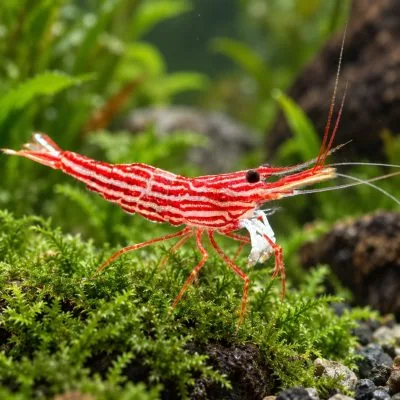
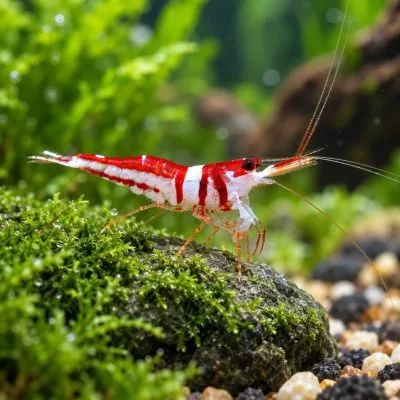
The 8.5 was built for the more sensitive Lake Towuti species, and the 7.5 suits the less finicky ones. SaltyShrimp is unusually direct about it: its page names the freshwater harlequin shrimp (Caridina woltereckae) and the red-banded shrimp (Caridina striata) as the reason for the 8.5, and says the freshwater cardinal shrimp (Caridina dennerli) has been kept and bred with positive outcomes on both products.2
That second half is what most comparisons leave out, and it changes the decision. For the species most keepers choose as the best Sulawesi shrimp for beginners, the company that makes both salts doesn’t claim the higher one is required. If you’re still choosing what to stock, the cardinal shrimp lines that make up much of our tank-bred Sulawesi shrimp listing are the ones named on either mineral. The Towuti species are the ones that pull you toward 8.5 and everything it asks of you.
None of that’s a survival promise. A mineral sets the water. It doesn’t carry an animal through a tank that isn’t ready for it.
What dissolving Sulawesi Mineral 8.5 asks of you before every water change
It asks for carbon dioxide and several days of lead time. Stirring harder or mixing warmer won’t do it. SaltyShrimp’s instruction for 8.5 is a regular rate of about one bubble of carbon dioxide per second, at which the salt dissolves almost totally in roughly 3-4 days. The water then needs at least three hours on an air stone to drive that carbon dioxide back out before it’s used.2
- Dose the powder into a mixing container to remineralize RO water for Sulawesi shrimp, never into the aquarium.
- Run carbon dioxide into the container at about one bubble per second and leave it for 3-4 days.
- Once the water has gone from milky to clear, aerate it with an air stone for at least three hours.
- Bring it to tank temperature, then test pH, GH and TDS before any of it reaches the shrimp.
Skipping either half changes the water you’re adding
Water that still looks milky hasn’t finished dissolving, so it carries less carbonate and less hardness than the dose suggests. Water that hasn’t been aerated still holds the carbon dioxide you put into it. Either way, you’re adding something other than the mix you meant to.
The real cost is several days of lead time on every batch. If keeping prepared water ahead of the tank is already a habit, that’s manageable. It becomes a problem the first time you need water on a Tuesday and the container’s still cloudy. Improvising at that point is how a colony gets a parameter swing in place of a water change.
Why ammonia turns more dangerous in a Sulawesi tank held at pH 8.5
Because a higher pH shifts more of the same ammonia into its toxic form. Total ammonia in water exists as the ammonium ion and as un-ionized ammonia, and the un-ionized form is the one that does the damage. At high outside concentrations it reduces or reverses the diffusive gradient, so ammonia builds up in the animal’s tissues and blood. How the total splits between the two forms is set by pH and temperature. In fresh water the share of un-ionized ammonia rises about tenfold for each single pH unit. It rises roughly twofold for every 10 degree Celsius rise in temperature across the 0 to 30 degree range.3
Now line that up with the two products. The step from a 7.5 tank to an 8.5 tank is exactly one pH unit. So the same reading on your ammonia test kit means on the order of ten times as much toxic ammonia in the 8.5 tank. Add the heat these shrimp need anyway, 79-86°F (26-30°C), and it pushes the same way. Those figures were derived for the freshwater community the EPA assessed, not for Caridina, so use them for direction and scale, not as a threshold for your aquarium.
In practice, the higher endpoint is a demand on your filter more than a preference about chemistry. It belongs on a system that isn’t merely cycled but genuinely mature, with the settled biological filtration and grazing surfaces that the beginner guide to keeping Sulawesi shrimp is built around. The overfeeding, the dead shrimp you missed behind a rock and the over-cleaned sponge that a 7.5 tank shrugs off can each become a real event at 8.5.
Picking the Sulawesi mineral your setup can actually hold steady
Pick the salt whose routine you’ll repeat without shortcuts, then check it against the shrimp you keep. Two questions settle it for most keepers. Can you prepare water in a separate container several days before every change, with carbon dioxide and an air stone? And are Towuti species the reason this tank exists? Two yeses point to 8.5. Anything else points to 7.5. Whichever you choose, stay with it, because alternating batches means every water change adds water a full pH unit away from the last one.
Start on 7.5 when you mix water by hand each week
This is the first Sulawesi tank with no carbon dioxide gear, water made up in a bucket the evening before, and cardinal or white sock type lines in the plan. You get a mix that’s usable in seconds, a wider margin on ammonia, and one less system to keep running.
The trade-off is the floor. Water mixed on 7.5 sits at the bottom of the pH 7.5-8.5 range, with less carbonate behind each degree of hardness than 8.5 has. A slow KH slide takes the tank below range sooner, so test KH as well as pH between water changes.
Step up to 8.5 when the Towuti species are the point
Harlequin or red-banded shrimp, a carbon dioxide setup and air stones you already own, and somewhere to store batches made days ahead. Add a filter you’ve matured on purpose, and the discipline to test every batch. It’s the closer copy of their water, and it’s unforgiving about everything else.
At Shrimp Aquatics, most of our Sulawesi systems currently run at TDS 150 ppm, GH 6-7 dGH and pH 7.5. We start those systems with RO water. We then use Sulawesi Mineral 7.5 to prepare the water for our current tank targets before shrimp are introduced. We test the finished pH, GH and TDS before the water goes into a tank.
We mention it because of what it settles. If you’ve read that 8.5 is the only serious option, most of our Sulawesi systems run at the lower end of that range.
Neither salt is what keeps the animals alive. A stable, mature tank does that, and the mineral you can hold steady week after week is the better mineral for your setup.
Moving a running Sulawesi tank from 7.5 to 8.5 without a pH swing
Change the water gradually and let the tank follow. Moving a colony a full pH unit in a single water change is a shock in its own right, and it can undo the reason you switched.
- Prepare and test a complete 8.5 batch, carbon dioxide and aeration included, before you plan the first changeover.
- Use the same small volumes that Sulawesi shrimp water changes already call for, so the tank climbs over weeks instead of jumping in a day.
- Track carbonate hardness between changes, because carbonate is what holds the higher pH up. When Sulawesi shrimp KH and alkalinity slide, the pH slides with them.
- Don’t blend the two products in one batch to land somewhere in the middle. Each is built around its own carbonate to hardness ratio, and a blend leaves you with no published figure to check the result against.
- Don’t start the switch in the same week you add new stock or chase a heater problem. Give the colony one change at a time.
Can you have prepared 8.5 water ready every time the tank needs it? If the honest answer is no, stay on 7.5 and put that effort into filter maturity and grazing surfaces. For most keepers that’s the better trade.
References
3 Sources
- Sulawesi Mineral 7,5, SaltyShrimp (Garnelenhaus), manufacturer product information page, accessed September 2, 2026.
- Sulawesi Mineral 8,5, SaltyShrimp (Garnelenhaus), manufacturer product information page, accessed September 2, 2026.
- Aquatic Life Ambient Water Quality Criteria for Ammonia, Freshwater, U.S. Environmental Protection Agency, Office of Water, April 2013.
Ready to get started?
Shop our Sulawesi Shrimp collection
27 products available · Live Arrival Guarantee
Featured Sulawesi Shrimp
Sulawesi Orange Eyes White Sock
Caridina dennerli
Advanced · 79-86°F · pH 7.5-8.5
From $19.99View Product