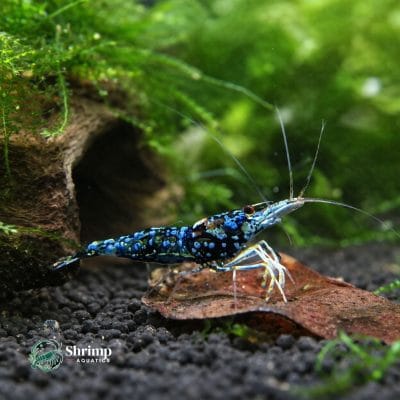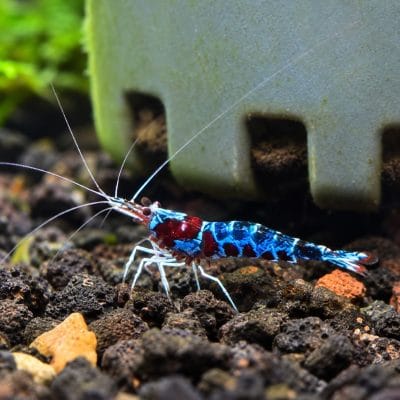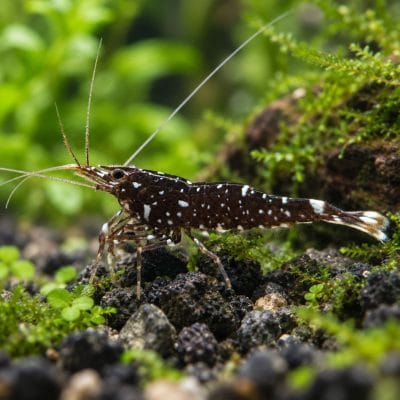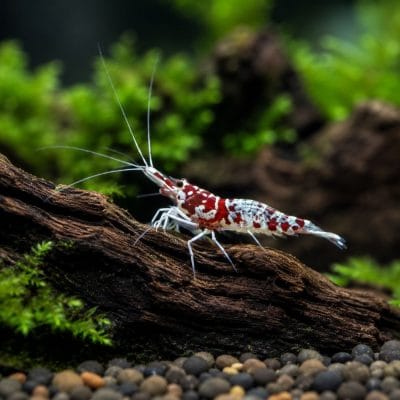
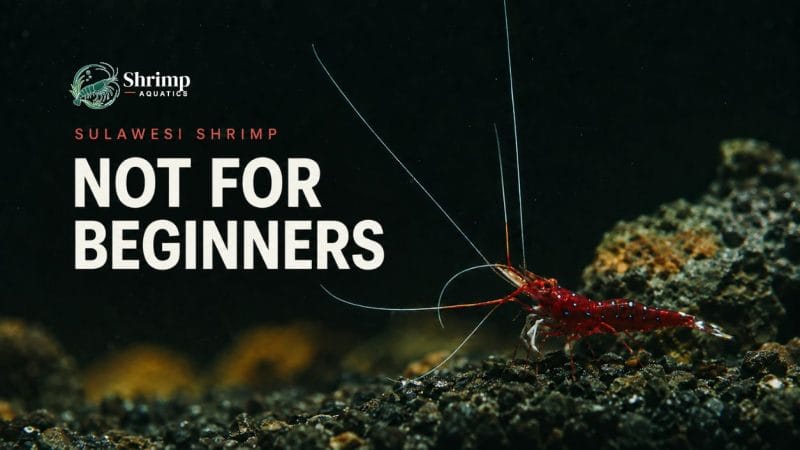
No Sulawesi shrimp is a beginner shrimp. If you want one anyway, start with tank-bred Cardinal shrimp (Caridina dennerli), the lake species with published rearing data behind it and an established place in the aquarium trade. The species you pick matters far less than the water you build, how mature the tank is on stocking day, and where the animals came from.
Is any Sulawesi shrimp a beginner shrimp?
No, and it’s worth being blunt about why. Our reference for Sulawesi lake Caridina as a group places them at advanced to expert, and that rating comes from the water rather than from the animals being delicate in some vague way. These shrimp need warm, alkaline, low-mineral water held steady, which is an unusual combination to build and an easy one to lose. The rest of the setup behind that rating is in the beginner guide to keeping Sulawesi shrimp.
| Difficulty | Advanced to expert |
|---|---|
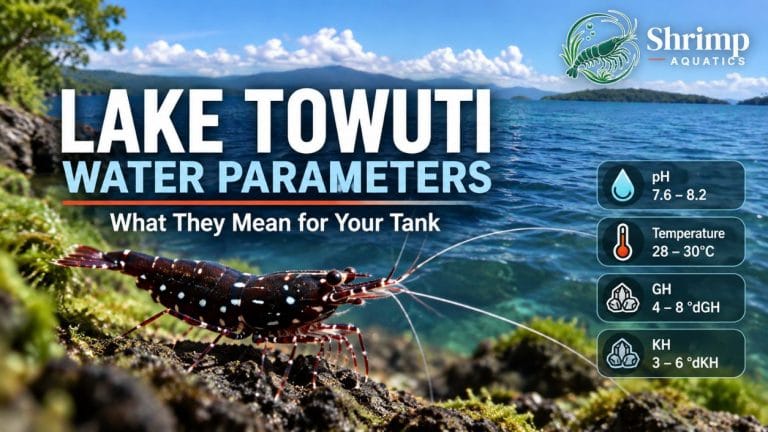
| Temperature | 79-86°F (26-30°C) |
| pH | 7.5-8.5 |
| GH | 4-8 dGH |
| KH | 3-6 dKH |
| TDS | 150-250 ppm |
| Nitrate | Aim for under 10 ppm |
| Substrate | Inert substrate and hardscape, never an active pH-lowering soil |
| Tank | Mature and stable, with established grazing surfaces and biofilm |
| Behavior | Peaceful and often shy, with visibility varying by setup |
Read that temperature row alongside a piece of physics that catches a lot of new keepers out. Cold water can hold more dissolved oxygen than warm water, so the same tank you’d run comfortably at room temperature has less oxygen headroom once it’s sitting in this range.1 Warm water also runs every biological process faster, which means waste breaks down faster and mistakes show up sooner. That’s the real content of the advanced rating: not one hard parameter, but a warm system with a narrow margin that punishes drift.
Don’t reuse a bee shrimp setup for these
Bee and Crystal Caridina are kept in soft, acidic, cooler water, and the active buffering soils sold for them are designed to pull water in that direction. Put one of those soils under a Sulawesi tank and it works against the carbonate hardness these shrimp depend on. Sharing a genus name doesn’t mean sharing the same water. That’s one of several ways Sulawesi shrimp differ from other freshwater shrimp, and most of what works in a cherry or crystal shrimp tank has to change for them.
Why the easiest Sulawesi shrimp rankings can’t choose for you
Search this question and you’ll find difficulty scores out of ten, ranked species tables and confident statements that one lake species is the forgiving one. We couldn’t find a published study that ranks Sulawesi Caridina by how hard they’re to keep. Those rankings are hobby consensus, often copied between pages, and consensus isn’t measurement. They’re a reasonable starting hunch and a poor basis for spending money on a threatened animal.
Here’s what has actually been measured. A 2025 rearing trial worked with Caridina dennerli starting at an average total length of 1.445 cm, and compared commercial pellets against a bacterial starter, each with either stone or Hydrilla as shelter. Over 30 days the best-performing group, pellets with Hydrilla, gained an average of 0.119 cm in total length, and survival across the four groups ran from 22.7% to 72.7%.2 Those numbers describe that trial under its own conditions and aren’t a Sulawesi shrimp survival rate to expect from stock you buy. What they do show is the shape of the animal: it grows in very small increments, and outcomes vary enormously with husbandry detail rather than with species choice.
The reproductive picture points the same way. In the taxonomic revision that described the species, wild ovigerous Caridina dennerli females were recorded carrying 8-14 eggs, from a sample of seven females.3 Related Sulawesi species in that same work sat anywhere from around ten eggs to several dozen, most on samples of two to four females, so no single group figure is supportable. For a keeper the practical reading is simple: a Sulawesi colony builds slowly, and a tank that looks static after two months is usually normal.
So choose on what you can verify. Availability of genuinely tank-bred stock, the seller’s willingness to name the species, and whether the animals are already living in water you can reproduce are all checkable. A difficulty score isn’t.
What makes a Cardinal shrimp listing worth ordering from
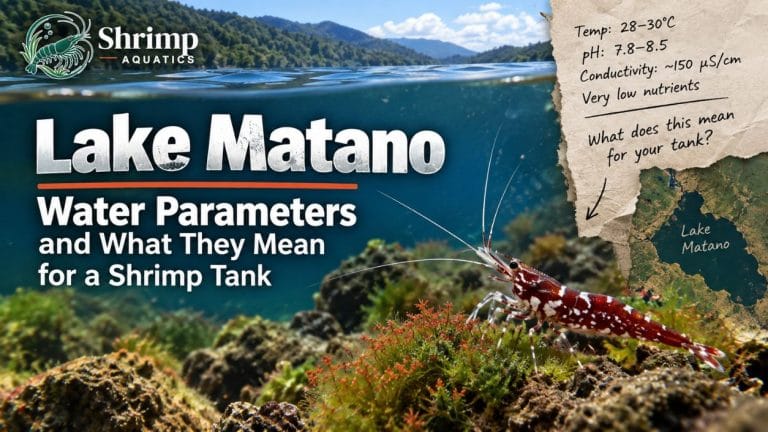
Cardinal shrimp is the species we’d point a first-time Sulawesi keeper at, and its conservation status is part of the reason to be careful about where the animals come from. The species is endemic to Lake Matano, part of the Malili Lakes system in Sulawesi. IUCN assessed it as Critically Endangered under criterion A2e on 20 August 2018, tagged Possibly Extinct in the Wild, with a decreasing population trend, and the same assessment records that it’s available in the aquarium trade.4 A wild-collected animal from a lake in that condition is the wrong thing to practice on, for the shrimp and for you.
Livestock sold by Shrimp Aquatics is bred by Shrimp Aquatics and isn’t collected from the wild. Ask any seller for the scientific name printed against the animal you’re buying, because trade names across tank-bred Sulawesi shrimp lines don’t map one to one onto species, and two sellers can use the same common name for different animals.
- The scientific name is stated, not implied by a common name.
- The stock is described as tank-bred, with the seller willing to say so directly.
- The seller can tell you the pH, GH and TDS the animals are currently living in, so you can match rather than guess.
- Your tank has already held the target range on its own for weeks, before you order.
- Don’t order because a listing calls a species easy, forgiving or beginner-friendly.
- Don’t buy the first Sulawesi shrimp you see if you’ve never run a warm alkaline system.
Does your species choice change the water you have to build?
Barely, and that’s the most useful thing on this page. The lake species in the group share one set of water values, so swapping which one you buy doesn’t spare you the reverse osmosis unit, the remineralizer or the testing. What changes between beginners and everyone else is whether they choose Sulawesi Mineral 7.5 or 8.5, and that decision is worth getting right the first time.
The reason the mineral matters is physiological. The major source of calcium a crustacean uses to calcify its exoskeleton is exogenous, meaning the water it lives in, with stored reserves and diet contributing less.5 Hardness is therefore not a cosmetic reading on a test kit. It’s the supply the animal draws on every time it molts.
Sulawesi Mineral 7.5, the beginner choice. The manufacturer says it almost totally dissolves within seconds and the water is ready for use immediately, that it buffers pH at around 7.5, and that cardinal shrimp breeders have used it very successfully.6 No gas equipment, no waiting period, and an entire class of preparation error removed.
Sulawesi Mineral 8.5, not a first salt. By the manufacturer’s own instructions it dissolves almost completely only when CO2 is added at a regular quantity of about one bubble per second, taking roughly three to four days, and the water must then be aerated with an air stone for at least three hours to expel the CO2 before use.7 That’s a multi-day preparation with a real failure mode if the aeration step is cut short.
Whichever salt you use, follow the current manufacturer directions and test the finished pH, GH and TDS before the water goes anywhere near shrimp. A salt gets you toward a target; the test kit is what tells you whether you arrived.
What has to be true of the tank before the first shrimp goes in
Warm alkaline water changes what a small feeding mistake costs. Total ammonia in fresh water splits between the ammonium ion and un-ionized ammonia, and it’s the un-ionized form that drives toxicity. That share rises roughly tenfold for each single rise in pH, and roughly doubles for each ten degree Celsius rise in temperature across the range assessed.8 A Sulawesi tank sits high on both scales at once, so uneaten food that would be a minor problem in a cool acidic tank is a genuine event here. Feed lightly, remove what isn’t eaten, and let established biofilm do most of the work.
At Shrimp Aquatics we don’t rush a new Sulawesi tank. With a powdered bacterial starter our normal minimum is three to four weeks, and with a liquid or live culture the same checkpoint may arrive in two to three weeks. The calendar doesn’t decide when shrimp go in. We wait for zero ammonia and nitrite, stable temperature and chemistry, an established biological filter and visible grazing surfaces before stocking.
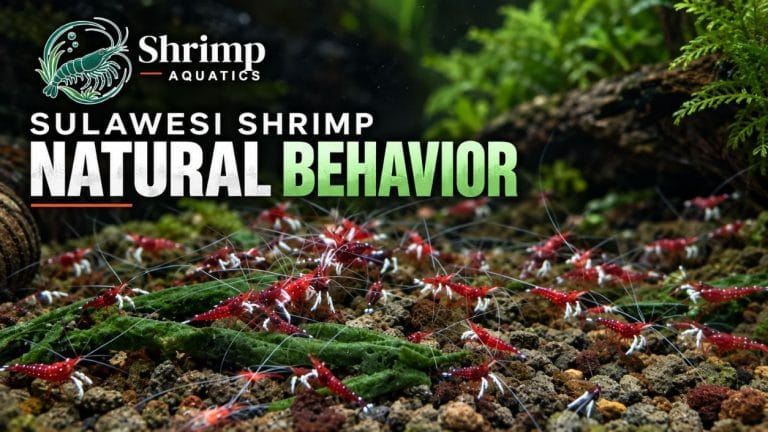
That last point is the one most worth copying. A tank can be through its nitrogen cycle and still be a poor place for a grazing shrimp, because the film of algae and microbes they feed on hasn’t developed yet. Look at the glass and the rock, not the calendar.
- Ammonia and nitrite both read zero on a test you trust.
- Temperature and chemistry have held steady without you intervening.
- Rock and glass show visible grazing growth.
- Substrate and hardscape are inert, so nothing is quietly pulling the buffer down.
- Flow is gentle at shrimp level while the surface is still well oxygenated.
- Don’t stock on a date because the tank has been running long enough.
References
8 Sources
- Dissolved Oxygen and Water, U.S. Geological Survey Water Science School, updated August 24, 2026.
- Effect of Using Different Shelter and Feed Types on Growth and Survival Rate of Sulawesi Endemic Ornamental Shrimps (Caridina dennerli), journal PDF, Jurnal Ilmiah PLATAX 13(1), pages 191 to 204, 2025.
- Radiation of endemic species flocks in ancient lakes: systematic revision of the freshwater shrimp Caridina from the ancient lakes of Sulawesi, Indonesia, with the description of eight new species, Raffles Bulletin of Zoology 57(2), pages 343 to 452, 2009.
- Caridina dennerli, IUCN Red List assessment, IUCN Red List of Threatened Species, assessed 20 August 2018.
- Biomineralizations: insights and prospects from crustaceans, ZooKeys 176, pages 103 to 121, 2012.
- Sulawesi Mineral 7,5, manufacturer product information, SaltyShrimp and Garnelenhaus, page copyright 2018.
- Sulawesi Mineral 8,5, manufacturer product information, SaltyShrimp and Garnelenhaus, page copyright 2018.
- Aquatic Life Ambient Water Quality Criteria for Ammonia, Freshwater, U.S. Environmental Protection Agency, Office of Water, April 2013.
Ready to get started?
Shop our Sulawesi Shrimp collection
27 products available · Live Arrival Guarantee