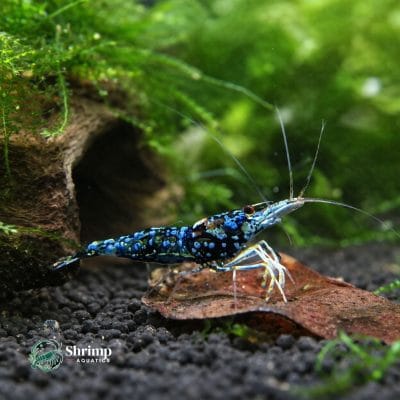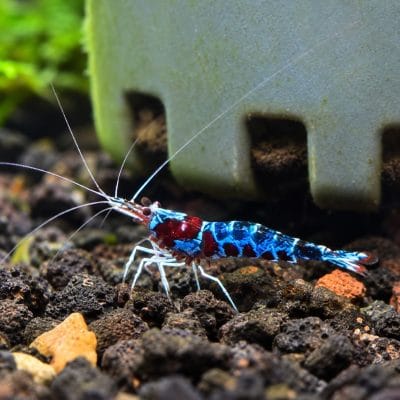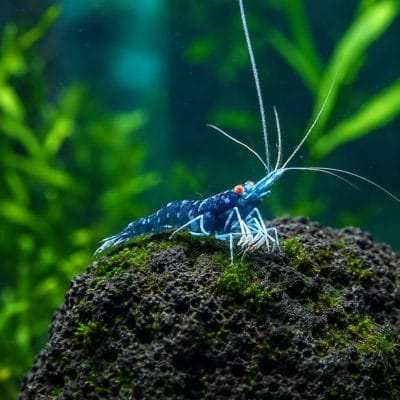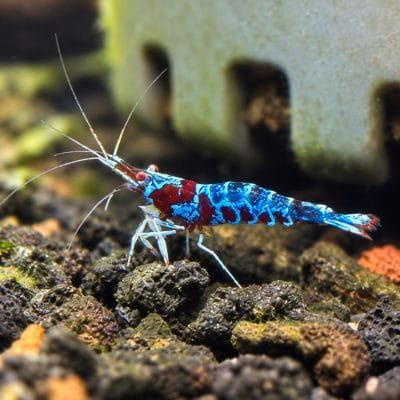
You raise a Sulawesi colony’s survival by removing the three things that kill it most often: stocking a tank before it’s genuinely mature, letting the water move under the shrimp, and letting waste build up in warm alkaline conditions that punish it harder than a cool soft-water tank would. Nothing here promises a survival rate, and no published figure exists for these shrimp in a home aquarium. What follows is the order the decisions actually arrive in, from an empty tank to a colony you’re already worried about.
What has to be true before Sulawesi shrimp go in the tank
Most first-month losses are decided before the shrimp arrive. A tank that has finished a nitrogen cycle isn’t the same thing as a tank that can feed and shelter a grazing animal, and Sulawesi shrimp need both. Judge readiness from what you can measure and see, not from how many weeks the tank has been running.
- Ammonia and nitrite both read zero on a test you ran yourself.
- Temperature, pH, hardness and TDS have held steady across repeated readings, not just landed once on target.
- The biological filter is established, with no recent media swap or cleaning.
- Rock and glass carry visible biofilm and diatom growth that the shrimp can graze from day one.
- A tank that looks clean, with bare hardscape and no grazing film, isn’t ready even if the test kit says it’s cycled.
At Shrimp Aquatics, we don’t rush a new Sulawesi tank. With a powdered bacterial starter our normal minimum is 3-4 weeks, and with a liquid or live culture the process may reach the same checkpoint in 2-3 weeks. The calendar doesn’t decide when shrimp go in. We wait for 0 ammonia and nitrite, stable temperature and chemistry, an established biological filter and visible grazing surfaces before stocking.
Give yourself margin on the stocking decision too. A small group dropped into a system that’s only just ready leaves you no room to read the tank before the losses start, so it’s worth waiting the extra fortnight and starting with tank-bred Sulawesi shrimp raised in warm alkaline water rather than stock that has to adapt to your chemistry as well as to your tank.
Mix Sulawesi water outside the tank and match it before it goes in
Every litre that enters the tank should already be at the tank’s temperature and chemistry. Prepare it in a separate vessel, remineralize it there, let it settle, then test pH, GH and TDS in that vessel before any of it reaches the shrimp. Water that’s mixed in the aquarium moves the colony while it’s mixing, which is the shock you were trying to avoid.
The carbonate hardness in alkaline water is what makes that possible. Alkalinity is the water’s capacity to neutralize acids and hold a fairly stable pH, and it comes from dissolved bicarbonates, carbonates and hydroxides; water with higher alkalinity shifts less when an acid enters it.1 In practice that means KH isn’t one more number on the test sheet. It’s the thing keeping the pH of a warm, biologically active tank from moving overnight, and a tank whose KH has quietly fallen will start swinging before anything else looks wrong.
Match the replacement water’s temperature as carefully as its chemistry. A jug of correctly remineralized water at room temperature is still a temperature change when you pour it in.
Getting shipped Sulawesi shrimp through arrival day
Shrimp arrive from a long transit in water that is nothing like your tank, and the safest handling depends on how they were packed and how long they travelled. Follow the instructions that came with your specific order over any general routine you read elsewhere: packing method, transit time and species all change the right answer, and the person who packed the bag knows what’s in it.
Don’t add transport water to your aquarium
Whatever transfer method your supplier specifies, the shipping water stays out of the display tank. If you’re moving shrimp yourself from a local tank rather than opening a courier bag, ask about transit time, bag condition, temperature and both water sources before choosing a method, because a routine that suits one of those situations can be the wrong one for the other.
Once the shrimp are in, leave them alone. Keep the lights off or very low for the first day, skip feeding entirely, and resist the urge to test every hour or move rock to find them. Sulawesi shrimp are shy in a new system and will spend the first day in crevices; a colony you can’t see isn’t a colony in trouble.
Why a warm Sulawesi tank needs more aeration than a cooler shrimp tank
Cold water can hold more dissolved oxygen than warm water.2 A Sulawesi tank runs at the top of the freshwater range, so it starts with less oxygen available at the same level of surface exchange, and at the same time everything in it, the shrimp and the bacterial film alike, is respiring faster. That combination is why an aeration setup that’s comfortable in a room-temperature Neocaridina tank can be marginal here.
Treat surface movement as permanent equipment. Run it day and night, since oxygen demand doesn’t drop when the lights go off, and keep the current gentle where the shrimp graze even while the surface is working hard. If your Sulawesi shrimp died overnight or in the early morning with no other change in the tank, aeration is the first thing to look at.
How much to feed a Sulawesi colony that grazes on biofilm
Mature biofilm, aufwuchs and algae are the important grazing resources in this kind of tank, and prepared food only supplements them. When you decide how much to feed Sulawesi shrimp, keep it light, watch whether anything is actually eaten, and remove what isn’t. It’s worth being honest about the limits of what’s known here: acceptance of prepared food varies by species, by system and by the food itself, so neither “they only eat biofilm” nor “they will take pellets like Neocaridina” holds across the group.
Overfeeding is dangerous in this tank for a specific chemical reason. Total ammonia in water splits between the ammonium ion and un-ionized ammonia, and the un-ionized form is the one that drives toxicity; the ratio of un-ionized ammonia to ammonium in fresh water rises about 10-fold for each single pH unit and roughly two-fold for each 10 degrees Celsius rise in temperature from 0 to 30 degrees Celsius, and high external un-ionized ammonia reduces or reverses the diffusive gradient so ammonia builds up in the animal’s tissues and blood.3 Warm and alkaline is exactly the corner of that relationship a Sulawesi tank sits in, so the same decomposing pellet that a cool acidic Bee tank would shrug off produces a larger share of the toxic form here.
The practical consequence is short. Feed less than you think, take out leftovers instead of leaving them to break down, and never use supplemental food to compensate for a system that hasn’t matured. If the grazing surfaces are thin, the answer is to give the tank more time, not more food.
Keeping TDS and hardness steady in a Sulawesi tank
These shrimp come from lakes with minimal seasonal temperature variability, which is part of why the water column there’s studied at all.4 Nothing in their history prepared them for a tank whose numbers move every weekend, and stability is a bigger lever on survival than hitting the exact centre of any range. Hold the values below and, just as importantly, hold them still.
| Difficulty | Advanced to expert |
|---|---|
| Temperature | 79-86°F (26-30°C) |
| pH | 7.5-8.5 |
| General hardness | 4-8 dGH |
| Carbonate hardness | 3-6 dKH |
| TDS | 150-250 ppm |
| Nitrate | Aim for under 10 ppm |
The slow drift most keepers miss is evaporation. Evaporation of shallow groundwater concentrates the dissolved solids in the water left behind, a physical mechanism USGS describes for arid regions.5 The same thing happens on a smaller scale on top of a warm open aquarium: water leaves, minerals don’t, and TDS climbs along with hardness. Replace evaporated volume with pure RO water and nothing else. Topping off with remineralized water is how a tank that tested correctly in January reads far too hard by March, without a single visible mistake in between.
That drift matters most at the molt. Crustaceans have to cast the exoskeleton in order to grow at all,6 and the major source of the calcium used to calcify a new one is exogenous, meaning the water the animal lives in, with stored premolt reserves and diet contributing less.7 Mineral content is therefore an input to every molt, which is why a hardness figure that has quietly climbed or a large water change that drops it suddenly shows up as molting trouble first.
So keep water changes small, matched and slow, and space them out instead of making one large correction. If a parameter has drifted a long way, walk it back over several small changes across weeks. Correcting it in one afternoon replaces a slow problem with an acute one.
Is running a Sulawesi tank hotter a way to lose fewer shrimp?
No. Warmer water inside the 79-86°F (26-30°C) range will speed things up, but speed isn’t the same as survival, and the trade goes the wrong way. In the lesser blue crab, rearing at elevated temperature decreased the intermolt period and decreased growth per molt, giving smaller sizes at each instar, and the authors note that earlier laboratory and field work suggests temperature affects both intermolt period and growth per molt across many crustaceans.8 Faster molt cycles in an animal that gets its molting minerals from the water simply means more chances for an unstable tank to catch it out.
Heat also costs you the oxygen headroom described above, and it accelerates the breakdown of any waste in the system. Pick a point you can hold and hold it. A tank sitting steadily in the lower half of the range will generally do better than one pushed to the top by a keeper hoping to see faster breeding.
What the only measured Sulawesi survival numbers actually say
Every survival figure you’ll find on a care sheet is an assertion. One controlled trial exists. In a 2025 rearing study, cardinal shrimp (Caridina dennerli) starting at an average total length of 1.445 cm were reared under four combinations of feed and shelter, with the pellet groups running 30 days and the bacterial starter groups 37 days.9
| Treatment | Trial length | Average total-length gain | Survival |
|---|---|---|---|
| Pellets with Hydrilla shelter | 30 days | 0.119 cm | 72.727% |
| Pellets with stone shelter | 30 days | 0.079 cm | 40.909% |
| Bacterial starter with Hydrilla shelter | 37 days | 0.017 cm | 22.727% |
| Bacterial starter with stone shelter | 37 days | 0.013 cm | 31.818% |
Read those numbers for what they are. They describe one species over one month in one setup whose tanks ran between 79.5°F (26.4°C) and 83.7°F (28.7°C), and the study varied feed and shelter, not water chemistry. They aren’t a survival rate you should expect from shipped or home-kept stock, and the best treatment still lost a quarter of its animals. What the trial does show is that shelter and food source together move survival by a wide margin over a short period, which is the practical argument for stocking into a tank that already has cover and grazing rather than one you intend to grow into the job.
It also sets a sensible expectation. Plan for some attrition in the first weeks after any move, buy a group, not a pair, so the colony can absorb it, and judge your husbandry on the trend across months instead of on the first shrimp you lose.
When Sulawesi shrimp start dying, check these before you change anything
The instinct to act fast is what turns a few deaths into a colony loss. Almost every emergency intervention in a shrimp tank is a parameter change, and a parameter change is the thing the shrimp are least able to take. Work through the observations first.
- Test ammonia and nitrite. In this water chemistry a reading you’d tolerate elsewhere isn’t tolerable here.
- Read the temperature at the glass instead of trusting the heater’s dial, and check whether it has been stable overnight.
- Compare TDS, GH and KH against your own previous readings. The direction and speed of the change tell you more than the absolute value.
- Account for everything that entered the tank in the past two weeks: new plants, a new rock, a top-off with the wrong water, a different food, a treatment used in the room.
- Add aeration. It’s the one intervention that carries almost no risk of making things worse.
- Then change one thing at a time, slowly, and give the tank days to answer rather than hours.
Copper and fish medications
Copper and some fish medications can harm shrimp and snails, and a product’s actual formulation matters more than its label. Don’t dose a shrimp tank on a guess about what’s wrong. If the observations point to a disease and not to water quality, or if you’re unsure, get a qualified aquatic veterinarian or a specialist to look at it before you add anything to the water.
Losses that keep arriving after the water checks out, or that come with visible damage to the animals, are past the point where a care guide helps. Write down what you measured and when, and take that record to someone who can examine the shrimp. Losses that keep coming one animal at a time are the pattern of Sulawesi shrimp dying gradually.
References
9 Sources
- Alkalinity and Water, U.S. Geological Survey Water Science School, updated August 24, 2026.
- Dissolved Oxygen and Water, U.S. Geological Survey Water Science School, updated August 24, 2026.
- Aquatic Life Ambient Water Quality Criteria for Ammonia, Freshwater, U.S. Environmental Protection Agency, Office of Water, April 2013.
- The biogeochemistry of tropical lakes: A case study from Lake Matano, Indonesia, Limnology and Oceanography 53(1), 2008, repository record and abstract.
- Chloride, Salinity, and Dissolved Solids, U.S. Geological Survey Water Resources Mission Area, March 1, 2019.
- Farming freshwater prawns, biology chapter, Food and Agriculture Organization of the United Nations, FAO Fisheries Technical Papers No. T428.
- Biomineralizations: insights and prospects from crustaceans, ZooKeys 176, 2012.
- Elevated temperature induces a decrease in intermolt period and growth per molt in the lesser blue crab Callinectes similis, Journal of Crustacean Biology 39(1), January 2019, abstract.
- Effect of Using Different Shelter and Feed Types on Growth and Survival Rate of Sulawesi Endemic Ornamental Shrimps (Caridina dennerli), Jurnal Ilmiah PLATAX 13(1), 2025, journal PDF.
Ready to get started?
Shop our Sulawesi Shrimp collection
27 products available · Live Arrival Guarantee