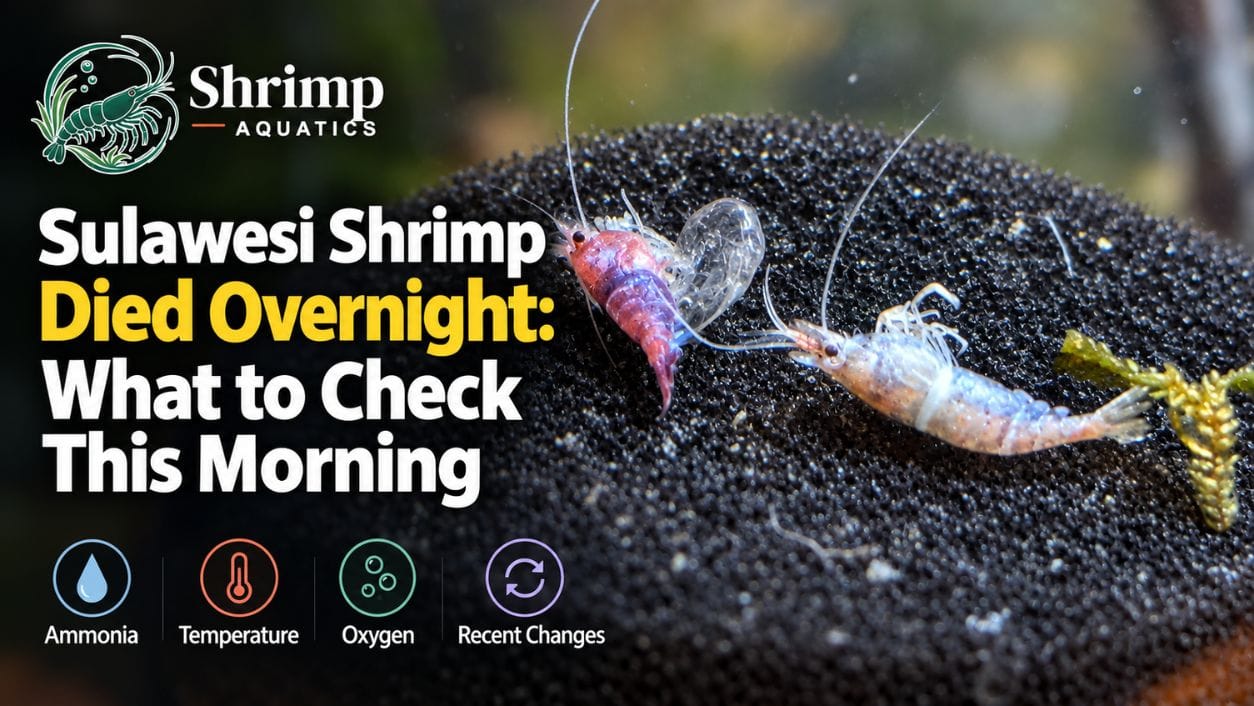
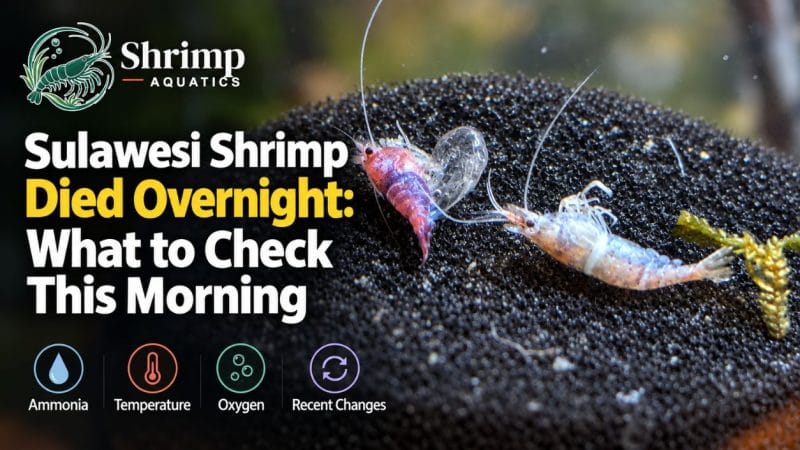
If a Sulawesi tank looked fine at lights out and holds dead shrimp in the morning, the cause is almost always something that changed in the previous 24 hours, in the water or in the room. The readings that would identify it start disappearing the moment you begin fixing things. So test first, correct second.
Sulawesi shrimp (lake Caridina) are kept at 79-86°F (26-30°C) and pH 7.5-8.5. That’s warm enough and alkaline enough that a small fault does more damage here in one night than the same fault would do in a week in a cool, slightly acidic tank. It’s the honest reason these losses arrive in a single block rather than spread out, and it’s why the first hour matters more than the next three days.
What to do in the first ten minutes after a Sulawesi overnight loss
Do the reversible things now and nothing else. Your aim in the first ten minutes is to stop the tank getting worse while keeping the evidence intact. The water in front of you is the only record of what happened while you were asleep.
- Take the readings before anything else. Ammonia, nitrite, temperature, pH, KH, GH and TDS, from water drawn before you disturb the tank. Ten minutes with a test kit beats a day of guessing.
- Lift the bodies out. Leaving them in adds organic waste to a tank that may already be carrying too much of it.
- Increase surface movement, gently. Raise the filter outlet so it breaks the surface, or run an air stone on a low setting. That’s the one change worth making before you know the cause.
- Check the heater reading against a second thermometer. Not the heater’s own dial. An independent probe or a glass thermometer in the tank.
- Write down what you did to the tank yesterday. Feeding, a water change, a top-off, a new rock, a new plant, a filter clean, anything sprayed or plugged in nearby.
Don’t do a big water change yet
We know the instinct is to replace half the water and hope. In a warm alkaline tank holding stressed survivors, a large change of fresh mineral water is a second shock on top of the first. It also takes your readings away before you’ve read them. If ammonia is present, small and matched beats large and fast every time.
Get oxygen in without pushing the survivors around
Warm water holds less dissolved oxygen than cool water.1 At Sulawesi temperatures you’re already working with a thinner reserve than a Neocaridina keeper has. So the safest thing you can do this morning is improve gas exchange without turning the tank into a current.
At Shrimp Aquatics, our Sulawesi shrimp tanks run biological filtration together with a Kaldnes moving bed filter, and we tune the outlet so the shrimp aren’t pushed around while grazing. The goal is high oxygen with gentle movement at shrimp level.
Copy the principle rather than the equipment. Aim the return so it ripples the surface instead of driving down into the substrate. If you add an air stone, start it low and watch where the shrimp go. Survivors that leave the rock and cling to the glass near the outlet are telling you the flow is too much for them right now. Holding the tank near saturation from here on is a setup question, not an emergency one, and Sulawesi shrimp oxygen requirements is where that one belongs.
Did your Sulawesi colony go in one night, or has this been building?
The shape of the loss narrows the cause list faster than any single test. A whole colony gone between lights out and breakfast points at something that arrived, not something that drifted. Losses that add up over a fortnight point at the opposite.
Most or all of them, in one night
Something entered the tank or the room, or a piece of equipment failed. Think aerosols, a heater, a water source, a large feed the night before, or a filter that stopped. This page is written for you.
One or two, most mornings
If the count has been one or two most mornings, you’re looking at drift rather than a single event, and the check order for Sulawesi shrimp dying gradually is the one that fits.
Two other patterns get mistaken for this one. Did you run a water change yesterday evening? That timing changes the whole cause list, and Sulawesi shrimp dying after a water change is where it’s worked through. If the shrimp arrived in the last week, you’re probably looking at the move and at the tank they moved into, not at an overnight event.
What the bodies tell you before you bin them
Look at them properly once, in good light, before they go. You aren’t diagnosing anything. You’re separating one pattern from another.
- Bodies gathered high in the tank, on the heater top, the filter rim or right at the waterline, with no other obvious damage. That distribution is worth noting against your oxygen and temperature readings.
- Juveniles and the smallest shrimp gone first, with adults following. Note the order, because it’s information even when it doesn’t name a cause.
- Survivors twitching, lying on their sides, or swimming in a way you haven’t seen before. The living tell you more than the dead do.
- A white gap at the carapace joint with a half shed shell beside it. That shrimp died in a molt rather than from whatever hit the colony, and Sulawesi shrimp stuck in a molt covers what to check next.
- Opaque, milky muscle through the tail. Opaque abdominal muscle is described in a virus disease of a farmed freshwater prawn, where it comes with very heavy losses.2 That work is on a different animal, so treat it as a pattern to keep separate.
Which Sulawesi readings to take first, while the evidence is still there
Test in this order, because the early ones change what the later ones mean. Ammonia and nitrite first, then temperature, then pH and KH, then GH and TDS. Compare what you get against the numbers below.
| Ammonia and nitrite | 0 in a cycled tank, so anything above zero is the finding |
|---|---|
| Temperature | 79-86°F (26-30°C) |
| pH | 7.5-8.5 |
| GH | 4-8 dGH |
| KH | 3-6 dKH |
| TDS | 150-250 ppm |
| Nitrate | The number we aim to stay under is 10 ppm |
| Difficulty | Advanced to expert |
A reading that sits inside those numbers this morning doesn’t clear the night. Ammonia produced by a heavy evening feed can be eaten by the filter before you test. A heater that ran hot for six hours can be back on target by nine. That’s why the notes you wrote about yesterday matter as much as the test kit does.
Why the same ammonia reading is worse at pH 8.5
Total ammonia in water splits between the ammonium ion and un-ionized ammonia, and it’s the un-ionized form that drives the toxicity. The split depends on pH and temperature. The ratio of un-ionized ammonia to ammonium rises about tenfold for each single pH unit, and roughly doubles for each rise of 10°C between 0 and 30°C.3
Run that out and the consequence is blunt. A 0.25 ppm total ammonia reading at pH 8.5 carries on the order of a hundred times the un-ionized share that the same reading would carry in a bee shrimp tank at pH 6.5, before the warm water adds anything on top. That comparison is derived from the published relationship, not measured in Caridina. The direction isn’t in doubt, though, and it’s why a number a bee keeper would shrug at isn’t a number you can shrug at.
What high external un-ionized ammonia does is reduce or reverse the gradient the animal uses to shed its own ammonia, so it builds up in tissues and blood instead of leaving.3 An animal in that state also extracts oxygen less well. That’s how the two problems in this section stop being separate problems.
Oxygen falls all night and bottoms out near dawn
Nothing photosynthesizes in the dark. Plants and algae are usually the biggest producers of oxygen in a system, and they’re also among its biggest users. Decomposition of organic matter consumes oxygen too. The result is a daily cycle: oxygen climbs through the lit hours, falls through the night, and reaches its lowest point before sunrise.4
Now put that cycle in a tank held at 79-86°F (26-30°C), where the water already holds less oxygen to begin with. Add a heavy feed that gives the bacteria something to work on overnight. The bottom of that curve arrives at roughly the hour you’re asleep, just before the hour you find the bodies. A tank that’s been fine for months can reach it for the first time after one warm night, one extra portion of food, or one filter that quietly stopped.
So check that the filter is actually moving water and not just humming. Check that nothing slid over the outlet. Did the room get warmer overnight, say because the air conditioning went off? That alone lowers what the water can hold while raising what the animals need.
Clean Sulawesi readings point away from the water and into the room
This is the part most cause lists skip. When ammonia, nitrite, temperature, pH, KH and TDS all come back where they should be, and the colony is still dead, the water probably wasn’t the problem. Something got into it, or the room did something to it.
Mosquito vaporizers, coils and sprays running overnight
Shrimp are arthropods, and the products sold to kill arthropods in your bedroom don’t distinguish. Permethrin, one of the pyrethroid insecticides, works by interfering with sodium channels in nerves, which makes muscles spasm and ends in paralysis. It’s described as highly toxic to freshwater fish and other aquatic organisms, and highly toxic to invertebrates.5 Household mosquito products use related pyrethroids. What we have is the chemical family and its mode of action, not a dose for your tank.
The air pump is the route in
An air pump sitting on the floor of a closed room pushes that room’s air through your water for hours. If a vaporizer, coil, spray or fogger was used in the same room last night, or in a room sharing air with it, treat that as your leading candidate. Say so to anyone else in the house before tonight.
Living shrimp are the evidence here. Uncoordinated swimming, twitching pleopods and animals lying over on their sides, in a tank whose every reading is normal, is the pattern to take seriously. If you suspect it, move the air pump intake to another room or outside a window, and run fresh activated carbon in the filter.
A heater that stuck on or stuck off overnight
A heater that fails closed keeps heating a tank it should have stopped heating. A heater that fails open lets a warm alkaline tank drop out of range while you sleep. Neither leaves a trace in a chemistry test by morning, which is exactly why the temperature reading you take at 7am can look perfect and mean nothing.
Feel the heater, look for condensation or a cracked tube, and if you have any doubt, unplug it and put a spare in. A cheap thermometer that logs a minimum and maximum is the least expensive insurance in this hobby. It turns the next night from a guess into a record.
Copper that came in with the water or with a product
Elevated copper is toxic in aquatic environments and can affect invertebrates as well as fish, with acute effects that include mortality. How toxic it is depends on water chemistry, including pH, alkalinity, dissolved organic carbon and hardness.6 In a laboratory study on a juvenile freshwater prawn, waterborne copper from 0.01 mg/L to 0.4 mg/L over seven days produced structural damage to the gills and the hepatopancreas, worse at the higher concentrations.7 That’s a different animal, and no safe or lethal copper figure has been established for Caridina, so treat copper as something to exclude rather than something to measure against a threshold.
The usual ways it arrives are ordinary. Tap water that ran through copper plumbing. A plant fertilizer containing chelated copper. A fish medication used in the same tank, or with the same bucket. A snail treatment. Did you top off or change water with anything other than your usual prepared water last night? Then that’s your candidate.
Correct a Sulawesi tank slowly enough to keep the survivors
Say it plainly: the correction kills more Sulawesi colonies than the fault does. The shrimp still alive this morning have already taken one hit, and they’re the ones who’ll pay for a fast fix.
- Replacing a large share of the water at once. If you must change water because ammonia is present, go small, and match temperature, pH, KH, GH and TDS to the tank before it goes in.
- Adding water straight from the tap, or from a fresh mineral mix you haven’t tested. Mix and measure outside the tank, every time, including in an emergency.
- Chasing pH with a product. Sudden pH changes in a stressed tank are a worse problem than a pH sitting slightly off.
- Dosing a medication at a colony that hasn’t been diagnosed. There’s nothing to treat if the cause was oxygen, temperature or an aerosol, and the treatment is its own stressor.
- Feeding as normal tonight. A reduced colony eats less, and the leftovers are what feeds the next ammonia rise.
- Tearing down the hardscape to find the culprit. Disturbing the biofilm and the filter bed removes the processing capacity the tank has left.
The things worth doing are dull. Hold the Sulawesi shrimp tank temperature steady at one point in the range. Keep the surface moving. Feed lightly or not at all for a couple of days, and lift anything uneaten within a few minutes. Test daily for a week so you can see a trend instead of a snapshot. If a reading needs to move, move it over days, in steps small enough that the shrimp don’t register the change.
When a Sulawesi overnight loss has gone past what testing can answer
Some of these nights don’t get explained, and it’s more useful to say so than to pick a cause and act on it. There’s no published tolerance figure for ammonia, oxygen or copper for this group. The signs a keeper can see after the fact don’t map cleanly onto causes. What you can do is exclude the things that are testable and remove the things that are removable.
Get qualified help when losses continue after the water tests clean and the room has been cleared, when survivors show signs you can’t account for, or when you’re considering any treatment. An aquatic veterinarian or a specialist who can examine the animals is the right next step, and a care guide isn’t a substitute for that. If you’d like another pair of eyes on the numbers first, send your ammonia, nitrite, nitrate, pH, KH, GH, TDS, temperature, tank size, cycle status and current livestock to contact@shrimpaquatics.com and we’ll tell you honestly what we’d check next.
References
7 Sources
- Dissolved Oxygen and Water, U.S. Geological Survey Water Science School, last updated August 24, 2026.
- White Tail Disease of Freshwater Prawn, Macrobrachium rosenbergii (abstract), Indian Journal of Virology 23(2), Springer, 2012.
- Aquatic Life Ambient Water Quality Criteria for Ammonia, Freshwater, U.S. Environmental Protection Agency Office of Water, April 2013.
- Dissolved Oxygen for Fish Production, FA002, Ruth Francis-Floyd, University of Florida IFAS Extension, April 2021.
- Permethrin Technical Fact Sheet, National Pesticide Information Center, Oregon State University Extension Services, March 2009.
- Supplementary Training Materials for Aquatic Life Criteria, Copper, Background, U.S. Environmental Protection Agency, last updated May 6, 2026.
- Impact of waterborne copper on the structure of gills and hepatopancreas and its impact on the content of metallothionein in juvenile giant freshwater prawn Macrobrachium rosenbergii (abstract), Archives of Environmental Contamination and Toxicology 52(1), Springer, 2007.
Ready to get started?
Shop our Sulawesi Shrimp collection
27 products available · Live Arrival Guarantee
Featured Sulawesi Shrimp
Sulawesi Orange Eyes White Sock
Caridina dennerli
Advanced · 79–86°F · pH 7.5–8.5
From $19.99View Product