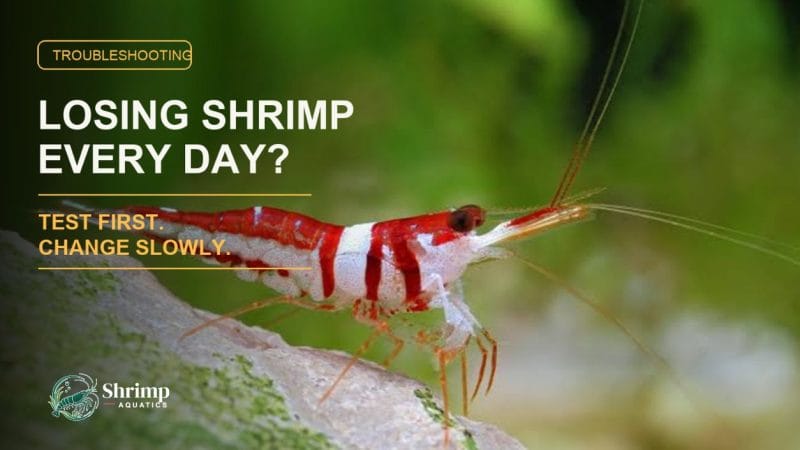
Losing one or two Sulawesi shrimp a day, day after day, is a different problem from losing most of the colony at once. A steady trickle points at a condition the tank has drifted into, one the shrimp can hold out against for a while but not indefinitely, so the weakest animals go first and the rest follow slowly. Work through the checks below in the order given, starting with ammonia and nitrite, and change one thing at a time.
Is a Death a Day Normal, or Is Your Sulawesi Colony Actually Failing?
Treat it as a system problem, not as bad luck, when any of three things are true: the losses continue at about the same pace for more than a few days, they include shrimp of different sizes rather than only the oldest and largest, or the survivors have changed how they behave. A settled colony does occasionally lose a single animal, and an old shrimp that has lived as long as Sulawesi shrimp live isn’t a failure of the tank. A rate that stays steady points at a condition the tank is maintaining. One shrimp gone by morning is not trouble by itself, and a Sulawesi shrimp that died overnight shows how to tell.
Before you touch anything, spend a day collecting evidence. Almost every keeper who can’t solve a slow die-off is missing the history rather than the test kit.
- The date and count of every loss so far, so you can see whether the rate is steady, rising or falling.
- Temperature, pH, GH, KH, TDS, ammonia, nitrite and nitrate, all measured on the same day with a kit you trust and written down.
- Everything added or changed in the last month: top-off water, new food, new stock, plants, hardscape, filter media, and any medication or cleaner used anywhere in the room.
- Whether what you’re finding is a whole body or an empty shell, counted separately.
- Whether the survivors are still grazing across the rock and glass, or sitting still in one place.
Don’t treat while you’re still gathering evidence
A large water change, a pH adjustment or a dose of medication all change the readings you’re about to interpret, and each one is a fresh disturbance for animals that are already struggling. Collect the numbers first.
Test Ammonia and Nitrite First, Because Sulawesi Water Makes Both Worse
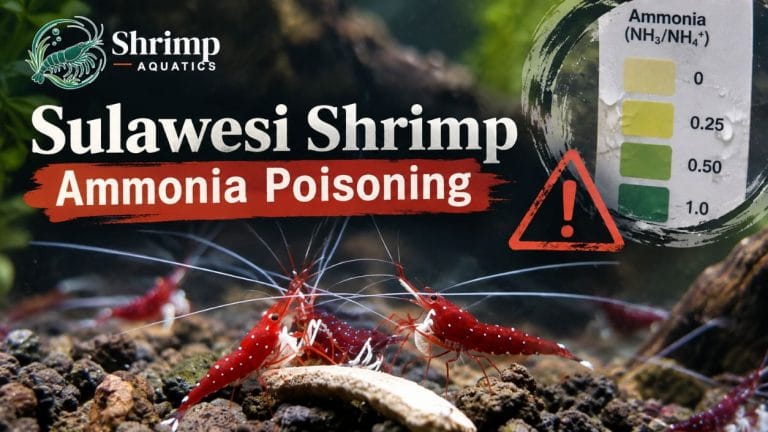
Ammonia and nitrite come first because they’re the fastest killers on the list and the easiest to rule out. Both should read zero. If either reads anything at all, stop working through the rest of this guide and deal with that.
There’s a specific reason a small reading deserves more attention in a Sulawesi tank than in a cooler, more neutral one. Total ammonia in water splits between the ammonium ion and un-ionized ammonia, and the un-ionized form is the one that drives toxicity to aquatic life. The EPA’s freshwater ammonia criteria describe how that split moves: the ratio of un-ionized ammonia to ammonium ion in fresh water increases roughly tenfold for each rise of one pH unit, and roughly twofold for each 10 degree Celsius rise in temperature across the range those criteria cover.1 A Sulawesi tank is deliberately run warm and alkaline, so the same total ammonia reading sits further toward the toxic form than it would in a cool, soft-water tank.
What that chemistry does and doesn’t tell you
It explains why a trace reading is worth taking seriously here. It doesn’t give a safe ammonia number for shrimp. Those criteria were derived for the freshwater species assemblage the EPA assessed, and no figure in them is a tolerance threshold for Caridina or for any Sulawesi species. Treat any detectable ammonia or nitrite as something to fix, not something to compare against a limit.
When ammonia shows up in an established tank, the source is usually small, local and recent. Check for a snail that died out of sight, food buried under rock or in the substrate, a body you missed, a filter that was cleaned or had media replaced in the last two weeks, or a period of heavier feeding. A stocking increase counts too, because the biofilter takes time to catch up.
At Shrimp Aquatics, mature algae and biofilm do most of the feeding in our Sulawesi shrimp tanks. We normally offer prepared food only about once a week and remove leftovers, both because many of the shrimp in these systems show limited interest in it and because food that sits in warm water adds organic waste and can raise ammonia, nitrite and nitrate as it breaks down.
If your feeding routine is heavier than the tank is consuming, that alone can keep a low-level ammonia source running. A grazing colony needs far less prepared food than most keepers offer, which is the core of what Sulawesi shrimp eat.
Sulawesi Readings Can Sit in Range and Still Be Drifting Upward
The second most common answer is drift. Keepers test, see numbers inside the published range, and rule water chemistry out. What matters to a shrimp isn’t only where the number sits but how far it has moved since the animal last molted. Compare your current readings against the group range below, then against your own older records.
| Temperature | 79-86°F (26-30°C) |
|---|---|
| pH | 7.5-8.5 |
| GH | 4-8 dGH |
| KH | 3-6 dKH |
| TDS | 150-250 ppm |
| Ammonia and nitrite | Zero, always |
| Nitrate | Aim for under 10 ppm |
These are typical reference values for lake-system Sulawesi Caridina, useful for catching an obvious error rather than as survival limits. Holding them steady matters more than where inside the range you sit, which is the point of Sulawesi shrimp care parameters.
The classic slow killer is upward mineral drift from topping off. Evaporation removes water and leaves the dissolved solids behind, which concentrates whatever is already in the tank.2 Top off with tap water or with water you’ve already remineralized and you add minerals to a volume that just lost none, so TDS and GH climb week after week while every individual reading still looks acceptable on the day you take it. Only pure RO or DI water replaces evaporated water without adding to the load.
Drift matters most at the molt, and that’s why it kills gradually rather than all at once. The major source of calcium a crustacean uses to calcify a new exoskeleton is exogenous, meaning the water it lives in, with stored reserves and diet contributing less.3 Hardness in a Sulawesi tank is therefore not a cosmetic target. It’s the supply the animal draws on at the single most vulnerable point in its life, and each shrimp reaches that point on its own schedule. That’s exactly how a colony produces a steady trickle of losses instead of one bad night.
A steady point inside the range is more useful than a moving one near an endpoint. KH decides whether your pH stays where you put it, and it is used up over time, so topping it back up is part of Sulawesi shrimp KH and alkalinity.
Find What in the Tank Is Fighting Your Alkaline Sulawesi Water
If your numbers keep sliding back after you correct them, something in the tank is pulling in the opposite direction to your remineralizer. This is a design conflict, and no amount of testing fixes it.
- Active, pH-lowering aquasoil. Soils made for Bee and Crystal Caridina strip carbonate hardness and drive pH down by design. Run one under a Sulawesi mineral and the two work against each other daily. Sulawesi systems need inert substrate and hardscape. Bee tanks and Sulawesi tanks run on opposite chemistry, which Caridina vs Sulawesi shrimp makes plain.
- Decoration borrowed from a soft-water tank. Driftwood, botanicals, leaf litter and peat are staples of Bee and Crystal setups. If any of them went into your tank in the weeks before the losses started, take it out and watch whether KH and pH stop sliding.
- A remineralizer that never fully dissolved. Undissolved mineral keeps releasing into the tank on its own schedule, which is drift you can’t see in a single test.
- Contamination from outside the tank. Copper in any form, fish medications dosed in a shared system, untreated tap water, and aerosols or cleaners used near an open tank all carry real risk to invertebrates. Check what has been used in the room, not only in the water.
The dissolution point deserves detail because it catches careful keepers. SaltyShrimp’s own technical page for Sulawesi Mineral 8.5 states that the salt will almost totally dissolve if CO2 is added for a few days, taking roughly 3-4 days at a regular CO2 quantity of about one bubble per second, and that the water must then be aerated with an air stone for at least three hours to expel the CO2 before use.4 Skip that and you’re adding a slow-release mineral source to the tank. Those are the manufacturer’s instructions for that specific product, so follow the current instructions for whichever remineralizer you actually use, and confirm the finished pH, GH and TDS before the water goes anywhere near the shrimp.
Check Temperature and Oxygen Together in a Warm Sulawesi Tank
Read these two as one check, because the setting that makes a Sulawesi tank correct is also the setting that reduces its oxygen headroom. Cold water can hold more dissolved oxygen than warm water.5 A tank run at 79-86°F (26-30°C) therefore starts with less dissolved oxygen available than a room-temperature shrimp tank, and everything competing for it, including the biofilter, a growing colony and any decaying organic matter, is drawing from a smaller supply.
Two failures show up here. The first is a heater stuck on, or a room that got hot, pushing the tank above the range for part of each day. Measure at the same time daily for several days, since a heater fault often shows only in the afternoon. The second is inadequate gas exchange, which usually means too little surface movement rather than too little filtration. Which kind of flow you have decides the fix, and an air stone or filter for Sulawesi shrimp tells them apart.
Shrimp gathering near the surface, near the filter outflow or on the highest hardscape are worth acting on the same day by increasing surface movement. More gas exchange costs nothing and changes no chemistry, so it’s one of the few things you can do immediately without adding a variable.
Read the Shells and Bodies Before You Treat a Sulawesi Tank
What you’re picking out of the tank narrows the list faster than any test kit. An empty shell that looks intact and translucent, sometimes split at the joint between the carapace and the abdomen, is a molt, and finding molts is a good sign. A whole body is opaque and either holds its color or has lost it. Count the two separately from the start. Take whole bodies out as you find them, since a body decaying in warm water feeds the same organic load you tested for earlier, and leave the molt shells where they are. If shrimp are vanishing and never turn up dead at all, record that separately, because a tank where bodies never appear raises a different question about what else is living in it.
Bodies found beside a fresh molt, or animals that died part way out of the old shell, point at the molt itself, which sends you back to hardness, mineral stability and any recent abrupt change before disease.
There’s one more pattern worth knowing if the losses skew toward mature females. In most shrimps mating takes place at the female’s molt, and the short period of premating attractiveness limits harassment of the female, which can result in her injury or even death.6 Applied to an aquarium, that makes a crowded or male-heavy group a plausible contributor when females keep dying shortly after molting, and it’s worth checking your group composition. We build a breeding group in a set order, the one in how to breed Sulawesi shrimp.
Discoloration, milky or opaque muscle, and eroded or dark patches on the shell are the point at which self-diagnosis stops being useful. Appearance alone doesn’t identify an organism, several very different causes look similar, and the treatments people reach for carry their own invertebrate risk. Each has its own signs and a first check, listed in common health problems in Sulawesi shrimp.
No doses here, and that’s deliberate
Exact hydrogen peroxide, salt dip and dewormer doses circulate widely in shrimp keeping, and you won’t find them in this guide. Dosing an entire tank based on a photograph risks the animals that are still healthy, and any copper-containing product or general fish medication can harm shrimp and snails. If the tank has reached the point where treatment seems necessary, that’s the point to involve an aquatic veterinarian or an experienced local specialist.
Can Your System Actually Feed the Sulawesi Colony You Put in It?
If the water checks out, nothing in the tank is fighting the chemistry, and the losses began in the weeks after you stocked, look at the grazing base instead. A tank can be fully cycled, with ammonia and nitrite at zero, and still be too young to support a colony of Sulawesi shrimp, because cycling and maturity are two different things. Cycling is a working biofilter. Maturity is the layer of algae, diatoms and biofilm across the rock and glass that these shrimp graze on all day. A colony still losing animals weeks after stocking often has nothing left to graze, the case of Sulawesi shrimp dying after introduction.
The pattern fits when losses are spread across shrimp of every size, the survivors graze constantly without settling, and juveniles disappear before they reach adult size. Losses spread across every size are what Sulawesi shrimp survival rate is really about.
Feeding more prepared food is the intuitive response and usually the wrong one, particularly in warm alkaline water where uneaten food becomes an ammonia source. Acceptance of prepared food varies by species and by system, so this isn’t a case where a heavier feeding schedule substitutes for a mature tank. Let the grazing surfaces develop before you stock, and use the readiness signs in the beginner guide to keeping Sulawesi shrimp.
Correct a Drifted Sulawesi Tank Slowly Enough to Avoid a Second Wave
By this point you should have one or two leads. Fix them in this order, and resist the urge to do all of it in an afternoon. Animals already carrying a chronic stressor handle a rapid correction badly, and a colony that was losing one a day can lose several after a well-intentioned overhaul. A rapid correction can turn one loss a day into several, the pattern of Sulawesi shrimp dying after a water change.
- Remove the ammonia source. Take out the body, the buried food or the dead snail, and stop feeding until the reading returns to zero. This is the only step that should happen immediately.
- Restore gas exchange. Increase surface movement or add aeration. Oxygen is the cheapest, safest thing you can give a stressed colony and it carries no chemistry risk.
- Freeze everything else. No new stock, no new products, no new hardscape and no substrate stirring while you’re working, because each addition costs you a variable. That includes moving the survivors. A rescue tank helps only if it’s already mature, already at Sulawesi parameters and already stable, and a tank set up in a hurry is usually none of those.
- Remove whatever fights the water. Take out the driftwood or botanicals. If the problem is active soil, plan a rebuild, because removing it in place will swing the chemistry hard.
- Bring drift back over days, not hours. Move TDS, GH, KH and pH toward the range with small, matched water changes spread over several sessions. Build and match the replacement water first, so the change itself is not the shock, the method behind Sulawesi shrimp water changes.
- Keep testing and recording. Stay on the same testing schedule you started with, and judge the result by whether the loss rate falls, not by whether the readings look better on the day you take them. An unchanged rate sends you back to the checks with one more variable eliminated.
When to Stop Troubleshooting and Get Help for a Sulawesi Colony
Some situations are past the point where a care guide helps. Stop working through this on your own and get another set of eyes when the loss rate keeps rising, when lesions or discoloration spread from one animal to others, when the whole colony stops grazing at once, or when you’ve worked through every check here and still can’t name a cause.
An aquatic veterinarian or an experienced local specialist can examine an animal properly, which no written guide can do. If you want a second opinion on the readings themselves, email us at contact@shrimpaquatics.com with your pH, GH, KH, TDS, temperature, ammonia, nitrite and nitrate, your tank size and age, when the losses started and what has changed recently. The history is what makes the numbers readable.
References
6 Sources
- Aquatic Life Ambient Water Quality Criteria for Ammonia, Freshwater (2013), U.S. Environmental Protection Agency, Office of Water, April 2013.
- Chloride, Salinity, and Dissolved Solids, U.S. Geological Survey, March 1, 2019.
- Biomineralizations: insights and prospects from crustaceans, Gilles Luquet, ZooKeys 176, 2012.
- Sulawesi Mineral 8,5, Minerals and trace elements, SaltyShrimp product information page, copyright 2018.
- Dissolved Oxygen and Water, U.S. Geological Survey Water Science School, June 5, 2018.
- Mating Behavior and Strategies, Raymond T. Bauer, University of Louisiana at Lafayette research page.
Ready to get started?
Shop our Sulawesi Shrimp collection
27 products available · Live Arrival Guarantee
Featured Sulawesi Shrimp
Sulawesi Orange Eyes White Sock
Caridina dennerli
Advanced · 79–86°F · pH 7.5–8.5
From $19.99View Product