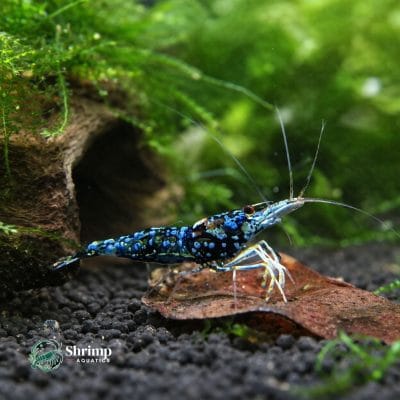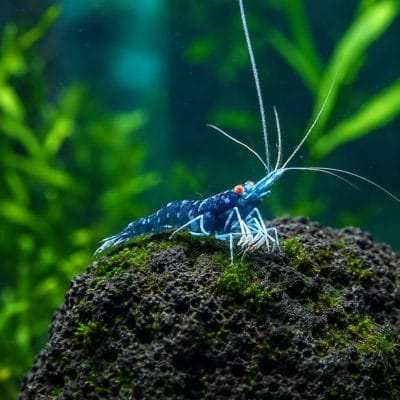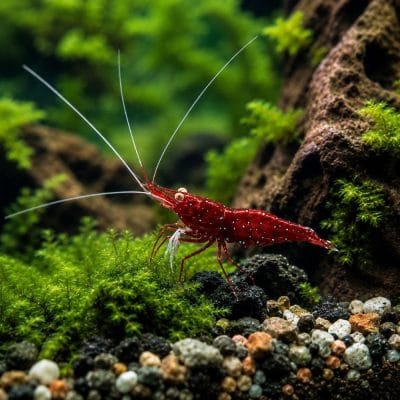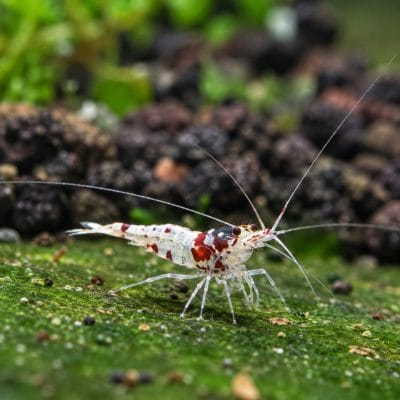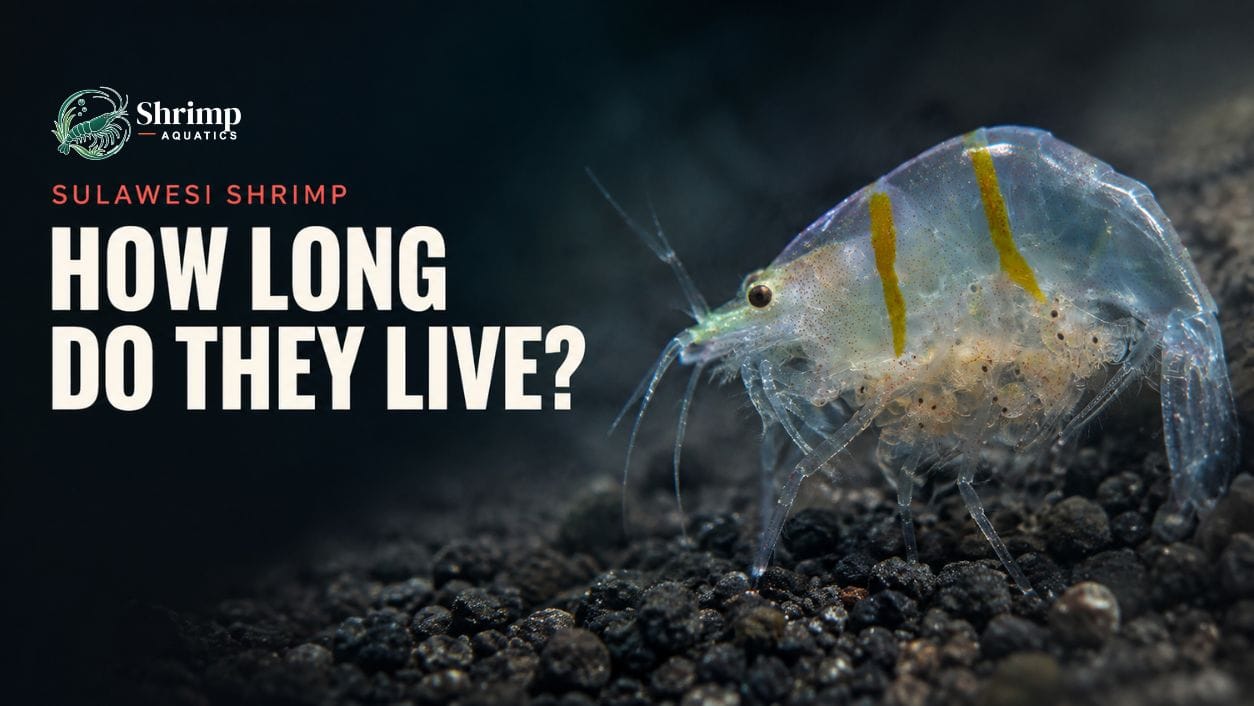
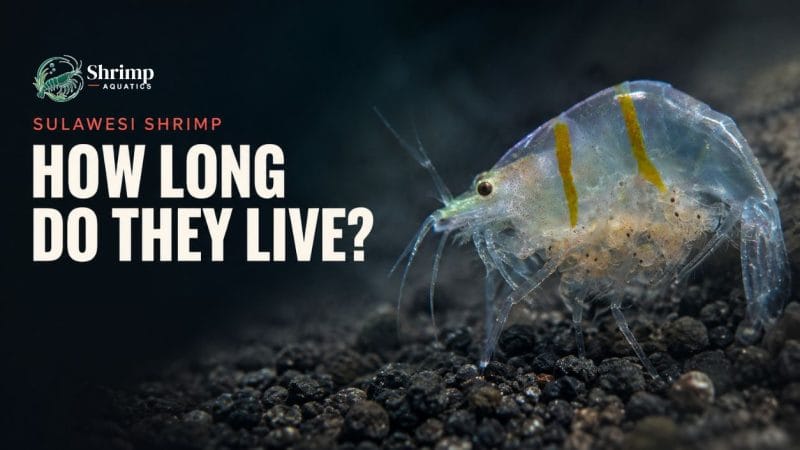
At Shrimp Aquatics, our Sulawesi shrimp live about one to two years, and most keepers plan on about two. There’s no published lifespan for Caridina dennerli, for White Sock, Blue Ghost, Oiran or any other lake species in the group, either in the Sulawesi lakes or in an aquarium. The nearest real measurement in the same genus comes from a stream shrimp in Japan, and it describes an animal living in a different climate and a different kind of water. The thing that decides how long your shrimp actually live isn’t a species constant. It’s whether the tank stays where you set it.
Where the 1-3 year lifespan figures come from
Search the question and you get a different answer on each of the first few results. One care sheet says up to a year and a half in captivity, the next says about two years, a third says two to three years for most species. None of them cites a measurement, and the figures are close enough to each other that they look copied rather than observed.
The primary literature doesn’t fill the gap either. The taxonomic revision that describes most of these shrimp, including Caridina dennerli, records carapace measurements and the eggs a female was carrying when she was collected. It records no ages at all.1 That’s normal for a museum revision, and it’s worth knowing, because it means the hobby figures didn’t come from the scientific work on these animals.
None of this makes a keeper estimate useless. People who have run these colonies for years have a real sense of how long their shrimp last. It does mean you should use the figure the way you’d use a rough map. Fine for planning what a tank will look like in two years. Useless for deciding whether the shrimp you found this morning died of old age.
Is there a measured lifespan for any Caridina shrimp?
There’s one, and it isn’t a Sulawesi shrimp. A study of the amphidromous shrimp Caridina leucosticta in the Isazu River in Japan estimated longevity at 15-25 months.2 It found that females grew faster and reached a larger body size at a given age than males.2 That population lives in a temperate river where growth slows as the water cools through winter. So the number can’t be carried across to a lake species held year round in a heated tank. It’s useful as a scale check, not an answer. A small Caridina that grazes rock and carries a handful of eggs is an animal that lives for a year or two, not for a decade.
For the Sulawesi species themselves, the only controlled measurement of any kind is a rearing trial on Caridina dennerli that ran for a month.3 It was designed to compare feed and shelter, not to follow animals to the end of their lives, but what it recorded still tells you something about time.
| What was measured | The figure | Animal and setting | What it does not settle |
|---|---|---|---|
| Longevity | Estimated at 15-25 months | Caridina leucosticta, wild population, Isazu River, Japan | Not a lake species, not a heated aquarium, not the same climate |
| Growth over 30-37 days | Average total length gain of 0.013 cm to 0.119 cm, depending on the feed and shelter combination | Caridina dennerli, controlled rearing trial, animals starting at about 1.4 cm total length | A month of growth isn’t a life curve, and the trial recorded no ages |
| Survival across the same trial | 72.7% in the best treatment, down to 22.7% in the weakest | Same trial, four combinations of feed and shelter | Those are trial conditions, not a survival rate you should expect from shipped or home kept stock |
Read the middle row again, because it’s the part keepers underestimate. The best treatment added roughly a millimeter of total length in a month, and the weakest added almost nothing measurable. These shrimp build slowly. An adult you buy has already spent a serious share of its life getting to that size, and a colony that loses adults replaces them on that same slow schedule.
The bottom row is the honest version of the lifespan answer. Inside a single month, with the same species and the same starting size, the share of animals still alive moved by a factor of three depending on what the keeper provided. Whatever ceiling the species has, that’s how much of the outcome sits with the keeper rather than with the animal.
Why waste is more dangerous in a warm Sulawesi tank
Total ammonia in fresh water sits in two forms, the ammonium ion and un-ionized ammonia, and it’s the un-ionized form that drives ammonia toxicity in aquatic animals. The split between them isn’t fixed. The ratio of un-ionized ammonia to ammonium rises by about tenfold for each rise of a single pH unit.4 It roughly doubles for each 10 degree Celsius rise in temperature between 0 and 30 degrees Celsius.4 Those criteria describe freshwater aquatic life in general, not shrimp, and they set no safe level for any Caridina. What they do explain is why the same number on a test kit means something different in each tank.
A Sulawesi setup runs at pH 7.5-8.5 and 79-86°F (26-30°C). A Bee or Crystal tank runs cool and acidic. Feed both the same way and let both develop the same trace of ammonia behind a rock. The warm alkaline tank is carrying far more of it in the form that actually harms the animals. The same water is also holding less oxygen, because cold water can hold more dissolved oxygen than warm water.5 Decomposition runs faster, oxygen supply is lower, and the toxic fraction of whatever is produced is higher. That combination is why a Sulawesi tank punishes a feeding mistake that a cooler, more acidic tank would absorb.
At Shrimp Aquatics, mature algae and biofilm do most of the feeding in our Sulawesi systems. We normally offer prepared food only about once a week and remove leftovers, both because many of the shrimp in these systems show limited interest in it and because food that sits in warm water adds organic waste and can raise ammonia, nitrite and nitrate as it breaks down.
That’s the practical shape of it. Ammonia and nitrite belong at zero, and nitrate is worth holding under 10 ppm as a housekeeping target. A mature grazing surface does more for a colony than any feeding schedule, and it’s the one thing a new tank can’t be given quickly.
When shrimp start dying, don’t feed more
The instinct is to assume the colony is hungry. In a warm alkaline tank, extra food that isn’t eaten within a few hours becomes the next ammonia source. The animals least able to survive that are the ones already stressed. Test first, remove uneaten food, and change nothing else until you know what the water is doing.
Molting is where a drifting Sulawesi tank fails
Shrimp, like other crustaceans, have to cast the exoskeleton in order to grow.6 The calcium that hardens the new shell is drawn mainly from the water the animal lives in, with stored reserves and diet contributing less.7 That’s why hardness on a Sulawesi tank isn’t a comfort setting. It’s the supply for a process the animal has to complete on a schedule it doesn’t choose. The molt is the point where anything wrong with that supply shows up.
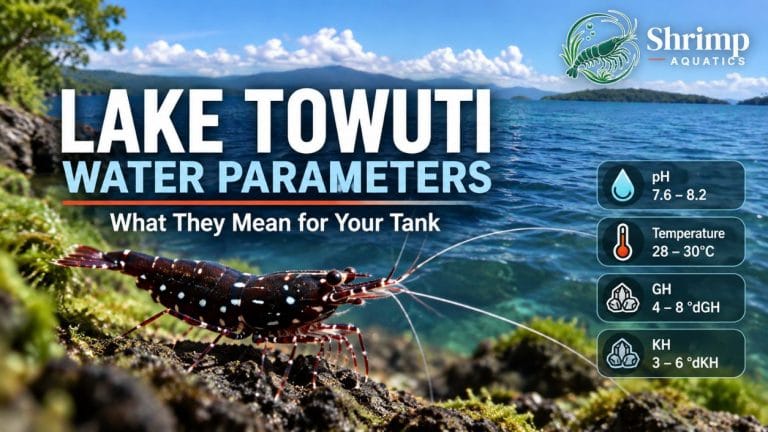
The reference range for a Sulawesi tank is GH 4-8 dGH, KH 3-6 dKH and TDS 150-250 ppm. Holding those steady matters more than where inside the range you sit. The usual source of slow movement is evaporation, which runs hard in a warm tank: evaporation leaves dissolved solids behind and concentrates them in the water that remains.8 Replace evaporated volume with plain RO water rather than remineralized water. Let a TDS reading, not the line on the glass, tell you when something has moved. Weekly figures written down somewhere are worth more than a good memory, because the drift that matters is the one too small to notice between one week and the next.
Does running the tank cooler make Sulawesi shrimp live longer?
Not in any way anyone has shown, so hold the tank steady inside the range rather than chasing a cooler number. Anyone who tells you a specific temperature adds months is guessing. What was measured, in other crustaceans, is that temperature changes molt frequency. In one study, lesser blue crabs reared at elevated temperature showed both a shorter intermolt period and less growth per molt.9 The authors note that is consistent with earlier work across many crustaceans, and they add that if the pattern continued through the pubertal molt, elevated temperatures would produce a smaller size at maturity.9 Faster molting with less gained at each one isn’t the trade most keepers think they’re making when they warm a tank up.
The practical answer is unglamorous. Pick a point inside 79-86°F (26-30°C), set it, and defend it. The reasons to avoid the top of the range are the ones you can point at: less dissolved oxygen and a larger toxic share of any ammonia present. Below the range you’re outside the conditions this group is kept in. A heater that swings a tank across the range overnight is worse for the animals than either endpoint.
How do you tell an old shrimp from a sick tank?
Pattern tells you more than the individual body does. A colony that grazes in the open, molts on a normal rhythm and carries the occasional berried female is a colony where a single loss every few weeks reads as ordinary attrition. Two or three losses inside a week, or losses that cluster after a water change, a new rock, a new food or a warm afternoon, are the tank talking. Age doesn’t arrive on a schedule shared by several animals at once.
When the pattern looks like the second case, work through the checks before you change anything:
- Ammonia and nitrite, on a kit you trust, before you touch the tank.
- Temperature now and temperature overnight, since a failing heater shows up as a swing rather than as a wrong reading at noon.
- TDS, GH, KH and pH against what you recorded last month, not against what you meant to be running.
- What changed in the last two weeks, including top-off water, a new food, a treated plant, a cleaning product used near the tank.
- Whether the bodies are near shed shells, and whether the rest of the colony is still out grazing or has gone into the rock.
- Don’t dose a medication or a mineral in response to a body. Shrimp can’t be diagnosed from a body, and copper and some fish medications can harm shrimp and snails.
If the checks come back clean and the colony is otherwise behaving normally, you’re probably watching age. That’s an unsatisfying answer, and it’s the correct one more often than the hobby admits.
How a Sulawesi colony outlives the shrimp you bought
Since no individual can be counted on much past a couple of years, the thing worth managing is whether the group replaces itself faster than it loses members. That’s slow work here, for the reason the trial above shows. Growth in these shrimp is measured in fractions of a centimeter over a month, so a shrimplet isn’t a replacement adult for a long time.
Two things follow. The first is that the grazing surface has to be established before the colony needs it. Biofilm and algae on rock are what baby Sulawesi shrimp eat, and a bare new tank has nothing on it for them. The second is that group size matters more than variety when you’re choosing which Sulawesi shrimp to start with. A group that’s already breeding absorbs the loss of an old animal and a pair doesn’t.
The sign that it’s working is visible without a test kit. When you can see three or four clearly different sizes of shrimp on the same rock, the colony has started producing its own next generation. The lifespan of any single animal in it has stopped being the number that matters.
References
9 Sources
- Radiation of endemic species flocks in ancient lakes: systematic revision of the freshwater shrimp Caridina from the ancient lakes of Sulawesi, Indonesia, with the description of eight new species, Raffles Bulletin of Zoology 57(2), Lee Kong Chian Natural History Museum, 2009.
- Life history of the amphidromous shrimp Caridina leucosticta (Decapoda: Caridea: Atyidae) in the Isazu River, Japan (abstract), Journal of Crustacean Biology 33(4), Oxford University Press, 2013.
- Effect of Using Different Shelter and Feed Types on Growth and Survival Rate of Sulawesi Endemic Ornamental Shrimps (Caridina dennerli) (journal PDF), Jurnal Ilmiah PLATAX 13(1), Universitas Sam Ratulangi, 2025.
- Aquatic Life Ambient Water Quality Criteria for Ammonia, Freshwater, U.S. Environmental Protection Agency, Office of Water, April 2013.
- Dissolved Oxygen and Water, U.S. Geological Survey, Water Science School, June 5, 2018.
- Farming freshwater prawns: a manual for the culture of the giant river prawn (Macrobrachium rosenbergii), biology chapter, Food and Agriculture Organization of the United Nations, FAO Fisheries Technical Paper 428.
- Biomineralizations: insights and prospects from crustaceans, ZooKeys 176, 2012.
- Chloride, Salinity, and Dissolved Solids, U.S. Geological Survey, Water Resources Mission Area, March 1, 2019.
- Elevated temperature induces a decrease in intermolt period and growth per molt in the lesser blue crab Callinectes similis Williams, 1966 (Decapoda: Brachyura: Portunidae) (abstract), Journal of Crustacean Biology 39(1), Oxford University Press, 2019.
Ready to get started?
Shop our Sulawesi Shrimp collection
27 products available · Live Arrival Guarantee
Featured Sulawesi Shrimp
Sulawesi Orange Eyes White Sock
Caridina dennerli
Advanced · 79–86°F · pH 7.5–8.5
From $19.99View Product