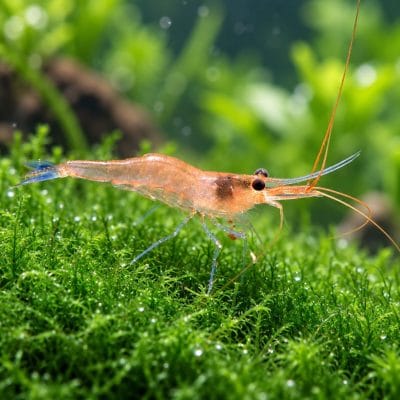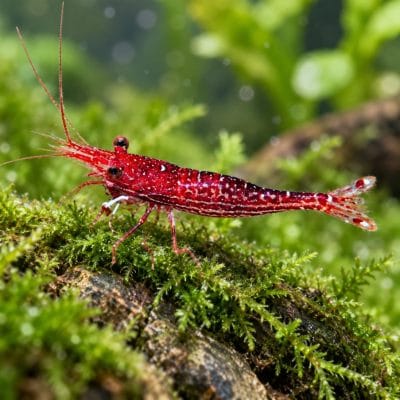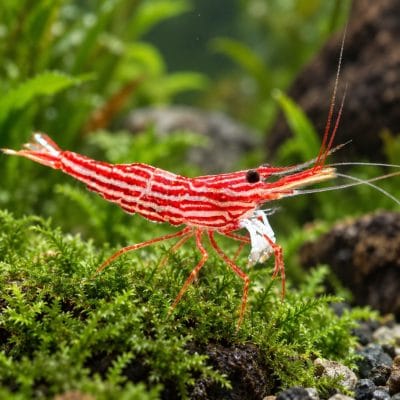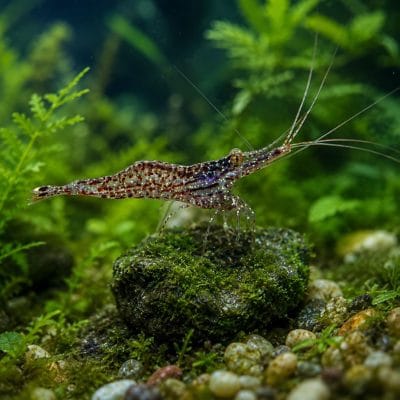

No. Sulawesi shrimp don’t need frequent water changes, and a fixed weekly schedule is one of the easier ways to destabilize a colony. In a mature, lightly fed tank the useful routine is replacing evaporation with pure RO water, testing regularly, and changing tank water only when a reading or a specific problem calls for it. When a change is justified, keep the volume small, match the replacement water to what the tank is already holding, and add it slowly.
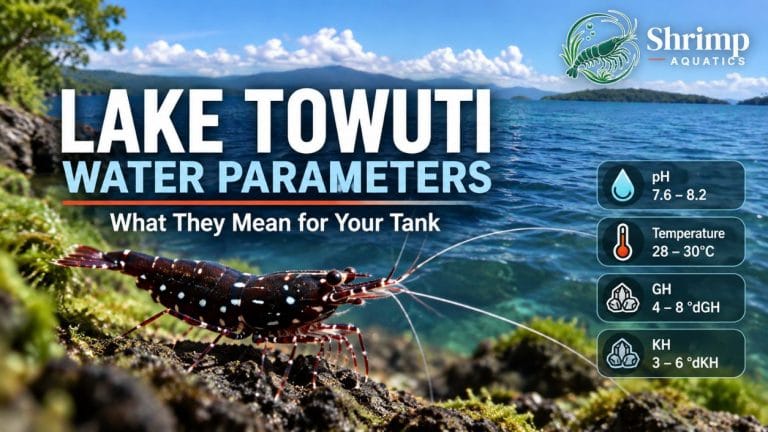
The reason is where these shrimp come from. Sulawesi shrimp are lake Caridina species confined to a small group of ancient lakes in Indonesia. Lake Poso on its own holds an endemic species flock, with nine lacustrine species recognized after the most recent revision.1 That water barely moves. Lake Towuti sits at roughly 82.4-84.2°F (28-29°C) at the surface through the year, is weakly conductive at about 210 microsiemens per centimeter, close to pH 7.8, with a chemistry dominated by magnesium and bicarbonate.2 A water change shifts temperature, TDS, hardness and pH at the same moment, in the one part of the tank where you pour it. That’s a real disturbance for an animal with no evolutionary experience of disturbance, so each one should buy you something specific.
Top off evaporation in your Sulawesi tank instead of changing water
Sulawesi tanks run warm, so they lose water quickly. When water evaporates the dissolved minerals stay behind, so TDS and GH climb steadily between any two maintenance sessions. Left alone, an evaporating tank drifts above the typical 150-250 ppm TDS range and above 4-8 dGH on its own, without you touching anything.
That drift isn’t cosmetic. A crustacean has to find calcium that’s immediately available right after it sheds its shell, and the surrounding water is one of the sources it draws on, which makes the repeated calcium turnover of a molting life energetically demanding.3 Hardness in a Sulawesi tank is the material the shrimp rebuilds itself from, and letting it wander is a slow version of the instability you were trying to avoid by skipping water changes.
Replace the lost volume with pure RO water only. Remineralized water adds more minerals to a tank that’s already concentrating them, and tap water introduces an unknown mineral profile plus a real risk of copper and other metals that harm shrimp. Mark the water line on the glass, top off in small daily amounts or with an automatic top-off, and check TDS weekly so you see drift while it’s still small.
Practical check
If TDS climbs week after week while your feeding and stocking haven’t changed, you’ve an evaporation problem rather than a water quality problem. Fix the top-off routine first. A water change used to correct weeks of neglected evaporation is a far larger disturbance than the small daily additions it replaces.
Top offs use plain RO for the same reason Sulawesi shrimp need RO water in the first place: whatever tap water carries stays in the tank.
How to keep nitrate low in a Sulawesi tank without dilution
The usual argument for regular water changes is nitrate removal. Nitrification converts ammonia to nitrite and then to nitrate, and in closed systems with little or no water exchange nitrate accumulates until it’s either diluted out or processed by a separate denitrification step. The ammonia toxicity side is worse at Sulawesi conditions, because the un-ionized ammonia fraction rises with both pH and temperature and is roughly a hundred times more toxic than ammonium: at 82.4°F (28°C) and pH 8.4 about 15 percent of total ammonia sits in the toxic form, against under 1 percent at pH 7.0. When ammonia does appear, the first move is to cut or stop feeding so the biological filter can catch up.4
The practical conclusion runs the other way from the usual advice. If nitrate accumulation is what forces water changes, the lever is what enters the tank, not how much you take out. A sparsely fed Sulawesi tank with a modest colony and a mature biofilter produces so little nitrate that the under 10 ppm nitrate target holds for long stretches without dilution.
In our Sulawesi tanks
In our Sulawesi systems, mature algae and biofilm do most of the feeding. We normally offer prepared food only about once a week and remove leftovers, because food that sits in warm water adds organic waste and can raise ammonia, nitrite and nitrate as it breaks down.
Our Sulawesi systems use biological filtration together with a Kaldnes moving-bed filter. The combination gives us strong aeration and active biological media, but we tune the outlet so the shrimp aren’t pushed around while grazing. The goal is high oxygen with gentle movement at shrimp level.
None of that removes the need to test. It changes what the test is for. Instead of confirming that a schedule is working, testing tells you whether the tank is still importing less than it can process. Siphon detritus and waste out of feeding areas as normal upkeep, because removing solids before they break down is much gentler than diluting the nitrate they would otherwise become. Test to see what the tank is still importing, not to tick a schedule, a habit that runs through Sulawesi shrimp tank maintenance.
Test results that justify a Sulawesi water change
Change water when a reading or an event tells you to. These are the situations where the disturbance is worth it. Let a reading or an event set the moment, which is the logic of Sulawesi shrimp water change frequency.
- Ammonia or nitrite above 0. A cycled tank reads 0 for both. Anything else means the biological filter isn’t keeping up, and a small matched change buys time while you reduce the load.
- Nitrate approaching 10 ppm. Under 10 ppm is the nitrate target we keep to for Sulawesi shrimp. Treat a rising trend as the signal. Don’t wait for a single reading at the limit.
- TDS outside 150-250 ppm with top-offs already correct. If pure RO top-offs are holding the water line steady and TDS still sits above the range, mineral load has genuinely accumulated.
- Suspected contamination. Copper, some fish medications, cleaning aerosols and unrinsed new hardscape are all reasons to act rather than wait for a test to confirm it.
- A feeding accident or an animal that died out of reach. Warm alkaline water breaks organics down fast, and the resulting ammonia is in its most dangerous form.
Notice what’s missing from that list. Cloudy glass, visible algae, a week having passed and general unease aren’t reasons. A water change also can’t substitute for a tank that was stocked before its biological filter and grazing surfaces were established. If that’s the real problem, repeated changes will keep unsettling the shrimp without fixing the cause. If repeated changes unsettle the shrimp without fixing the cause, a Sulawesi shrimp tank reset becomes worth weighing.
Neither routine is a guarantee
Nobody can promise that a matched, slow water change is safe, or that leaving the water alone will keep a colony alive. What you can control is how far the parameters move and how fast. Ask what a change is meant to correct, and how you’ll measure whether it worked.
Match replacement water to your Sulawesi tank before it goes in
The goal isn’t to hit the middle of a published range. It’s to land on the numbers your tank is already holding, so the shrimp experience as little movement as possible. Freshwater crustaceans keep their internal fluid saltier than the water around them and defend that difference with active ion transport across the gills, and a tight gill surface is useful precisely because it lowers the energy needed to replace what leaks out.5 Change the water around them and that balance has to be re-established. Test the tank first, build the replacement water to those readings, and confirm them before anything is added. Aim for the numbers your tank already holds, not a published middle, the target in how to stabilize Sulawesi shrimp water.
| Parameter | Typical Sulawesi range | What to match |
|---|---|---|
| Temperature | 79-86°F (26-30°C) | Your tank’s current reading, measured with the same thermometer |
| TDS | 150-250 ppm | Your tank’s current reading, not the midpoint of the range |
| GH | 4-8 dGH | Your tank’s current reading |
| KH | 3-6 dKH | Your tank’s current reading |
| pH | 7.5-8.5 | Your tank’s current reading, tested after the mix has finished settling |
Start from RO or DI water rather than tap water. To remineralize RO water, use a Sulawesi-specific mineral following the current manufacturer instructions for that product. Prepare the water ahead of time and test the finished result. Preheating it to tank temperature is the last step, not an optional one.
In our Sulawesi tanks
We start our Sulawesi systems with RO water, then use Sulawesi Mineral 7.5 to prepare the water for our current tank targets before shrimp are introduced. We test the finished pH, GH and TDS before the water goes into a tank.
At Shrimp Aquatics, most of our Sulawesi systems currently run at TDS 150 ppm, GH 6-7 dGH and pH 7.5. Those are our operating numbers for our own tanks, at the lower end of the typical group range, and your target should be whatever your own tank is already holding.
The numbers to match are the same Sulawesi shrimp care parameters the tank was built on, read from your own tank.
Add a small, slow water change to a mature Sulawesi tank
Once the replacement water is matched and warm, execution decides how much the shrimp actually feel.
- Test the tank for temperature, TDS, GH, KH, pH, ammonia, nitrite and nitrate, and write the numbers down.
- Confirm the replacement water reads the same and is at tank temperature.
- Siphon detritus from feeding areas and low spots rather than deep-cleaning the whole substrate, so you remove solids without stripping the biofilm the shrimp graze on.
- Remove a small volume of tank water. Small enough that the tank barely registers it’s the target, not a fixed fraction.
- Return the new water slowly through a drip line or airline, so it mixes into the whole volume instead of creating a pocket of different water where the shrimp happen to be sitting.
- Retest TDS, pH and temperature once the tank has mixed.
That last step is how you calibrate the next change. If your post-change readings are close to the pre-change readings, the volume and the matching were both right. If TDS, GH, KH or pH moved noticeably, the volume was too large or the replacement water wasn’t matched as well as you thought, and the next change should be smaller. This is a better guide than any fixed percentage, because it accounts for your actual tank volume, your mixing accuracy and your test kit.
If the tank isn’t yet mature, a water change is the wrong tool, and keeping Sulawesi shrimp starts with getting a tank to that point first.
What to watch after a Sulawesi water change
Retest TDS, pH and temperature the following day. A tank that reads the same as it did before the change is the outcome you want, and it’s worth recording so you’ve something to compare against later.
Then watch behavior. Shrimp that return to grazing on rock and glass within a few hours, move normally and stay visible are behaving as they did before. Sulawesi shrimp that stay on the bottom without moving, refuse to graze, dart erratically or gather at the surface are worth taking seriously. Sulawesi shrimp are naturally shy, so one hidden animal proves nothing, but a colony that stops grazing after a change is telling you something.
Don’t chase it
If the colony reacts badly, the instinct to do another water change is the wrong one. Stop changing water, confirm the temperature is stable and the heater is working, and test ammonia and nitrite. Don’t add medication. Copper and several common fish treatments are harmful to shrimp, and a shrimp reacting to a parameter shift isn’t a shrimp with an infection. A second change on top of a bad reaction is how many keepers end up with Sulawesi shrimp dying after a water change.
If losses continue while the readings look correct, the cause is usually upstream of the water change itself, in tank maturity, stocking, temperature control or an outside contaminant. You can email contact@shrimpaquatics.com with your pH, GH, KH, TDS, temperature, tank size, cycle status and current livestock, and we will tell you what we’d check first.
The same discipline applies before the first order: a tank that holds its numbers without a water change for several weeks is the tank to put tank-bred Sulawesi shrimp into.
References
5 Sources
- Lake Poso’s shrimp fauna revisited: the description of five new species of the genus Caridina (Crustacea, Decapoda, Atyidae) more than doubles the number of endemic lacustrine species, ZooKeys 1009, 2021.
- Geomicrobiological Features of Ferruginous Sediments from Lake Towuti, Indonesia, Frontiers in Microbiology 7:1007, 2016.
- Biomineralizations: insights and prospects from crustaceans, ZooKeys 176, 2012.
- Ammonia in Aquatic Systems, UF/IFAS Extension publication FA16, revised 2023.
- Multiple functions of the crustacean gill: osmotic/ionic regulation, acid-base balance, ammonia excretion, and bioaccumulation of toxic metals, Frontiers in Physiology 3:431, 2012.
Ready to get started?
Shop our Sulawesi Shrimp collection
27 products available · Live Arrival Guarantee
Featured Sulawesi Shrimp
Sulawesi Red Line Blue Dot
Caridina sp. "Red Line Blue Dot"
Advanced · 79–86°F · pH 7.5–8.5
From $15.99View Product