A Sulawesi tank stays stable because of what you don’t change. The water sits in a warm, alkaline band that holds less oxygen and is less forgiving of waste than a Neocaridina tank, so the routine that keeps a colony going is small, matched and slow. Replace evaporation with pure water, change little at a time and only after the replacement water matches, keep organic waste out of a warm tank, and measure before you correct anything.
How far a Sulawesi tank’s readings can move before it stops being stable
Stable doesn’t mean perfect, and it doesn’t mean one exact number. It means the readings you can actually measure stay inside the group band and move slowly inside it. Two tanks can both sit at legal values and only one of them is stable: a tank that reads pH 7.6 every week is fine, and a tank that reads pH 7.6 one week and pH 8.3 the next isn’t, even though neither reading is outside the range.
| Difficulty | Advanced to expert |
|---|---|
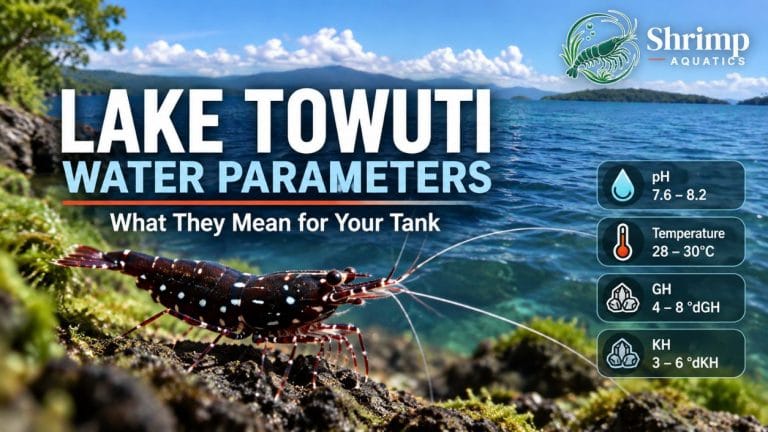
| Temperature | 79-86°F (26-30°C) |
| pH | 7.5-8.5 |
| GH | 4-8 dGH |
| KH | 3-6 dKH |
| TDS | 150-250 ppm |
| Nitrate | Aim for under 10 ppm |
| Substrate | Inert substrate and hardscape, with established grazing surfaces |
These are typical ranges for the group, not survival limits and not a promise. A specific species or line may sit in a narrower part of the band, and where a seller publishes a narrower range for a named line, that line’s record is what applies to it.
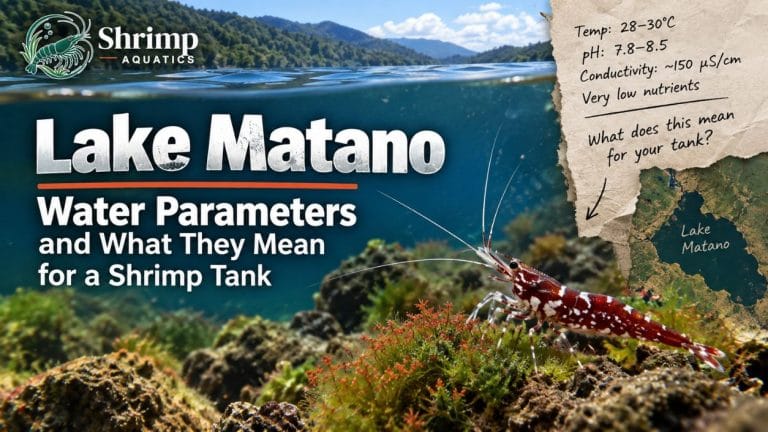
The reason the band is drawn where it’s comes from the lakes these shrimp evolved in. Lake Towuti water temperatures are reported at approximately 82°F (28°C) throughout the year, with only weak thermal stratification in the water column.1 Lake Matano has been studied partly because it combines abundant iron oxides with minimal seasonal temperature variability.2 Neither of those is a target you set on a heater. What they describe is an environment where the numbers barely move, which is the part most home tanks fail to reproduce even when every individual reading is correct.
Of the readings in the table, KH is the one that protects the others. Alkalinity is the water’s capacity to neutralize acids and so hold a fairly stable pH, and water carrying more of it shifts less when something acidic enters.3 Let KH slide toward the bottom of the band and pH becomes the reading that moves first, which matters because pH is also what decides how dangerous the waste in your tank is. Watching KH is therefore an early warning for two problems at once.
Before you change anything else, write down where your tank actually sits inside the band this week, and keep writing it down. A single reading tells you almost nothing. A column of readings tells you whether you have a stable tank, a slow drift or a fault.
Top off evaporation with pure RO water, not remineralized water
A tank held in the Sulawesi temperature band loses water to evaporation, and the water that leaves is pure. Evaporation removes water and leaves the dissolved solids behind, concentrating them in what remains.4 That’s a physical property of water, and it’s the whole reason a Sulawesi tank’s TDS and GH climb on their own while you’re doing nothing wrong.
So the volume evaporation takes is replaced with pure RO or DI water and nothing else. Topping off with remineralized water adds minerals to water that already has more minerals than it started with, and every top-off makes the next reading worse. Left alone, that’s enough to walk a tank out of the top of the TDS and GH band without a single dramatic event to blame it on.
Two different waters, two different jobs
Top-off water replaces what evaporated, so it carries no minerals. Water-change water replaces what you removed, so it carries the same minerals as the tank. Keeping two labelled containers is easier than remembering which is which at the end of a long day.
Practically, this means topping off little and often rather than letting the level fall and then refilling. A float valve or a small auto top-off unit keeps the water line flat instead of letting it sawtooth, and it removes the one maintenance job that’s easiest to skip. If you top off by hand, do it on a fixed schedule rather than when the tank looks low.
The reading that tells you whether your top-off routine is working is TDS, not the water line. A TDS reading that climbs steadily between water changes means minerals are getting in somewhere, and top-off water is the first place to look.
How big a water change a Sulawesi colony can take
A water change on a Sulawesi tank isn’t a cleaning step. It’s a controlled replacement of water whose whole purpose is to move a reading back where you want it while disturbing everything else as little as possible. That framing decides the size, the timing and the speed.
Match the replacement water before any of it reaches the tank
Mix and rest the replacement water in a separate container, then test its temperature, pH, GH, KH and TDS against the tank before you use it. Water mixed straight into a bucket and poured in is the shock you were trying to avoid, and on a specialist warm alkaline tank that shock lands on animals with little tolerance for rapid change in chemistry or temperature.
Add it slowly once it matches. Dripping or ladling the replacement in over a long stretch lets the colony meet the new water gradually, and it gives you time to stop if something looks wrong halfway through.
The reason precision here matters more than it does on a hardier tank is the molt. Crustaceans have to regularly cast the exoskeleton in order to grow,5 and the major source of the calcium used to build the new one is exogenous, meaning the water the animal lives in, with food and stored reserves contributing less.6 Mineral content that moved while a shrimp was between molts is therefore felt at the molt, not when the change happened. That delay is why a colony can look untroubled for weeks and then run into trouble in a few days with no obvious trigger in that week.
Why the ten percent water change figure on Sulawesi care sheets isn’t measured
The Sulawesi care sheets that rank for this question publish some version of about ten percent every one to two weeks. It’s a reasonable habit to start from, but no measurement supports it for these shrimp, and none of the pages publishing it cites a source. Treat it as a default, not as a schedule your tank owes you.
Your own readings are the better instruction. If TDS, GH and KH are sitting where you want them and nitrate is comfortably under 10 ppm, a water change is routine, and it can be small and unhurried. If a reading has drifted, the size of the change is whatever moves that reading back over more than one session. Splitting a correction across several small changes gets you to the same place as one large change without asking the colony to absorb the whole difference at once.
Large changes are worth avoiding for the same reason. A single big replacement moves temperature, minerals and pH together, and it does it faster than anything in the Sulawesi shrimp natural habitat ever moves.
Why warm alkaline water punishes leftover food in a Sulawesi tank
Total ammonia in water is split between the ammonium ion and un-ionized ammonia, and the un-ionized form is the one that drives ammonia toxicity in aquatic animals. That split isn’t fixed. The ratio of un-ionized ammonia to ammonium in fresh water increases by tenfold for each rise of a single pH unit, and by roughly twofold for each 10 degree Celsius rise in temperature across the range EPA assessed.7
A Sulawesi tank sits high on both of those axes at the same time. That’s why the same total ammonia reading isn’t the same problem here that it would be in a Bee Caridina tank at pH 6.5, and why a pellet left under a rock is a bigger event in this tank than in a cooler, softer one. The consequence isn’t a special product or an extra filter. It’s less food going in and no leftovers staying in.
At Shrimp Aquatics, mature algae and biofilm do most of the feeding in our Sulawesi systems. We normally offer prepared food only about once a week and remove leftovers, both because many of the shrimp in these systems show limited interest in it and because food that sits in warm water adds organic waste and can raise ammonia, nitrite and nitrate as it breaks down.
Your colony may want more or less than that. Species, colony size, and how much grazing surface the hardscape actually carries all change the answer, and a young tank with thin biofilm is a different situation from a mature one. The check is the rock rather than the calendar: if the shrimp are grazing steadily across the hardscape and the surfaces still carry a visible film, the tank is feeding them and you can leave the food out.
What doesn’t work is treating supplemental food as a fix for a system that isn’t mature enough. Adding more food to a tank with too little grazing surface adds waste to the water without adding grazing surface, and in warm alkaline water that trade is a bad one.
Hold oxygen up in a warm Sulawesi tank without adding current
Cold water can hold more dissolved oxygen than warm water,8 so a tank running at the top of the Sulawesi temperature band starts with less oxygen available than a room-temperature shrimp tank at exactly the same level of aeration. That gap isn’t something you can see, which is why aeration is the part of a warm tank that’s easiest to under-provide.
What you can raise is the aeration. What you must not raise with it’s how hard the water moves at shrimp level. Air-driven sponge filtration and air stones are the usual answer in these tanks because the aeration and the filtration come from the same gentle source, and because they leave no intake for shrimplets. Sulawesi shrimp feed by working over surfaces, and a shrimp being pushed off a rock isn’t eating.
Aim to add oxygen without adding current, and judge the result by what the animals do. Shrimp grazing calmly on exposed rock faces in the flow are comfortable. Shrimp that stay wedged in shelter on the low-flow side, or that gather high in the water column and stop grazing, are worth taking seriously: check temperature, aeration and recent waste before you assume anything else.
Reading a bad week in a Sulawesi tank before you change anything
Two different situations in these tanks get treated as the same emergency, and they need opposite responses. Slow drift shows up in your readings before it shows up in the shrimp: TDS creeping, KH sagging, nitrate climbing week after week. A failure shows up in the shrimp first and in one reading hard, usually because a heater, a pump or an air supply stopped, or because something got into the water.
The first response to both is the same, and it isn’t a water change. Measure. Ammonia, nitrite, temperature, pH, KH, GH and TDS, plus an honest list of everything that changed in the last week, including new hardscape, a cleaned filter, a new food, a treated plant or anything used near the tank. A tank that has been sitting still doesn’t usually turn without a reason, so that list is where to look first.
Then resist the large corrective change. If the readings show drift, correct it across several small matched changes and let the colony arrive gradually. If the readings show a fault, fix the fault first and let the water settle back with the tank running, because chasing a reading while the cause is still there means two disturbances instead of one.
Raising the temperature isn’t a repair
Warmth gets treated as a general tonic in this hobby, and it’s worth closing that door. In the lesser blue crab, elevated temperature was measured to decrease both intermolt period and growth per molt, producing smaller sizes at each instar, and the authors note that earlier laboratory and field work suggests temperature affects both in many crustaceans.9 That’s a crab, not a Caridina, so read it as a direction only. Nothing in it supports pushing a Sulawesi tank hotter to speed a colony along, and heat costs you dissolved oxygen at the same time.
If shrimp are dying and the readings don’t explain it, stop and get help. Don’t treat blind. Copper-bearing products and many fish medications can harm shrimp and snails, and an unnecessary treatment in warm alkaline water becomes a second problem stacked on the first. A description of symptoms isn’t a diagnosis, and no article can give you one.
The weekly checks that keep a Sulawesi tank inside its band
Almost all of the work in a stable Sulawesi tank is a short, dull routine repeated without variation. That’s the point of it.
- Top off to the same water line with pure RO or DI water, on a schedule.
- Read temperature, pH, KH, GH and TDS, and write them into a running log so drift shows up as a trend instead of a surprise.
- Look at the hardscape: grazing surfaces carrying film, shrimp working across them, and no food left from the last feeding.
- Confirm heater, air supply and filter are all actually running, since these are what fail suddenly.
- Don’t vacuum the grazing surfaces clean, and don’t replace filter media and rearrange hardscape in the same week.
Water changes come out of the log rather than the calendar. When the log shows a trend rather than a wobble, mix matched replacement water, change a small volume slowly, and check the following week that the trend actually turned. When the log is flat, a small change is still worth doing for the nitrate, but there is nothing to correct and no reason to make it large. Let the log, not the calendar, set the timing of Sulawesi shrimp water changes.
Anything you add later has to belong in this same water, because a shrimp sold under a Sulawesi name isn’t automatically kept in Sulawesi conditions. Check a new line against the table above before it goes in. The tank-bred Sulawesi shrimp lines we ship are kept in this water, while Bee and Crystal Caridina need soft, acidic water and shouldn’t be mixed into it.
A colony that has spent a year in water that never moved much is the outcome this routine is built for. It isn’t exciting to run, and the weeks when you measure, write it down and do nothing are the weeks doing the most work.
References
9 Sources
- Geomicrobiological Features of Ferruginous Sediments from Lake Towuti, Indonesia, Vuillemin et al., Frontiers in Microbiology 7, article 1007, 2016.
- The biogeochemistry of tropical lakes: A case study from Lake Matano, Indonesia, repository record and abstract, Crowe et al., Limnology and Oceanography 53(1), 2008.
- Alkalinity and Water, U.S. Geological Survey Water Science School, updated August 24, 2026.
- Chloride, Salinity, and Dissolved Solids, U.S. Geological Survey Water Resources Mission Area, March 1, 2019.
- Farming freshwater prawns, biology chapter, Food and Agriculture Organization of the United Nations, FAO Fisheries Technical Papers No. T428.
- Biomineralizations: insights and prospects from crustaceans, Gilles Luquet, ZooKeys 176, 103-121, 2012.
- Aquatic Life Ambient Water Quality Criteria for Ammonia, Freshwater (2013), U.S. Environmental Protection Agency, Office of Water, April 2013.
- Dissolved Oxygen and Water, U.S. Geological Survey Water Science School, updated August 24, 2026.
- Elevated temperature induces a decrease in intermolt period and growth per molt in the lesser blue crab Callinectes similis Williams, 1966, abstract, Kuhn and Darnell, Journal of Crustacean Biology 39(1), 22-27, January 2019.
Ready to get started?
Shop our Sulawesi Shrimp collection
27 products available · Live Arrival Guarantee
Featured Sulawesi Shrimp
Sulawesi Red Line Blue Dot
Caridina sp. "Red Line Blue Dot"
Advanced · 79–86°F · pH 7.5–8.5
From $15.99View Product