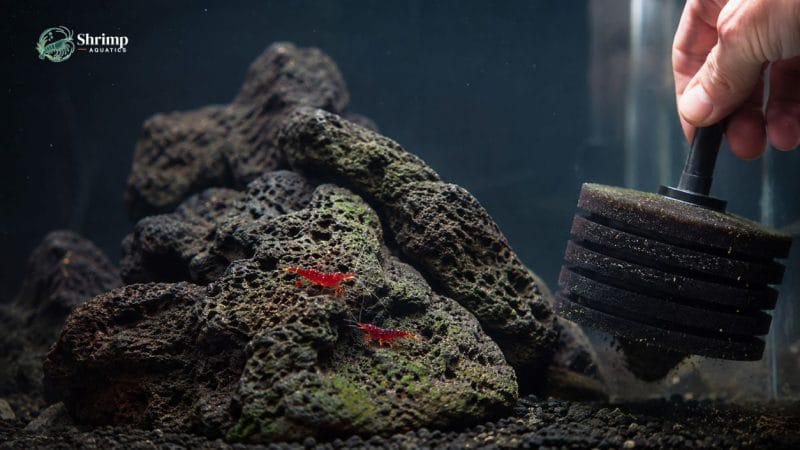
If Sulawesi shrimp are still dying one at a time after you’ve corrected everything the water will let you correct, a full reset is worth considering because the suspects that are left don’t live in the water column. They live in the substrate bed and in the filter media, and those are the two things you can’t flush, dilute or dose your way through. A reset replaces them. It’s a last step that neither diagnoses nor treats anything, it carries a real cost to the shrimp you still have, and it earns its place only once the causes you can fix in place have been excluded.
Rule out a drifting tank before you consider a reset
First, settle what you’re looking at. This page is about a slow trickle, one or two shrimp every few days, continuing for weeks with nothing obvious changing in between. A crash that takes most of the colony inside a day is a different event with something recent behind it, and tearing the tank down in the middle of one destroys the evidence you need to stop it happening again.
A reset is expensive in the ways that matter to shrimp. It costs the colony its established grazing surface, it costs you weeks of maturation, and it puts every remaining animal through handling twice. So it earns its place only after the causes you can still correct in place have been excluded, and that exclusion is a job of its own.
Work through the ordered checks for Sulawesi shrimp dying gradually before anything on this page, because most slow declines turn out to be a drift that’s still reversible. Confirm what your tank is actually running against the Sulawesi shrimp care parameters instead of what you last mixed, since a tank moves between water changes and a number you remember isn’t a measurement. And if the shrimp themselves are carrying visible fuzz, worms, lesions or failed molts, that belongs with common health problems in Sulawesi shrimp instead, because a reset does nothing about an organism that travels across with the animals.
If all of that comes back clean, or has been corrected and given several weeks to show a result, and the losses are still arriving on the same schedule, then the reset conversation starts.
Why the remaining suspects sit in the substrate and the filter media
A liquid test kit reads the open water column. That’s the compartment you can flush, and it’s the compartment the diagnostic above walks you through. A reset is aimed at two others, and neither one is on the test card. A change only reaches the open water, which is why Sulawesi shrimp water changes cannot fix a dirty substrate or filter.
The first is the water held between the substrate grains, which isn’t the water your sample comes from. In pond aquaculture, where this has actually been measured, hydrogen sulfide is produced by the chemical reduction of the organic matter that accumulates at the bottom, and one recorded case found 0.037 to 0.093 ppm in the pond water while the water held inside the sediment reached 10 ppm.1 Alkaline water works in your favor out in the open water, because the toxic un-ionized fraction of hydrogen sulfide falls steeply as pH rises. It’s the boundary layer that matters, and a grazing shrimp spends its whole day at the boundary layer, which is the one place the sample was never taken from. That’s pond data, so read it as a reason to be suspicious of an aged bed and not as a measurement of yours. We haven’t found a published measurement of the interstitial chemistry of a home Sulawesi aquarium.
The second is the microbial community, which no aquarium test shows you at all. Fisheries and Oceans Canada describes Vibrio infections in cultured shrimp as opportunistic, probably resulting from poor husbandry and possibly secondary to other disease processes, and its prevention advice is about avoiding temperature extremes, rapid temperature variation, handling and overcrowding, and none of it is about medicating.2 That’s a penaeid aquaculture record and not a Caridina finding, and it doesn’t tell you what your tank is carrying. What it does tell you is that where shrimp health has been studied at scale, the environment is the lever people pull first, before the medicine cabinet, which is the same logic a reset applies.
Both compartments share one practical property. You can’t reach either of them with a water change, and both of them sit inside the substrate and the media. Replacing those two things is the whole argument for a reset, and it’s also the limit of what a reset can claim to do.
What deep cleaning and heavy water changes do to a tank that’s already losing shrimp
The instinct at this stage is to intervene harder inside the running tank, and in a Sulawesi system that instinct is the problem. Every tool available to you either stirs the compartment you’re worried about or moves the chemistry the colony is currently surviving on.
- Deep gravel vacuuming. In pond systems the bottom soil turns black and a rotten smell is discharged if it’s disturbed.3 That’s a pond and not an aquarium, but the route is recognizable: detritus settles, gets buried, and whatever forms underneath stays put until something stirs it. Vacuuming a loaded bed releases into the water column exactly what was sitting below it, and it does so with the shrimp still in the tank.
- Large water changes. A Sulawesi colony is being carried by the stability of its chemistry rather than by the freshness of its water. A big change moves pH, hardness and TDS together, which is the opposite of what a colony already under stress needs.
- Medicating the display tank. Treatment safety depends on the exact active ingredient, its concentration, the species and the water chemistry. Directions written for fish carry no invertebrate safety with them, and a colony you’re trying to save isn’t the place to find out by trying.
- Planaria and hydra treatments. These are dosed chemicals like any other, their safety for shrimp depends on the exact formulation and concentration, and a tank that’s already losing animals has no margin for an experiment.
- Oxidizers such as hydrogen peroxide and glutaraldehyde. Whatever they do to the target, they go straight into the water an already stressed animal is breathing.
- Feeding more, or dosing more minerals, to support the survivors. Both add to the load you’re trying to reduce, and warm water breaks a surplus down quickly.
Don’t dose a Sulawesi tank on a guess
We won’t publish a dose here. The products keepers reach for aren’t labelled with a concentration verified for ornamental shrimp, and their safety depends on the exact active ingredient, the concentration and your own water chemistry. If you believe you’re dealing with an infection, that’s a question for a qualified aquatic veterinarian or a specialist who can look at the animals, not for a care guide.
How to tell that a Sulawesi tank has passed the point of in-tank repair
Reset when all of these are true at the same time. The losses have continued for more than two or three weeks. Every check on the diagnostic page is either clean or has been corrected and given time to show a result. The tank is old enough, and has been fed long enough, to have built a real detritus layer under the hardscape and inside the bed. And you’ve somewhere safe to put the survivors, because if you don’t, that’s the first problem to solve, before the tank.
Wait when the losses began within days of something identifiable, when a correction is still working its way through, or when the colony is now so small that the handling itself is the larger risk to the animals that remain.
Be clear with yourself about what this decision rests on. Resetting is built on keeper experience, and we haven’t found a controlled comparison of resetting an ornamental shrimp tank against leaving it alone. Treat it as a considered last step. It also has a defined blind spot. A reset replaces the tank, so it does nothing about source water that was already wrong, a heater that swings, a room that swings, or a colony larger than the grazing surface can feed. Correct those in the same operation or you’ll rebuild the same decline on a new substrate.
A reset is itself a handling event
Every shrimp you move is handled at least twice and then spends weeks in a container with no established grazing surface. On a colony that’s already losing animals, that cost is real, and it’s the reason the exclusion work comes first.
Reset the Sulawesi tank without losing the survivors
Order matters more than speed here. The goal is to break the shrimp’s contact with the old substrate and media without changing their water chemistry on the same day, which is why the holding container is prepared before anything is disassembled and why it’s filled from the running tank.
- Set up the holding container first. A bare container, filled with water taken straight from the running tank so the chemistry doesn’t move, a heater set to the temperature the shrimp are already living at, an air driven sponge filter or an airstone, and a lid. Give them something clean to hold onto, such as previously unused or heat cleaned surfaces. Don’t carry pieces of the old scape across, which would defeat the point of the move.
- Move the shrimp slowly and count them out. A cup is gentler than a net for an animal this size. Write the number down, because it’s the only way you’ll know later whether the losses actually stopped.
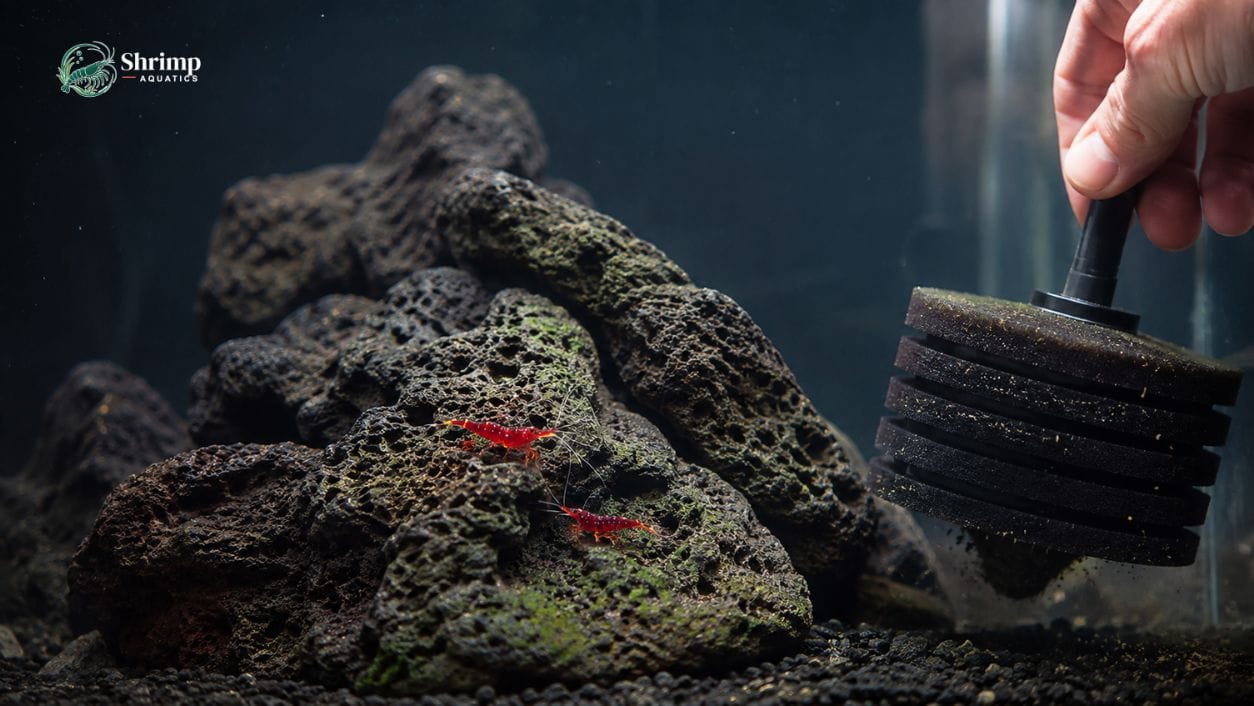
- Strip the tank. Lift out the hardscape and the filter media, then drain the water and remove the substrate completely. Don’t wash it and put it back.
- Clean before you disinfect, because organic matter reduces the disinfection capacity of most disinfectants. Permeable surfaces are harder to disinfect and need longer contact, and equipment that can’t be cleaned properly is better replaced than treated.4 Scrub and rinse everything first, apply whatever disinfectant you use according to its own instructions, then rinse thoroughly and let it all dry.
- Replace the biological media instead of reseeding the new filter from the old one. Reseeding carries the microbial community across, and that community is one of the two compartments you set out to replace.
- Rebuild with a bed you can actually keep clean. Shallow enough that you can see detritus and lift it off without stirring the layer underneath, or bare bottom in the area where you feed. Keep the substrate and hardscape inert, and don’t use the opportunity to switch to an active pH lowering soil.
- Refill with freshly mixed water at the same targets you were already running, then let temperature and flow settle before you think about anything else. Aim for good oxygenation with gentle movement at shrimp level rather than a current that pushes a grazing animal around.
- Leave the tank empty and start it as a new tank. The shrimp stay in the holding container until the rebuilt system is genuinely ready, which is the next decision.
Bring the shrimp back only when the rebuilt tank has matured
Readiness here’s measured, not scheduled, and shortening this stage is what turns one reset into a second round of losses. A rebuilt tank has to hold ammonia and nitrite at zero under a real bioload, and it has to have grown back the grazing surface the colony lives on, because extra prepared food can’t make up for an immature system.
At Shrimp Aquatics, we don’t rush a new Sulawesi tank. With a powdered bacterial starter our normal minimum is 3-4 weeks, and with a liquid or live culture the same checkpoint may arrive in 2-3 weeks, but the calendar doesn’t decide when shrimp go in. We wait for 0 ammonia and nitrite, stable temperature and chemistry, an established biological filter and visible grazing surfaces before stocking any Sulawesi shrimp.
When the tank passes those checks, move the survivors back the way you moved them out, slowly and with the two bodies of water brought close together first. Feed lightly through the first few weeks, let the grazing surface carry the colony, and keep counting. If the count holds steady across a full month, the tank is doing its job.
What has to change so the new bed doesn’t load the same way
A reset buys you a clean starting point and nothing else. Whatever loaded the old bed will load the new one on the same schedule unless something about the routine changes, and in a warm tank that schedule is short.
- Feed the grazing surface rather than the shrimp. Biofilm, aufwuchs and algae are the important grazing resources in a mature Sulawesi tank, so treat prepared food as a supplement to them.
- Take uneaten food out instead of letting it break down. Warm water processes a surplus quickly, and the byproducts settle into the bed you just replaced.
- Keep the substrate shallow enough that you can lift detritus off the surface without stirring the layer below it.
- Keep water moving across the substrate surface, with enough surface agitation for oxygen and a gentle enough current that a shrimp can hold position and graze where it wants to.
- Quarantine everything new, plants and hardscape included, before it goes anywhere near the colony.
- Keep a short written log of what you changed and when. The next slow decline is far easier to read when it has a timeline attached to it.
If the losses restart in the rebuilt tank on the same schedule as before, then the substrate wasn’t the cause, and the next things to examine are the water going into the tank and the stability of the room the tank sits in.
References
4 Sources
- Site selection for aquaculture, chemical features of water, section 11.1 Hydrogen sulfide and shrimps, Food and Agriculture Organization of the United Nations.
- Vibrio spp. (Vibrio Disease) of Cultured Shrimp, Fisheries and Oceans Canada, last modified December 4, 2018.
- Shrimp culture, pond design, operation and management, section 9.6 Hydrogen sulfide, Food and Agriculture Organization of the United Nations.
- Methods for disinfection of aquaculture establishments, chapter 1.1.3, Manual of Diagnostic Tests for Aquatic Animals, World Organisation for Animal Health, 2009.
Ready to get started?
Shop our Sulawesi Shrimp collection
27 products available · Live Arrival Guarantee