
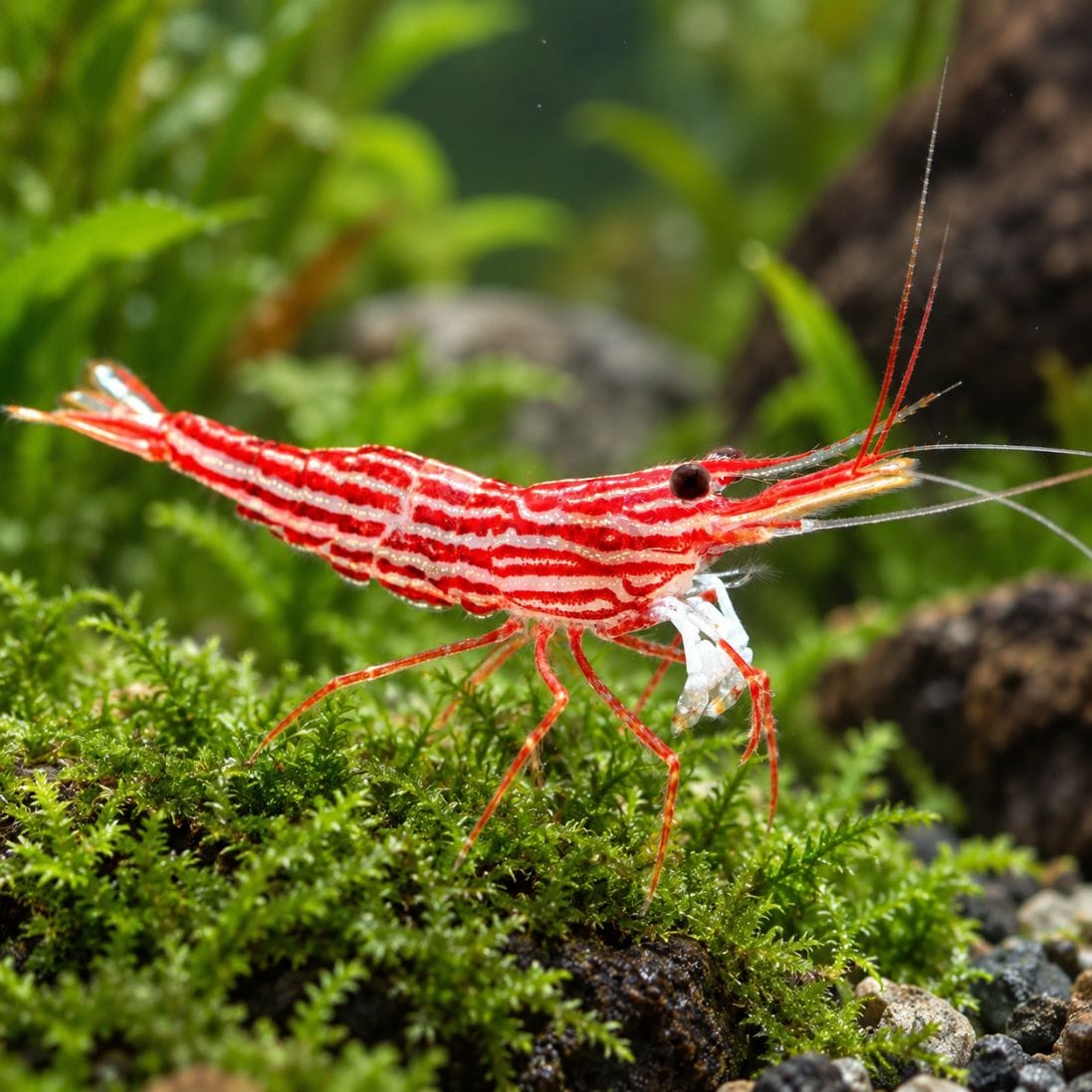
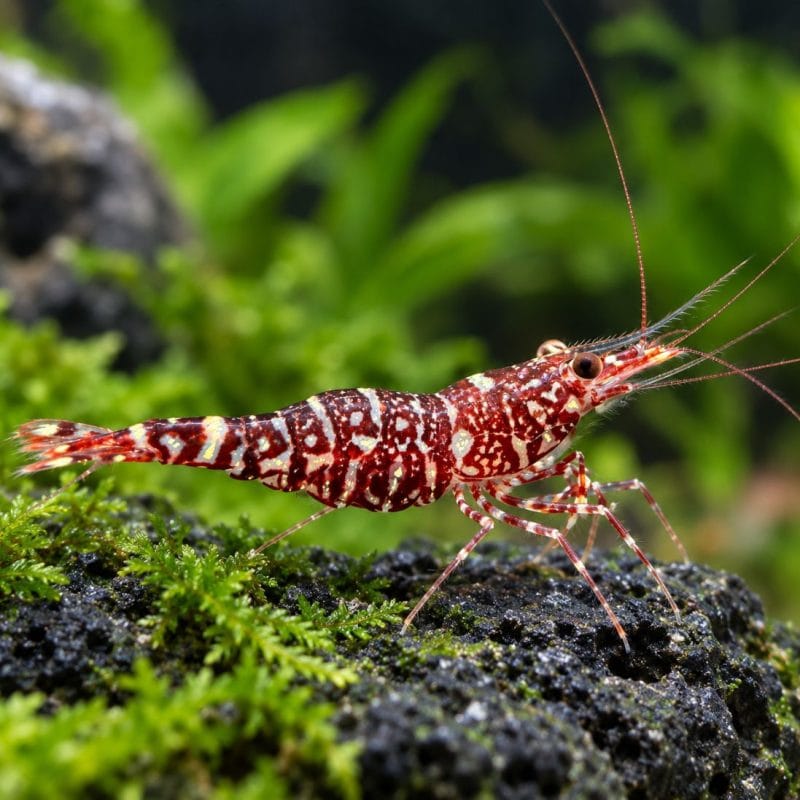
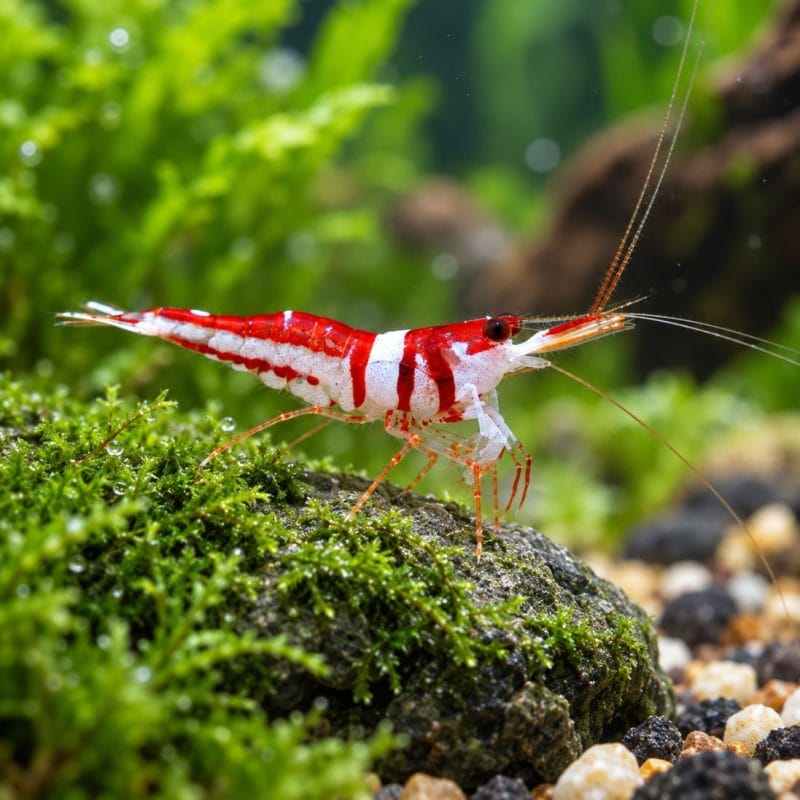
The Sulawesi Red Line shrimp (Caridina striata) is the crimson one with white pinstripes running the length of its body and solid white front claws. It’s tank-bred by Shrimp Aquatics, and it’s an advanced animal: your tank has to be warm, alkaline and grazed-in before it arrives.
How to tell a Red Line from the other striped Sulawesi shrimp
Which way does the white run? That’s the whole test. On a Red Line the stripes are unbroken and horizontal, nose to tail, over a deep crimson body, and the first two pairs of claws are opaque porcelain white. If the white sits in bold bars across the back instead, that’s the Harlequin, Caridina woltereckae, a different animal sold under a similar description. Trade names get swapped around in this group, so don’t buy on the label alone.
Caridina striata comes from Lake Towuti and Lake Mahalona in the Malili lakes of Sulawesi. The shrimp we ship are bred by Shrimp Aquatics, not collected from the wild.
The water a Sulawesi Red Line needs
| Difficulty | Advanced to expert |
|---|---|
| Temperature | 79-86°F (26-30°C) |
| pH | 7.5-8.5 |
| GH | 4-8 dGH |
| KH | 3-6 dKH |
| TDS | 150-250 ppm |
| Ammonia and nitrite | 0 ppm |
| Nitrate | Keep it under 10 ppm |
Warm and alkaline is the easy part. Holding it still is the job. These shrimp evolved in a lake that barely moves chemically from one year to the next, so a number that sits slightly off but never budges is safer than a perfect number that drifts every week. If you want the reasoning behind each figure and how to hold it, our Sulawesi shrimp care parameters guide goes through them one at a time.
Test before you order, not after
Take your own readings for pH, KH, GH, TDS and temperature on the tank these shrimp would go into, and take them twice a week apart. If the two sets disagree, the tank is still moving, and this isn’t the animal to put in it yet.
Check your tank against this list before you order Red Lines
- Ammonia and nitrite both read 0, and they’ve been reading 0 for a while.
- The rock and the back glass carry visible brown biofilm, and you’re willing to leave it there.
- Temperature holds inside 79-86°F (26-30°C) without dropping overnight.
- pH, KH, GH and TDS land in the band above and read the same a week later.
- Replacement and top-off water is mixed outside the tank from RO water and a Sulawesi mineral, so topping off doesn’t push TDS around.
- The substrate and hardscape are inert. An active plant soil pulls the pH down and undoes everything above it.
If one of those isn’t true yet, wait. A tank that’s cycled but not yet grazed-in is the usual reason a first order thins out over the following weeks.
What can share a tank with Sulawesi Red Lines
Another Sulawesi line on the same water is the safest company, so if you want a mixed display, pick both animals from our tank-bred Sulawesi shrimp rather than reaching across water types. Sulawesi rabbit snails suit the same warm alkaline band, but they add waste, so count them in your stocking.
What about fish? We’d keep them out. Small peaceful species are often low risk with adult shrimp, but shrimplets are food to almost anything that can fit them in its mouth, and a colony this slow won’t build if the young ones keep disappearing.
Feeding a Red Line colony that grazes rock all day
Most of the feeding is already done by the tank. These shrimp scrape biofilm, diatoms and algae off hard surfaces, and a mature rock pile keeps them busy without you. Prepared food is occasional and small: a pinch every few days is plenty, and the usual rule is to lift whatever is left within an hour or two. Warm alkaline water breaks leftovers down fast, and the waste coming off them bites harder here than in a cool soft-water tank. Interest in prepared food varies between shrimp and between tanks, so watch yours instead of following a schedule.
What to do on the day your Red Lines arrive
Follow the instructions packed with your order first, because the packing method and the transit time change the right call. Shrimp Aquatics’ current shipment protocol is to equalize temperature with the transport bag still sealed, then move the shrimp across into the aquarium without letting shipping water in with them. Keep the lights low, skip food that first day, and leave the tank alone apart from watching. If anything about the bag looks wrong on arrival, photograph it before you open it and email contact@shrimpaquatics.com.





There are no reviews yet.