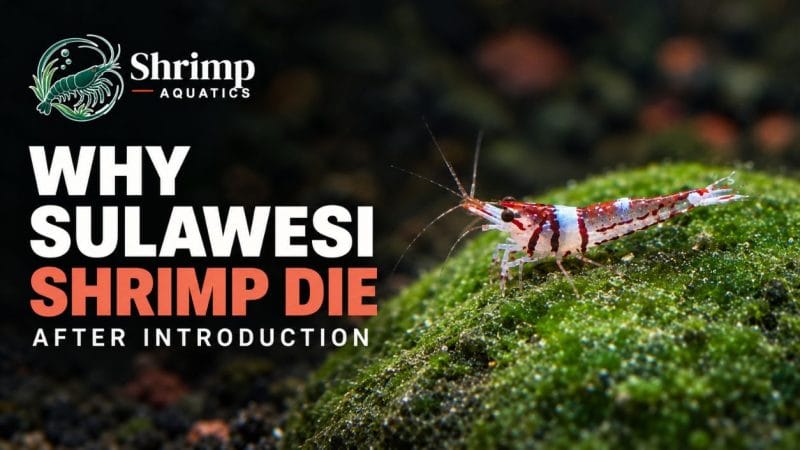
When Sulawesi shrimp die in the days after you add them, the cause is almost never something you can treat. It’s nearly always the water they moved into, or a tank that had finished cycling but hadn’t finished maturing. That matters, because the useful work is measuring, waiting and leaving the tank alone, not dosing it.
What to do in the first hour after finding dead Sulawesi shrimp
Take the dead animals out, then stop and gather information before you change anything. Almost every instinct at this moment makes the tank less stable, and instability is what’s killing the shrimp. A large water change, a dose of minerals, a medication or a few extra degrees on the heater all move the water further, and every one of those moves lands on animals that are already struggling.
- Remove the dead shrimp so they don’t add to the waste load, and look at each one before you discard it.
- Test ammonia and nitrite first. Both should read zero in a tank that’s ready to hold livestock.
- Read the temperature at the glass, not off the heater dial.
- Test pH, GH, KH and TDS, and write the numbers down so the next reading means something.
- Write down everything you changed in the past two weeks, including top offs, new rock, a new mineral batch and any food you started using.
- Don’t run a large water change to try to fix a reading you haven’t identified yet.
- Don’t add medication. Copper and some fish medications can harm shrimp and snails, and nothing here has been identified as a disease.
If the animals arrived recently, keep the rest of the box out of it. Don’t move survivors to a second tank in the middle of a die off unless that tank is already running at the same chemistry and temperature, because the move itself is another transfer.
How long after introduction they died narrows the cause
The single most useful thing you’ve is when it happened. What went wrong at the transfer and what was already waiting in the tank don’t fail on the same schedule, and sorting the two apart tells you where to look. The table below gives plausible categories to check, in the order Sulawesi tanks usually fail.
| What you are seeing | What that pattern usually points to | What to check first |
|---|---|---|
| Deaths the same day, within hours of the transfer | The transfer itself. A gap between the transport water and the tank water in temperature, mineral content or pH, or transport water entering the tank. | Temperature at the glass, TDS and pH of the tank, and whether any bag water went in. |
| Deaths over the first few days, with no shed shells found | The tank chemistry the shrimp are now sitting in, most often a buffer that’s falling or was never there. | KH and pH, the substrate, and whether the replacement water was fully prepared before use. |
| A shrimp found part way out of its old shell | A molt that didn’t complete, which points at the mineral content of the water rather than at food or disease. | GH and KH, and whether either has moved since the shrimp went in. |
| Steady losses spread across the first month | The tank rather than the transfer. Too little grazing surface, too much added food, or both at once. | Rock surfaces for visible biofilm, uneaten food on the substrate, and nitrate. |
None of these rows is a diagnosis, and none of them can be confirmed from appearance alone. They tell you where to spend the next hour, and a tank can be running two of them at once.
What measured data exists
Very little has been measured on these animals. In a 2025 rearing trial on Caridina dennerli, survival across four feed and shelter combinations ran from 22.7% to 72.7% over 30 to 37 days, with the highest survival and the fastest growth in the group given commercial pellets and a Hydrilla shelter.1 Those are results from one controlled trial under its own conditions. They aren’t a Sulawesi shrimp survival rate to expect from your own tank, and they don’t make a loss acceptable.
Compare your tank against the Sulawesi range, then against itself
Start with the group range, because a tank outside it won’t recover on patience alone.
| Difficulty | Advanced to expert |
|---|---|
| Temperature | 79-86°F (26-30°C) |
| pH | 7.5-8.5 |
| GH | 4-8 dGH |
| KH | 3-6 dKH |
| TDS | 150-250 ppm |
| Nitrate | Aim for under 10 ppm |
| Ammonia and nitrite | Zero, with an established biological filter |
| Substrate | Inert substrate and hardscape |
Now do the harder comparison, which is your tank against itself. Take a reading, take another one a few days later, and look at the difference rather than the value. A tank that sits quietly inside the range is a different animal from a tank that arrives at the same numbers by drifting up and being corrected back down, even though both look identical in a single test.
That’s the part of the water this group is least willing to negotiate on. Lake Towuti, one of the Malili lakes these shrimp come from, has a tropical humid climate with little variation in monthly temperatures, and its surface water sits in a narrow warm band with only weak thermal stratification through the column.2 Nothing in that Sulawesi natural environment prepares an animal for water that moves.
Two mundane sources of movement account for most of it. The first is topping up. Evaporation concentrates dissolved solids in the water left behind, a mechanism USGS describes for shallow groundwater in arid regions,3 and the same physics applies to an open aquarium, so a tank topped up with remineralized water gains minerals it never lost. Top off with pure water only. The second is replacement water that was mixed in a hurry and arrives at a different chemistry than the tank it’s entering, which turns a routine water change into the shock you were trying to avoid.
Check the substrate and hardscape for something that’s spending your buffer
Alkalinity is the water’s capacity to neutralize acids and hold a fairly stable pH, and it comes from bicarbonates, carbonates and hydroxides in the water. Water with high alkalinity changes less when acid enters it than water with low alkalinity does.4 In a Sulawesi tank, that carbonate buffer is what holds alkaline water at the pH the shrimp expect, and anything quietly consuming it’s a slow leak under everything else you do.
The most common leak is an active substrate. Soils sold for Bee and Crystal Caridina are built to bind minerals out of the water and hold pH down, which is exactly right for those shrimp and exactly wrong here. A Sulawesi tank set up on aquasoil will keep losing buffer no matter how carefully you prepare the replacement water. Leave peat, botanicals and anything else sold to soften or acidify water out of this tank too. The best substrate for Sulawesi shrimp is inert, like the hardscape, and the buffer comes from the prepared water instead.
If your tank is on an active soil, no amount of dosing will hold the line. That’s a Sulawesi shrimp tank reset, and it’s better done with the surviving shrimp moved to matched water than attempted underneath them.
Sulawesi mineral water that wasn’t finished before it went in
This is the failure that catches careful keepers, because the mistake happens in a bucket rather than in the tank. Sulawesi Mineral 8.5 doesn’t dissolve on its own. The manufacturer states that it will almost totally dissolve if CO2 is added for a few days, that at a regular CO2 quantity of one bubble per second the salt dissolves totally in approximately 3-4 days, and that water prepared this way must then be aerated with an air stone for at least three hours to expel the CO2 before use. It raises carbonate and total hardness at a ratio of KH to dH of 0.78 to 1.0.5
Two things go wrong with that sequence. Water that was never fully dissolved goes in cloudy, carries undissolved mineral and doesn’t lift pH the way the label says it will. Water that was dissolved but not aerated for the stated minimum goes in still carrying the CO2 the manufacturer tells you to expel. Once carbon dioxide dissolves in water it reacts with water molecules to form carbonic acid, and the lower the pH value the higher the acidity of a liquid.6 That’s why a batch still holding CO2 reads lower in the bucket than it will settle at, and why the reading you took an hour ago isn’t the water the shrimp are in now. Either way the animals get a moving target, and if the batch went in on the day the shrimp arrived, the two events are hard to tell apart.
Test the finished water, not the recipe
Prepare and finish every batch outside the aquarium, then measure pH, GH and TDS in the container before any of it reaches the tank. A batch that’s still clouding, or whose pH is still climbing while it sits, isn’t finished.
What changes if you prepare water with Sulawesi Mineral 7.5
The 7.5 formulation behaves differently. The manufacturer states that it will almost totally dissolve within seconds and the water is ready for use immediately, with no CO2 step, that it buffers the pH at around 7.5, and that it raises carbonate and total hardness at a ratio of KH to dH of 0.42 to 1.0.7 That removes the preparation failure described above, which is a real advantage when you’re trying to eliminate variables during a die off. It also parks the tank at the bottom of the group pH range, so there’s less room above you if something starts pulling pH down. Whichever you use, the value that counts is the one you measure in the finished water.
Why feeding a new colony is the riskiest thing you can do this week
New shrimp that aren’t eating look like they’re starving, and the natural response is to feed more. In a warm alkaline tank that response is how a survivable week becomes a fatal one.
Total ammonia in water sits in equilibrium between the ammonium ion and un-ionized ammonia, and it’s the un-ionized form that drives toxicity. The ratio of un-ionized ammonia to ammonium ion in fresh water increases by 10-fold for each rise of a single pH unit, and by approximately two-fold for each 10 degrees Celsius rise in temperature from 0 to 30 degrees Celsius. High external un-ionized ammonia concentrations reduce or reverse diffusive gradients and cause ammonia to build up in internal tissues and blood.8 A Sulawesi tank is warm and alkaline by design, so the same number on the same test kit is a worse situation here than it’s in a cool soft water tank.
The oxygen side works against you at the same time. Cold water can hold more dissolved oxygen than warm water,9 so a warm Sulawesi tank has less oxygen in reserve at exactly the point where you’ve given the system something extra to break down. Aeration and surface movement matter more here than they do in a cool tank.
The practical answer is unglamorous. Add no prepared food for the first days, let the shrimp graze the rock, and take out anything they haven’t eaten before it breaks down. If the rock has nothing on it to graze, that’s the real finding, and food isn’t the fix for it.
A shrimp that died mid molt is telling you about the water
A shrimp found part way out of its old shell, with a visible gap across the back between the carapace and the abdomen, is a common sight after a rough introduction. Keepers call it the white ring of death, which is a description of what you’re looking at and not a diagnosis of what happened.
The reason it points at chemistry is where the material comes from. In crustaceans the major source of calcium used for exoskeleton calcification is exogenous, meaning the water the animal lives in, while food, sometimes including the shed shell itself, is a minor contribution.10 Applied to your tank, that means the mineral content of the water and its steadiness are what a molting shrimp is drawing on, and a supplement added at the moment of a die off is neither fast enough nor stable enough to help.
So read the GH and KH, read them again in a few days, and look at whether either has moved since the shrimp went in. Correct the water slowly toward the range and then hold it there. Don’t dose the tank in the middle of a die off, and if losses continue while your parameters sit inside the range and stay put, that’s the point to bring in a qualified aquatic veterinarian or an experienced local specialist. Losses that continue after the water settles are a different pattern, Sulawesi shrimp dying gradually.
When a Sulawesi tank is ready to hold shrimp again
A cycled tank and a mature tank aren’t the same thing, and this group needs the second one. Cycling means the filter processes waste. Maturity means there’s something on the rock to eat, and the chemistry has proven it will sit still for weeks without you steering it.
At Shrimp Aquatics we don’t rush a new Sulawesi tank. With a powdered bacterial starter our normal minimum is 3-4 weeks, and with a liquid or live culture the process may reach the same checkpoint in 2-3 weeks. The calendar doesn’t decide when shrimp go in. We wait for zero ammonia and nitrite, stable temperature and chemistry, an established biological filter and visible grazing surfaces before stocking.
Use that as a floor, and let the tank tell you the rest.
- Ammonia and nitrite read zero on two tests several days apart.
- Temperature, pH, GH, KH and TDS have been logged for at least two weeks and aren’t drifting.
- Rock surfaces carry visible brown or green growth, so there’s something to graze on the day the shrimp arrive.
- Every batch of replacement water is prepared, finished and measured before it goes near the tank.
- Top off water is pure water only, so TDS doesn’t climb between water changes.
- Don’t restock because the calendar says the tank is old enough while a reading is still moving.
When the next order of Sulawesi shrimp does arrive, follow the acclimation instructions supplied with that shipment, not a general method from another site, because packing method, transit time and species all change the right answer. Whatever method you use, keep transport water out of the aquarium.
References
10 Sources
- Effect of Using Different Shelter and Feed Types on Growth and Survival Rate of Sulawesi Endemic Ornamental Shrimps (Caridina dennerli), journal PDF, Jurnal Ilmiah PLATAX 13(1): 191-204, 2025.
- Geomicrobiological Features of Ferruginous Sediments from Lake Towuti, Indonesia, Frontiers in Microbiology 7, article 1007, 2016.
- Chloride, Salinity, and Dissolved Solids, U.S. Geological Survey, Water Resources Mission Area, March 1, 2019.
- Alkalinity and Water, U.S. Geological Survey Water Science School, updated August 24, 2026.
- SALTYSHRIMP, Sulawesi Mineral 8,5, manufacturer product information page, SaltyShrimp (Garnelenhaus), no revision date shown.
- Understanding the Science of Ocean and Coastal Acidification, U.S. Environmental Protection Agency, updated August 24, 2026.
- SALTYSHRIMP, Sulawesi Mineral 7,5, manufacturer product information page, SaltyShrimp (Garnelenhaus), no revision date shown.
- Aquatic Life Ambient Water Quality Criteria for Ammonia, Freshwater (2013), U.S. Environmental Protection Agency, Office of Water, April 2013.
- Dissolved Oxygen and Water, U.S. Geological Survey Water Science School, updated August 24, 2026.
- Biomineralizations: insights and prospects from crustaceans, ZooKeys 176: 103-121, 2012.
Ready to get started?
Shop our Sulawesi Shrimp collection
27 products available · Live Arrival Guarantee
Featured Sulawesi Shrimp
Sulawesi Orange Eyes White Sock
Caridina dennerli
Advanced · 79–86°F · pH 7.5–8.5
From $19.99View Product