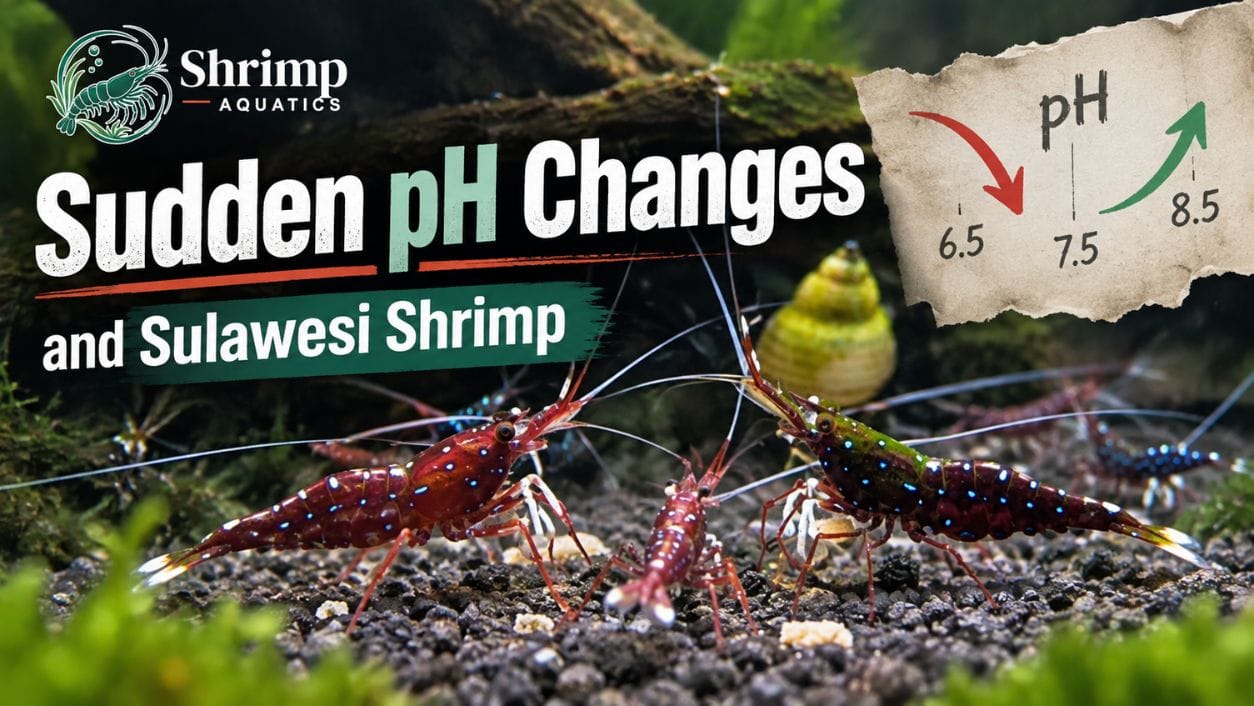
If the pH reading in your Sulawesi tank has moved and the shrimp are behaving strangely, the speed of the move matters more than the number it landed on. These shrimp come from lakes that barely change from one year to the next, and the shift itself is what hurts them. So your first job isn’t to correct the pH. It’s to confirm the reading is real. Then stop adding anything, get more air into the water, and bring the chemistry back over days with water you mixed and matched outside the tank. A pH adjuster poured into a tank that’s already moving is the second shock, and it’s the one keepers cause themselves.
Check whether your Sulawesi tank really moved, or only the test did
Before anything else: did the water change, or did the measurement? We know the question feels like a delay when shrimp are behaving oddly. But a false reading sends keepers into a correction the tank never needed, and that correction is far more dangerous than the reading was.
Three things make a pH number lie. Liquid reagents age and drift, often reading low after a year in a warm room. A digital probe that hasn’t been calibrated against fresh buffer solution wanders, and it wanders fastest in the alkaline range Sulawesi shrimp live in. And pH genuinely rises and falls a little across a day in any tank, so a morning reading and an evening reading are not the same test.
- Retest with a second method. If your drop kit and your probe disagree, you have a test problem, not a tank problem.
- Calibrate the probe with fresh buffer, then read again.
- Check the reagent date, and open a new bottle if it’s more than a year old.
- Take the reading at the same time of day you normally do.
- Don’t compare a fresh reading against a number you half remember from last month. Read KH, GH and TDS now, and compare those instead.
KH is the useful cross-check here. Your pH sits on top of your carbonate level, so a genuine downward move almost always shows up as a lower KH first. If KH is exactly where it has always been and TDS hasn’t moved either, treat the pH reading as suspect until a second method agrees with it. Learn your tank’s usual number by heart, because a Sulawesi shrimp KH that has slipped a degree is the earliest warning you get.
A Sulawesi pH drop and a pH spike are different emergencies
Once you’re satisfied the move is real, the direction tells you what you’re dealing with and how fast you need to move.
The pH fell
Something is producing acid faster than your water can absorb it, or the carbonate that absorbs it has run out. Left alone, a falling pH keeps falling, and the fall accelerates once KH reaches zero because nothing is holding the number up any more. Read KH immediately. A KH at or near zero alongside a low pH is the clearest version of this. It means the correction has to increase KH in the Sulawesi tank, not just push the pH number back.
The pH rose
A rise is nearly always something you added. It might be a batch of mineral water with carbon dioxide still coming out of it, a carbonate-heavy salt dosed straight into the tank, or a large replacement volume that didn’t match. A rise rarely keeps climbing on its own, so the animals are usually reacting to the jump rather than to a runaway. The danger here is indirect, and it’s ammonia.
Here’s why a rising pH deserves respect even when the new number is still inside the range you keep. Ammonia in water sits in two forms, and only the un-ionized form drives toxicity. The share in that toxic form increases roughly tenfold for each rise of a single pH unit, and roughly twofold for each 10 degrees Celsius of warming.1 Your tank is already at 79-86°F (26-30°C), which is the warm end of that relationship, so a trace of ammonia that your colony tolerated at pH 7.6 is a different animal at pH 8.4. Test ammonia and nitrite the moment you see the pH has climbed, before any attempt to lower pH in a Sulawesi shrimp tank. If either reads above zero, that’s your emergency, not the pH itself.
In the first hour, stabilize the Sulawesi tank instead of correcting it
The instinct in the first hour is to fix the number. Resist it. Everything in this list buys the colony time without moving the chemistry again, and nothing in it is hard to undo.
- Stop feeding. Nothing goes in until the tank is steady again. Uneaten food in warm water is the fastest way to turn a chemistry problem into an ammonia problem.
- Turn the lights off or right down. It calms the colony and it slows plant and algae activity, which is one of the things pushing pH around across the day.
- Turn the air up. Add a second air stone if you have one, and raise the outlet so the surface is genuinely moving. Warm water holds less dissolved oxygen than cool water,2 and a stressed colony at 79-86°F (26-30°C) needs every bit of it. More surface exchange also lets excess carbon dioxide leave, which is often enough on its own to walk a pH back up gently.
- Stop every additive. Fertilizers, bacteria doses, carbon sources, mineral top-ups, carbon dioxide injection if you run any. All of it pauses.
- Leave the substrate alone. Don’t dig, don’t deep clean, don’t rearrange rock. Lift what’s loose on the surface with narrow tubing if you must, and nothing more.
- Write the numbers down. pH, KH, GH, TDS, temperature, ammonia and nitrite, with the time beside them. You’ll need to know later whether the tank is recovering or still drifting, and memory is not good enough for that.
Do not dose a pH product
A commercial pH adjuster, or baking soda tipped into the tank, moves the number fast. It moves sodium and total dissolved solids with it. A colony that has just absorbed one shift then absorbs a second one, in the opposite direction, from a keeper trying to help. If you take one thing from this page: the correction kills more Sulawesi shrimp than the crash.
Bring a Sulawesi tank back with matched water, not a pH product
The safe correction is boring on purpose. You remake water outside the tank to the numbers you normally hold, you test the finished batch, you match its temperature, and you let it in slowly. Then you do it again tomorrow.
| pH | 7.5-8.5 |
|---|---|
| KH | 3-6 dKH |
| GH | 4-8 dGH |
| TDS | 150-250 ppm |
| Temperature | 79-86°F (26-30°C) |
| Nitrate | under 10 ppm |
Aim the batch at where your tank normally sits inside those numbers, not at the middle of them. If your colony has lived at the lower end for a year, that’s the target. The point here is to stop the water moving, not to relocate it somewhere theoretically better.
Then take your time getting it in. Small volumes, dripped through airline with a knot or a valve in it, repeated daily, will get a badly drifted tank home over a week. Give each one an hour or more. A single large matched change will not, however good the batch is. If mixing is the part you’re least sure of, get that right first, because remineralizing RO water for Sulawesi shrimp is where most of these emergencies actually start.
How slowly is slowly enough? No study has measured a safe rate of pH change for any Sulawesi lake Caridina, and at Shrimp Aquatics we’d rather say so than invent a figure. Every number quoted in the hobby is somebody’s habit. The direction of the error isn’t in doubt. A correction spread over days has cost keepers nothing. A correction spread over an hour has cost them colonies. Err slow.
Find what moved the pH in your Sulawesi tank
Stabilizing buys you time. It doesn’t stop the thing that caused this, and in three of the four common cases the cause will do it again next week. So what actually moved it? Work through these in order. The first is both the most common and the only one you can’t fix with a change of habit.
Soil made for bee shrimp is pulling your pH down
This is the big one, and it’s usually invisible until the buffer gives out. Active soils made for bee and crystal shrimp are engineered to hold water at pH 5.8-6.8 with almost no carbonate behind it, at KH 0-2 dKH. They do that by stripping carbonate out of whatever water you put on top of them. Pour alkaline Sulawesi water onto that bed and the soil does exactly what it was built to do. For a while the mineral salt you keep adding wins, and then it doesn’t.
There’s no dosing your way out of this one. The bed has to come out and be replaced with something inert, which is a Sulawesi shrimp tank reset rather than a fix. Plan it properly, because you only want to move the colony once, and pick the best substrate for Sulawesi shrimp you can live with for years before you start stripping anything out.
Nitrification has used up the carbonate holding your pH up
Your filter is quietly consuming alkalinity every day. Converting ammonia through to nitrate is an acid-producing process, and the alkalinity it destroys is real and measurable. Wastewater engineers budget for roughly 7.14 parts of alkalinity as calcium carbonate destroyed per part of nitrogen oxidized, and the process lowers pH as it goes.3 Your tank does the same thing on a smaller scale, all the time.
A tank held at KH 3-6 dKH doesn’t have an enormous reserve to spend. If you top off with pure water and change little, that reserve slowly drains. The pH holds steady for months because carbonate is doing its job, then falls off a cliff when there’s nothing left. The fix is a habit, not a product. Read KH on a schedule, and treat a falling KH as the early warning it is.
Mineral water went in before the carbon dioxide came out
This one catches careful keepers, because it’s a side effect of doing something right. Carbonate-heavy Sulawesi salts don’t dissolve on their own. The manufacturer of Sulawesi Mineral 8.5 states the product needs additional measures to dissolve, and that it almost totally dissolves when carbon dioxide is added over roughly 3-4 days. The water must then be aerated with an air stone for at least three hours to expel that carbon dioxide before use.4 Skip or shorten the aeration step and you’re pouring carbonic acid into your tank. The pH drops immediately, then climbs back as the gas leaves, and the shrimp ride both directions.
The lower-pH formulation behaves differently. The maker states Sulawesi Mineral 7.5 almost totally dissolves within seconds, is ready for use immediately, and buffers the pH at around 7.5.5 It asks less of you at mixing time. That’s a real advantage if this is the mistake you keep making.
You’ve been topping off with remineralized water instead of plain RO
Evaporation takes water out and leaves the dissolved solids behind, concentrating what’s left.6 Replace that lost water with more mineral water and you add solids on top of solids, week after week. Nothing carries the minerals back out. TDS climbs, the mineral balance skews, and the tank drifts somewhere it has never been. Nobody notices until a water change finally corrects it hard, and the shrimp pay for that correction.
Top-offs are plain RO water, every time. The mineral salt only goes into water that is replacing volume you removed, never volume that evaporated.
What the week after a pH swing looks like, and when losses should stop
Expect the tank to look worse before it looks better, and expect the next round of losses to arrive at the molts rather than immediately. A crustacean draws most of the calcium for its new shell from the water it’s sitting in rather than from its food.7 So a shrimp that molts while the mineral content of your water is still moving is doing the hardest thing it does under the worst conditions. That’s why steadiness matters more than speed now.
Leave the shed shells where they fall. If you find a shrimp stuck partway out of its old shell, don’t try to free it. Handling adds a shock to an animal that has already had one, and a Sulawesi shrimp stuck in a molt is better left where it is while you steady the water around it.
Otherwise, keep your hands out of the tank for a week or so. Small matched additions, daily readings, no feeding until you see the survivors grazing normally again, and then very light feeding. If losses keep arriving after the chemistry has been steady for several days, or if ammonia or nitrite read above zero at any point, stop guessing. Email contact@shrimpaquatics.com with your pH, KH, GH, TDS, temperature, tank size, how long it has run and what you changed most recently. We’ll work through it with you.
References
7 Sources
- Aquatic Life Ambient Water Quality Criteria for Ammonia, Freshwater, U.S. Environmental Protection Agency, Office of Water, April 2013.
- Dissolved Oxygen and Water, U.S. Geological Survey, Water Science School, updated August 24, 2026.
- Long Island Sound Nitrogen Removal Training Program, Module 4: Fixed Film Operational Strategies, SUNY Farmingdale, hosted by the New York State Department of Environmental Conservation, 1997.
- Sulawesi Mineral 8,5, Minerals and trace elements, SaltyShrimp (Garnelenhaus), product technical page, no revision date shown.
- Sulawesi Mineral 7,5, Minerals and trace elements, SaltyShrimp (Garnelenhaus), product technical page, no revision date shown.
- Chloride, Salinity, and Dissolved Solids, U.S. Geological Survey, Water Resources Mission Area, March 1, 2019.
- Biomineralizations: insights and prospects from crustaceans, ZooKeys 176, 103-121, 2012.