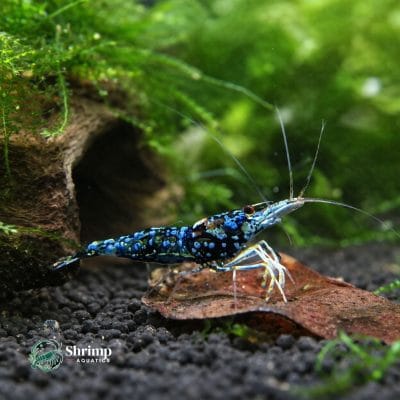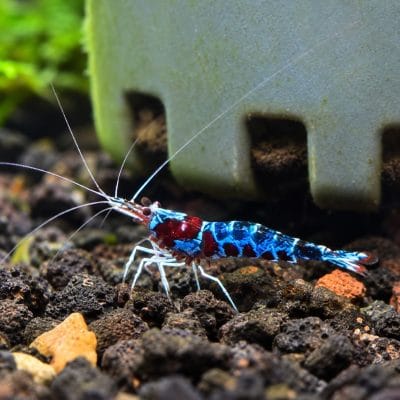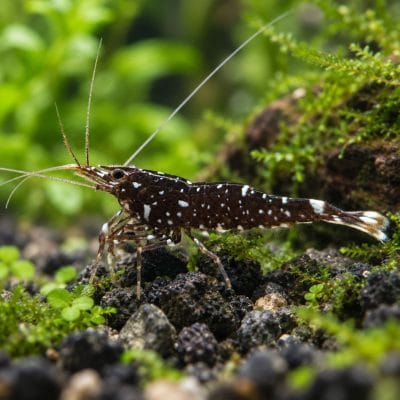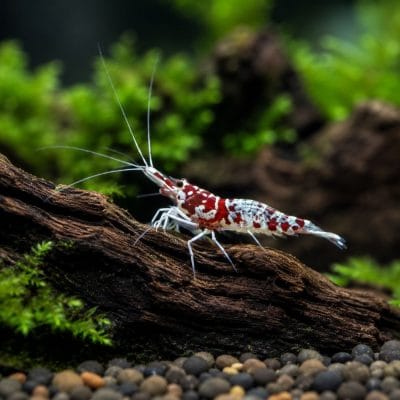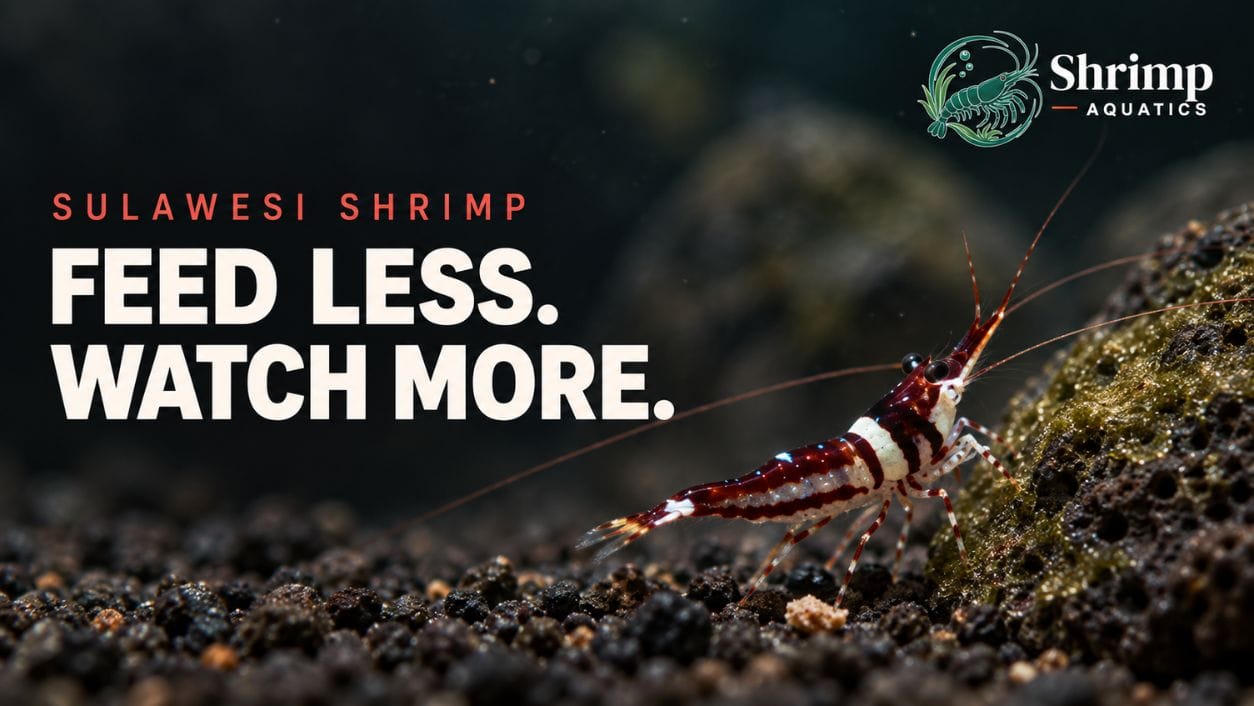
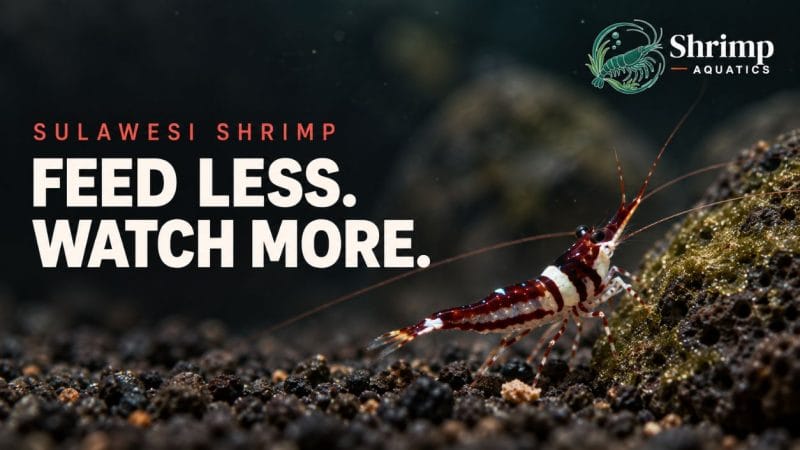
Less than most keepers expect, and less often than the label on a shrimp food suggests. No feeding ration has been measured and published for Sulawesi shrimp (Caridina spp. from the Sulawesi lake systems), so there’s no gram figure to copy. In an established tank the biofilm and algae on the hardscape are the main thing these shrimp graze, and the prepared food is a top-up on that. The workable rule is a portion small enough that nothing is left for you to take back out.
Why the biofilm in a Sulawesi tank sets the portion, not a chart
Mature biofilm, aufwuchs and algae are important grazing resources for this group. In a tank with well colonized rock, they’re available all day rather than at feeding time. That’s why a per shrimp weight is the wrong unit for the question. A three month old tank with a thin film on smooth stones and a two year old tank with textured rock covered in a soft green layer can hold the same twenty shrimp and need very different amounts of prepared food. In one of them the shrimp are already eating between your feedings. In the other they aren’t.
So where do you start? Look at the rock, not the headcount. If the hardscape carries a visible film and the shrimp are working over it steadily, prepared food is a supplement and the portion can be tiny. If the surfaces look scrubbed and pale, the tank is producing less than the colony is taking. The fix is more grazing surface and a longer light period, not a bigger pinch of powder.
Acceptance varies as well. Some Sulawesi species and lines take prepared food readily and others show very little interest in it. So a portion that vanishes in one tank can sit untouched in another. Watch what your own animals do with it before you settle on an amount.
How often to offer prepared food to a grazing Sulawesi colony
Frequency matters more than the size of the pinch, because the risk isn’t the food itself but the fraction of it that stays in the tank and breaks down.
At Shrimp Aquatics, mature algae and biofilm do most of the feeding in our Sulawesi systems. We normally offer prepared food only about once a week and remove leftovers, both because many of the shrimp in these systems show limited interest in it and because food that sits in warm water adds organic waste and can raise ammonia, nitrite and nitrate as it breaks down.
That cadence suits a mature, lightly stocked tank whose rock is already feeding the colony. A younger tank, a denser colony or a line that eats prepared food eagerly can justify more. The way to find out is to move one step at a time and let the tank answer. Offer a small amount, watch what happens to it, and let the result decide the next portion.
- Nothing is left to siphon out after the shrimp have finished with it.
- The film on the hardscape is still there the next day, so the colony isn’t stripping its grazing base between feedings.
- The shrimp go back to grazing the rock and leave the spot where the food went in.
- If you’re regularly removing uneaten food, the portion was too big, and the next one is smaller rather than the same size offered less often.
What a shrimp powder’s label dose assumes about your tank
Of everything Sulawesi shrimp eat, powdered biofilm foods are the format that suits a grazing colony, and they come with real dosing instructions, which is more than any Sulawesi care sheet offers. GlasGarten’s instructions for Bacter AE, for roughly 120 liters of aquarium water, are half a measuring spoon once daily at low stocking, one spoon once daily at normal stocking and one spoon twice daily at high stocking.1 One spoon holds approximately 0.5 g, and the manufacturer suggests you start at half the dosage for about a week.1 Spirulina powders and wafers raise the same portion question: Sulawesi shrimp eat spirulina readily enough, so what matters is the share they leave behind.
Read that as what it is. It’s the manufacturer’s instruction for its own product at a stated volume and stocking level, written for shrimp keeping in general. Nothing in it knows how much your rock is already producing. In a mature Sulawesi tank that’s lightly stocked and well grazed, a daily dose at that scale is far more organic input than the colony is taking out of the water. Treat the label figure as the ceiling and work upward from a much smaller amount, not downward from the tin.
Portion discipline matters more here than in most shrimp tanks
An overfeed that a Neocaridina tank would absorb without much sign can cost you animals in a warm alkaline system. If you’re unsure, feed less and feed again sooner.
Why an overfeed costs more in warm alkaline Sulawesi water
Total ammonia in water sits in two forms, the ammonium ion and un-ionized ammonia, and it’s the un-ionized form that drives toxicity. High external concentrations reduce or reverse diffusive gradients and cause ammonia to build up in internal tissues and blood. The share present as un-ionized ammonia isn’t fixed. The ratio of un-ionized ammonia to ammonium ion in fresh water increases by tenfold for each rise of a single pH unit, and by approximately twofold for each 10 degree Celsius rise in temperature from 0-30 degrees Celsius.2
A Sulawesi tank runs at pH 7.5-8.5 and 79-86°F (26-30°C), which sits at the top of both of those relationships. The same reading on the same test kit therefore represents a larger share of the toxic form than it would in a cooler, more acidic Caridina tank. Decomposing food is exactly where that ammonia comes from. Warm water also holds less dissolved oxygen than cold water3, so the tank has less room to spare while it processes whatever you added.
None of that makes these shrimp fragile animals. It makes the same mistake more expensive. That’s why the safe direction of error in this group is feeding too little, and why leftovers come out instead of being left to break down.
Feeding a Sulawesi tank that’s still building its grazing surfaces
A new tank is the situation where keepers reach for food hardest and where it does the most damage. Supplemental feeding can’t compensate for an immature system. The biological filter and the grazing surfaces both take time. Adding prepared food to a tank that has neither means the organic load lands in the system least able to process it.
While a tank is maturing, the levers that matter are light on the hardscape, patience and confirmed zero ammonia and nitrite before shrimp arrive. Prepared food during that period is there to seed microbial growth, not to feed animals, and it comes back out. Once shrimp are in, keep the portion smaller than you would in a settled tank for the first weeks, and let the film build up ahead of the colony.
Will feeding more give you bigger Sulawesi shrimp or more shrimplets?
It won’t, and the reason is structural. Like other crustaceans, shrimp have to cast the exoskeleton in order to grow.4 So length arrives in steps at each molt and no amount of food adds size in between. Feeding for growth mostly buys you waste.
The one controlled feeding trial published on a Sulawesi species gives a sense of the scale involved. Working with Caridina dennerli averaging 1.445 cm total length, researchers compared commercial pellets against a bacterial starter, each paired with either Hydrilla or stone as shelter.5 They measured growth and survival over 30 days for the pellet groups and 37 days for the starter groups.5
| Feed and shelter | Trial length | Average total length gain | Survival |
|---|---|---|---|
| Pellets with Hydrilla | 30 days | 0.119 cm | 72.727% |
| Pellets with stone | 30 days | 0.079 cm | 40.909% |
| Bacterial starter with Hydrilla | 37 days | 0.017 cm | 22.727% |
| Bacterial starter with stone | 37 days | 0.013 cm | 31.818% |
Those are the conditions of one trial rather than a schedule for a home tank. The survival column belongs to that setup, not to shipped or home kept stock. What it’s useful for is calibration. The best performing combination moved these shrimp about a tenth of a centimeter in a month. A keeper watching for visible growth week to week has no lever to pull. The honest read is that feed type and shelter mattered, and nothing in the trial suggests that a larger portion would have done more.
Molting is worth a separate word, because mineral rich foods are often sold as the answer to failed molts in Sulawesi shrimp. The major source of calcium for crustacean exoskeleton calcification is exogenous, meaning the water the animal lives in, with stored premolt reserves and diet contributing less.6 If molts are the concern, the water is the place to look, and feeding more of a mineral food isn’t the same lever.
Adjusting the portion as your Sulawesi colony grows
A colony that’s breeding changes both sides of the equation at once. There are more mouths, but there’s also more grazing pressure on the same rock. So the surfaces get cleaned faster and the tank produces less between feedings than it used to. Raise the portion in small steps, keep applying the leftovers test after each one, and add grazing surface when the film stops keeping up. More textured rock feeds the colony without adding anything to the water.
Stocking lightly at the start keeps this whole question simple, because a small group in a well grazed tank barely needs you. The tank-bred Sulawesi shrimp we breed are listed line by line. So you can begin with one group and let it build. Feed the tank you have this week, not the colony you’re hoping for next year.
References
6 Sources
- Bacter AE, for bio film and shrimp rearing feed, GlasGarten, updated December 25, 2024.
- Aquatic Life Ambient Water Quality Criteria for Ammonia, Freshwater (2013), U.S. Environmental Protection Agency, Office of Water, April 2013.
- Dissolved Oxygen and Water, U.S. Geological Survey, Water Science School, updated August 24, 2026.
- Farming freshwater prawns, biology chapter, Food and Agriculture Organization of the United Nations, FAO Fisheries Technical Paper T428.
- Effect of Using Different Shelter and Feed Types on Growth and Survival Rate of Sulawesi Endemic Ornamental Shrimps (Caridina dennerli), journal PDF, Jurnal Ilmiah PLATAX 13(1), 2025.
- Biomineralizations: insights and prospects from crustaceans, ZooKeys 176, 2012.
Ready to get started?
Shop our Sulawesi Shrimp collection
27 products available · Live Arrival Guarantee