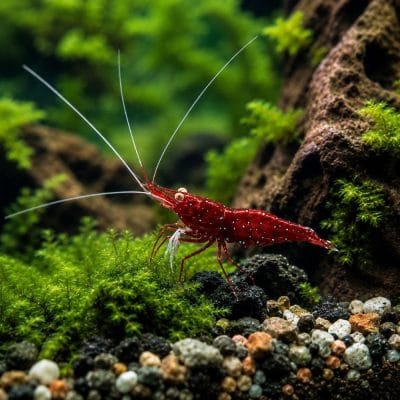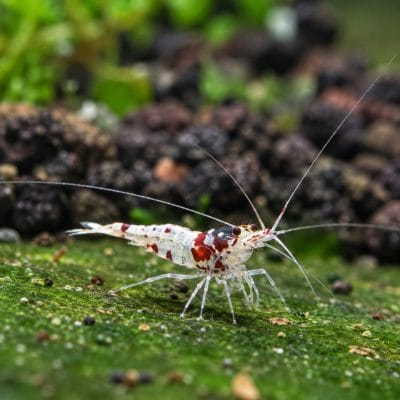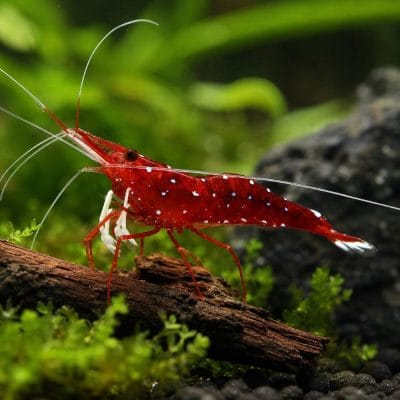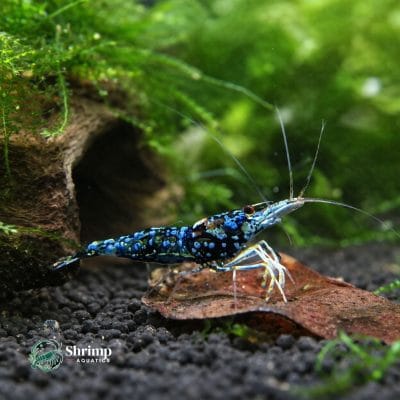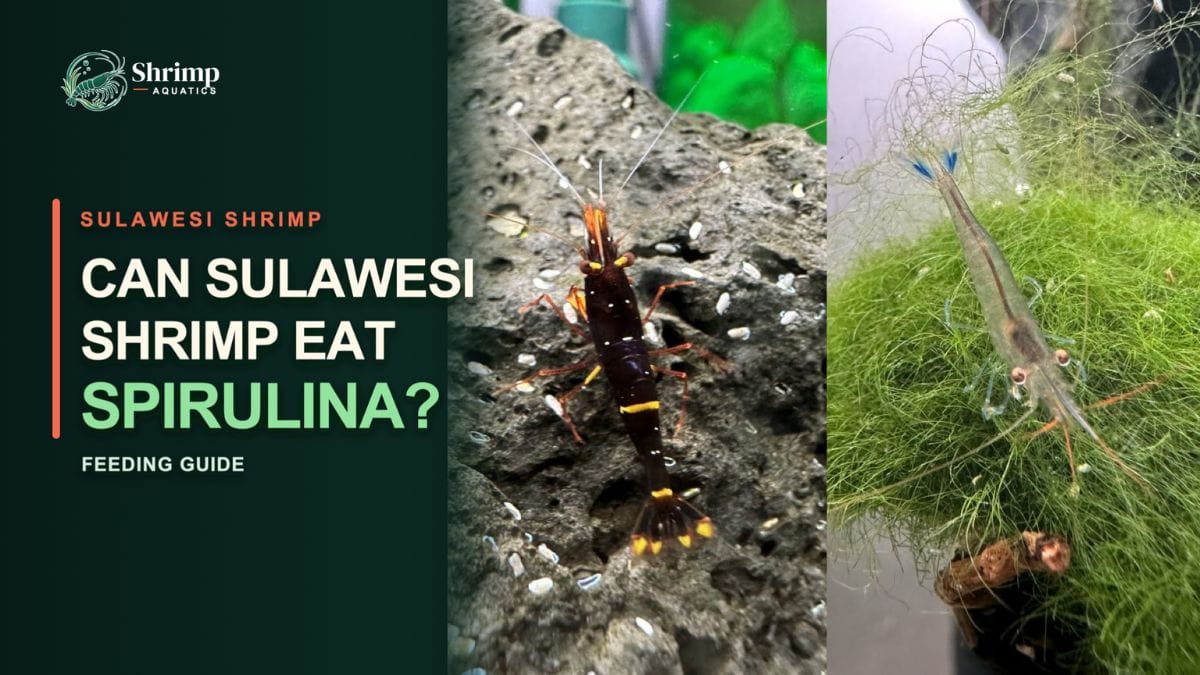
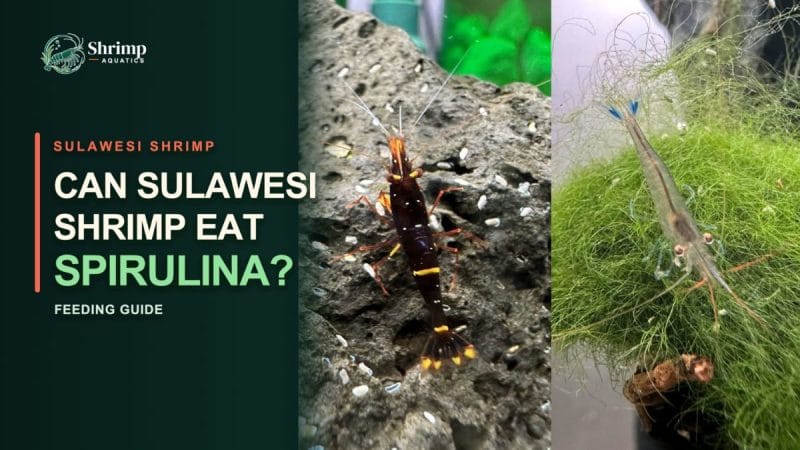
Yes. Sulawesi shrimp will graze spirulina, and nothing about them makes it a strange food. These lake Caridina spend their day scraping biofilm, aufwuchs and algae off rock. Spirulina (Arthrospira platensis) reaches the tank as a dried powder or pressed into tablets and wafers. The useful question isn’t whether they can eat it. It’s what the share they don’t eat does to a tank held at 79-86°F (26-30°C) and pH 7.5-8.5. There the same amount of leftover food is harder on the animals than it would be in a cooler, softer shrimp tank.
Has anyone tested spirulina on Sulawesi shrimp?
No spirulina feeding trial has been published for a Sulawesi lake Caridina, so anyone telling you what it will do to your colony is extrapolating. The closest thing this group has to feeding data is a 2025 rearing trial on Caridina dennerli. It compared commercial pellets against a bacterial starter, with either stone or Hydrilla as shelter.1 Spirulina wasn’t one of the treatments, but the result still matters here. It’s the one measurement showing that a prepared food outperformed a bacteria-first approach in this group without simply fouling the water.
| Animal tested | What was fed | What was measured | Why it only partly answers this question |
|---|---|---|---|
| Caridina dennerli, a Sulawesi lake species | Commercial pellets or a bacterial starter, each with stone or Hydrilla shelter | Shrimp started at 1.445 cm average total length. Pellets with Hydrilla gave 0.119 cm of length gain over 30 days and 72.7 percent survival. The bacterial starter with stone gave 0.013 cm over 37 days and 31.8 percent survival.1 | Spirulina was never offered, and the survival figures describe that trial rather than what a home colony should expect |
| Neocaridina davidi, red cherry shrimp, same family | Formulated diets containing 0, 1, 3, 5, 8 or 10 percent Arthrospira platensis meal, fed for 11 months | Growth indicators were highest at 10 percent inclusion. Female survival reached 75-81 percent at 8-10 percent inclusion against 25-73 percent in the other groups. Hatching reached 91-94 percent against 78-84 percent at the lower doses.2 | A different genus kept in cooler, softer water, and spirulina milled into a compound diet rather than powder dosed into a tank |
Read together, those two lines of evidence support something narrower than the claims on a tub of powder. Spirulina is a reasonable ingredient for a dwarf shrimp, and prepared food isn’t automatically a mistake in a Sulawesi tank. Neither result tells you a dose, a frequency or an outcome for a Caridina species from the Sulawesi lakes.
Will spirulina improve color or help Sulawesi shrimp molt?
Those are the two reasons most keepers buy it, and they hold up differently. On color, the cherry shrimp study that does exist measured growth, survival, body composition and reproduction, not pigmentation.2 So a deeper red or a cleaner white is something you may see and can’t plan on. Lighting, genetics, age and stress all move visible color as well, which is part of why single-variable claims about food and color are so hard to stand behind.
On molting, the mechanism argues against the marketing. In crustaceans the major source of the calcium used to build a new exoskeleton is exogenous, meaning the water the animal lives in. Food, including eaten molts, is a minor contribution.3 If you’re dealing with a failed molt in Sulawesi shrimp, the productive move is to check GH and KH against the Sulawesi range of 4-8 dGH and 3-6 dKH. Then look at what has changed in the water recently. Adding a protein-rich powder to a tank with a molting problem usually adds a waste problem on top of it.
Why leftover spirulina is more dangerous in a warm alkaline Sulawesi tank
Spirulina is a high-protein food, and whatever the shrimp don’t eat is broken down by bacteria into nitrogen compounds. What happens next depends on the water it breaks down in. Total ammonia in fresh water sits in equilibrium between the ammonium ion and un-ionized ammonia, and it’s the un-ionized form that drives ammonia toxicity in aquatic animals. That ratio increases by 10-fold for each rise of a single pH unit. It rises by roughly two-fold for each 10 degrees Celsius rise in temperature between 0 and 30 degrees Celsius. Where external un-ionized ammonia is high, it reduces or reverses diffusive gradients and ammonia builds up in internal tissues and blood.4
That relationship is the whole reason generic shrimp feeding advice travels badly. A Sulawesi tank sits at pH 7.5-8.5 and 79-86°F (26-30°C). A Bee and Crystal Caridina tank sits at pH 5.8-6.8 and 60-72°F (15.5-22°C). The same test kit reading of total ammonia means a considerably higher ammonia toxicity risk in the first tank than in the second. The food you drop in is the fastest way for a keeper to create that reading.
Temperature works against you a second time. Cold water can hold more dissolved oxygen than warm water.5 So the warm end of the Sulawesi range gives you less oxygen margin at the same aeration. That’s exactly the moment a decomposing feeding is making the biological demand on it higher.
Feed less than feels right
The nitrate target for a Sulawesi tank is under 10 ppm, and prepared food is the quickest way to spend that headroom. If you can’t tell whether the colony finished a portion, the portion was too big.
How to offer spirulina without fouling a Sulawesi tank
- Grow the grazing surface first. Mature biofilm, aufwuchs and algae on rock and glass are what this group actually lives on, and supplemental food doesn’t make up for the lack of a mature Sulawesi tank. Wait for that film before you add shrimp at all. A tank that has already grown one is a far better place for a colony of tank-bred Sulawesi shrimp than a fresh setup.
- Prefer a bound form over loose powder. A pressed tablet, a sinking stick or a baked wafer stays where you put it and can be lifted out whole. Dry powder floats, spreads on the surface film and settles into rock crevices you can’t siphon.
- If you only have powder, wet it before it goes in. Stir a small pinch into a cup of tank water and let it soak until it sinks, then release it low and close to the rockwork so it lands where you put it.
- Put it on a feeding dish. A shallow glass dish on the substrate keeps the food in one place, tells you at a glance how much is left. It makes removal a single siphon.
- Offer a crumb, not a portion. Start with visibly less than you think a colony that size needs and let the next feeding be decided by what was left over from this one.
- Siphon the remainder. Once the shrimp have lost interest, take whatever is still on the dish out with rigid airline tubing instead of leaving it to break down.
At Shrimp Aquatics, mature algae and biofilm do most of the feeding in our Sulawesi systems. We normally offer prepared food only about once a week and remove leftovers. Many of the shrimp in these systems show limited interest in it. Food that sits in warm water adds organic waste and can raise ammonia, nitrite and nitrate as it breaks down. Mature algae and biofilm still carry most of the feeding, the starting point of what Sulawesi shrimp eat.
Treat that weekly rhythm as a starting point. How much to feed your own Sulawesi shrimp depends on how much film the rock is carrying and how many shrimp are grazing it. The tank tells you more than a schedule does.
What to watch in the tank for two days after a spirulina feeding
A single feeding is also a test of whether your tank can absorb one. Check these in the day or two after it, while the result is still attributable.
- The dish is empty or has been siphoned, and nothing green has drifted into the rockwork or settled under the substrate.
- Ammonia and nitrite still read zero the morning after, and you’ve actually tested it.
- The shrimp are out and grazing across the hardscape instead of sitting still in one place or gathering at the surface.
- Nitrate hasn’t stepped up from where it normally sits after a water change.
- Don’t scale the portion up because the food vanished quickly. Fast disappearance tells you the colony was hungry, not that the system can process more waste.
If two offerings in a row go untouched, stop for several weeks and put the effort into light duration and grazing surface instead. Nothing about this group requires spirulina. A colony grazing well-established rock in stable water is in a better position than one being fed on a schedule it never asked for.
References
5 Sources
- Effect of Using Different Shelter and Feed Types on Growth and Survival Rate of Sulawesi Endemic Ornamental Shrimps (Caridina dennerli), journal PDF, Jurnal Ilmiah PLATAX 13(1): 191-204, Universitas Sam Ratulangi, 2025.
- Effects of dietary incorporation of Arthrospira (Spirulina) platensis meal on growth, survival, body composition, and reproductive performance of red cherry shrimp Neocaridina davidi (Crustacea, Atyidae) over successive spawnings, article abstract, Journal of Applied Phycology 30: 431-443, 2018.
- Biomineralizations: insights and prospects from crustaceans, ZooKeys 176: 103-121, 2012.
- Aquatic Life Ambient Water Quality Criteria for Ammonia, Freshwater, U.S. Environmental Protection Agency, Office of Water, April 2013.
- Dissolved Oxygen and Water, U.S. Geological Survey, Water Science School, updated August 24, 2026.
Ready to get started?
Shop our Sulawesi Shrimp collection
27 products available · Live Arrival Guarantee
Featured Sulawesi Shrimp
Sulawesi Orange Eyes White Sock
Caridina dennerli
Advanced · 79–86°F · pH 7.5–8.5
From $19.99View Product