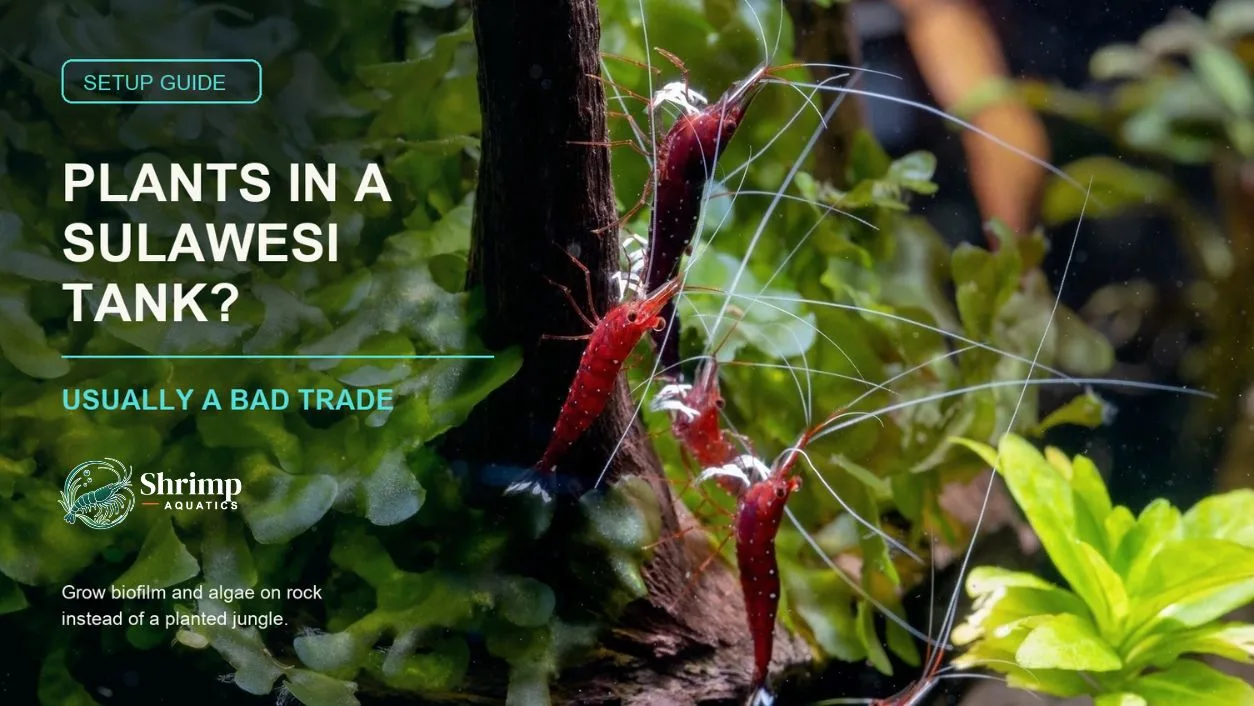
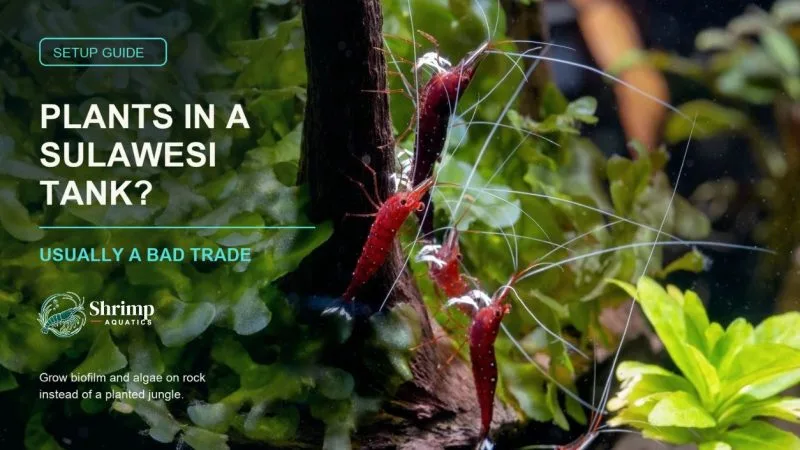
Can you grow aquatic plants in a Sulawesi shrimp tank? For most keepers, no, because water held at 79-86°F (26-30°C) and pH 7.5-8.5 leaves plants almost no free carbon dioxide to work with. Worse, any leaf that melts there becomes a far more dangerous source of ammonia than it would in a soft water shrimp tank. If you want green, grow it as biofilm and algae on inert rock. Still want a real plant? Keep it to one or two epiphytes tied to stone, and treat them as something you watch, not something you plant and forget.
Why alkaline Sulawesi water starves most aquarium plants of carbon
Plants build tissue from dissolved inorganic carbon, and the cheapest form for them to use is free carbon dioxide. At the pH a Sulawesi tank is held at, there’s very little of it. Above neutral pH, bicarbonate is usually present at several times the concentration of free carbon dioxide.1 The carbon is in the water. It’s just locked up in a form that’s harder to reach.
About half of submerged aquatic plant species can use bicarbonate as an alternative source of inorganic carbon. Their affinity for it is lower, though, and it costs them more than carbon dioxide does.1 That’s a more useful picture than the usual advice to pick something hardy. Plants can live in alkaline water. The trouble is that in a tank held to the Sulawesi shrimp care parameters of pH 7.5-8.5 and KH 3-6 dKH, roughly half the species on the shelf have no route to the carbon at all. The half that do are paying extra for it and growing more slowly as a result.
And the heat? A Sulawesi tank also runs at 79-86°F (26-30°C). We have no eligible source that shows how the plants people usually ask about cope with sustained temperatures in that range. So treat every species suggestion for a Sulawesi tank as untested, including the short list further down this page. Guides that promise you a plant will be fine at these temperatures aren’t working from published evidence either.
A melting leaf releases more toxic ammonia at Sulawesi pH and temperature
Total ammonia in water splits between the ammonium ion and un-ionized ammonia, and pH and temperature set that split. The un-ionized form is the one that drives ammonia toxicity in aquatic animals.2 Its ratio to ammonium rises about tenfold for every single pH unit, and roughly doubles for every 10 degree Celsius rise in temperature.2
A Sulawesi tank sits high on both scales at once. Run the EPA speciation formula at the two ends of the range this group is kept in and you get the derived shares below.2
| Condition in a Sulawesi tank | Share of total ammonia that is un-ionized |
|---|---|
| pH 7.5 at 79°F (26°C) | about 1.9 percent |
| pH 8.5 at 86°F (30°C) | about 20 percent |
In the cool, acidic water that Bee and Crystal Caridina are kept in, the same formula puts the un-ionized share well under one percent. That gap is what most keepers miss when they carry planted tank habits across. A leaf melting in a soft water shrimp tank is untidy. The same leaf melting in a Sulawesi tank releases ammonia into water that turns a much larger fraction of it into the form that does the damage. And it does so in a system where you’re already trying to hold nitrate under 10 ppm.
What this doesn’t tell you
None of this gives you a safe ammonia number for Sulawesi shrimp. The EPA criteria were derived for the freshwater assemblage that agency studied, not for ornamental invertebrates. We have no eligible source that states a tolerated concentration for this group. The working rule is the one it’s always been for these tanks. You want a fully cycled system reading 0 ammonia and 0 nitrite with an established biological filter, and nothing added that creates avoidable decay.
Never fix a starving plant with active soil or fertilizer in a Sulawesi tank
When plants stall, the planted tank reflex is to give them what they’re missing, and both of the usual fixes work against this group. That’s why the plant question rarely stays a plant question for long.
Active, pH lowering aquasoil is what makes stem and root plants easy, and it’s the one substrate a Sulawesi setup rules out. This group is kept over inert substrate and hardscape, and an active, pH lowering substrate is excluded as a Sulawesi default. The whole point of the setup is to hold the water in the alkaline range these shrimp are kept in. A substrate whose job is to pull pH down is fighting pH 7.5-8.5 every day it sits in the tank.
Water column fertilizer is the other reflex. It adds nutrients to a system whose nitrate target sits under 10 ppm, so you’re loading the water to feed a plant that’s struggling for reasons fertilizer doesn’t solve. It’s also a product whose actual formulation you’d have to read.
Check the bottle, not the label claim
Copper and some fish medications can harm shrimp and snails. Read the ingredients on the specific product. Don’t assume a plant fertilizer, algae treatment or pest dip is safe for invertebrates because it’s sold for aquarium use.
Grow biofilm and algae on inert rock instead of plants in a Sulawesi tank
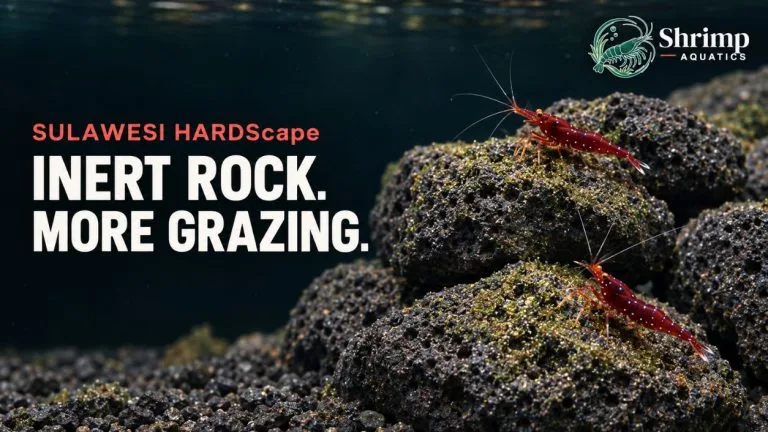
Rock gives a Sulawesi tank the grazing surface most people actually want from plants, and it does so more reliably than foliage. This group is kept in a mature, stable system with established grazing surfaces, and on inert stone those surfaces are biofilm and algae. Nothing in that layer can shed a leaf.
It’s the same argument as the one against plants, applied to something you can control. Anything that breaks down in a warm, alkaline tank feeds the same problem. A leaf you can’t pull out on a schedule is harder to manage than a feeding you can. Build the grazing surface instead of the foliage and you remove the decay risk while giving the shrimp their surface at the same time.
That doesn’t mean every Sulawesi species lives on algae alone. Acceptance of prepared food varies by species, by system and by the food itself, and supplemental feeding doesn’t make up for a tank that isn’t mature yet.
Mount epiphytes on inert stone if you still want a plant in a Sulawesi tank
If you want a plant anyway, pick the form before the species. Epiphytes attach to hardscape instead of rooting in substrate, so they don’t need the soil this setup can’t have. You can also lift one out of the tank in a single movement. Anubias and Java fern are the usual examples, with their rhizomes kept above the substrate and attached to hardscape. Java fern, Anubias, Java moss, many Cryptocoryne and Vallisneria are the common low tech candidates in general aquarium keeping. Requirements vary by species and by source water, and none of that list has been shown to hold up at Sulawesi temperature.
Attach them to inert hardscape rock, not wood. This setup calls for inert substrate and hardscape, and stone is the mount we can confirm meets that. We have no eligible source for how far a given piece of wood shifts pH in a tank held at KH 3-6 dKH. So leave wood out of these tanks instead of guessing.
At Shrimp Aquatics, we commonly use Sula Sand Volcanic Rock in our Sulawesi systems. It’s inert and has worked well in tanks where we need pH to remain steady.
If your Sulawesi shrimp share the tank with rabbit snails, factor the snails in before you buy the plant. Don’t assume any snail is plant safe without checking the species. Rabbit snails leave Anubias alone, but softer plants are another matter. One keeper’s two orange rabbit snails ate jungle val, Brazilian pennywort and water fern while leaving the Anubias and Java moss untouched. A snail that grazes soft foliage turns a plant you were watching into plant debris you now have to find and remove.
Plants from unknown systems may carry pesticides, pests or treatments that are risky to shrimp. Rinse a new plant thoroughly and hold it in a separate container before it goes anywhere near the tank. Tissue culture cups reduce the reason for doing this without removing it. Can’t find out what a plant was grown in or treated with? That’s a stronger reason to leave it out of a Sulawesi tank than out of any other tank you own. This is the setup with the least room for an avoidable problem.
When to pull a plant out of a Sulawesi shrimp tank
Decide the exit condition before the plant goes in. Almost all of the risk in this experiment lies in how long a failing plant stays in the water, and that’s the one variable you fully control.
- A leaf has gone translucent or soft, or is coming apart. Remove the whole leaf, not just the pieces that have already floated free.
- The plant has stopped putting out new growth. Take that as the point to remove it, without waiting to see whether it turns around.
- You’re reading ammonia or nitrite above 0 and the plant is the newest thing in the tank. Take it out and keep testing.
- You can’t lift the plant out in one piece. That’s your cue to remount it on a stone you can remove, before you need to.
The baseline for this group doesn’t move. It’s a fully cycled tank reading 0 ammonia and 0 nitrite with an established biological filter, held steady at 79-86°F (26-30°C) and pH 7.5-8.5. A plant earns its place in a Sulawesi tank only as long as it isn’t working against that. Once it stops being an ornament and starts being an input, it goes.
Once the tank is settled without plants and the grazing layer is established, the next decision is which tank-bred Sulawesi shrimp line to stock, not which plant to try.
References
2 Sources
- Acclimation of photosynthesis to supersaturated CO2 in aquatic plant bicarbonate users, Hussner, Mettler-Altmann, Weber and Sand-Jensen, Freshwater Biology. Hosted copy, University of Florida IFAS Aquatic Plant Information Retrieval System, accessed August 7, 2026.
- Aquatic Life Ambient Water Quality Criteria for Ammonia, Freshwater 2013, U.S. Environmental Protection Agency, Office of Water, April 2013.
Ready to get started?
Shop our Sulawesi Shrimp collection
27 products available · Live Arrival Guarantee
Featured Sulawesi Shrimp
Sulawesi Orange Eyes White Sock
Caridina dennerli
Advanced · 79-86°F · pH 7.5-8.5
From $19.99View Product