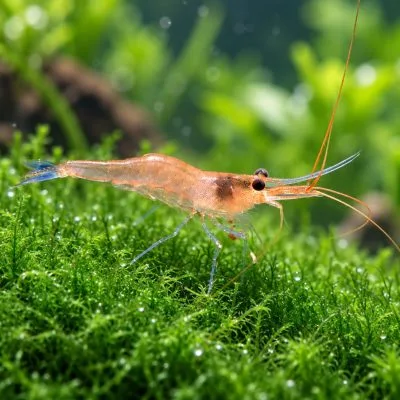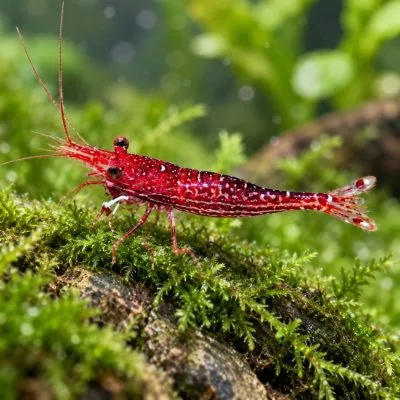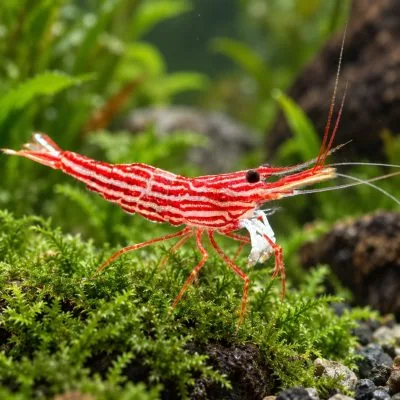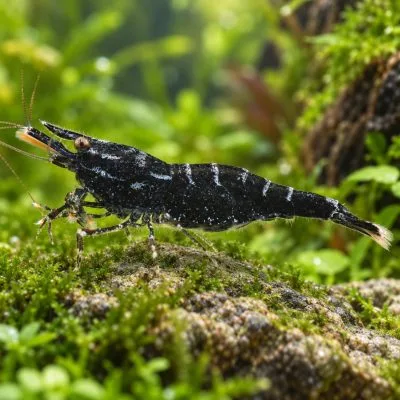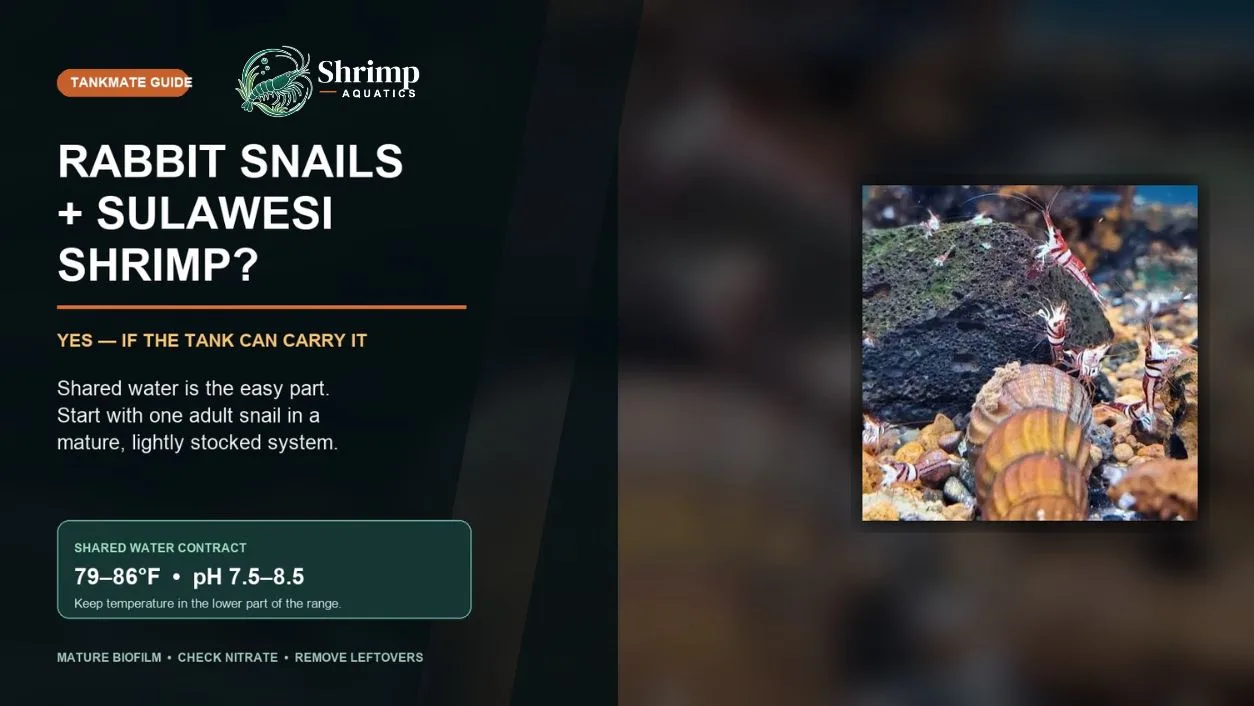
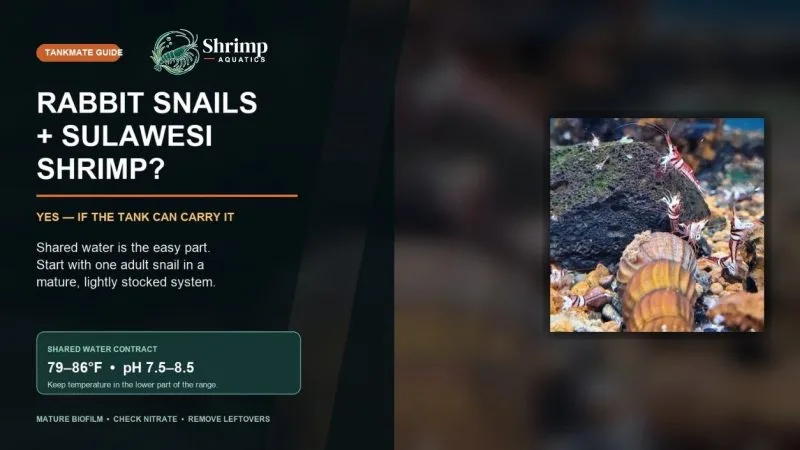
Your Sulawesi tank is running warm and alkaline, and a rabbit snail looks like the one tankmate that would fit straight in. Rabbit snails (Tylomelania spp.) are one of the few tankmates whose water genuinely matches Sulawesi shrimp, because the two animals come out of the same lakes. Chemistry isn’t what decides how this goes. Load is. A full grown rabbit snail is a big animal in a tank you’re deliberately keeping clean and lightly fed. So the useful question isn’t whether the snail can live in this water. It’s whether your tank can carry it. Sulawesi shrimp are an advanced to expert group either way, and a snail won’t make them any easier.
The water range Sulawesi shrimp and rabbit snails actually share
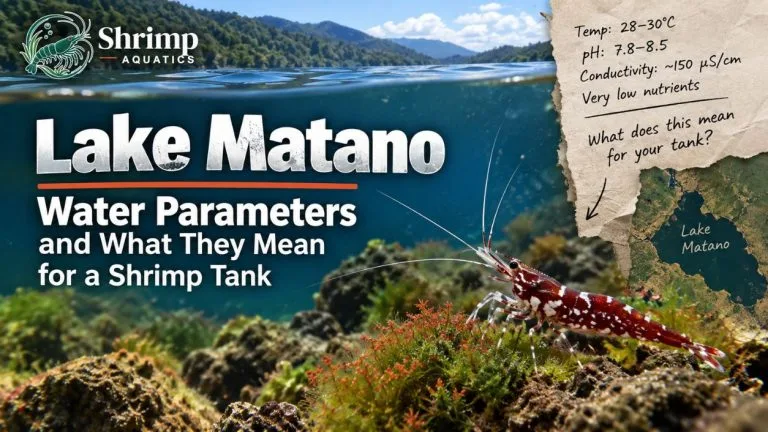
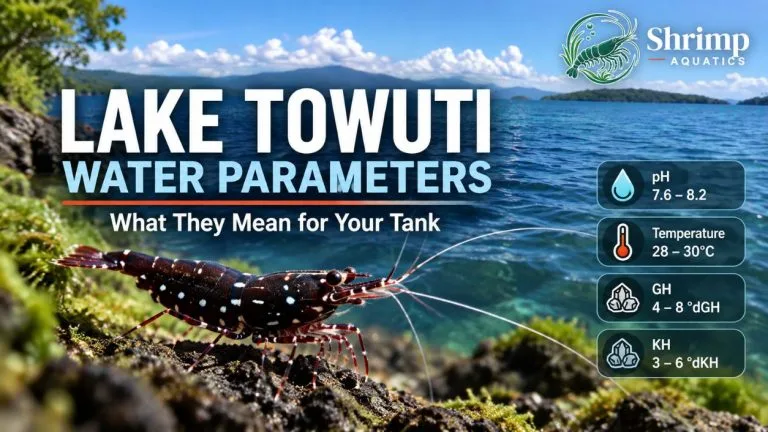
Sulawesi shrimp and rabbit snails share almost the whole water range, because both come from the same lakes. Rabbit snails aren’t a general aquarium snail that happens to tolerate heat. The genus Tylomelania is an endemic group of live bearing pachychilid snails found only in two central ancient lake systems on Sulawesi.1 Those are Lake Poso and the Malili lakes of Danau Matano, Mahalona and Towuti.1 Those two systems are different places, and where rabbit snails come from explains why you usually can’t tell which one yours traces back to. The lake Caridina sold as Sulawesi shrimp come from the same two systems.2 The standing revision of the group describes 15 species from the Malili lakes and 6 from Lake Poso.2 That shared origin is why the parameter argument most keepers brace for never really happens here. If you want the same water without a shrimp colony in it, Sulawesi rabbit snail care covers the tank and feeding on their own.
| Parameter | Sulawesi shrimp, typical range | Rabbit snails, reference guidance | Setting for a shared tank |
|---|---|---|---|
| Temperature | 79-86°F (26-30°C) | Warmer than most aquarium snails, but the published range doesn’t reach the top of the shrimp band; verify by species | Hold in the lower part of the shrimp range |
| pH | 7.5-8.5 | Neutral to alkaline; an unsuitable pH contributes to shell erosion | 7.5-8.5 |
| GH | 4-8 dGH | Enough dissolved minerals for shell growth, with no single threshold that fits every species | 4-8 dGH |
| KH | 3-6 dKH | Carbonate buffering that holds the pH steady | 3-6 dKH |
| TDS | TDS 150-250 ppm | Not published separately for this group | TDS 150-250 ppm |
| Nitrate | Aim for under 10 ppm | Not published separately for this group | Nitrate under 10 ppm |
| Substrate and hardscape | Inert substrate and hardscape, with no pH lowering soil | Open substrate to work over, plus surfaces to graze | Inert sand with an inert rock structure above it |
Temperature is the only line in that table where the two published ranges disagree, and only at the top end. Set the heater so the tank sits in the lower part of the Sulawesi band, and both animals stay inside their own range. Rabbit snail is also a trade name that covers several Tylomelania species, so check what you’re actually buying, because one range won’t fit all of them. Our guide to the types of rabbit snails explains what those names can and can’t tell you.
Where you settle inside these ranges matters less than holding it there. Both animals live in water you built from a remineralized base. A tank that wanders between the ends of these numbers is harder on them than one held steady anywhere inside them.
What a rabbit snail’s waste costs in warm alkaline water
In warm, alkaline water the same waste is more toxic, which is why experienced Sulawesi keepers hesitate over a big snail. Total ammonia in fresh water sits in balance between the ammonium ion and un-ionized ammonia, and it’s the un-ionized form that drives toxicity in aquatic animals.3 The share of un-ionized ammonia rises 10-fold for each rise of one pH unit, and roughly doubles for each 10°C rise in temperature between 0 and 30°C.3 You run a Sulawesi tank warm and alkaline on purpose, so the same total ammonia reading doesn’t mean here what it would in a cool, soft-water tank.
Oxygen moves the same way. Cold water can hold more dissolved oxygen than warm water.4 So the tank working hardest to deal with waste is also the one with the least oxygen headroom to do it with. Does that make a rabbit snail unsafe to keep? No. It sets the conditions. The snail goes into a tank that’s already mature and stable, with an established biological filter and grazing surfaces that have had time to grow. And your water change and testing routine doesn’t get lighter just because there’s now a scavenger in the tank.
Check on a rabbit snail you haven’t seen for two days
Find it before your filter has to
Rabbit snails burrow and sit still for long stretches. A snail you can’t see isn’t automatically a dead one. It’s still worth confirming. A full grown Tylomelania is a large soft body. In the water chemistry described above, you’d far rather find it yourself than read about it on a test strip. Lift the rock it was last on and check the open substrate. If you do find a dead snail, take it out and test ammonia and nitrite the same day.
How many rabbit snails a Sulawesi shrimp tank can carry
Start with one adult rabbit snail, because no measured stocking figure exists for this pairing. The gallon numbers quoted for rabbit snails in shrimp tanks come from hobby consensus, and a nominal volume is the wrong thing to measure anyway. What limits you is how much grazing surface has actually grown and how much nitrogen your tank is already carrying. If you’re weighing a mystery snail instead, rabbit snail vs mystery snail lines up how the two loads compare.
Numbers also don’t stay where you put them. Tylomelania keep their eggs and embryos in a pallial oviduct modified into a uterine brood pouch, and they produce embryos continuously.5 They release young that already have a shell, in some species close to 2 cm long at birth.5 That’s slow next to a pond snail, but it doesn’t stop, so treat the number you buy as a starting point.
Pick a Sulawesi rabbit snail that has already been kept warm and alkaline. That way its first week with you is a recovery from shipping and not a chemistry change as well. Then let the tank answer the question for you. Run your normal maintenance through a full cycle of water changes and check whether nitrate still sits where it did before. If it does, a second snail is a reasonable step. If it has climbed, you’ve got your answer without losing anything to get it.
- The rock and glass carry a grazing layer you can see, not just a clean new surface.
- Nitrate sits under 10 ppm with your current stock and your current maintenance.
- Temperature is held in the lower part of the Sulawesi range.
- You have somewhere to move the snail if the readings change.
- The tank is still cycling, was restocked in the last few weeks, or has never held a steady nitrate reading.
Feeding a rabbit snail without stripping the shrimp’s grazing surfaces
Feed the snail on the open sand, away from the rock the shrimp graze, so it doesn’t wear down their food. Mature biofilm, aufwuchs and algae are the food a Sulawesi colony depends on, and they’re also exactly what a large detritivore works over. A snail eating a day’s worth of film isn’t the problem. The problem is a lightly fed tank with a big grazer in it losing that layer faster than the rock can rebuild it. The shrimp are the ones with nowhere else to feed. If you’re worried about the snail eating the shrimp themselves, will rabbit snails eat shrimp answers that.
Add a rabbit snail and that weekly feed takes on a new job. Snail diets depend on the species and take in algae, biofilm, detritus and suitable supplemental food. So in a Sulawesi tank, the snail becomes the main eater of anything prepared you put in. Use that. Put the food down on the open substrate where you can see it and reach it, well away from the rock the shrimp are working. Take out whatever’s left before it breaks down in the warm water. You’re giving the snail a reason to spend its time on the sand.
A rabbit snail’s shell reads the mineral level in the whole tank
A rabbit snail’s shell is the best gauge it gives you, and it reports on the whole tank. In a trial on Florida apple snails, low calcium together with low pH gave the least shell growth and visible shell erosion.6 Soft, acidic water is what takes a shell apart.
That matters to your shrimp as well, because they’re drawing on the same water. Crustaceans take most of the calcium for a new shell from the water they live in.7 A tank held inside the ranges in the table above already suits both animals, so what you’re watching for is drift, not the set point. If the shell starts pitting or the spire looks eaten back, read it as a sign about your GH, KH and pH management, not a snail problem. Fix it by bringing your remineralized water back into range on your normal schedule. Don’t dose something into the tank to move pH quickly.
When a species-only Sulawesi tank is the better call
Leave the rabbit snail out if the tank is new or the rock hasn’t built a grazing layer yet. That isn’t a compromise. The same goes if nitrate already sits close to the target with the shrimp alone. If you’re trying to grow a colony from a small group, a large grazer is competing for the one resource the whole project depends on. While you’re still building numbers, keep the food base entirely for the Sulawesi shrimp. Come back to the snail once the rock carries a film you can see from across the room.
The decision is also only easy to undo in one direction. You can move a snail to another tank in an afternoon. A grazing base that’s been worked flat takes weeks to come back, and a colony that thins out while it recovers doesn’t simply refill. That’s the real reason to add the snail late.
What the research says about rabbit snails with Sulawesi shrimp
The shell evidence in this guide comes from another family of snails and from crustaceans in general. Read it as the mechanism, not a measurement of your tank. In controlled trials with the Florida apple snail, shell length growth over six weeks was significantly higher at or above 28 mg of calcium per liter than at or below 14 mg per liter.6 Snails held at 3.6 mg per liter combined with pH below 6.5 showed the smallest growth, visible shell erosion and the lowest shell crush weights.6 Low minerals and low pH together did the damage.
On the shrimp side, the major source of the calcium a crustacean uses to harden its exoskeleton is exogenous, meaning the water it lives in.7 Stored premolt reserves and diet contribute less.7 Put the two together and you get the practical rule above: keep the remineralized water steady in range, and you’ve looked after the shells of both animals.
References
7 Sources
- The species flocks of lacustrine gastropods: Tylomelania on Sulawesi as models in speciation and adaptive radiation (abstract), Hydrobiologia 615, Springer Nature, 2008.
- Radiation of endemic species flocks in ancient lakes: systematic revision of the freshwater shrimp Caridina from the ancient lakes of Sulawesi, Indonesia, with the description of eight new species, Raffles Bulletin of Zoology 57(2), Lee Kong Chian Natural History Museum, 2009.
- Aquatic Life Ambient Water Quality Criteria for Ammonia, Freshwater, U.S. Environmental Protection Agency, Office of Water, April 2013.
- Dissolved Oxygen and Water, U.S. Geological Survey, Water Science School.
- Anatomy of an adaptive radiation: a unique reproductive strategy in the endemic freshwater gastropod Tylomelania (Cerithioidea: Pachychilidae) on Sulawesi, Indonesia, and its biogeographical implications (abstract), Biological Journal of the Linnean Society 85(4), 2005.
- The effect of calcium and pH on Florida apple snail, Pomacea paludosa (Gastropoda: Ampullariidae), shell growth and crush weight (abstract), Aquatic Ecology 43, Springer Nature, 2009.
- Biomineralizations: insights and prospects from crustaceans, ZooKeys 176, 2012, PubMed Central copy.
Ready to get started?
Shop our Sulawesi Shrimp collection
27 products available · Live Arrival Guarantee
Featured Sulawesi Shrimp
Sulawesi Red Line Blue Dot
Caridina sp. "Red Line Blue Dot"
Advanced · 79-86°F · pH 7.5-8.5
From $15.99View Product