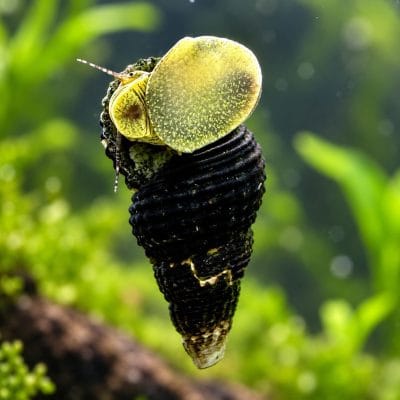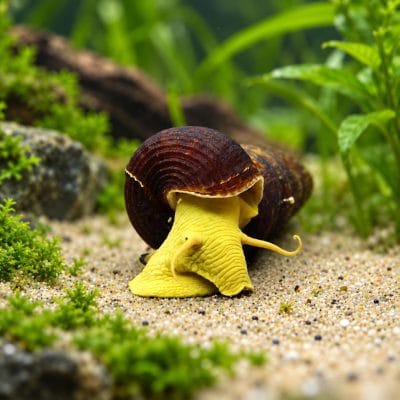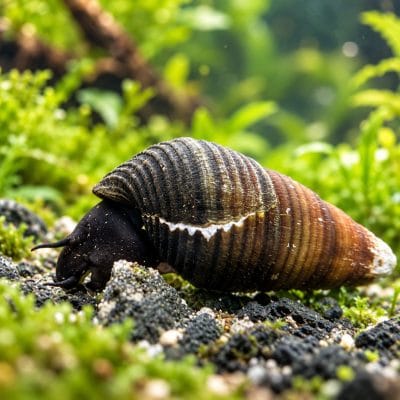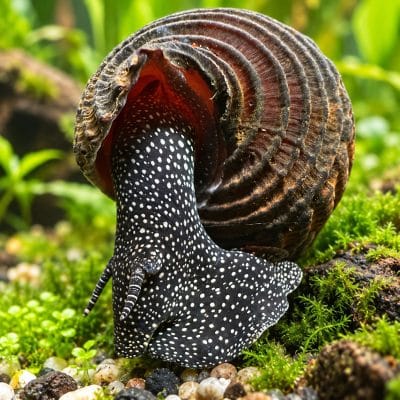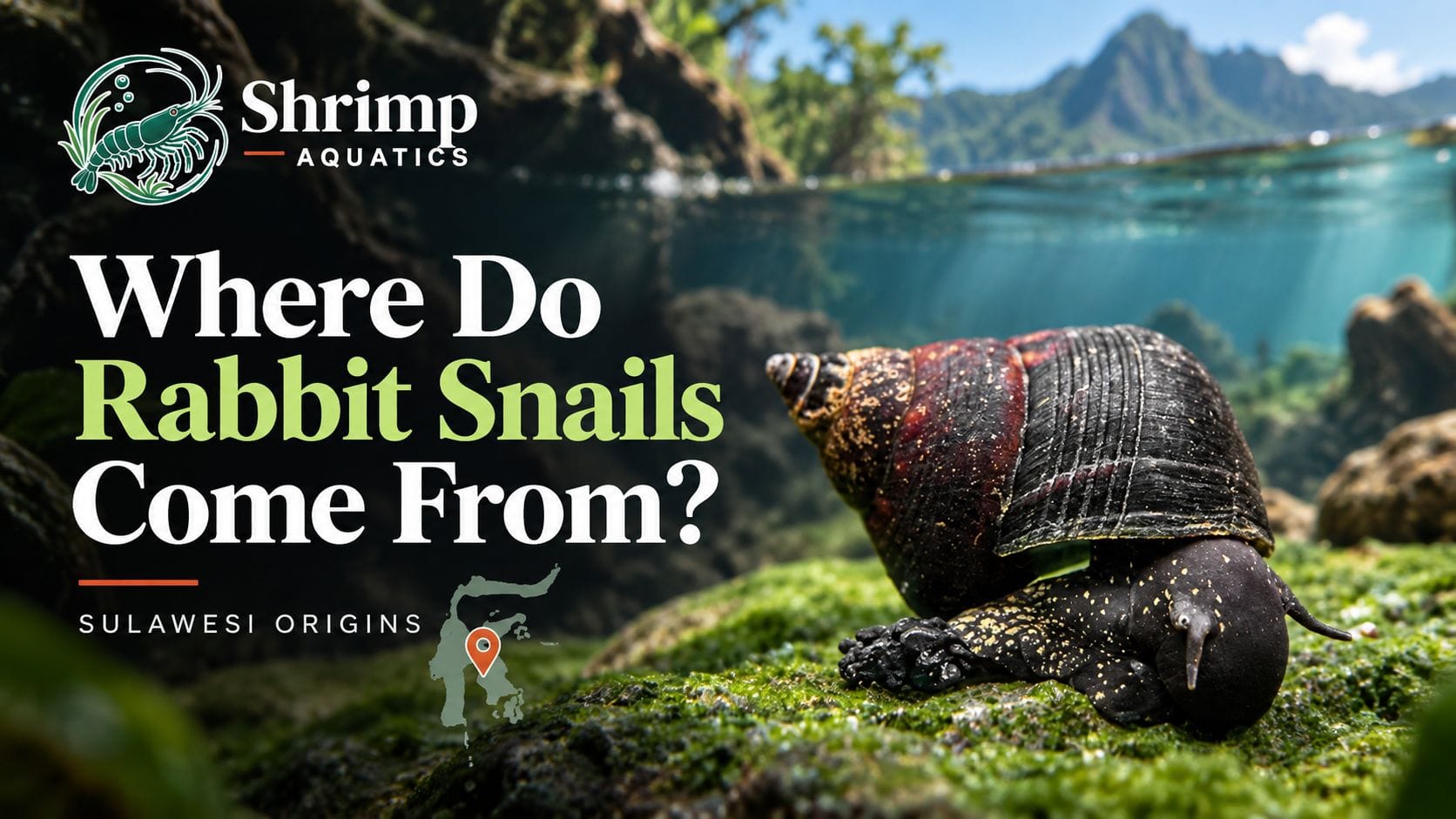
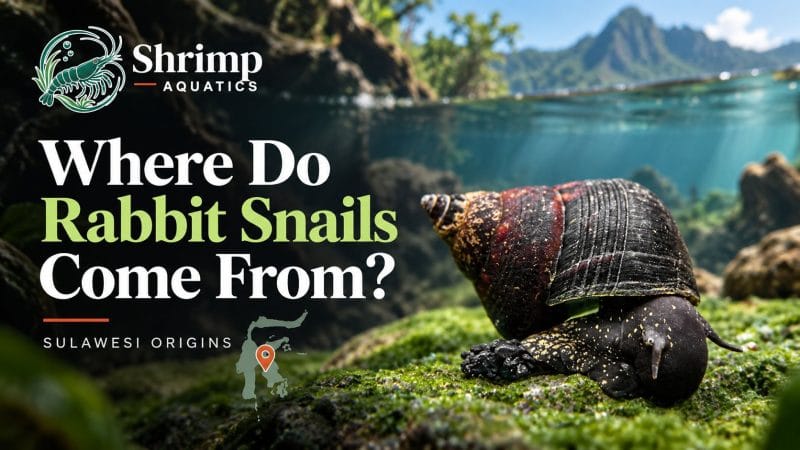
Rabbit snails (Tylomelania) come from one island: Sulawesi, Indonesia.1 The best-known species live in its two ancient lake systems, Lake Poso and the Malili lakes, but the genus also lives in rivers across most of the island. For your tank, the useful part is simple. Keep them warm and alkaline, in the same range as Sulawesi shrimp, and don’t try to copy a lake.
Where rabbit snails live in the wild
Only on Sulawesi, and by 2024 scientists had described 53 species there.2 Most famous are the lake species of the island’s two ancient lake systems.3 Lake Poso has about 25 species found nowhere else.4 The Malili lakes form a chain: Lake Matano, Lake Mahalona and Lake Towuti flow into one another and feed the Larona River.5 Two smaller lakes, Lontoa and Masapi, belong to the same system.
| Lake Towuti | 11 species |
|---|---|
| Lake Mahalona | 9 species |
| Lake Matano | 6 species |
| Lake Lontoa | 2 species |
| Lake Masapi | 1 species |
Some species live in more than one lake, so the counts overlap.2 They aren’t only lake animals, either. The genus is widespread in rivers and streams across almost all of Sulawesi except the north.6 Lake, river or stream, rabbit snails are freshwater snails throughout, with no brackish stage.
Does it matter which lake your snail came from?
Not for the water, and you usually can’t find out anyway. A trade name or shell color won’t tell you which lake or river a line came from. Our four lines have no confirmed species, so we list them as Tylomelania sp. and don’t claim a home lake for any of them. Our guide to the types of rabbit snails explains what the names can and can’t tell you.
What does carry over is the surface. Some lake species graze biofilm on stones and other hard surfaces, and others live on fine sand or mud and don’t climb stones at all.7 Since nobody knows which kind your snail descends from, give it both: open sand as well as rock.
How did rabbit snails end up on Sulawesi?
Probably on a piece of Australia. Their closest living relative lives on two islands in the Torres Strait, off northern Australia. The two split about 19.5 million years ago. The ancestor likely arrived when a promontory of the Australian margin collided with Sulawesi.1
What Sulawesi lake water means for your tank
The lakes are warm and alkaline, but not hard. Sulawesi Keepers, a conservation group that keeps these snails, describes the lake water as around 84°F (29°C), very clean, and soft yet alkaline. The group also says the differences between lakes don’t matter much for keeping.7 If you’ve read that rabbit snails need very hard water, the lakes don’t back that up.
Here is what the lakes actually measure:
| Lake Matano | Shoreline spot readings of 83°F (28.5°C), pH 8.53 and 177 µS/cm at one site.8 pH 8.36 and 187 µS/cm at another site.9 More than 590 m (about 1,940 ft) deep.10 |
|---|---|
| Lake Towuti | Surface water commonly 82-84°F (28-29°C). 210 µS/cm and pH about 7.8, reported from earlier surveys, in water that is mostly magnesium and bicarbonate.11 A second study cites earlier surveys at pH 7.3-7.7 and describes the lake as extremely nutrient poor.12 |
| Lake Poso | Soft water, mostly calcium and bicarbonate, low in nutrients.13 The temperature and pH survey figures we found mix river and estuary stations with lake stations, so we don’t quote them as lake values. |
Converting those conductivity readings with a common factor of 0.55-0.65 gives roughly 100-140 ppm on a hobby TDS meter. That’s an estimate, but it shows how dilute the lakes are.
Don’t copy lake numbers into a tank, though. These are huge, deep, nutrient-poor lakes, and a glass box is none of those things. We keep rabbit snails in the same range as our Sulawesi shrimp: 79-86°F (26-30°C), pH 7.5-8.5, GH 4-8 dGH, KH 3-6 dKH and TDS 150-250 ppm. The temperature and pH line up with the lakes; the TDS sits above them, so hold it steady inside that range. That same range is what a shared tank has to hold when shrimp move in, which is Sulawesi shrimp living with rabbit snails. The rest of the setup is in our guide to Sulawesi rabbit snail care.
Is the rabbit snail you buy wild-collected or tank-bred?
Ask the seller, because it varies. A survey of Singapore’s ornamental trade found rabbit snails on sale that traced back to wild Sulawesi populations.14 It didn’t say whether those snails were collected or bred before export.
Ours are simple to answer. Everything in our catalog is bred or propagated in our own tanks rather than collected from the wild. That includes all four rabbit snail lines in our Sulawesi snail range. We won’t tell you that buying a tank-bred snail protects the lakes, because we haven’t seen evidence that it does. The wild populations are under real pressure: in Lake Matano, smaller rabbit snail species and the young of larger ones disappeared as invasive flowerhorn cichlids spread.15 Which species are listed, and in what category, is covered in are rabbit snails endangered.
Confirming your own import rules is part of ordering. We cannot tell you that live freshwater invertebrates are legal to import where you live. No rabbit snail species is on Indonesia’s national list of protected animals,16 but that isn’t the same as permission to export. We also couldn’t confirm the genus’s CITES status.
References
16 Sources
- A Snail Perspective on the Biogeography of Sulawesi, Indonesia, PLOS ONE, 2014.
- Mitogenomes do not substantially improve phylogenetic resolution in a young non-model adaptive radiation of freshwater gastropods, BMC Ecology and Evolution, 2024.
- The species flocks of lacustrine gastropods: Tylomelania on Sulawesi as models in speciation and adaptive radiation, Hydrobiologia, 2008 (abstract).
- The complete mitogenome of Tylomelania sp. “Poso A” from Lake Poso assembled from long-read sequencing data, Molecular Biology Reports, 2026.
- Operation and Water Management of Dam Cascade System, E3S Web of Conferences, 2022.
- Freshwater snails of Sulawesi: a brief overview, Thomas von Rintelen, Sulawesi Keepers, undated.
- Do you know Sulawesi snails?, Markéta Rejlková, Sulawesi Keepers, undated.
- Encyonopsis indonesica sp. nov., a new diatom from the ancient lake Matano, PhytoKeys, 2021.
- Achnanthidium gladius sp. nov., a new monoraphid diatom species from Indonesia, PhytoKeys, 2021.
- Mixing and its effects on biogeochemistry in the persistently stratified, deep, tropical Lake Matano, Indonesia, Limnology and Oceanography, 2010 (abstract).
- Geomicrobiological Features of Ferruginous Sediments from Lake Towuti, Indonesia, Frontiers in Microbiology, 2016.
- Hydrological connectivity and mixing of Lake Towuti, Indonesia in response to paleoclimatic changes over the last 60,000 years, Palaeogeography, Palaeoclimatology, Palaeoecology, 2015.
- Perspectives from modern hydrology and hydrochemistry on a lacustrine biodiversity hotspot: Ancient Lake Poso, Central Sulawesi, Indonesia, Journal of Great Lakes Research, 2023 (abstract).
- Molluscs for Sale: Assessment of Freshwater Gastropods and Bivalves in the Ornamental Pet Trade, PLOS ONE, 2016.
- Endemic crabs from ancient Sulawesi lakes under double threat, Oryx, 2024.
- Peraturan Menteri LHK Nomor P.106/MENLHK/SETJEN/KUM.1/12/2018 tentang Jenis Tumbuhan dan Satwa yang Dilindungi, Indonesian Ministry of Environment and Forestry, 2018.
Ready to get started?
Shop our Sulawesi Snail collection
12 products available · Live Arrival Guarantee