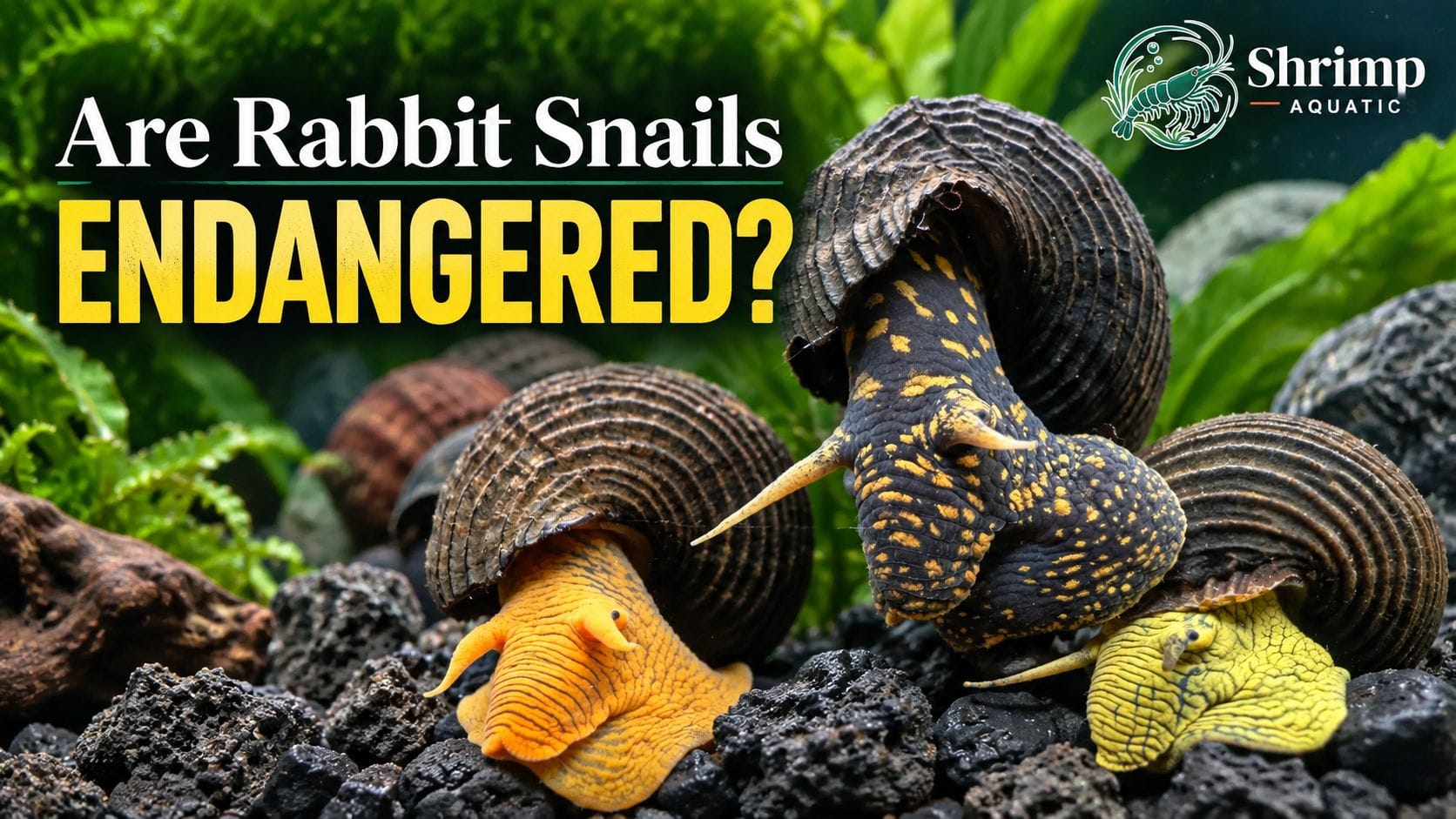
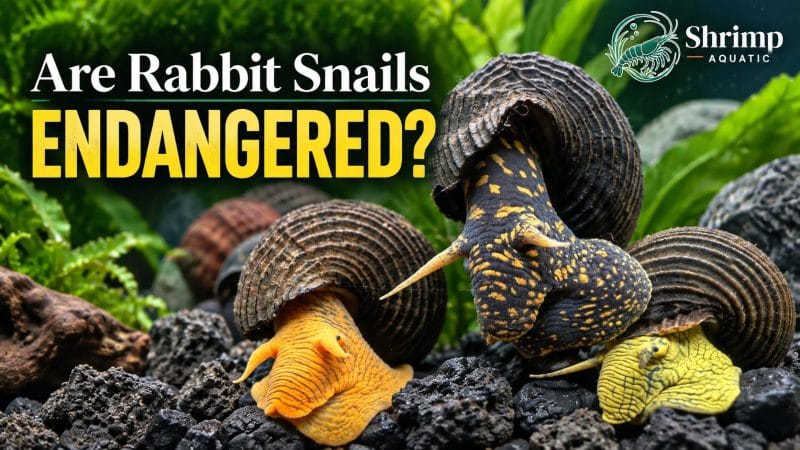
Many rabbit snail species are, but “rabbit snail” isn’t one animal. Most species that have been assessed are listed as threatened, and 19 are Critically Endangered.1 The genus as a whole has no single status, and the snails sold in the hobby have no confirmed species at all. So the useful questions are which species are listed, what’s threatening them, and what buying a tank-bred snail does and doesn’t do.
Are rabbit snails endangered?
Most of the ones that have been assessed, yes. Of the rabbit snail species that carry an IUCN Red List category, here’s how they break down:1
That’s 43 species, counted in the Red List checklist as GBIF publishes it, which carries no assessment years. They are counts of species with a category, not of animals left in the lakes. None is listed as Vulnerable or Least Concern. About 53 species have been described in total,2 so roughly ten aren’t in this count. “Rabbit snails are endangered” is too broad, and “rabbit snails are fine” is wrong. Which species you mean decides the answer.
Which rabbit snail species are listed
These nine are the species named on our other rabbit snail guides. Categories were read in September 2026.
| Species | Red List category |
|---|---|
| Tylomelania zeamais | Critically Endangered3 |
| Tylomelania insulaesacrae | Critically Endangered1 |
| Tylomelania sinabartfeldi | Critically Endangered1 |
| Tylomelania hannelorae | Critically Endangered1 |
| Tylomelania gemmifera | Endangered4 |
| Tylomelania sarasinorum | Endangered5 |
| Tylomelania patriarchalis | Endangered1 |
| Tylomelania towutica | Endangered1 |
| Tylomelania carbo | Endangered1 |
Only T. gemmifera comes with more than a category: assessed in 2018, population decreasing, with mining and quarrying, dams, invasive species and pollution listed as threats.4 For the other eight, a category is all the record gives, and the Red List is a living record, so every row is what it said in September 2026.
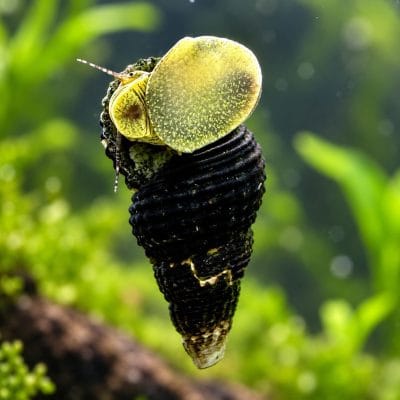
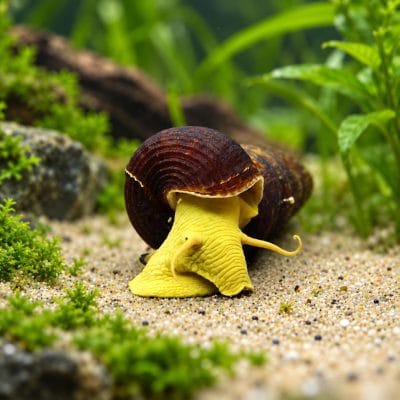
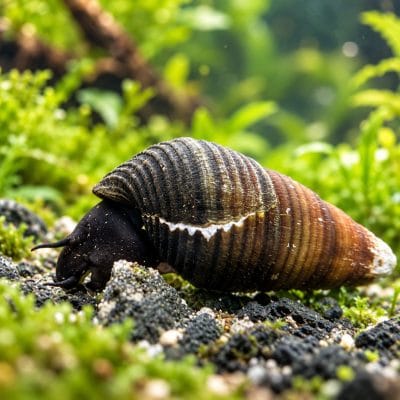
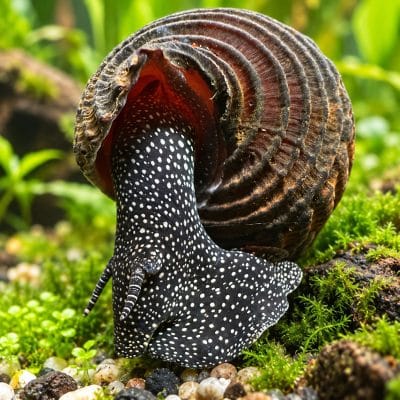
Is your snail one of them? Nobody can tell you. Trade names describe color, not species, and the types of rabbit snails sold in shops have no confirmed species behind them. The same uncertainty runs into age, which is why how long rabbit snails live has no published figure behind it.
What threatens rabbit snails in the wild
Everything they have is on one island. These snails live only on Sulawesi,6 and the best-known species in a handful of lakes covered in where rabbit snails come from. Four threats come up in the published work:
- Invasive fish. The best documented. Flowerhorn cichlids spread around all of Lake Matano by 2012,7 and smaller rabbit snail species and the young of larger ones disappeared from the lake as they spread, an observation rather than a census.8 In Lake Poso, introduced fish species now outnumber the native ones.9
- Mining, dams and pollution. Listed for T. gemmifera.4
- Nutrient pollution. Lake Matano was once extremely clean and is now heavily enriched, according to a study of a different snail in the same lake.10
- Collection for the aquarium trade. Rabbit snails traced to wild Sulawesi populations do reach shops,11 but nobody has measured what collection costs any population.
There is some good news, from a field project’s own case study rather than a published paper. T. zeamais, once feared lost, was found again at 20 of 32 sites around Lake Matano, and a conservation team bred it and released the young back into the lake.12
Does “rare in shops” mean endangered?
No. When keepers call rabbit snails rare, they mean hard to buy. A line can be hard to find because of supply, demand or how slowly it breeds, and none of that tells you anything about snails in a lake. Whether you can keep one comes down to warm, alkaline, mature water, which is the core of Sulawesi rabbit snail care.
Buying tank-bred rabbit snails: what it does and doesn’t do
Everything in our catalog is bred or propagated in our own tanks rather than collected from the wild. So the snail you buy from us wasn’t taken from a lake. We keep four lines.
All four are listed as Tylomelania sp., because no species has been confirmed for them. That means we can’t tell you whether your snail belongs to one of the listed species above, and we can’t tell you it doesn’t.
We also won’t tell you that your purchase helps the lakes. We’re a shop, not a conservation body. Real conservation breeding does exist: Sulawesi Keepers runs a programme with zoo partners in the Czech Republic and Poland that includes T. zeamais and T. gemmifera.13 You can see all four of our lines in our tank-bred Sulawesi snails range.
Never release a snail
Don’t put a rabbit snail, a plant or anything else from your tank into a pond, stream or storm drain. Introduced fish have already changed both of these lake systems.79
References
13 Sources
- The IUCN Red List of Threatened Species (checklist dataset as published through GBIF), IUCN via GBIF, queried September 19, 2026.
- Mitogenomes do not substantially improve phylogenetic resolution in a young non-model adaptive radiation of freshwater gastropods, BMC Ecology and Evolution, 2024.
- Tylomelania zeamais, IUCN Red List of Threatened Species, species assessment page.
- Tylomelania gemmifera, IUCN Red List of Threatened Species, assessed 9 July 2018, published 2019.
- Tylomelania sarasinorum, IUCN Red List of Threatened Species, species assessment page.
- The species flocks of lacustrine gastropods: Tylomelania on Sulawesi as models in speciation and adaptive radiation, Hydrobiologia, Springer Nature, 2008 (abstract).
- Alien invasion in Wallace’s Dreamponds: records of the hybridogenic “flowerhorn” cichlid in Lake Matano, with an annotated checklist of fish species introduced to the Malili Lakes system in Sulawesi, Aquatic Invasions, 2012.
- Endemic crabs from ancient Sulawesi lakes under double threat, Oryx, Cambridge University Press for Fauna and Flora International, 2024.
- More non-native fish species than natives, and an invasion of Malawi cichlids, in ancient Lake Poso, Sulawesi, Indonesia, Aquatic Invasions, 2022.
- New species from a “lost world”: Sulawesidrobia (Caenogastropoda, Tateidae) from ancient Lake Matano, Sulawesi, Indonesia, European Journal of Taxonomy, 2023.
- Molluscs for Sale: Assessment of Freshwater Gastropods and Bivalves in the Ornamental Pet Trade, PLOS ONE, 2016.
- Saving Critically Endangered Freshwater Snail Tylomelania zeamais in The Ancient Lake of Matano (case study), Mohamed bin Zayed Species Conservation Fund, grant awarded 9 October 2023.
- Conservation Breeding, Sulawesi Keepers, viewed September 2026.
Ready to get started?
Shop our Sulawesi Snail collection
12 products available · Live Arrival Guarantee