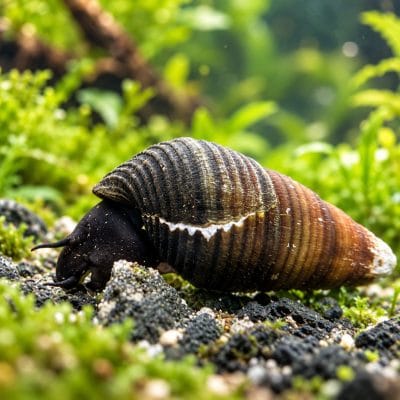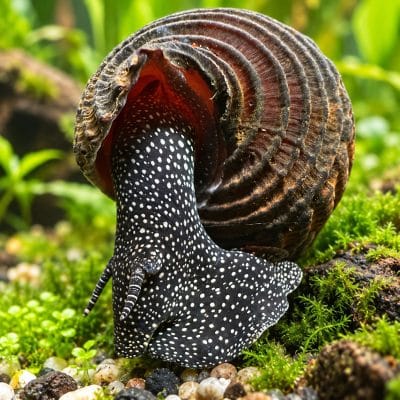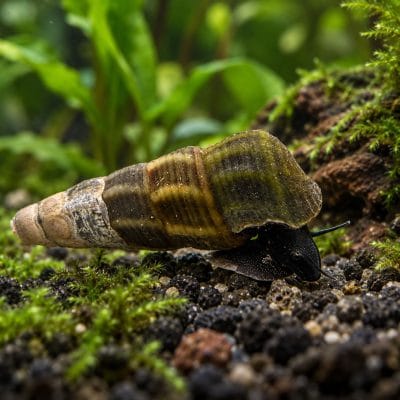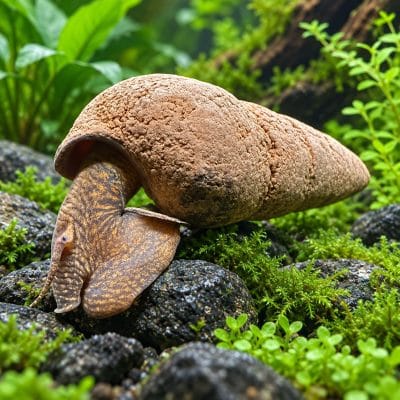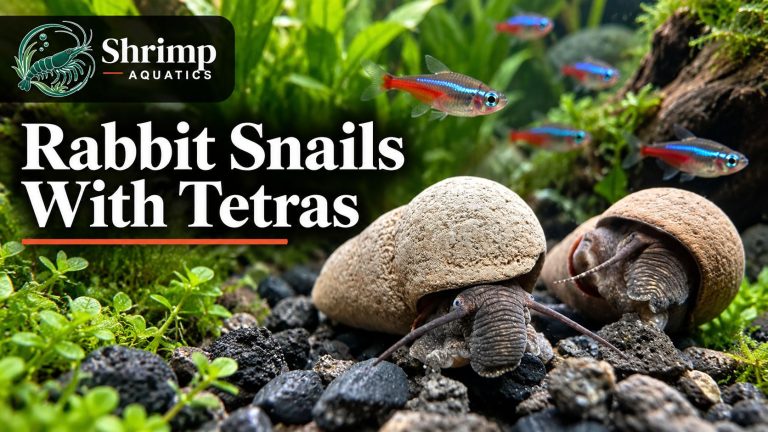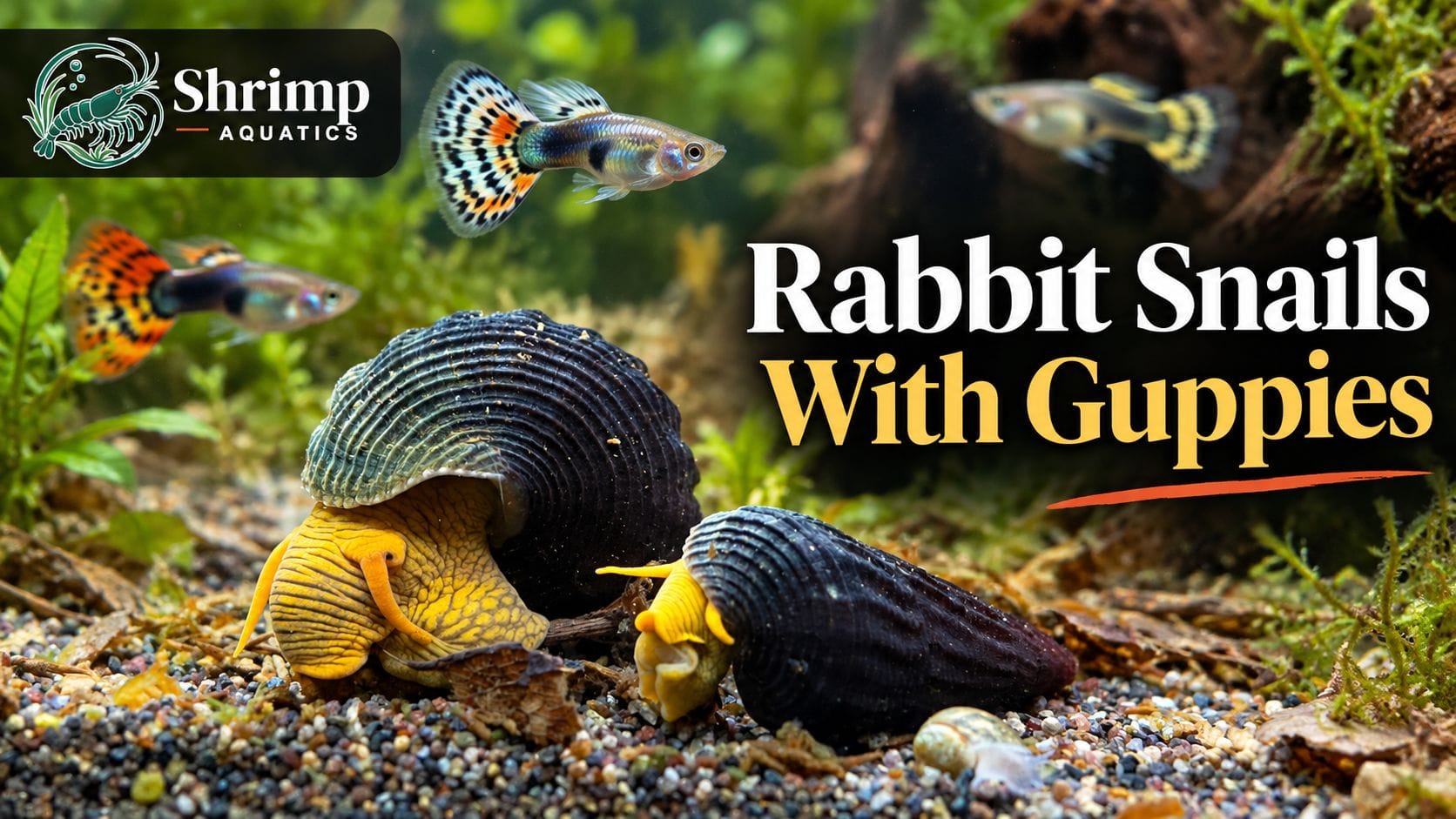
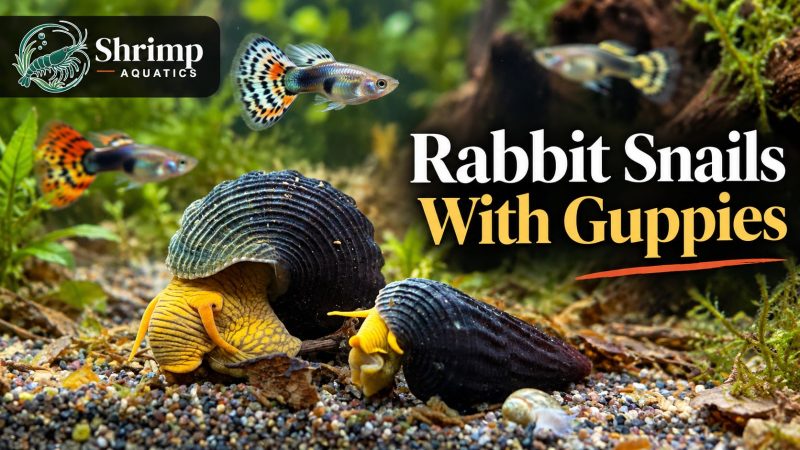
No, we wouldn’t put guppies in a rabbit snail tank. Sulawesi rabbit snails (Tylomelania sp.) need 79-86°F (26-30°C) and 4-8 dGH, while FishBase lists guppies (Poecilia reticulata) up to 28°C (82°F) with hardness of 9-19 dH, so the two only share 79-82°F (26-28°C) and never meet on hardness.1 That shared band is the cool edge of the snail’s range, so any mix asks both animals to live at a compromise.
Where do rabbit snail and guppy water ranges meet?
Only in a narrow warm band, and not at all on hardness. The table sets the range we keep rabbit snails in, which is the same water Sulawesi shrimp need, beside what FishBase lists for guppies.1
| Parameter | Rabbit snail, the range we keep to | Guppy, as listed by FishBase | Shared ground |
|---|---|---|---|
| Temperature | 79-86°F (26-30°C) | Up to 28°C (82°F) | 79-82°F (26-28°C) |
| pH | pH 7.5-8.5 | 7.0-8.0 | The low end of the snail’s range |
| General hardness | 4-8 dGH | 9-19 dH | None |
| Carbonate hardness | 3-6 dKH | Not listed | Not assessed |
| TDS | 150-250 ppm | Not listed | Not assessed |
| Nitrate | Under 10 ppm | Not listed | Hold the snail’s limit |
dH and dGH measure the same thing, total hardness in German degrees, so the gap is real: the guppy’s listing starts one degree above the top of the snail’s range. Temperature is tight too. Run the tank at 84°F and you’re above anything FishBase lists for guppies. Cool it toward the middle of the guppy’s listing and the snail drops below the water it’s kept in. Tetras miss from the other direction, wanting softer, more acidic water, which is why rabbit snails with tetras rarely work either.
You’ll find wider rabbit snail ranges on hobby care sheets. We don’t widen the snail’s range to fit a tankmate. This tank exists for the snail, so its numbers set the water and any tankmate has to fit inside them. Those are the numbers behind Sulawesi rabbit snail care, and they don’t stretch for a guppy.
Do guppies compete with a rabbit snail for food?
Yes, and that’s the problem people miss. Wild guppies in low-predation streams feed mostly on algae and detritus,2 which is the same film of algae and biofilm on rock and glass that a rabbit snail grazes. A snail this size already makes a real dent in that film, which is why the tank needs a visible layer on its surfaces before a snail goes in. Put a group of guppies picking at the same surfaces all day and the snail’s share shrinks.
Can’t you just feed more? Extra food doesn’t replace a mature film, and whatever the guppies miss sits in warm water adding waste.
Then there’s breeding. Female guppies store sperm and can give birth about every four weeks, 20-40 young at a time.1 A few females can fill a tank quickly, and every extra fish adds waste to a tank you’re trying to hold under 10 ppm nitrate. That’s a fight you’d be having every week.
Will guppies eat or nip a rabbit snail?
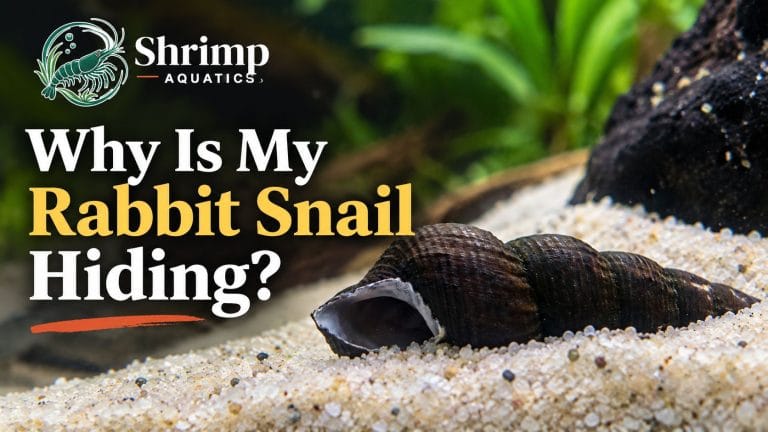
An adult guppy isn’t going to eat an adult rabbit snail. In a gut-content study of wild guppies, snails from a related family were common on the stream bed yet never turned up in the fish’s guts.2 The thing to watch is pecking at the snail’s long tentacles. No study has measured how often it happens, so treat it as a check: if your snail stays sealed in its shell while the guppies hover over it, the pairing isn’t working and the snail should move. Separation is the fix, because once pecking starts there’s no reliable way to stop fish attacking rabbit snails in a shared tank.
Why can’t guppy medication go in a rabbit snail tank?
Because some fish treatments contain copper, and copper kills snails at low concentrations. In a related freshwater snail, copper was the most toxic of eight metals tested, killing half the snails within four days at 0.14 mg per liter.3 That’s a figure for a different snail, and it tells you nothing about a safe level for this one.
If guppies and a rabbit snail share a tank, every guppy treatment has to happen somewhere else. Read the active ingredients on any product before it goes near the snail, and never dose the display tank. In practice, a mixed setup means owning a second tank anyway.
Already have guppies with a rabbit snail? Check these first
Test the tank against the snail’s range before you change anything.
- Temperature stays inside 79-86°F (26-30°C), day and night.
- pH reads 7.5-8.5.
- GH reads 4-8 dGH and KH reads 3-6 dKH.
- TDS sits at 150-250 ppm.
- Nitrate stays under 10 ppm between water changes.
- The snail is out and grazing, not sealed in its shell for days at a time.
If the tank fails on temperature or hardness, move the snail to a tank set up for it. Don’t drag the whole tank toward the snail’s numbers in a hurry; a fast swing in temperature, pH or hardness stresses everything in the water. Expect the snail to stay withdrawn for a while after the move.
What if every check passes? Then your water suits the snail and sits below the hardness guppies are listed for, so it’s the guppies you’re asking to compromise. That’s the test every entry on a list of rabbit snail tankmates has to pass: the snail’s water, not a compromise.
What can share a rabbit snail tank instead of guppies?
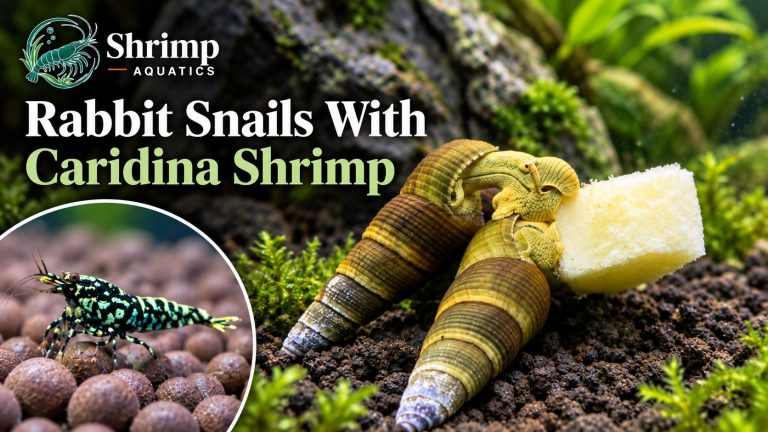
Sulawesi shrimp are the natural companion, because they live in exactly the same water and graze the same film. With them the question is how much film the tank grows, not whether the animals get along. Neocaridina are usually kept below this tank’s temperature, but a small group lives and breeds in some of our own Sulawesi tanks, so they’re a possibility with care rather than a natural partner. Bee and Crystal Caridina need soft, acidic water, which is a different tank entirely. Never add an assassin snail. Keeping rabbit snails with Sulawesi shrimp is the pairing we’d build this tank around.
If you want guppies and a snail together, pick a snail whose needs match your guppy water and check its own numbers before you buy. If it’s the rabbit snail you’re set on, our tank-bred Sulawesi rabbit snails all need the water in the table above. Every one is bred by Shrimp Aquatics, not collected from the wild, and we don’t promise breeding, sex or the number of young from any order.
References
3 Sources
- Poecilia reticulata, Guppy: species summary, FishBase, page last modified 20 July 2016.
- Zandonà E. et al., Diet quality and prey selectivity correlate with life histories and predation regime in Trinidadian guppies (author-hosted PDF), Functional Ecology 25: 964-973, 2011.
- Shuhaimi-Othman M. et al., Toxicity of Metals to a Freshwater Snail, Melanoides tuberculata, The Scientific World Journal, 2012.
Ready to get started?
Shop our Sulawesi Snail collection
12 products available · Live Arrival Guarantee