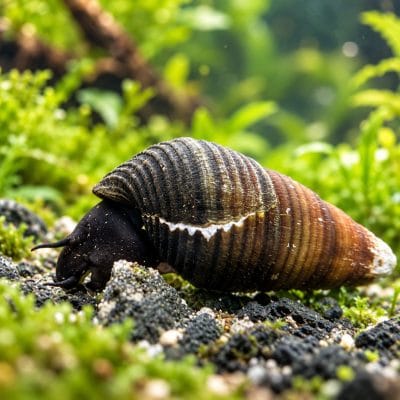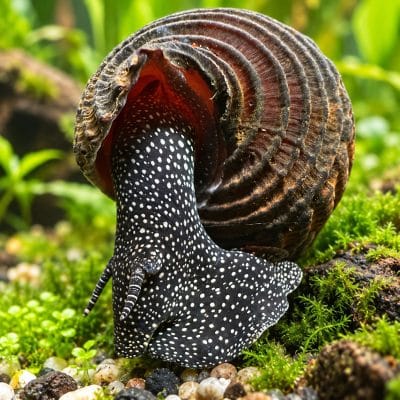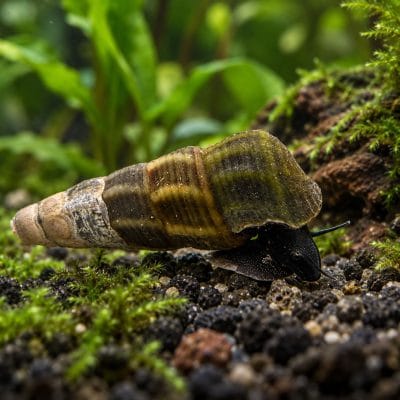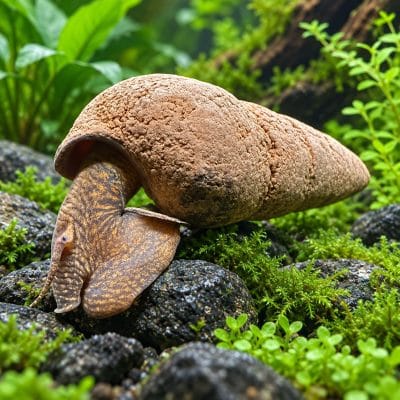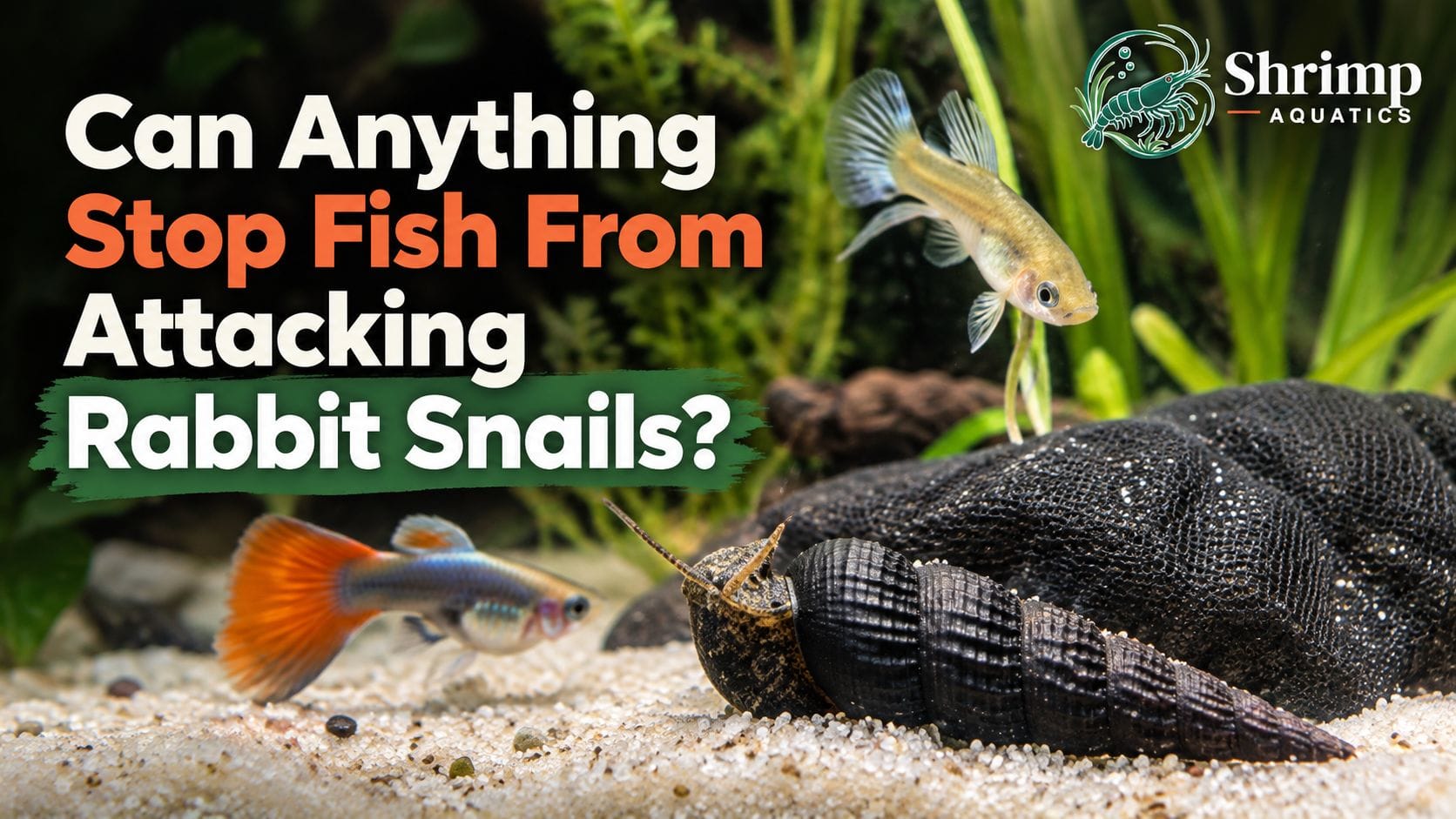
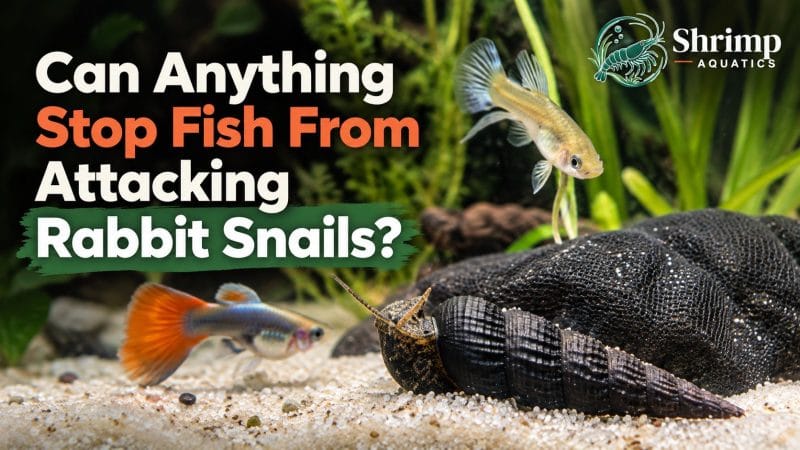
No. Once a fish has started nipping a rabbit snail (Tylomelania sp.), nothing you add to the tank reliably stops it. Extra food, a rearranged layout, more plants, a cave the fish can’t reach: keepers try all of it. The snail still has to come out and graze on open glass and open rock, which is where the fish is. The fix is separation. In a warm alkaline Sulawesi tank, it’s usually the fish that shouldn’t be there.
How to tell a fish is what’s damaging your rabbit snail
Start by watching, not by dosing anything. A rabbit snail that pulls in and seals its operculum for a while is doing something ordinary, so a closed snail on its own tells you very little. What tells you something is damage plus a pattern.
Look for tentacles that are shorter than they were, or uneven, one long and one blunt. Look for a ragged edge on the foot or the snout. Then watch the tank for ten quiet minutes with the lights on. If a fish tracks the snail, hangs over it, and darts in as the snail extends, you have your answer. You’ll usually see the snail snap shut within a second of the strike.
If you’re not sure the snail is alive at all, that’s a different question from this one, and a touch response is what settles it. That question has its own answer in rabbit snail not moving, with the touch test and the water checks that follow it.
Is a fish really capable of clearing snails out? In these snails’ own lakes, yes. Sulawesi Keepers, the conservation group working on the Malili lakes, reports that the invasive flowerhorn cichlid pushes shrimp and snail populations down there, with the smallest snails disappearing as the fish spreads.1 That’s a lake, not your tank, and your fish is probably nipping instead of eating. But it should settle the question of whether a fish will keep going. It’s the same reason we wouldn’t keep rabbit snails with cichlids of any size.
Why more food and a rearranged tank don’t stop a fish nipping your snail
These are the three fixes the internet hands you. Here’s what each one is worth.
- Feeding the fish more. A well-fed fish still investigates a moving tentacle. Worse, the leftovers go somewhere. Ammonia in water at 79-86°F (26-30°C) and pH 7.5-8.5 is more dangerous than the same test reading in a cool acidic tank. The share sitting in the un-ionized form that actually poisons animals climbs about tenfold with each pH unit, and roughly doubles with a temperature rise of 18°F (10°C), in EPA’s freshwater criteria.2 So the popular fix quietly adds a second problem.
- Rearranging the hardscape. This can reset a territorial fish for a few days. It does nothing to a fish that is simply curious about small moving things, and the effect fades.
- Adding cover the snail can hide in. Cover helps against a fish that hunts by sight in open water. It doesn’t help an animal whose job is to crawl slowly across the most exposed surfaces in the tank looking for biofilm. Your snail will leave the cave.
We know you’d rather fix this without moving anyone. Every keeper would. But a fish that has learned a snail’s tentacles are worth investigating goes on investigating, and the snail pays for the experiment each time.
Separating the fish and the snail is the fix that holds
There are three ways to do it, and they are not equal.
Rehome the fish. If the tank is set up as a Sulawesi tank, the fish is the animal in the wrong place. Moving it out ends the problem permanently, and that’s our advice in almost every case.
Divide the tank. A rigid perforated divider shares heat and filtration across both sides and works long term. The openings need to be smaller than the fish’s snout, and water still has to move freely through them. It costs you swimming space on both sides, so it suits a long tank better than a tall one.
Use a hang-on box, but only briefly. A box is triage for an injured snail while you sort out the permanent answer. A few days to a couple of weeks is the honest limit. A small enclosed volume in a warm tank is where two things go wrong at once. Warm water holds less dissolved oxygen than cool water to begin with,3 and a box with weak flow and a bit of uneaten food in it goes stale faster than the tank around it. If you use one:
- Put the outlet of a filter or an air line where it drives water through the box, not past it.
- Feed lightly and lift what isn’t eaten the same day.
- Check each morning that the snail is upright and attached. A snail on its back in a bare box can’t right itself as easily as one on rock.
- Don’t park a snail in a box for weeks because the fish problem is hard to solve. That’s a slow version of the same harm.
Can a rabbit snail recover from a nipped tentacle?
Soft tissue can rebuild. In a different snail family, the apple snail Pomacea canaliculata, researchers amputated a cephalic tentacle and watched the whole tentacle reconstruct within three months.4 Read it as something snails are capable of, not as a timetable for yours. What it does tell you is the practical part. Regrowth is slow enough that a snail left with the same fish loses new tissue as fast as it makes it. Moving an injured snail carries its own risk, which is why pulling a rabbit snail off the glass is worth reading first.
So the useful sequence is to separate first, then leave the animal alone. Hold the water steady inside the range you keep. Keep the grazing surfaces intact so the snail can feed without crossing open ground. Expect a snail that has been harassed to stay withdrawn for a while even after the threat is gone.
Don’t treat the tank
There’s no medication for a bitten snail, and the things keepers reach for can finish the job. Copper is the clearest case. EPA’s criteria guidance states plainly that elevated copper is toxic in aquatic environments and can harm invertebrates as well as fish.5 Plenty of fish treatments and some plant or algae products contain it. If the fish needs treating for something, treat it in a separate tank, and read the full ingredient list before anything goes into a tank holding snails or shrimp.
What you can keep with rabbit snails without starting this again
Here the water does most of the deciding for you. These snails need 79-86°F (26-30°C) and pH 7.5-8.5, held steady. That’s warmer and harder than the tank most community fish want. So the honest answer to “which peaceful fish can I add” is that the list is short, and we’re not going to pad it. We’d keep this tank as an invertebrate tank and stop there. What the water has to look like every day is the subject of Sulawesi rabbit snail care, and it rules out most tankmates already. Bettas are the most common case, and whether rabbit snails can live with bettas is settled by the water before a single nip.
Three specifics are worth knowing before you shop.
- Sulawesi shrimp share the same water and the same grazing layer. The question with them is grazing capacity and total stocking, not whether they’ll hurt the snail.
- Neocaridina are a maybe, not a default. Neocaridina are usually kept at 65-78°F (18-26°C) and this tank starts at 79°F (26°C), so on paper the ranges don’t meet, but a small group lives and breeds in some of our own Sulawesi tanks. Keep the tank in the snail’s range and the group small, the way we keep rabbit snails with Neocaridina shrimp.
- Assassin snails eat other snails. Never in this tank.
Keepers most often report tentacle nipping with bettas, gouramis, larger barbs, loaches and cichlids. No one has tested which aquarium fish go after Tylomelania specifically, so treat that as what keepers see, not a verified list. If a fish you already own has shown interest in any snail, believe it. Fish are not the only risk worth ruling out, since assassin snails with rabbit snails covers a tankmate people add on purpose.
Adding rabbit snails to a mature, warm, alkaline tank? Our Sulawesi snail lines are bred in our own tanks, so they arrive used to the same water this page describes. What they still need from you is a system with visible biofilm on rock and glass, and no tankmate that treats a tentacle as food.
References
5 Sources
- Our Causes, Sulawesi Keepers, page last modified August 18, 2023.
- Aquatic Life Ambient Water Quality Criteria for Ammonia, Freshwater, U.S. Environmental Protection Agency, Office of Water, April 2013.
- Dissolved Oxygen and Water, U.S. Geological Survey, Water Science School, updated August 24, 2026.
- A New Protocol of Computer-Assisted Image Analysis Highlights the Presence of Hemocytes in the Regenerating Cephalic Tentacles of Adult Pomacea canaliculata, International Journal of Molecular Sciences 22(9): 5023, 2021.
- Supplementary Training Materials for Aquatic Life Criteria, Copper, Background, U.S. Environmental Protection Agency, updated May 6, 2026.
Ready to get started?
Shop our Sulawesi Snail collection
12 products available · Live Arrival Guarantee