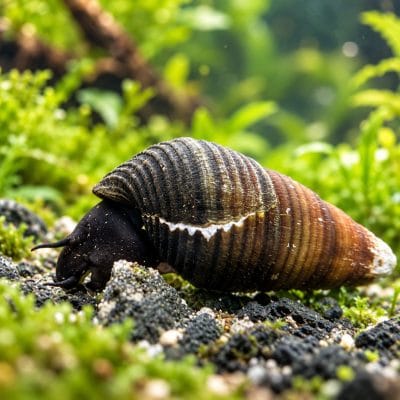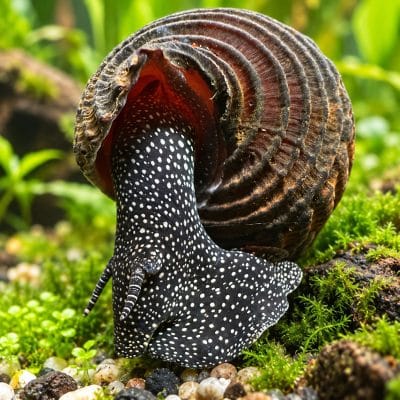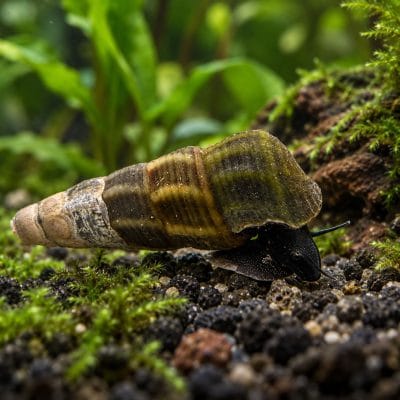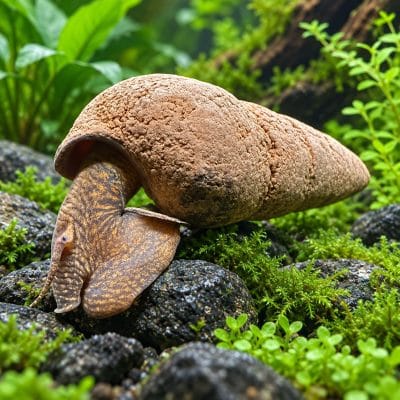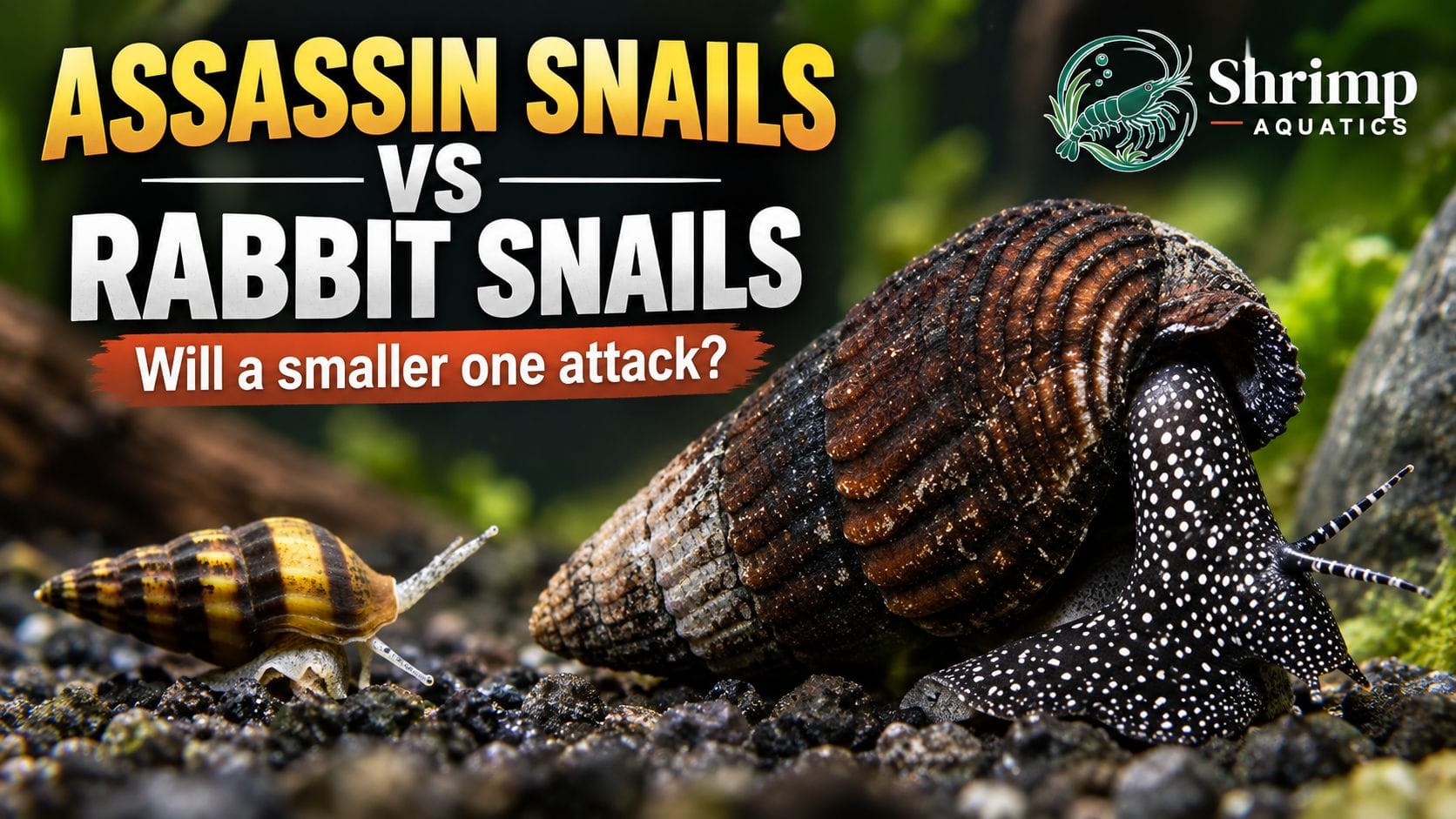
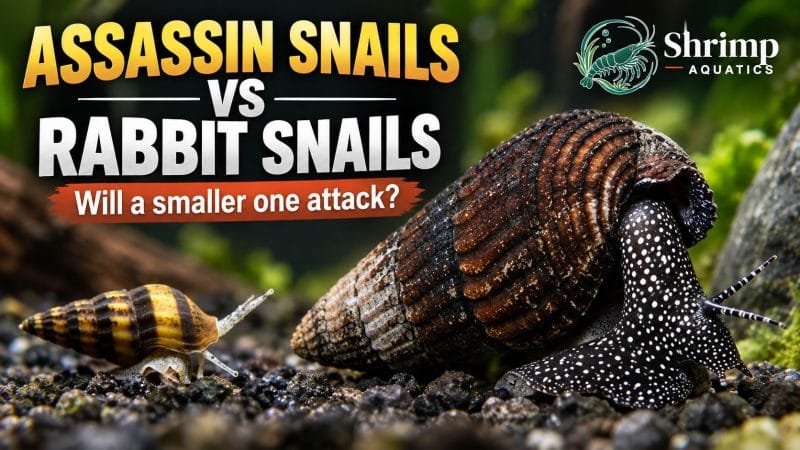
Short answer: we wouldn’t risk it. An adult assassin snail (Anentome helena) reaches about 30 mm at most1, and a grown rabbit snail (Tylomelania sp.) is several times that. The size gap is real, and it still isn’t what decides the outcome, because an assassin snail never has to get through the shell.
Why shell size doesn’t protect a rabbit snail from an assassin snail
Assassin snails aren’t grazers that occasionally bite. They feed mostly on decaying protein and published accounts describe them attacking living snails and worms1. When they do take a snail, the published description of the behavior is short and unpleasant: the assassin snail subdues its prey with its foot and then consumes it through the prey’s aperture2. Read that again with your rabbit snail in mind. The shell is never the barrier. The opening the animal has to keep usable is.
So what about the trapdoor? That’s the fair question, because an operculum is the defense a heavy shell still leaves an animal. A prey-choice experiment in West Bengal put three predators against local pond snails and found that A. helena consumed significantly more operculate snails than the native leech and waterbug did. Those two preferred the soft, lidless species; the assassin snail preferred an operculate one3. Different snails, a different continent, and no rabbit snail anywhere in it. It still points the wrong way for anyone hoping the lid settles the question.
And here is the gap nobody has filled. The feeding work above used prey at roughly half the predator’s own weight2, so there is no published trial of a 30 mm predator against a snail several times its length. We’d rather hand you that hole in the evidence than dress a forum thread up as a study.
What months of quiet between your assassin and rabbit snails does not prove
Yours have shared a tank since spring and nothing has happened. Doesn’t that settle it? It settles something, just not the thing you need. In that same feeding study, 94 of 97 assassin snails had a single prey type making up at least half their diet, and each animal’s relative preferences held steady no matter how common the other prey was2. Individuals differ from one another, and they keep their habits.
So what your assassin snails have done so far describes those animals in that tank. It isn’t a rule you can pass to another keeper, and it isn’t a promise about the next assassin snail you add or the next time a rabbit snail sits still in the open. Keepers commonly report that the trouble starts once the pest snails run out. We’d plan around that, because the whole cost of being wrong lands on the animal that can’t leave. A rabbit snail that suddenly sits still after weeks of grazing is worth checking against rabbit snail not moving first.
Why baby rabbit snails can’t be protected in a tank with assassin snails
Rabbit snails are live-bearing. The young are released already shelled, and in some Tylomelania species they arrive close to 2 cm long, the largest juveniles known from any live-bearing gastropod4. That is big for a newborn snail. It is also, precisely, the size of animal an assassin snail hunts, and a newborn has nowhere to be except the substrate it was dropped on.
We don’t give a brood count for the animals in the trade, and we don’t promise breeding from any order. The decision is simpler than the biology: if you want young rabbit snails to reach adulthood in your tank, the assassin snails go first.
What to do when assassin snails and rabbit snails already share a tank
Move the assassin snails, not the rabbit snail. They are the easier animals to find a home for, and a rabbit snail needs water this warm and this alkaline, which is not something you improvise on a Sunday afternoon.
- Take out every assassin snail you can find today, then keep looking. They spend much of their time under the sand, so the number you catch in the first ten minutes is rarely the number in the tank.
- Look the rabbit snail over in the water. Trouble shows at the soft edge where the foot and mantle meet the shell opening, not on the shell itself. If you find torn tissue, there is no home treatment worth giving it; clean, stable water and being left alone is the useful thing.
- Give it a few quiet days before you read anything into its behavior. Keepers report that a rabbit snail closes up for a day or two for ordinary reasons, so a withdrawn snail straight after you have been netting the tank tells you very little. If it stays sealed longer than that, the checks in dead or just inactive tell you which one you are looking at.
- Keep checking the sand over the following weeks. Removing the adults you can see is not the same as clearing the tank of them.
- Deal with the reason you wanted a predator in the first place, which is almost always the feeding.
The tank you move a rabbit snail into has to hold these numbers
Whether the snail stays where it is or moves, this is the water we keep rabbit snails in, and it is the same water our Sulawesi shrimp live in.
| Difficulty | Moderate animal, demanding system |
|---|---|
| Temperature | 79-86°F (26-30°C) |
| pH | 7.5-8.5 |
| GH | 4-8 dGH |
| KH | 3-6 dKH |
| TDS | 150-250 ppm |
| Nitrate | Aim under 10 ppm |
| Substrate | Inert sand and hardscape, no pH lowering soil |
| Tank | Mature, with visible algae and biofilm on rock and glass before the snail goes in |
We’d call the snail itself moderate. The system is the demanding part, and that is the honest way round: warm, alkaline, mineral rich and mature, at 79-86°F (26-30°C) and pH 7.5-8.5, with GH 4-8 dGH, KH 3-6 dKH and TDS 150-250 ppm held steady. A rabbit snail is not an easier way into Sulawesi keeping and it is not an animal for a young tank. What holding that system steady looks like day to day is the subject of Sulawesi rabbit snail care.
If your answer is a second tank, let it mature before anything moves in: film on the rock and glass, ammonia and nitrite at zero, and those numbers holding for weeks rather than days. Our Sulawesi rabbit snails are tank-bred by Shrimp Aquatics, and we’d say the same thing to anyone ordering one: have the tank running first.
Clearing a pest snail outbreak out of a rabbit snail tank without a predator
A pest snail bloom is a feeding problem wearing a shell. The population tracks the food you put in and don’t take out, which is why a predator treats the symptom and leaves the cause running. In a tank built for rabbit snails you have a second reason to skip the predator, and you already know what it is.
- Cut the feeding first. In a mature Sulawesi tank the grazing surfaces do most of the feeding anyway, and the pest snails live on what is left over.
- Lift anything uneaten within a few minutes instead of letting it sit in warm water.
- Sink a piece of blanched vegetable overnight and take it out in the morning with whatever has collected on it. Run that for a week; one pass never does it.
- Check new plants and hardscape before they go in the tank, because that is how most pest snails arrive.
- Don’t reach for a predatory snail in a tank holding rabbit snails. It is a fast fix that puts the slowest animal in the tank on the menu.
That last line is the whole answer to the question you came in with. An assassin snail may well ignore your rabbit snail for a year. We don’t think the size gap is protection, the little evidence there is about opercula points the wrong way, and the animal carrying the risk cannot run. Keep them in separate tanks. The same logic applies to any tankmate that treats a snail as prey, and fish attacking rabbit snails is the fish version.
References
4 Sources
- Assassin Snail (Anentome helena) Ecological Risk Screening Summary, U.S. Fish and Wildlife Service, revised July 2018.
- Assassin snails (Anentome helena) as a biological model for exploring the effects of individual specialisation within generalist predators, PLOS ONE, 2022.
- Preferring what others avoid: differences in the vulnerability of freshwater snails to the exotic and native predators, Hydrobiologia, 2025.
- Anatomy of an adaptive radiation: a unique reproductive strategy in the endemic freshwater gastropod Tylomelania (Cerithioidea: Pachychilidae) on Sulawesi, Indonesia, and its biogeographical implications, Biological Journal of the Linnean Society, 2005.
Ready to get started?
Shop our Sulawesi Snail collection
12 products available · Live Arrival Guarantee