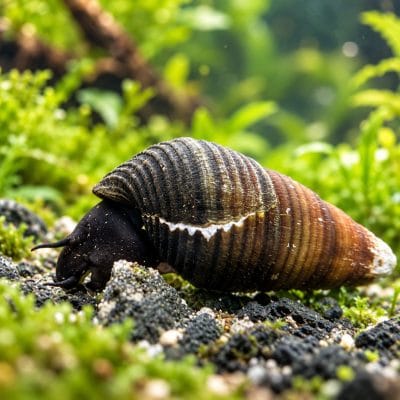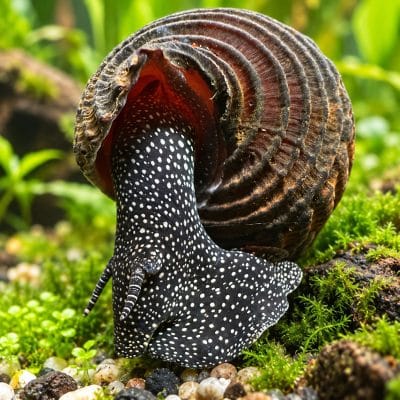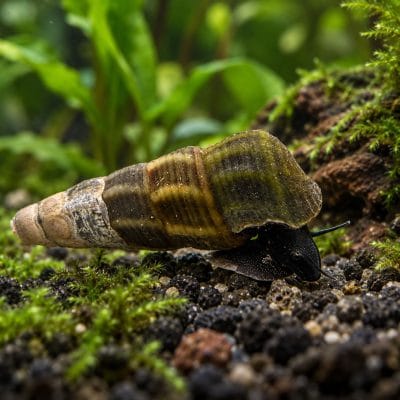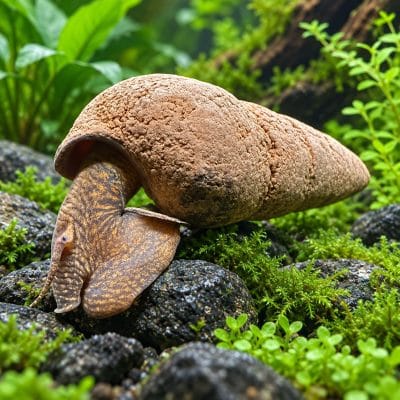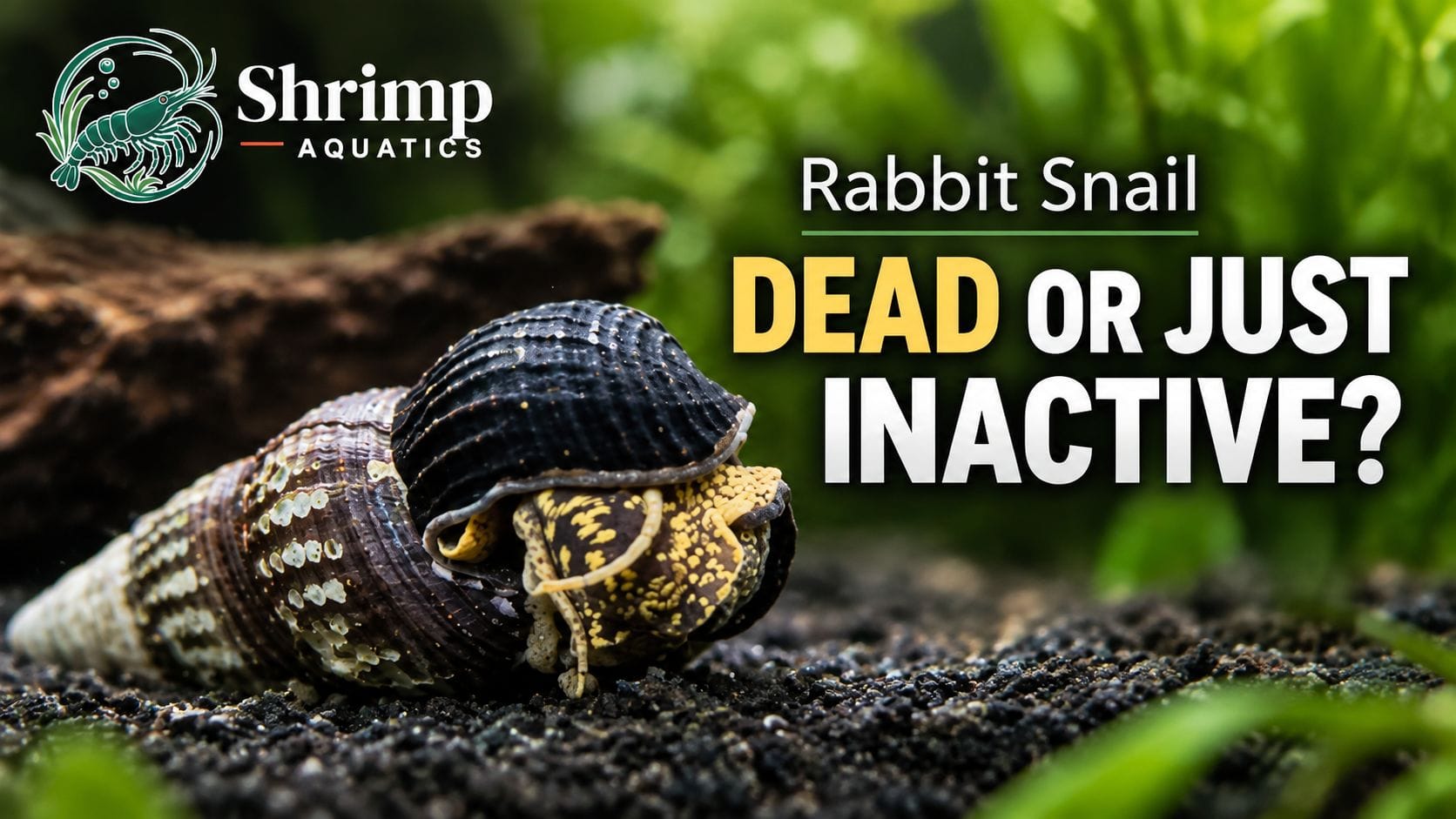
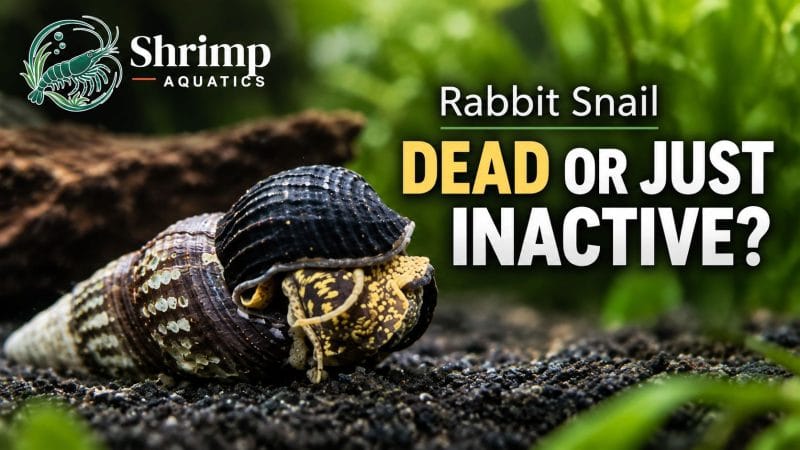
A rabbit snail that hasn’t moved since yesterday is usually fine. What tells you whether it’s alive is the trap door, not the clock. A living snail keeps that door shut and pulls back when you touch it, while a dead one hangs open and slack and the water turns foul within a day. Run the checks below before you do anything else, and don’t throw out a snail that has simply decided to sit still.
Start with your rabbit snail’s trap door, not the clock
Rabbit snails (Tylomelania sp.) carry an operculum, the hard oval plate you can see on the back of the foot when the animal is out. In snails that have one, it’s the lid that closes the shell opening when the animal withdraws inside.1 That matters here because the plate is part of a living body: the columellar muscle complex is what connects a snail to its shell, and its retractor part is what hauls the body in, as an imaging study of giant African land snails describes it.2 Muscle holds that door. Nothing holds it once the animal is gone.
- Look before you touch. Find the shell opening. A door sitting flush in the opening, or drawn a little way inside it, is a good sign. A door tilted at an angle, hanging half out, or lying loose in the sand isn’t.
- Lift the snail out and smell the opening. Five to ten seconds in the air is plenty, held level with the opening toward you. A live snail smells of almost nothing, or faintly of tank. A dead one smells like a drain.
- Touch the rim of the door, or the edge of the foot if any of it is showing, with something blunt and soft. Any reaction counts and it can be slow: a twitch, a fraction more retraction, the door easing tighter. That’s your answer.
- Put it back upright on sand or a flat piece of hardscape and mark where it sits. A line drawn in the sand beside the shell is enough. Look again in the evening.
A snail you find outside the tank altogether needs water before any of these checks, which is the case a rabbit snail out of water deals with. Once it’s back in, a lid with every gap closed is what stops rabbit snails climbing out of a tank a second time.
Got a smell? Stop testing and go to the last section. No smell and no reaction usually means the snail is alive but shut down, and the water is where you look next.
Never force the trap door open
Do not pry
The animal is anchored to the inside of its shell by muscle.2 Levering that door open with tweezers, a fingernail or a blade is how a worried evening turns into a dead snail. If the door won’t move, the resistance is the test result. You already have your answer.
How long can a rabbit snail stay shut before it means something?
Two or three days of stillness is ordinary by keeper reports, and longer for a snail that has just been moved or shipped. There’s no published figure for how long a Tylomelania stays withdrawn, how much ground it covers in a day or a night, or how deep it buries. The clock is the weakest signal you have.
Here’s what we’d do instead. Run the checks once, mark the position, then leave the snail alone; you’ll read the mark morning and evening. A shell that has shifted overnight, or a fresh grazing track through the algae film on the glass, ends the question without your touching the animal at all. If nothing has moved after three days and the water tests clean, repeat the touch test then, not four more times the same afternoon. Every check is another handling event for an animal that may already be stressed. A snail parked in the same spot after three quiet days is worth checking against the tank list in rabbit snail not moving.
Four ordinary reasons a rabbit snail stops moving
Before you treat anything, see whether one of these fits what you are looking at. All four are common, and none of them needs more than patience or a gentle nudge.
A snail that arrived in the last week
New snails shut. Bagging, transit, a temperature change and unfamiliar water all end the same way, with the door closed. Keep the tank warm and stable, keep the light low, and give it several days before you start worrying. Resist the urge to lift it out every few hours. A week sealed rather than a day or two is common enough to have its own page, a new snail that stays withdrawn for a week.
A snail lying on its back
This one catches keepers constantly and most care pages skip it. A tall, heavy, conical shell on a fairly narrow foot doesn’t do well on bare glass, sloping hardscape or loose sand. A snail that tips over may not find the leverage to right itself, and after a while it’ll stop trying and close up. Turn it over, foot down, onto sand or a flat rock. Do that every time you see it, not once.
Stillness after a female releases young
Rabbit snails are live-bearers. The embryos develop in a brood pouch and the young are released already shelled, close to 2 cm long in some species.3 Keepers commonly report a female going quiet, or ending up on her back, for an hour or more after a birth and righting herself afterwards; no published study confirms that pattern, so watch for it instead of treating it as a diagnosis. If a tiny shelled snail has appeared in the tank at the same time, you probably have your explanation.
A snail that has settled on a good grazing surface
These animals graze biofilm and algae, slowly. One that has found a patch it likes, or has pushed the front of its shell into the sand with the snout out, may be feeding in a spot you’ve written off as motionless. Look at the glass or rock immediately around it for a cleared track before you decide nothing is happening.
The water checks that matter when a rabbit snail stops grazing
A snail that is alive but shut is usually telling you something about the tank. Rabbit snails are moderate animals to keep; the warm, alkaline, mature system they need is the demanding part, and that system is where the problem normally sits. Test first and change second, because a blind water change on top of an unknown reading can make the shift worse. A blind water change can undo the stability Sulawesi rabbit snail care asks you to hold, which is why testing comes first.
| Temperature | 79-86°F (26-30°C) |
|---|---|
| pH | 7.5-8.5 |
| GH | 4-8 dGH |
| KH | 3-6 dKH |
| TDS | 150-250 ppm |
| Nitrate | Under 10 ppm |
| Ammonia and nitrite | 0 ppm, in a tank that finished cycling before the snail went in |
Ammonia and nitrite at zero is the baseline, and this tank punishes a slip more than a cooler, softer one does. Ammonia in water sits in two forms and the un-ionized form is the one that does the harm; its share rises roughly tenfold for each pH unit and about twofold for each 10 degrees Celsius of warming, in the freshwater assemblage the EPA assessed.4 Warm alkaline water therefore carries more of the damaging form at the same test reading. A number you’d shrug at in a cool soft-water tank isn’t one to shrug at here.
Oxygen is the check most keepers skip. Warm water holds less dissolved oxygen than cool water,5 and these snails come from lakes that the conservation group Sulawesi Keepers describes as very clean and high in oxygen.6 A tank sitting at the top of the range with a tired sponge filter and a still surface is a plausible reason for a heavy grazer to stop working. Add some gentle surface movement and watch for a day before you conclude anything.
Rule out copper first
If any fish medication, algaecide, plant fertilizer or snail treatment has gone into this tank recently, read the label for copper. In a related freshwater snail, copper was the most toxic of eight metals tested, with a 96 hour median lethal concentration of 0.14 mg per litre.7 That’s a different family from the rabbit snails, so take it as the reason for the warning and not as a safe level, because there’s no safe level we can give you. If copper has gone in, water changes and fresh carbon are the response, and how the animal comes through depends on the dose.
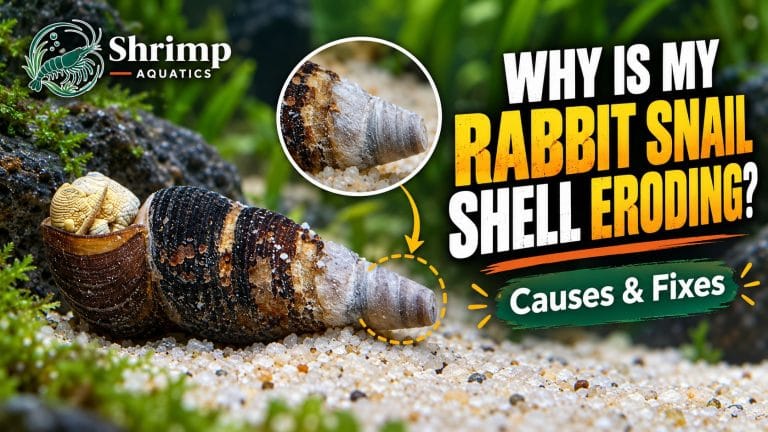
Minerals work on a longer timescale. In a related apple snail, water low in calcium combined with pH under 6.5 gave the smallest shell growth, visible erosion and the weakest shells over a six week trial.8 Hold the range in the table and keep KH from drifting downward instead of chasing a calcium number. One thing not to panic about: a worn, pitted or blunted shell tip on an adult is normal, and the Sarasin brothers’ 1897 survey of Sulawesi described the upper whorls of these snails as usually already much eroded in animals taken alive.9 Fresh damage at the growing edge of the shell is a different story and it does justify a mineral check.
Then look at the neighbours. Assassin snails hunt other snails, so they have no place in this tank. Even a small one can wear down a full grown shell over time, which is what assassin snails with rabbit snails works through. A fish that pecks at those long tentacles will keep a rabbit snail shut for days, and you’ll almost never catch it happening while you’re standing at the glass.
What to do when your rabbit snail really has died
Move quickly here. An adult rabbit snail is a large, dense animal, and in a warm tank it breaks down fast. The ammonia that comes off it lands in water where the damaging form is already favoured by the heat and the pH,4 and your shrimp and smaller snails will feel that before you see it.
- Lift the animal out with forceps or a net, not bare fingers, and take the shell with it.
- Test ammonia and nitrite straight away, then daily for the next few days.
- If either reads above zero, change water using matched, temperature-equal replacement water. Small and repeated beats one big change.
- Run fresh carbon for a few days if the water smelled at all.
- Don’t restock that spot until the readings have been clean for a week and the grazing film has grown back.
If the shell is empty and light when you lift it, the animal died a while ago and the tank has already cleaned it out. Same response, and test with a little more care, because you don’t know how long it was sitting there.
References
9 Sources
- Replacing mechanical protection with colorful faces, twice: parallel evolution of the non-operculate marine worm-snail genera Thylacodes and Cayo n. gen. (Gastropoda: Vermetidae), PeerJ, 2023.
- Comparative diagnostic imaging in giant African land snails (Achatinidae), Frontiers in Veterinary Science, 2023.
- Anatomy of an adaptive radiation: a unique reproductive strategy in the endemic freshwater gastropod Tylomelania (Cerithioidea: Pachychilidae) on Sulawesi, Indonesia, and its biogeographical implications, Biological Journal of the Linnean Society, 2005 (abstract).
- Aquatic Life Ambient Water Quality Criteria for Ammonia, Freshwater (2013), U.S. Environmental Protection Agency, Office of Water, April 2013.
- Dissolved Oxygen and Water, U.S. Geological Survey, Water Science School, updated August 2026.
- Do you know Sulawesi snails?, Sulawesi Keepers, undated.
- Toxicity of Metals to a Freshwater Snail, Melanoides tuberculata, The Scientific World Journal, 2012.
- The effect of calcium and pH on Florida apple snail, Pomacea paludosa (Gastropoda: Ampullariidae), shell growth and crush weight, Aquatic Ecology, 2009 (abstract).
- Materialien zur Naturgeschichte der Insel Celebes, volume 1, Paul and Fritz Sarasin, 1897.
Ready to get started?
Shop our Sulawesi Snail collection
12 products available · Live Arrival Guarantee