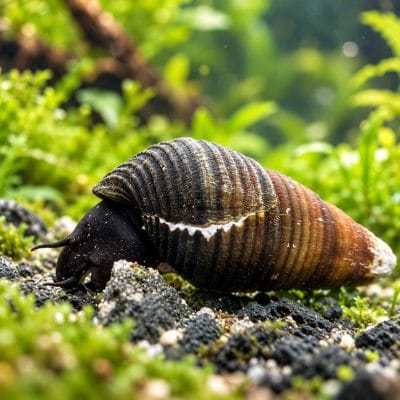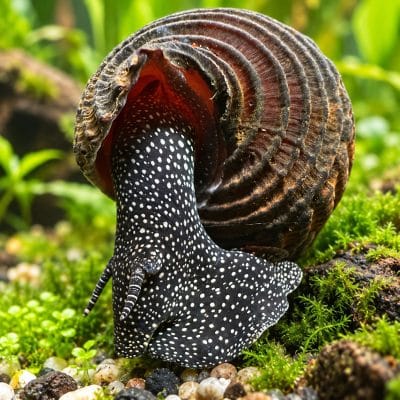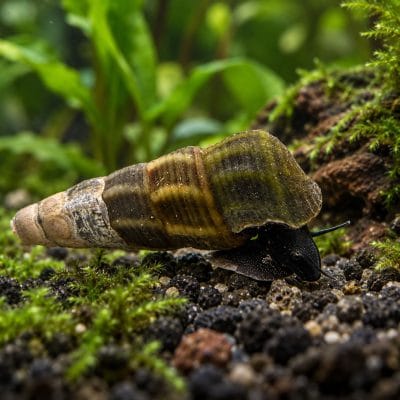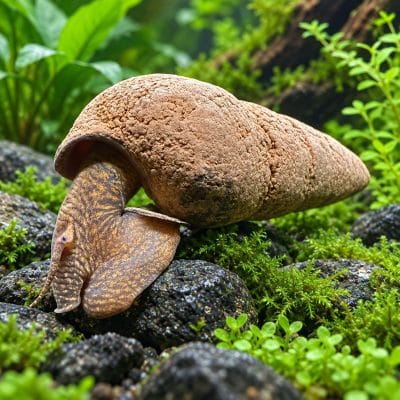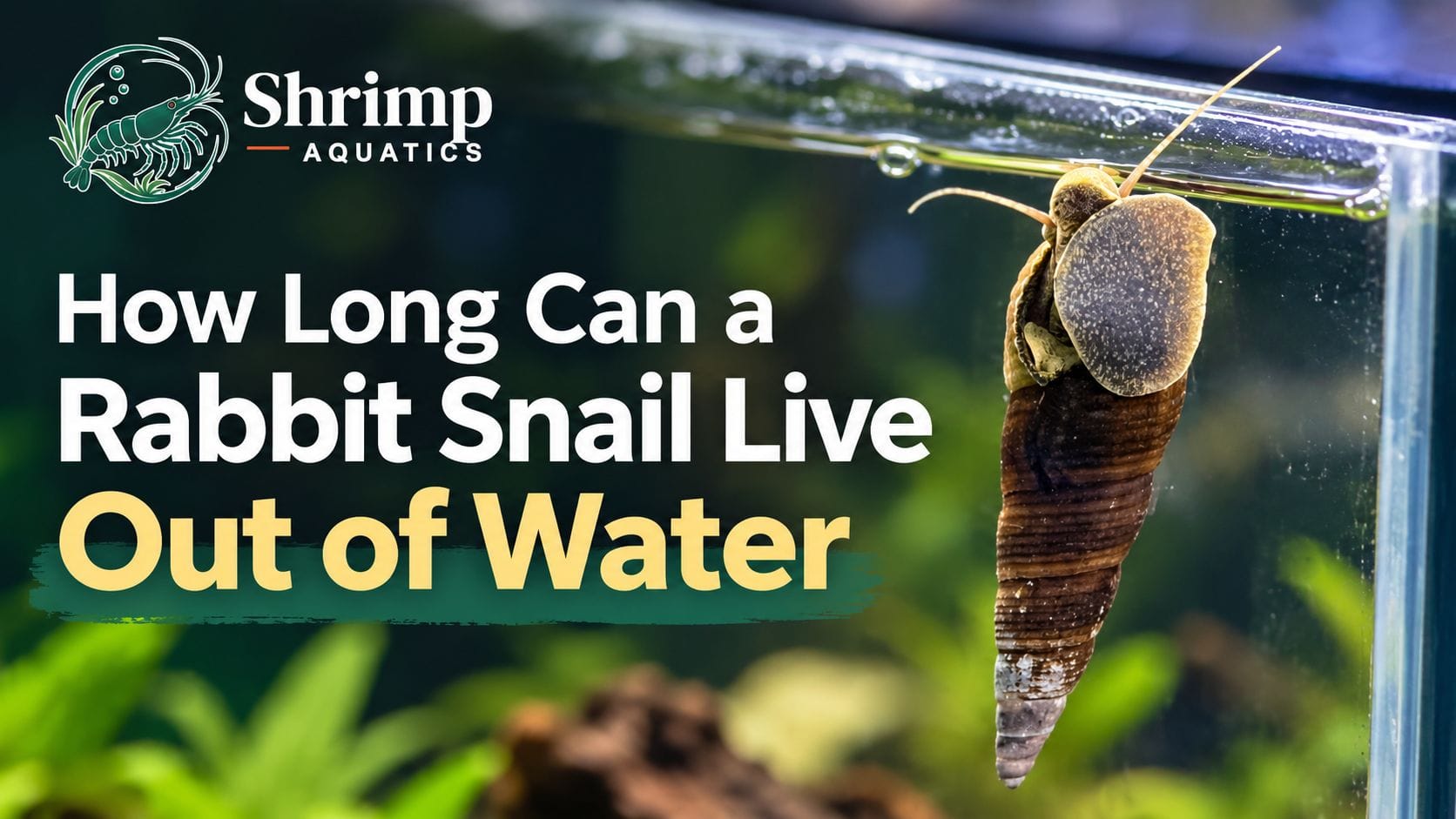
Found a rabbit snail on the floor and think it’s too late? Often it isn’t, because a rabbit snail (Tylomelania sp.) can last out of water longer than it looks: keepers pass around 12 to 14 hours, and a snail that looks dead after a night on the floor can still recover. That “12 to 14 hours” doesn’t trace back to any study, though, and no published study has measured how long a rabbit snail survives out of water. Research on other freshwater snails points to something more useful: what counts is how much water the snail has lost. A snail on a dry floor and one in a damp corner aren’t on the same clock. So don’t wait: get yours into water now.
Found a rabbit snail out of the tank? Get it into water first
Move now and read later. A snail that looks dead after a spell on the floor may not be, and the only way to find out is to give it water back. Once it’s back in water, the smell and touch checks for a rabbit snail that’s dead or just inactive tell you which one you’re holding.
- Pick it up by the shell. Don’t pull on the trapdoor (the operculum) or try to prise the body out to look; forcing it risks injuring the snail.
- Put it in a cup or small tub filled with water from its own tank. That water already matches the temperature and chemistry it came from, so you’re not adding a second shock.
- If it’s picked up carpet fluff or dust, swish it gently in that same water. Skip tap water.
- Set the container somewhere quiet, out of direct sun, and leave it alone.
If it’s clamped onto the glass or the lid instead, read whether forcibly pulling a rabbit snail off the glass could injure it before you lift it, so you don’t tear the foot.
Why a separate container and not straight back into the tank? If the snail has died, you’ll know within the day, and nothing will have rotted in your display tank in the meantime.
How to tell whether a dried-out rabbit snail made it
Give it a day before you decide. Researchers drying other freshwater snails didn’t call a snail dead because it looked dry; they judged survival by putting it back into water.1 That’s what you’re doing in the cup.
The clearest signs are the ones you can see: the foot comes out, or the snail rights itself and starts to move. Once it’s moving about, it can go back into the tank. Keepers also go by two quicker checks, and both are widely reported: the trapdoor pulls tighter when you touch it lightly, and a snail that has died gives off a strong, foul smell. If there’s no movement after a day and the smell is there, remove the snail and don’t return it to the tank.
Why drying, not the clock, decides a stranded rabbit snail’s chances
Because the hours depend on the air, and the air in your room isn’t the air in anyone else’s. Research on two other freshwater snails puts it simply: a snail dies once it has dried past a point, and dry air gets it there faster than damp air.1 A snail behind a warm heater vent and one in a damp corner behind the stand could be on very different clocks.
There’s a second reason to distrust any single figure. Tolerance to drying can vary enormously between lines within one snail family,2 so a number worked out for some other kind of snail won’t tell you much about a rabbit snail.
So what should you take from that? Assume every hour on a dry floor counts, act on the steps above, and don’t talk yourself out of trying because a number online says it’s too late.
Why did your rabbit snail leave the water?
You often can’t know for certain, but an escape is your cue to test the tank, and it’s worth doing the same day. Check the water before you blame the snail, especially if more than one has gone climbing. If a snail stays shut for days after an escape, that’s the case rabbit snail not moving covers.
| Ammonia and nitrite | Both should read 0 in a cycled tank |
|---|---|
| Temperature | 79-86°F (26-30°C) |
| pH | 7.5-8.5 |
| GH | 4-8 dGH |
| KH | 3-6 dKH |
| TDS | 150-250 ppm |
| Nitrate | We aim to keep it under 10 ppm |
These are the numbers we keep every Sulawesi lake species we sell in, snails included. If a reading sits outside them, bring it back slowly, because a fast swing is its own stress.
Look at oxygen too. Warm water holds less dissolved oxygen than cold water,3 and a rabbit snail tank runs warm, so make sure the filter outlet or an air stone keeps the surface moving. If every reading looks fine and the surface is rippling, note the date and keep an eye on things. One climb on its own isn’t a diagnosis. A snail that keeps trying is a different matter, and the checks for why rabbit snails will climb out of a tank start with the water.
What the research says about how long snails survive out of water
Neither study is on rabbit snails, so read them as the mechanism, not a timetable. Lab drying tests usually hold humidity steady and report hours to death, but real air changes from hour to hour. So in a study of two melania snails, the red-rimmed and the quilted, the author measured how much water each snail lost and used that as the yardstick, and survival was judged by putting each snail back into water.1 As the paper’s title puts it, the amount of water out of the snail matters more than the time it spent out of water.
The second study looked at eight introduced lines of thiarid snails in Martinique. All of them resisted drying fairly well, yet their tolerance varied enormously from one line to the next.2 If lines within one family differ that much, no borrowed figure should decide whether you try to save yours.
Keep rabbit snails in the tank with a lid that closes every gap
A lid is the usual rule for rabbit snails. The gaps are where it fails: the cut-outs for the filter, the heater cable and the airline. Close those with a trimmed insert or foam, and keep the water line a little below the rim so there’s less wet glass leading to the edge. The rest of the setup, water and hardscape included, is in Sulawesi rabbit snail care.
We know it’s tempting to run an open top for the look. With these snails, we wouldn’t. A stranded snail you find in the morning is a far worse outcome than a lid you have to lift at feeding time.
If you’re setting up a tank for Sulawesi snails, fit and check the lid before they arrive, and have the water tested and stable first. Every snail we sell is bred by Shrimp Aquatics, not collected from the wild.
References
3 Sources
- Aquatic mollusc control through desiccation: it is not the amount of time out of water, it is the amount of water out of the mollusc, D. L. Rogowski, Hydrobiologia (Springer Nature), published online 2023; article page and abstract.
- Variation in Desiccation Tolerance in Freshwater Snails and Its Consequences for Invasion Ability, B. Facon, E. Machline, J. P. Pointier and P. David, Biological Invasions (Springer), 2004; article page and abstract.
- Dissolved Oxygen and Water, U.S. Geological Survey, Water Science School, updated August 24, 2026.
Ready to get started?
Shop our Sulawesi Snail collection
12 products available · Live Arrival Guarantee