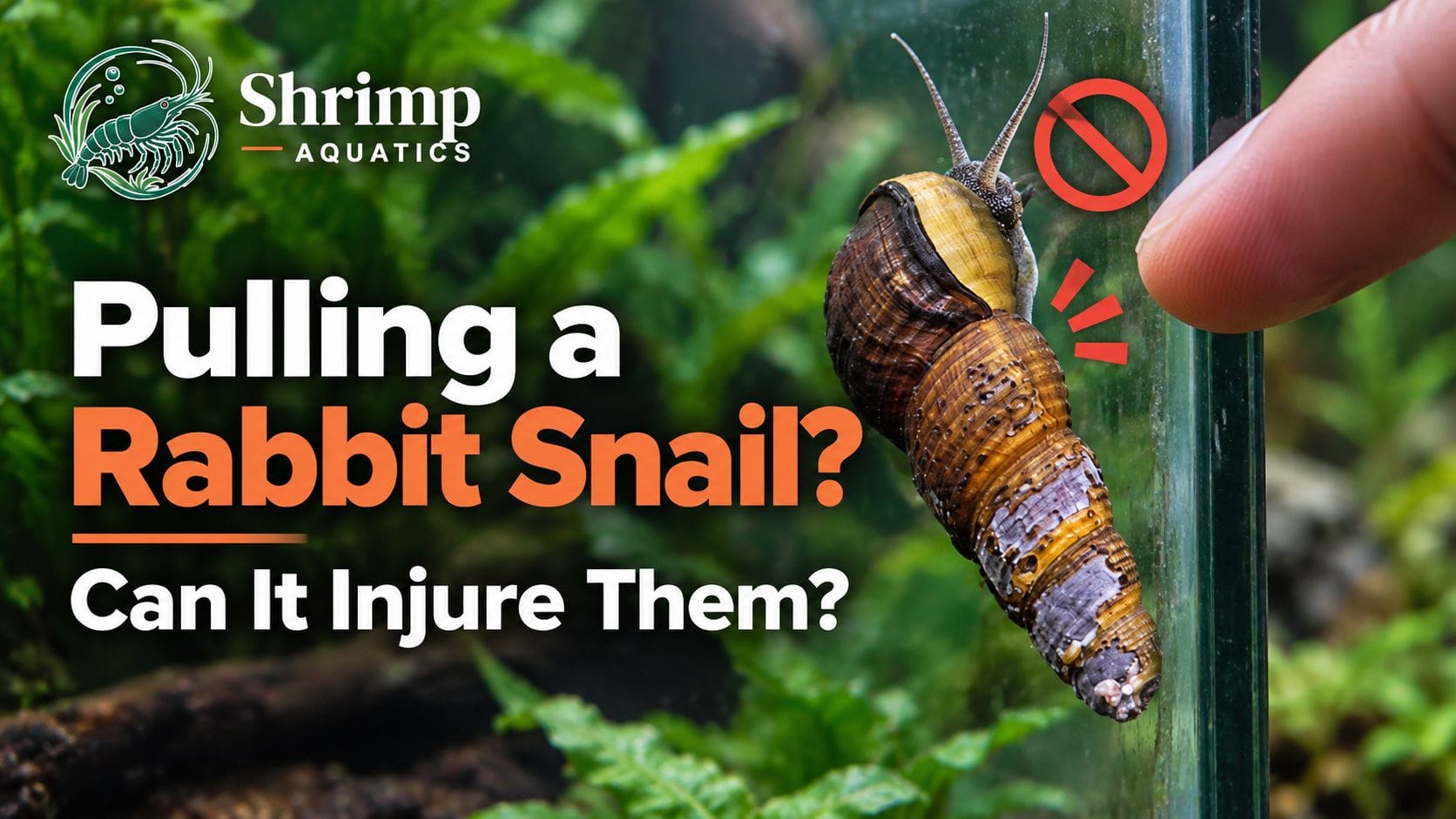
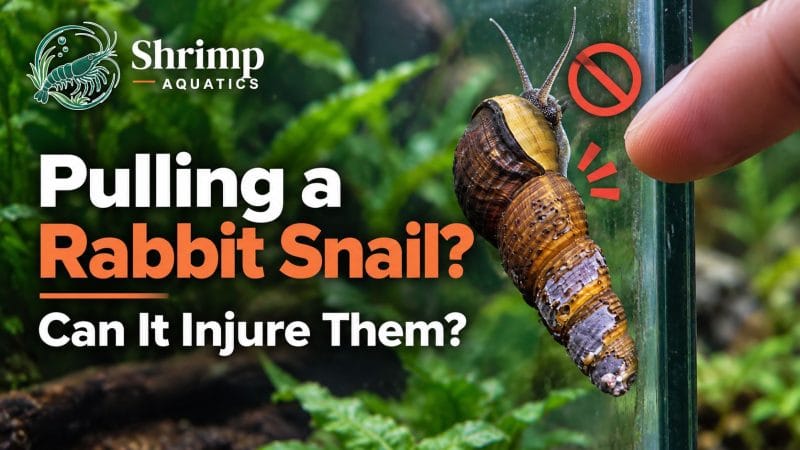
Yes, it can, and the damage is not always something you can see afterwards. A rabbit snail (Tylomelania sp.) grips the glass with its foot, while its body is anchored to the inside of its own shell by a separate muscle. Pull the shell straight out and you load both of those joins at the same time. The safe way round is to let the snail release, or to slide it sideways along the pane.
Does your rabbit snail actually need to come off the glass?
Usually it doesn’t, and that’s the cheapest way to avoid the whole problem. If you’re scraping algae, scrape around the snail and come back for that patch tomorrow. If you’re rescaping, work the other end of the tank first. A rabbit snail parked on the pane is grazing, which is what you bought it to do, and it’ll move on its own within a few hours.
There are real reasons to move one. You’re catching the snail to move it to another tank, it’s wedged somewhere it can’t right itself, it’s sitting on the intake, or you’re draining the tank and it’s above the new water line. Those are worth the handling. Getting a better photo is not, and neither is tidying the glass before guests arrive. Moving a snail away from a nipping fish belongs on that list too, and fish attacking rabbit snails is the case for separating them instead.
What tears when you pull a rabbit snail off the glass
The animal is not loose inside its shell like a hermit crab in a borrowed one. In gastropod anatomy the columellar muscle runs from the central pillar of the shell into the foot, and it is the connection that holds the animal firmly in its shell; when it shortens, the snail is drawn inside and the operculum closes the opening behind it.1 That muscle is doing two jobs at once while your snail is on the glass: holding the body to the shell, and being the thing that would pull the body in if the snail decided to let go.
So when you take hold of the shell and pull outwards, the force has to come out somewhere. Either the foot lets go of the glass, or the join between body and shell gives first. You can’t choose which. You’re also holding a long, heavy shell, which gives you leverage the snail has no way to resist, and you can’t feel how much of that is landing on the soft tissue at the aperture. Whether the antenna or the operculum hinge takes that strain changes what regrowing an antenna or operculum asks of the animal.
Don’t do these
Pulling the shell straight out, twisting the shell to break the seal, levering the shell off with a scraper or a fingernail, or yanking once the snail has already clamped down harder. Each of them puts the load through the shell and into the animal’s own attachment.
What happens next is where the hobby gets ahead of the evidence, so here’s the honest version. Keepers report torn mantle edges, bodies pulled part way out of the shell, and snails that came away from the shell completely and died within a day or two. No published study measures how often forced detachment injures Tylomelania, how bad the injury usually is, or how many snails recover, and none of the care sheets repeating those outcomes cites one either. Treat the severe accounts as warnings worth taking seriously, not as a prognosis anyone has measured.
Why a sideways slide releases the grip when a straight pull will not
Pedal mucus isn’t glue that sets. It’s a weak gel, and how it behaves depends on how it’s being deformed: measured on several snail and slug species it thins as it’s sheared, and whether it acts as an adhesive or as a lubricant comes down to the timescale of that deformation.2 Push slowly and steadily along the pane and you’re asking the film to flow, which is the one thing it does easily.
Pull straight out and you’re asking the opposite. In tests of snails on smooth surfaces, a force applied in the plane of the surface was the most effective way to get the animal off, and the same work found the grip stronger than the mucus alone could account for, which points to the foot holding a seal against the surface as well.3 Those were garden snails, so read it as the mechanism and not as a measurement of your rabbit snail. The mechanism is the part that transfers: break the seal at the edge, let water under the foot, and the grip is gone without anything pulling on the shell.
How to get a rabbit snail off the glass without hurting it
Work down this list and stop as soon as the snail is free. Each step is gentler than the one after it.
- Touch the front edge of the foot, the snout or a tentacle with a clean fingertip, then wait. When the snail draws in, the foot leaves the glass and the shell lifts away with no resistance at all.
- If nothing has changed after a minute, put a finger or a thumb against the side of the shell near the opening, not the pointed tip, and push it sideways along the pane. Keep it slow and steady, in one direction, and let the snail slide.
- Once it’s sliding, keep going gently until it comes free, or slide it up the glass toward the surface, where keepers commonly report the snail shuts itself in as the shell breaks the water line and comes away loose.
- Still stuck? Hold a thin, smooth plastic card flat against the glass and work its edge under the rim of the foot, so the foot peels off the glass and the shell carries none of the load. Stop if you meet resistance.
- If none of that works, leave it. Come back in an hour or after the lights go off. A snail that wants to be somewhere else is not a job that has to be finished now.
One more thing worth knowing: a snail that’s already been grabbed at will often clamp down harder. If that happens, take your hands out of the tank and give it time to relax before you try again.
What to check if you already pulled your snail off
Put it back in the tank first, upright, on the substrate or a flat piece of rock where it doesn’t have to climb. Then watch it, without picking it up again. If you find one on the floor rather than the glass, how long a rabbit snail can survive out of water is the page for that emergency.
- Touch the foot or the operculum lightly. A snail that draws in and shuts the trapdoor is doing exactly what that muscle is for.1
- Look at the rim of the opening. The soft edge should sit against the shell all the way round.
- Give it a day. Staying shut for several hours after being handled is something keepers see often.
- The body hangs out of the shell and doesn’t draw back when you touch it.
- The animal has come away from the shell, partly or completely.
- The soft rim is torn back from the shell edge, or the operculum is hanging loose.
A snail in the first group is probably fine and the best thing you can do is nothing. A snail in the second group is past what a keeper can fix at home, and we’re not going to pretend otherwise: there’s no published treatment for it in this genus, and no evidence that any of the home remedies circulating in the hobby change the outcome. If you want a professional opinion, an aquatic veterinarian is the person to ask, and it’s worth asking sooner than later. That verdict rests on the touch and smell checks in rabbit snail not moving, not on how long the shell has stayed closed.
How to look after a rabbit snail that came off badly
Everything useful here is about the water and about leaving the animal alone. Don’t change your parameters to try to help, don’t dose medications, and don’t lift the snail out every few hours to inspect it. Handling is what caused the injury; more handling won’t repair it. Keep the water where these snails should already be living:
| Temperature | 79-86°F (26-30°C) |
|---|---|
| pH | 7.5-8.5 |
| GH | 4-8 dGH |
| KH | 3-6 dKH |
| TDS | 150-250 ppm |
| Nitrate | under 10 ppm |
Minerals matter more than usual while a snail is repairing the edge of its shell or the tissue at the opening. There’s no figure published for Tylomelania, but in apple snails, a different family, low calcium combined with low pH produced the slowest shell growth, visible shell erosion and the weakest shells in the trial.4 The practical version for your tank: hold KH in range instead of letting it drift down between water changes, and keep the small, regular changes you were already making. Holding those numbers steady is the job in Sulawesi rabbit snail care, and it matters more while a shell edge is repairing.
Feeding needs no adjustment. A snail that’s shut in won’t eat, and one that’s recovering goes back to grazing biofilm off the rock and glass when it’s ready. If it’s still closed up and unmoved after a couple of days, check ammonia, nitrite and temperature before you assume the handling did it. Those are the first things to rule out, and they’re the ones you can fix.
References
4 Sources
- Invertebrate Anatomy OnLine: Littorina irrorata, Richard Fox, Lander University, 2003.
- Probing the compositional and rheological properties of gastropod locomotive mucus, Frontiers in Soft Matter, 2023.
- Wet adhesion and adhesive locomotion of snails on anti-adhesive non-stick coatings, PLOS ONE, 2012.
- The effect of calcium and pH on Florida apple snail, Pomacea paludosa, shell growth and crush weight, Aquatic Ecology, 2009.
Ready to get started?
Shop our Sulawesi Snail collection
12 products available · Live Arrival Guarantee