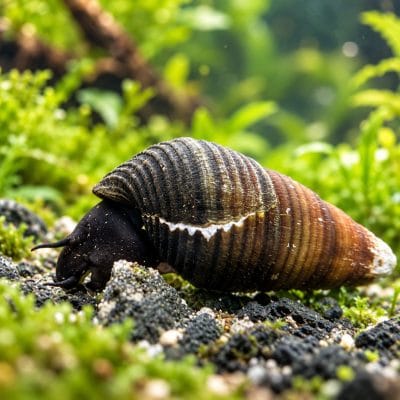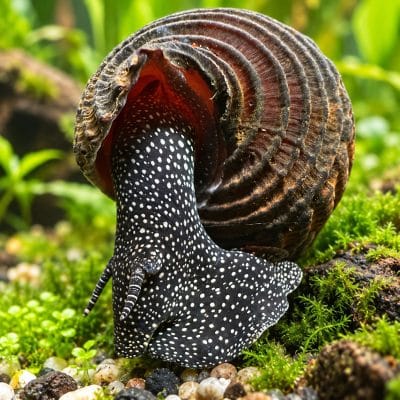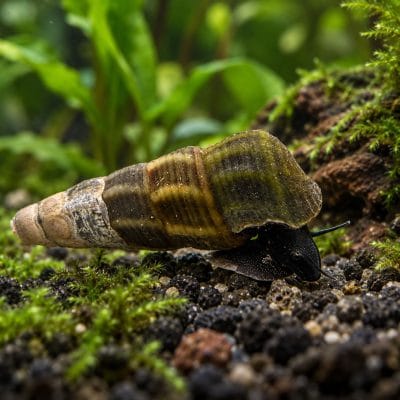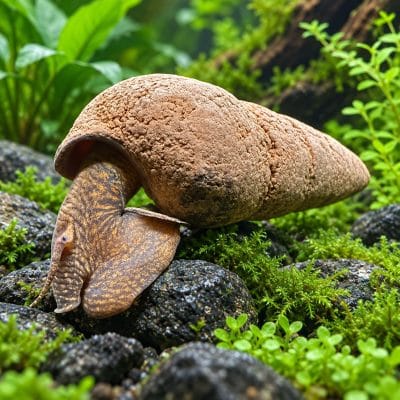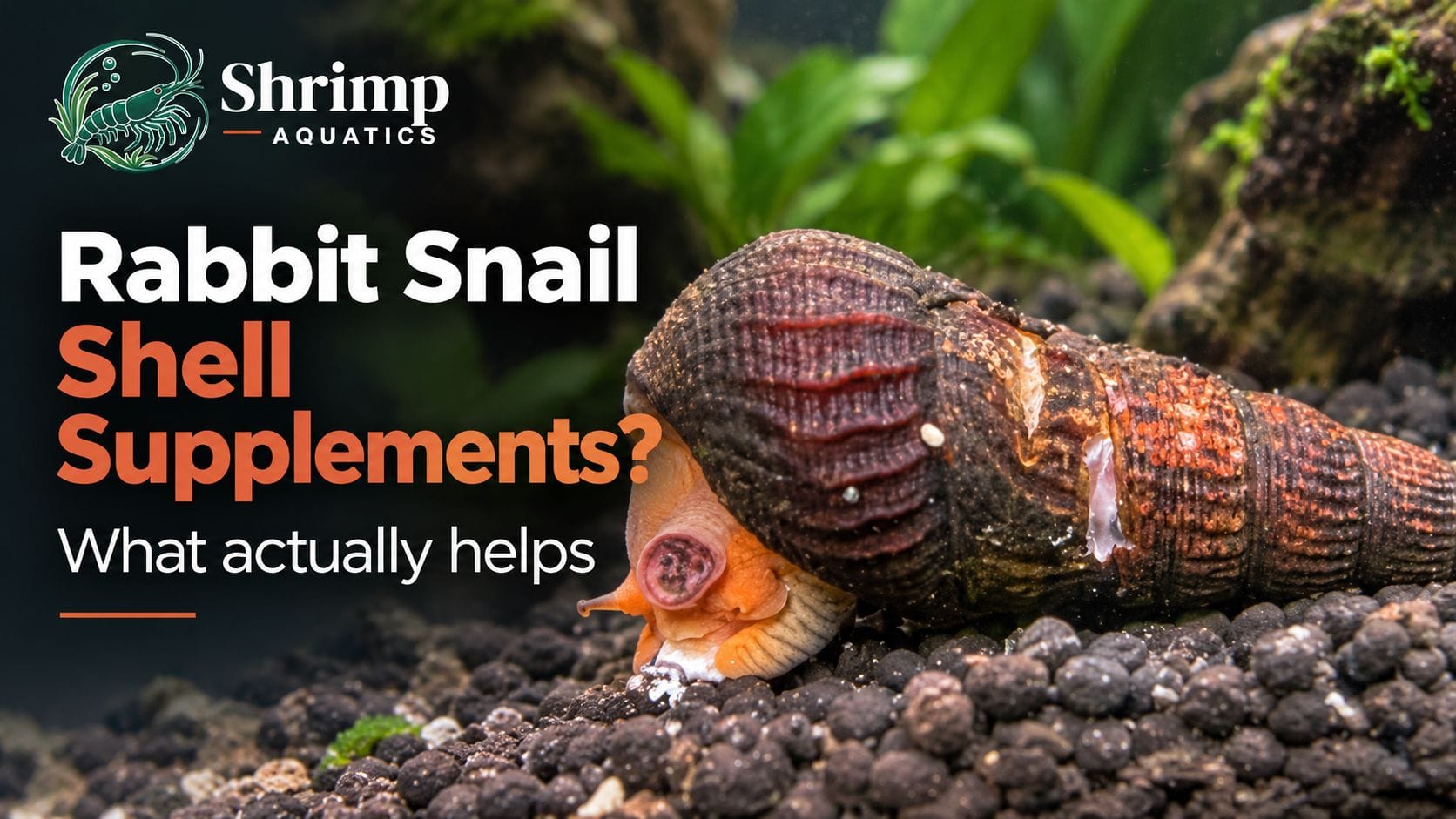
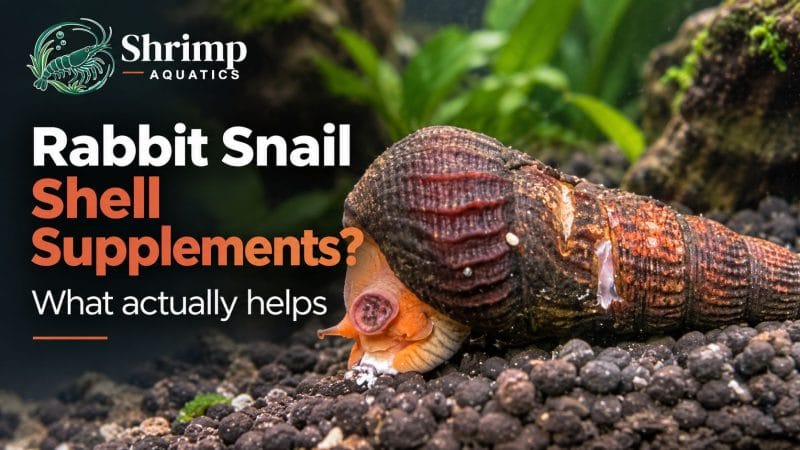
Yes, there’s a way to supplement a rabbit snail’s shell, and most of it happens before you buy a single product. Tylomelania snails build shell out of the minerals dissolved around them, so the water is the supplement. Cuttlebone, crushed coral and calcium-carrying food are the small extras on top.
Start with the water your rabbit snails already live in
Ask most keepers how to supplement a snail’s shell and you’ll get a shopping list. Start somewhere cheaper. A snail’s shell is calcium carbonate, and a freshwater snail spends its whole life sitting in a solution of the material it needs to build one.
Two studies on apple snails, a different family from rabbit snails, point the same way. In the first, snails grown for six weeks in higher-calcium water gained significantly more shell length than those in weaker water. The group held in the weakest, most acidic water was the only one showing visible shell erosion, and its shells were the weakest under crushing.1 In the second, every group ate the same feed for twelve weeks and only the water calcium differed. The snails in the richest water finished bigger, heavier and with measurably harder shells.2
What the apple snail work gives us is a direction and not a number: the water is the lever. Both studies measured new growth and shell strength, not the repair of damage already done. Damage that’s already there is a separate problem, and finding out why a rabbit snail shell is eroding starts with KH, not with a supplement.
If your tank isn’t ready yet, get the water sitting in range and mature for a few weeks before you buy Sulawesi rabbit snails, because the snail starts building shell in whatever water it lands in. Ours are bred in our own tanks and kept in the same water as our Sulawesi shrimp. Check your own country’s import rules before you order.
What to hold pH, GH, KH and TDS at for rabbit snails
These are the numbers we keep to. They’re the same ones our Sulawesi shrimp get, because the snails live in the same water.
| pH | 7.5-8.5 |
|---|---|
| GH | 4-8 dGH |
| KH | 3-6 dKH |
| TDS | 150-250 ppm |
Notice what that is and what it isn’t. It’s alkaline and buffered, and it’s nowhere near hard water. Sulawesi Keepers, the conservation group breeding these snails, describes the lake water as very clean, soft and yet alkaline, and says plainly that soft water isn’t the problem: shell damage comes from acidic water, from a fall, or from poor nutrition.3
So the instinct to pile in hardness until the shell looks better is the wrong move. GH is the least urgent of the four. KH is what holds pH up while your tank quietly makes acid, and low pH is what the apple snail trial punished hardest. Getting KH and pH to hold in soft tap water comes first, and that is rabbit snails in soft water.1
Don’t chase a number you can’t hold
A tank whose hardness wanders up and down every week is harder on a snail than one that sits still. Pick a point inside the range, hit it at every water change, and leave it alone.
How to raise minerals without swinging a Sulawesi tank
The mistake worth naming first is dosing powder straight into a tank with animals in it. You can’t see what you’ve done until it’s done, and a snail that has just been walked from one hardness to another gets no warning.
At Shrimp Aquatics we start our Sulawesi systems with RO water rather than tap water and use Sulawesi Mineral 7.5 to prepare it, and we test the finished pH, GH and TDS before that water goes into a tank.
That order isn’t ours alone. SaltyShrimp’s own instructions for that salt say to add it to water outside the aquarium, where it dissolves within seconds, and to bring the new water to tank temperature first.4 The same page is worth reading for a second reason: the salt lifts carbonate and total hardness together at a fixed ratio, so you can’t use it to nudge GH on its own.4
- Mix and test in a bucket. Aim for one point inside the range, not the whole band.
- Bring the bucket to tank temperature before it goes in.
- Change small volumes often instead of large volumes rarely.
- Top off evaporation with plain RO and save the mineral mix for water changes, so the numbers don’t creep up between tests.
- Test the tank a day later, not an hour later.
If your tap water already lands in range, you don’t need any of this. Test it, dechlorinate it, use it.
Is cuttlebone or crushed coral worth adding for rabbit snails?
Yes, with a limit on what you should expect. Both are calcium carbonate, both dissolve slowly, and both give the snail a surface worth grazing. Treat them as a reserve and not as a correction: you don’t set the rate they give their minerals up at, so nothing about them replaces preparing the water you pour in.
Crushed coral in a filter bag is the usual way keepers hold KH up between changes. A safe default is to start with less than you think and test weekly for a month before you trust it to hold anything. How much prepared water each change takes scales with the tank, which is rabbit snail tank size. Cuttlebone floats until it’s waterlogged, so boil a piece or soak it for a few days and it will sink and stay put.
What doesn’t belong in this tank is an active, pH-lowering aquasoil. It works against everything above. Use inert sand and rock, and let the minerals come from the water you prepare. The sand, rock and water routine around it are the same ones in Sulawesi rabbit snail care.
Can a rabbit snail get its calcium from food?
Partly. No published study reports what any Tylomelania eats in the wild, so a page that hands you a vegetable menu for this animal is making it up. What is documented is how they feed: grazing mature biofilm and aufwuchs off rock, wood and glass.
Calcium in food does measurable work in some snails. In an African land snail, calcium added to the food tracked closely with both weight gain and shell length, and the snails kept without it died at a high rate and laid no eggs. A land snail has no dissolved calcium to fall back on, which is why food matters so much to it and why it’s a poor model for an animal living inside its own supply. The apple snails in the twelve-week trial all ate the same feed and still ended up with different shells.2 How demanding this animal really is, once the water is right, is the question in are rabbit snails difficult to care for.5 Read that carefully before you act on it.
A sinking invertebrate food carrying calcium is a reasonable extra once or twice a week, and leftovers come out the same day. It stays an extra, though. Food doesn’t make up for an immature tank, and a rabbit snail belongs in a system that already carries a visible film on the rock and glass before it arrives.
Keep copper out of anything you put in the tank
Everything above is about adding things to water. This is the one to leave out. In a laboratory test of eight metals on Melanoides tuberculata, a freshwater snail in the same superfamily as rabbit snails, copper was the most toxic of the eight, killing half the exposed snails within four days at 0.14 mg per liter, and it built up in their soft tissue more than any other metal tested.6
That figure belongs to a different family and it is not a safe limit for your tank. Read it the other way around: a related snail dies at a concentration most keepers would never think to test for. So there’s no dose we’d give you. Check the label on fish medications, algae treatments and plant fertilizers before any of them go near a tank with snails in it.
Telling normal apex wear from fresh erosion on a rabbit snail
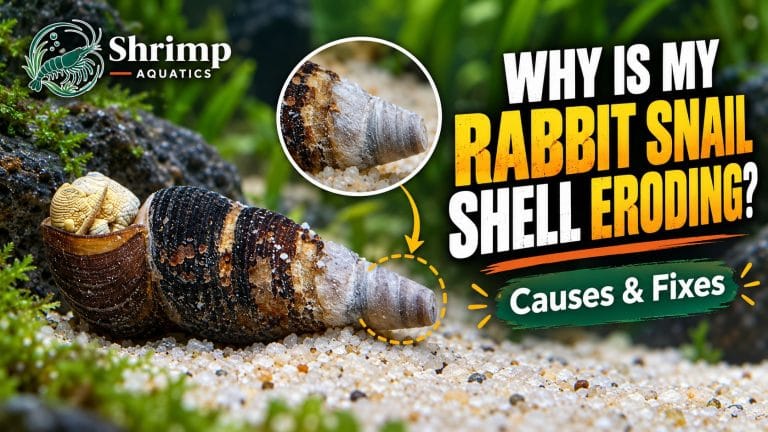
Before you change anything, look at where the damage is. On an adult Tylomelania, a worn, chalky, blunted tip is ordinary. The Sarasin brothers’ 1897 survey of Sulawesi describes the upper whorls of these snails as mostly considerably eroded from the third whorl onward, and records three snails taken alive whose ribs had been worn away completely on the upper whorls.7 Those animals were living in the lakes. A scarred apex on a snail you bought as an adult tells you about its past, not about your water.
What’s worth acting on sits at the other end of the shell. The tip is the oldest part of the animal, so the newest shell is out at the opening, and that’s where this month’s water shows up.
- Chalky white, pitted or flaking shell near the opening, on a snail that was smooth there last month.
- The newest shell at the lip looking thin or translucent next to the older whorls.
- A worn tip and eroded upper whorls, unchanged since the day the snail arrived.
If you’re seeing the first two, test pH, KH, GH and TDS before you buy anything, then work out what has gone into the tank lately. Fix the water first and give it months, because what you’re waiting on is new shell, and the trials above measured new growth and never the repair of old damage.
References
7 Sources
- The effect of calcium and pH on Florida apple snail, Pomacea paludosa (Gastropoda: Ampullariidae), shell growth and crush weight, Aquatic Ecology (Springer), 2009, abstract.
- Growth and shell hardness of the apple snail Pomacea flagellata Say, 1829, reared at three calcium concentrations, PeerJ, 2023.
- Do you know Sulawesi snails?, Sulawesi Keepers, undated page, read September 2026.
- Sulawesi Mineral 7,5, minerals and trace elements, SaltyShrimp (Garnelenhaus), manufacturer technical page.
- Effects of dietary calcium on growth and oviposition of the African land snail Limicolaria flammea (Pulmonata: Achatinidae), Revista de Biologia Tropical, Universidad de Costa Rica, 2008.
- Toxicity of Metals to a Freshwater Snail, Melanoides tuberculata, The Scientific World Journal, 2012.
- Materialien zur Naturgeschichte der Insel Celebes, volume 1, Paul and Fritz Sarasin, 1897, Internet Archive scan.
Ready to get started?
Shop our Sulawesi Snail collection
12 products available · Live Arrival Guarantee