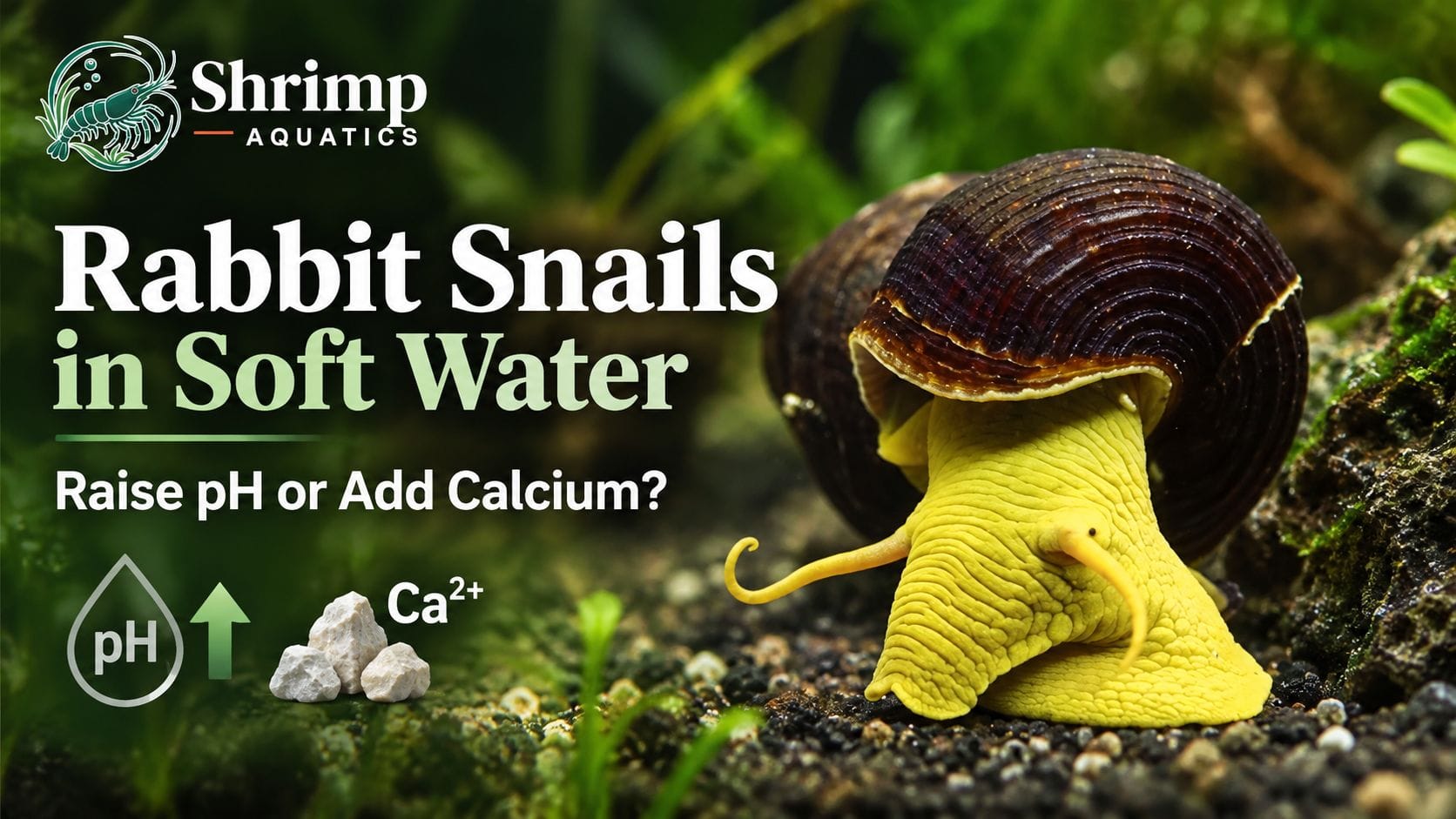
Yes to both, and the order matters. Soft water leaves a rabbit snail (Tylomelania sp.) short of two things at once. There’s no carbonate holding the pH up, so the water keeps pulling at the shell. And there’s little dissolved mineral left for the animal to build new shell out of. The conservation group Sulawesi Keepers describes the lakes these snails come from as very clean, soft and yet alkaline.1 That’s the odd pairing your tank has to copy. Calcium tipped into acid water won’t get you there.
Test KH, GH and pH before you change your rabbit snail’s water
Start with a test kit, not a bottle. KH is the reading that tells you whether you’ve got a problem at all. It’s the buffer standing between your tank and a falling pH, and in soft tap water or straight RO there’s almost none of it. GH tells you whether there’s anything dissolved for the snail to build with. In soft water those two are usually low together, and that pairing is what the research points at. In trials on a different freshwater snail, the smallest shell growth, the visible erosion and the weakest shells all came from low calcium combined with acid water, not from either one on its own.2
Here’s what we keep our own Sulawesi tanks to. Nobody has published an aquarium keeping range for these snails, so this is the range we hold. Our rabbit snails sit in the same water as our Sulawesi shrimp.
| pH | pH 7.5-8.5 |
|---|---|
| Carbonate hardness | 3-6 dKH |
| General hardness | 4-8 dGH |
| TDS | 150-250 ppm |
If your KH comes back at or near zero, treat that as the finding. One pH reading taken in the morning tells you very little in an unbuffered tank, because the number moves through the day as the tank breathes and feeds.
Is your rabbit snail’s worn shell tip old damage or fresh erosion?
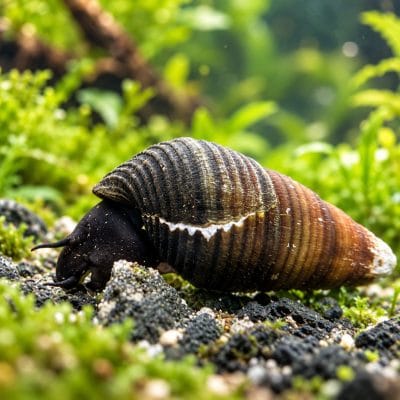
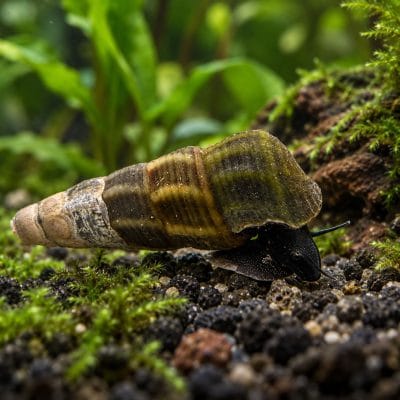
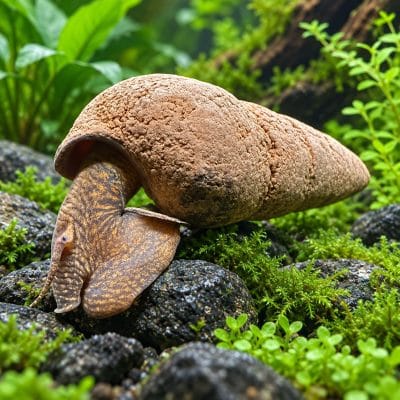
Before you change anything, look at where the damage sits. A scarred, blunt, chalky spire on a grown rabbit snail is the normal condition of this animal. It isn’t a verdict on your tank. The nineteenth century monograph that first described many of these snails records the upper whorls as mostly considerably eroded from the third whorl onward, and describes three snails taken alive whose ribs had worn away completely.3 Wild adults look like that.
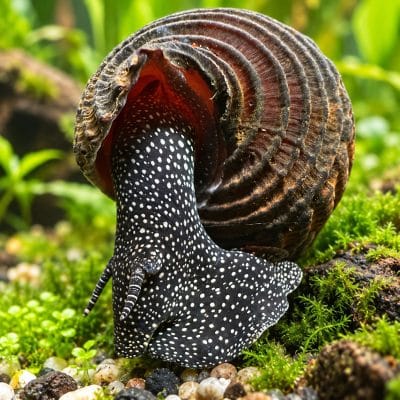
What you can act on is the other end of the shell. Look at the opening, where the animal is still growing. Fresh pitting there, a thin chalky white band, or a ragged crumbling rim, is damage happening now, and that’s worth a test kit today. So judge your water by the growing edge, not by the apex. Fresh pitting there is the sign that a rabbit snail shell is eroding now, not years ago.
How we’d bring a soft rabbit snail tank up to pH 7.5-8.5
There are two routes, and you can use both. The first is to build the water outside the tank. Start from RO, then remineralize with a salt made for Sulawesi water, which lifts carbonate and general hardness together instead of only one of them. If you’re reaching for SaltyShrimp Sulawesi Mineral 8.5, read the instructions before you buy, because it doesn’t simply stir in. The manufacturer says it needs CO2 added over roughly 3-4 days to dissolve. After that it wants at least three hours of aeration with an air stone to drive the CO2 back out, and it raises carbonate and total hardness at a ratio of KH to dH of 0.78 to 1.0.4 How much prepared water each change takes depends on the tank, which is rabbit snail tank size.
The second route is passive. Crushed coral or aragonite sitting in the filter flow dissolves as the water turns acid on it, so it tops the buffer up on its own schedule instead of yours. A safe default is a small bag to start with and a retest every few days, adding more only if the readings stay flat.
Either way, put the calcium in the water and not only in the feeding dish. In a rearing trial on an apple snail, the animals held at the highest dissolved calcium grew faster and ended up with harder shells. Most of a freshwater snail’s shell calcium is drawn straight from the water it sits in.5 That calcium goes onto the lip, which is the only place rabbit snail shells grow.
One thing will quietly undo all of it. An active plant soil is built to strip carbonate and hold the water acid, which is the exact fight you’re trying to stop. These snails want inert sand and rock under them.
At Shrimp Aquatics we start our Sulawesi systems with RO water instead of tap water, then use Sulawesi Mineral 7.5 to prepare it for our tank targets. We test the finished pH, GH and TDS before that water goes anywhere near an animal. If you’re choosing between the two routes, we’d build the water in a bucket first. It’s much easier to get a number wrong in a mixing bucket than in a tank with a snail in it.
Why a fast pH change is more dangerous than the soft water was
Don’t chase the table in a day. Small steps over a few weeks, with the replacement water matched to the tank before it goes in, is the whole method. There’s no prize for arriving early. The same patience applies to temperature, and what a tank that runs cool costs the animal is worth reading before you let it drift.
There’s also a hazard most care sheets skip. Ammonia is more poisonous in alkaline water than in acid water. The un-ionized form is the one that does the harm, and its share of the total climbs about tenfold for every single pH unit in fresh water, with warmer water pushing it the same way.6 Your snail lives in warm water by definition. So if the tank is still cycling, or ammonia shows anything above zero, that’s this week’s job. Raising the pH on top of an ammonia reading turns a chemistry problem into a poisoning.
Check before you buffer
Ammonia and nitrite at zero, on a liquid test, before you start lifting KH. If they aren’t, fix that first and leave the pH where it is for now.
Does calcium in your snail’s food do anything once the water is right?
Some, and it’s the smaller of the two levers. Feeding calcium does measurably matter to a snail. In controlled trials on a land snail, calcium added to the food tracked closely with both shell growth and egg production, and the animals kept off dietary calcium did badly.7 But a land snail has no dissolved calcium to draw on. Yours does, which is why the water comes first and stays first.5
So treat cuttlebone or a blanched calcium-rich vegetable as a useful extra once the chemistry holds. Cuttlebone and crushed coral get a closer look, including how to add them without swinging the tank, in rabbit snail shell supplements. Lift anything uneaten within a few hours, so it isn’t feeding your ammonia instead. Keep your expectations honest about the rest of the menu, too. What’s documented for these snails is grazing on mature biofilm, aufwuchs and algae. What any given one will accept beyond that isn’t, so build the tank around grazing surfaces and let the extras stay extras.
Soft water is not the only thing a rabbit snail tank needs
We rate the animal itself as moderate. The system is the demanding part, and that’s the honest version of this whole question. Alongside the chemistry above, these snails want 79-86°F (26-30°C) held steady and an inert substrate. They also want a mature tank, with a visible film of algae and biofilm already growing on rock and glass before they arrive. What that mature setup looks like when it is running is the full picture in Sulawesi rabbit snail care. A young tank, a cool tank or an acid tank is the wrong home, and a rabbit snail isn’t a gentler way into Sulawesi keeping than the shrimp are.
If that’s the tank you’re building, set the water up before you stock it. Our Sulawesi rabbit snails are tank-bred by Shrimp Aquatics and leave here out of the alkaline, mineralized water described above, so the closer your tank reads to it on arrival day, the less the animal has to take in at once.
References
7 Sources
- Do you know Sulawesi snails?, Sulawesi Keepers, Marketa Rejlkova, read 2026-09-20.
- The effect of calcium and pH on Florida apple snail, Pomacea paludosa (Gastropoda: Ampullariidae), shell growth and crush weight, Aquatic Ecology, 2009 (abstract).
- Materialien zur Naturgeschichte der Insel Celebes, volume 1, Paul and Fritz Sarasin, 1897.
- Sulawesi Mineral 8,5, minerals and trace elements, SaltyShrimp, manufacturer product information.
- Growth and shell hardness of the apple snail Pomacea flagellata Say, 1829, reared at three calcium concentrations, PeerJ, 2023.
- Aquatic Life Ambient Water Quality Criteria for Ammonia, Freshwater, U.S. Environmental Protection Agency, Office of Water, April 2013.
- Effects of dietary calcium on growth and oviposition of the African land snail Limicolaria flammea (Pulmonata: Achatinidae), Revista de Biologia Tropical, 2008.
Ready to get started?
Shop our Sulawesi Snail collection
12 products available · Live Arrival Guarantee