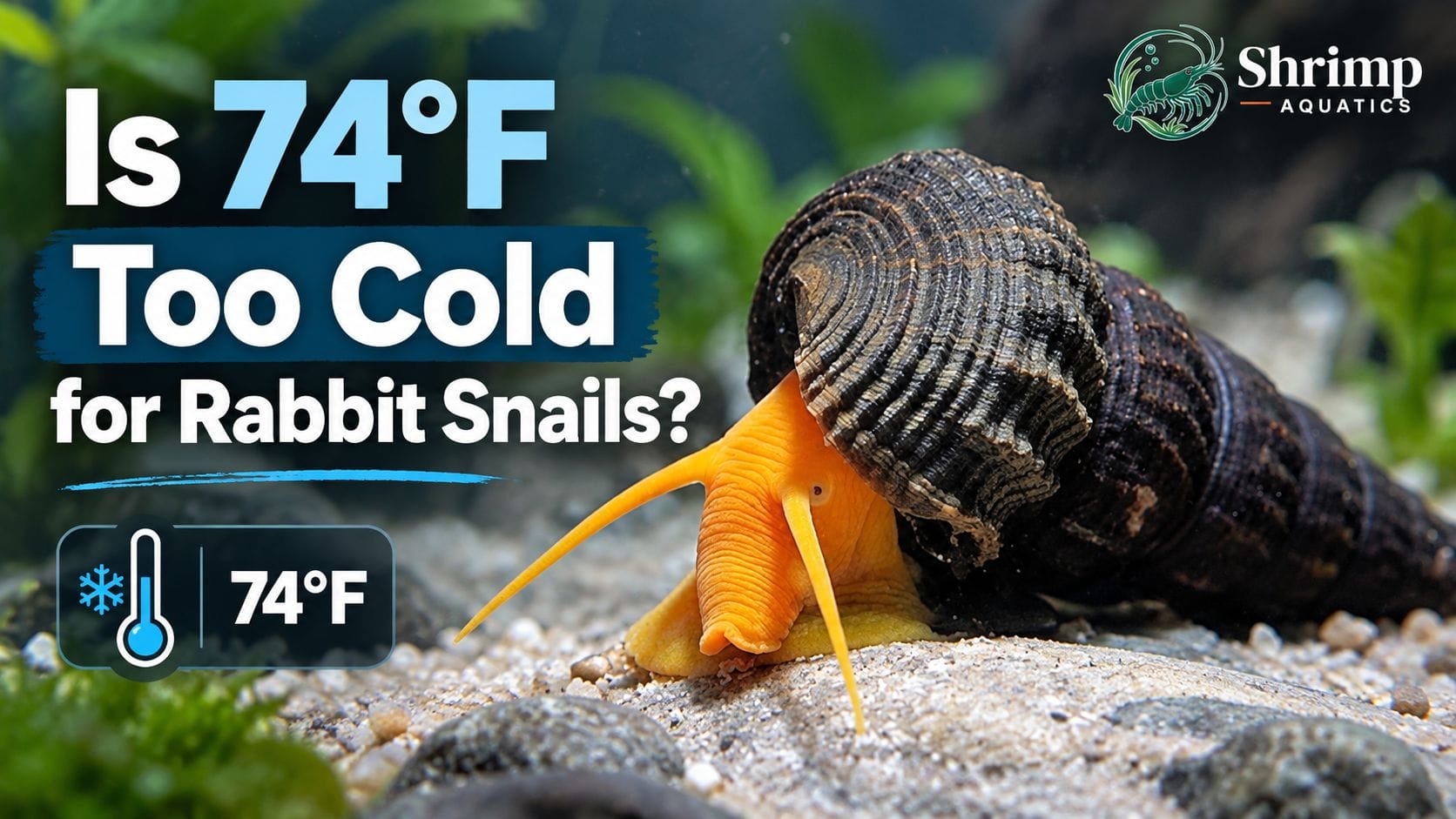
Yes, and not breeding them doesn’t change the answer. 74°F sits below 79-86°F (26-30°C), the range we keep rabbit snails (Tylomelania sp.) in. A tank held there is cool for the animal whether or not you ever want young from it.
Does it change anything if you are not breeding your rabbit snails?
No. We understand why the question comes up. Most care pages talk about warmth as the thing that gets snails breeding, which makes a cooler tank sound like it only costs you babies. We think that’s backwards. Temperature drives the metabolic rate of an ectothermic animal,1 and breeding is one of the things that rate pays for. A snail that isn’t breeding still spends its whole day at the pace the water sets. That evidence comes from work on a pond snail, not a rabbit snail, so read it as a general principle about cold-blooded animals.
There’s a second reason the breeding frame doesn’t help you. Rabbit snails are live-bearers, and no published figure ties any temperature to how, when or whether they breed. So the hobby’s warm-water-makes-babies line isn’t a threshold you can work backwards from. It leaves you where you started, with a tank cooler than the water these snails are kept in.
Where the 79°F floor for rabbit snails comes from
These snails come from the ancient lakes of Sulawesi, and those lakes are warm and steady in a way no living room is. Surface water and the water below it sit within a few degrees of each other, and the month to month movement is small.2 That’s a lake and not a tank, so read it as the animal’s background, not as a setting you dial in. Turning that lake warmth into a tank you can actually run is the work in Sulawesi rabbit snail care.
Published readings from Lake Towuti: surface water 82-84°F (28-29°C), water column 82-88°F (28-31°C), conductivity 210 microsiemens per centimeter, pH about 7.8.2
What we aim for in a home tank is the narrower band below. The temperature row is the one this page turns on. The mineral rows matter as much as the temperature row, and rabbit snails in soft water takes the pH and KH side further.
| Temperature | 79-86°F (26-30°C) |
|---|---|
| pH | 7.5-8.5 |
| GH | 4-8 dGH |
| KH | 3-6 dKH |
| TDS | 150-250 ppm |
| Nitrate | Aim under 10 ppm |
Now the honest part. There is no published study that sets a minimum temperature for any Tylomelania species, none that reports what a cool season does to one, and none that gives a lethal low. The numbers on other care pages are keeper estimates, and they disagree with each other by several degrees. We’re not going to invent a threshold to fill that gap. What we can tell you is where the animal lives, what we keep it in, and that your tank is below both.
One thing worth saying plainly: the snail is a moderate animal, but the tank is not. Warm, alkaline, mineral-rich water in a mature system with real biofilm on the rock is the demanding part. A rabbit snail is not a gentler way into Sulawesi keeping without it.
Why your thermometer answers this better than your rabbit snail does
Keepers often try to settle the question by watching the animal. It’s the least reliable instrument in the room. A rabbit snail is a slow grazer that pulls in and sits still for long stretches when everything is fine. A quiet snail in a cool tank tells you almost nothing, and an active one doesn’t clear the water either.
Check the reading first
Before you change anything, confirm the temperature with a second thermometer, ideally a glass one you trust. Stick-on strips and unchecked controller displays are the usual reason a tank runs several degrees off what the keeper believes.
How to bring a cool rabbit snail tank up into the range
- Confirm the real temperature with a second thermometer, and check that the heater suits the tank volume and is actually cycling.
- Move the setting up in small steps across several days instead of one jump. Steady beats fast here, and the snails have no reason to be in a hurry.
- Add surface movement as the water warms. Warm water holds less dissolved oxygen than cool water,3 so the filter outlet that was fine before is doing less for you now.
- Leave the rest of the water alone while you do it. One change at a time is easier to read than three.
- Once you’re in range, check the thermometer daily for a week. A heater that overshoots is its own problem, and the top of the range is not a target to chase.
Holding a tank at 74°F means choosing between rabbit snails and Neocaridina
Plenty of keepers sit at 74°F on purpose, usually because the tank belongs to Neocaridina or to fish that want it cool. That’s a real conflict. Neocaridina are usually kept at 65-78°F (18-26°C) and rabbit snails start at 79°F (26°C), so on paper the two ranges don’t meet. The way out runs upward, never downward: at Shrimp Aquatics a small group of Neocaridina lives and breeds in some of our Sulawesi tanks at the snail’s temperature, which is how we keep rabbit snails with Neocaridina shrimp. If a big shrimp colony is the point of the tank, keep it cool and give the snail its own tank. Whichever way you land, the weekly routine in how often to clean a rabbit snail tank has to match it.
So the choice belongs to the tank you actually have. If it has to stay cool, keep it cool and leave the snails out. That’s the kinder answer, not the disappointing one. If you can commit the tank to the warm end and give it mature, alkaline, mineral-rich water, that’s the point where Sulawesi snails are worth considering at all, and ours are tank-bred by Shrimp Aquatics. Whatever you settle on for the heater, the water and floor a snail needs is still rabbit snail tank size.
References
3 Sources
- Long-term and acute effects of temperature and oxygen on metabolism, food intake, growth and heat tolerance in a freshwater gastropod (abstract), Journal of Thermal Biology, 2017.
- Geomicrobiological Features of Ferruginous Sediments from Lake Towuti, Indonesia, Frontiers in Microbiology, 2016.
- Dissolved Oxygen and Water, U.S. Geological Survey Water Science School, updated August 24, 2026.
Ready to get started?
Shop our Sulawesi Snail collection
12 products available · Live Arrival Guarantee