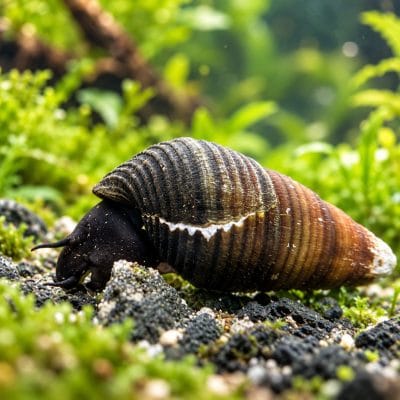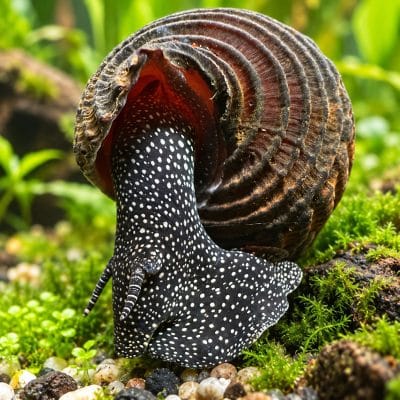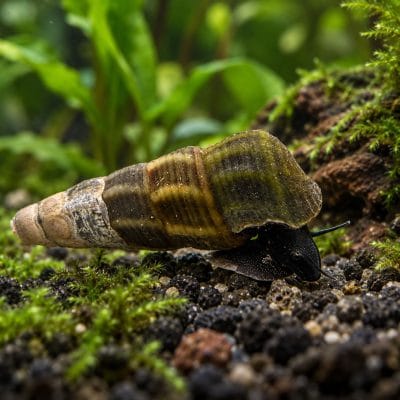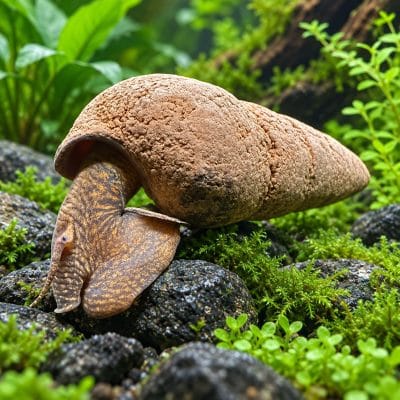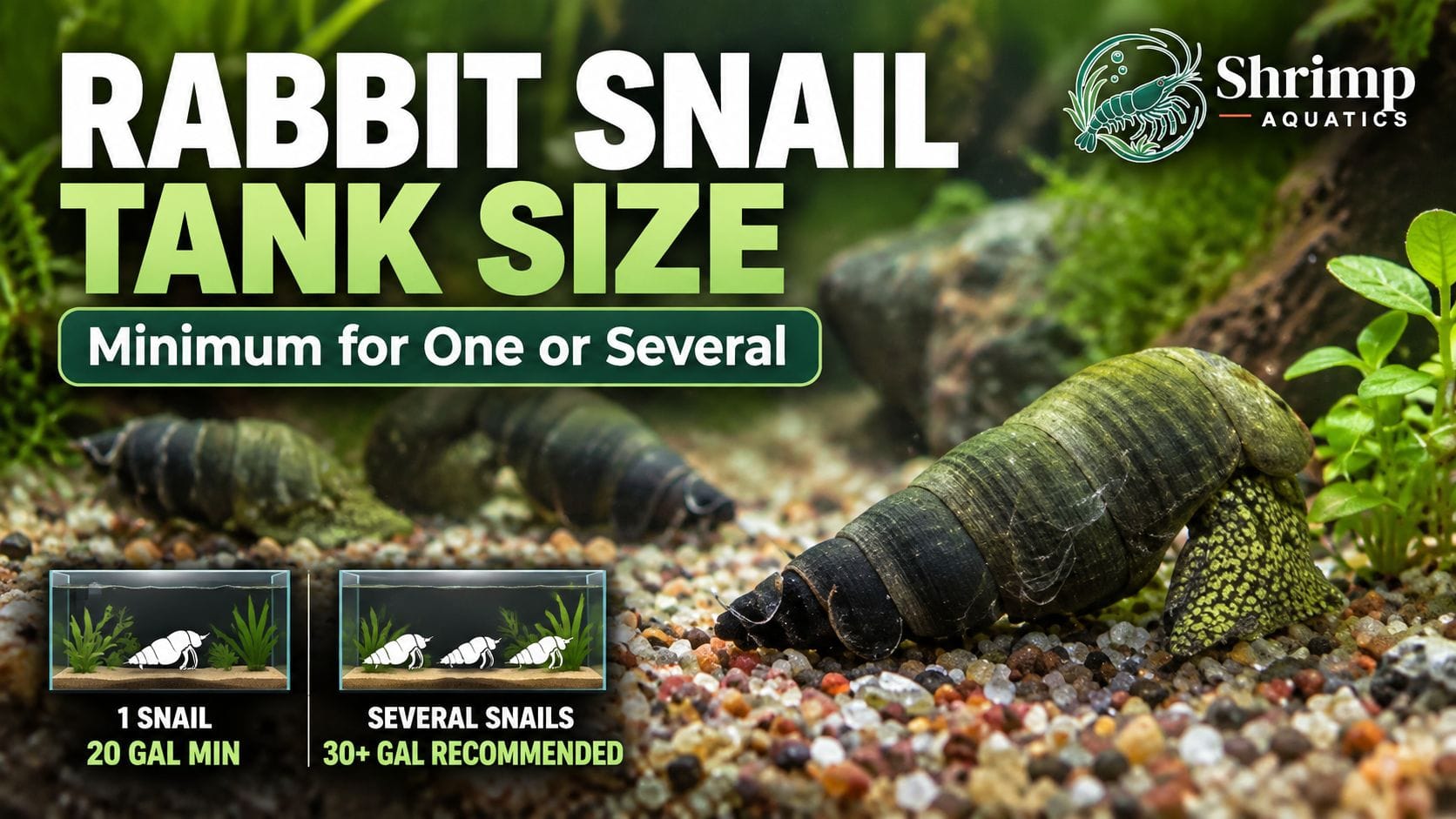
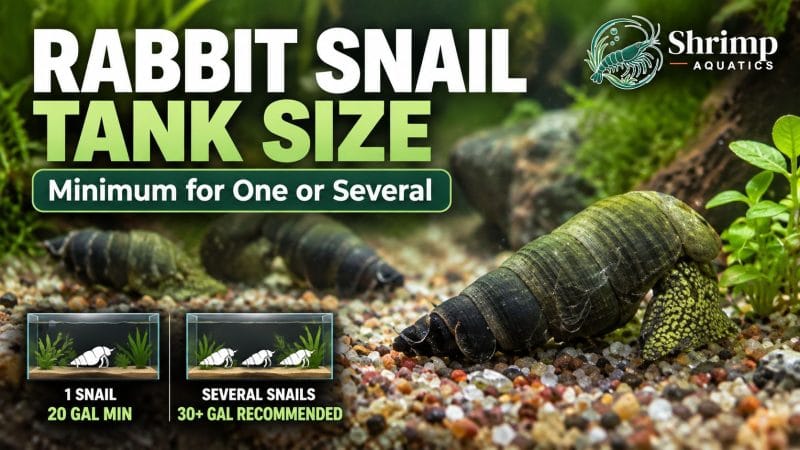
We’d put one adult rabbit snail (Tylomelania sp.) in 20 gallons (76 L), two or three in 29 gallons (110 L), and add roughly 10 gallons (38 L) per snail after that. That is our judgment, not a measurement, because no published study sets a minimum tank size for this genus. The reason isn’t the animal’s body. It’s the water a Sulawesi tank has to hold steady, and small volumes don’t hold it well. A pair or small group can live and breed in about 13 gallons (50 L), so a smaller tank can work; the extra water in ours is there to buy you time when something goes wrong.
Why we wouldn’t put a rabbit snail in a 5 or 10 gallon tank
Plenty of care sheets give 3 to 5 gallons for one rabbit snail. A few give 30. Look at what the tank has to do instead. A short supervised stay in a small cycled holding tank is a different situation from permanent housing.
These snails need the same water as Sulawesi shrimp, and that water is warm and alkaline. Both of those make ammonia worse. The share of ammonia sitting in the un-ionized form, the form that drives the toxicity, rises about tenfold for every pH unit. It roughly doubles again for each 10 degrees Celsius of warming across the range an aquarium lives in.1 A trace you’d barely notice in a cool, neutral community tank is a different problem in water this warm and this alkaline. Warm water also carries less dissolved oxygen than cold water does.2 And evaporation leaves the dissolved solids behind, so what’s left gets more concentrated.3 In a nano tank, a few days of evaporation is a visible TDS climb.
| Temperature | 79-86°F (26-30°C) |
|---|---|
| pH | 7.5-8.5 |
| GH | 4-8 dGH |
| KH | 3-6 dKH |
| TDS | 150-250 ppm |
| Nitrate | we aim for nitrate under 10 ppm |
Every one of those numbers is easier to hold in more water. That’s the whole argument. A heater sticking on, a skipped water change, a snail dying unnoticed behind the rock: in 20 gallons you’ve got time to catch these, and in 5 gallons they’re often finished before you look. A snail this size also counts toward what the tank has to graze and process. It isn’t a free addition to a full nano.
We’d call the animal itself moderate to keep. The system is the demanding part. No tank size turns a rabbit snail into an easy first step into Sulawesi water.
How much more water does each extra rabbit snail need?
Our working figure is about 10 gallons (38 L) per additional adult past the first two or three. That puts four snails in a 40 gallon breeder and gives you room to be late with maintenance. Treat it as a habit we’d keep to, not a measured requirement.
Grazing surface tends to run out before water volume does. Sulawesi Keepers, the conservation group that works with these animals, separates species that live on hard surfaces and feed on the biofilm growing on stones and glass from species that prefer soft substrate and don’t climb stones at all, for which rock in an aquarium takes away living space.4 For the traded lines, we’d plan for both: open sand they can move across, and clear rock and glass carrying a real film. The same group is blunt that green filamentous algae aren’t natural food for these snails.4 Don’t stock them to clean a tank, and don’t count algae as their food supply.
One more thing about groups. Rabbit snails are live-bearing: the female holds eggs and embryos in a brood pouch, and the young leave already shelled, in some species at close to 2 cm.5 A juvenile isn’t a speck you can ignore in the stocking plan. Whether yours breed at all is not something we or anyone else can promise. Plan the tank for a few more animals than you buy, and be pleased if it stays quiet.
Choose a long tank over a tall one for rabbit snails
Gallons are a poor unit for an animal that spends its time on surfaces. A 20 gallon tall and a 20 gallon long hold the same water. The long tank gives noticeably more floor, more lit glass and more room for rock, which is where the film these snails eat actually grows.4 Height gives them very little. Whether extra wood and rock makes up for going a size smaller is answered on its own page.
On floor space, here’s which way we’d err. Given two tanks of the same volume, take the wider footprint, keep the hardscape open instead of packing it, and leave a stretch of clear sand. Which number should drive the decision, the gallons or the footprint, is floor area against water volume.
Can a rabbit snail join the tank you already have?
Usually the tank people have in mind is a shrimp tank or a small planted tank, so here’s the honest answer for each.
Not with Neocaridina
Neocaridina shrimp are kept at 65-78°F (18-26°C), and a rabbit snail tank starts where that range ends, at 79°F (26°C). The two never overlap, so whatever the tank size, one of the two animals is being kept wrong. This isn’t a mix to manage carefully. It’s a mix to skip.
A planted tank raises a different question, and we don’t have a clean answer. No published work shows any Tylomelania eating living plant tissue, and none shows them leaving plants alone either. That’s why keeper reports disagree so sharply. Our advice is to treat soft-leaved plants as at risk and build around hardy epiphytes attached to rock, where the snails graze film off the leaf without much at stake if they do more.
Then there’s tank age, which matters more than the hobby usually admits. A tank that looks clean, with bare glass and new rock, has nothing for a grazer to eat. Wait until you can see a film on the hardscape and the back glass before a snail goes in. What a settled tank and that film look like once they are normal is shown in Sulawesi rabbit snail care.
Is your tank ready for a rabbit snail yet?
Run through this before you order, not after the box arrives.
- Fully cycled, with ammonia and nitrite reading zero on your own test, not on the calendar.
- Holding the numbers in the table above on its own, without you correcting something every day.
- 20 gallons (76 L) or more for one adult, with a footprint you’d call long rather than tall.
- A visible film of algae and biofilm on rock and glass, so there’s food the day the snail arrives.
- Inert substrate and hardscape. An active, pH-lowering aquasoil pulls against everything this tank is trying to do.
- No copper and no copper-based medication, now or later.
- No Neocaridina colony you were hoping to keep in the same water.
When the tank holds those numbers on its own, you’re choosing an animal instead of rescuing one. The Sulawesi rabbit snails we list are bred by Shrimp Aquatics and not collected from the wild, and they go into the same warm, alkaline water as our Sulawesi shrimp. We don’t promise breeding, sex, size or a number of young from any order.
And if the tank isn’t there yet, wait. A rabbit snail in a mature 20 gallon is a calm, long-lived animal that mostly asks to be left alone. The same snail in a 5 gallon that swings every week is a slow problem you’ll be solving later. Keeping it calm long term is the maintenance rhythm in how often to clean a rabbit snail tank, not the tank size alone.
References
5 Sources
- Aquatic Life Ambient Water Quality Criteria for Ammonia, Freshwater, U.S. Environmental Protection Agency, Office of Water, April 2013.
- Dissolved Oxygen and Water, U.S. Geological Survey, Water Science School, read 2026-09-19.
- Chloride, Salinity, and Dissolved Solids, U.S. Geological Survey, Water Resources Mission Area, March 1, 2019.
- Do you know Sulawesi snails?, Sulawesi Keepers, undated, read 2026-09-19.
- Anatomy of an adaptive radiation: a unique reproductive strategy in the endemic freshwater gastropod Tylomelania (Cerithioidea: Pachychilidae) on Sulawesi, Indonesia, and its biogeographical implications, Biological Journal of the Linnean Society, 2005.
Ready to get started?
Shop our Sulawesi Snail collection
12 products available · Live Arrival Guarantee