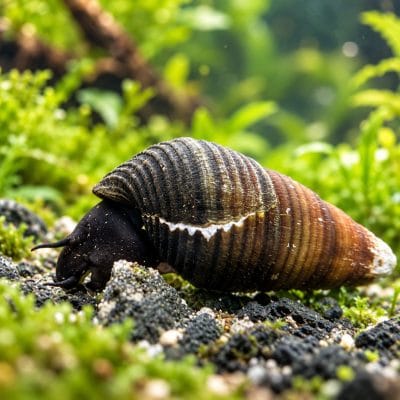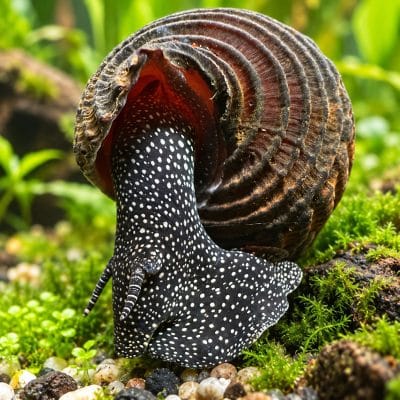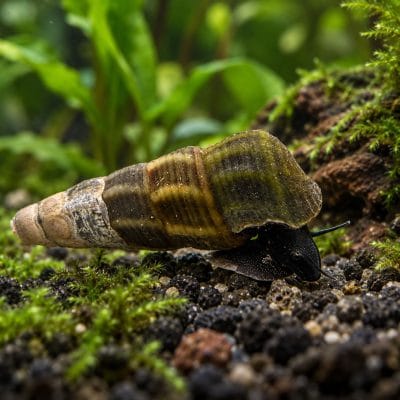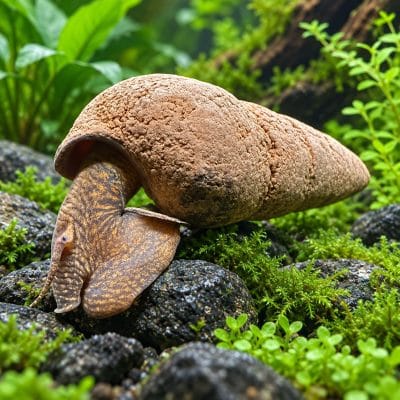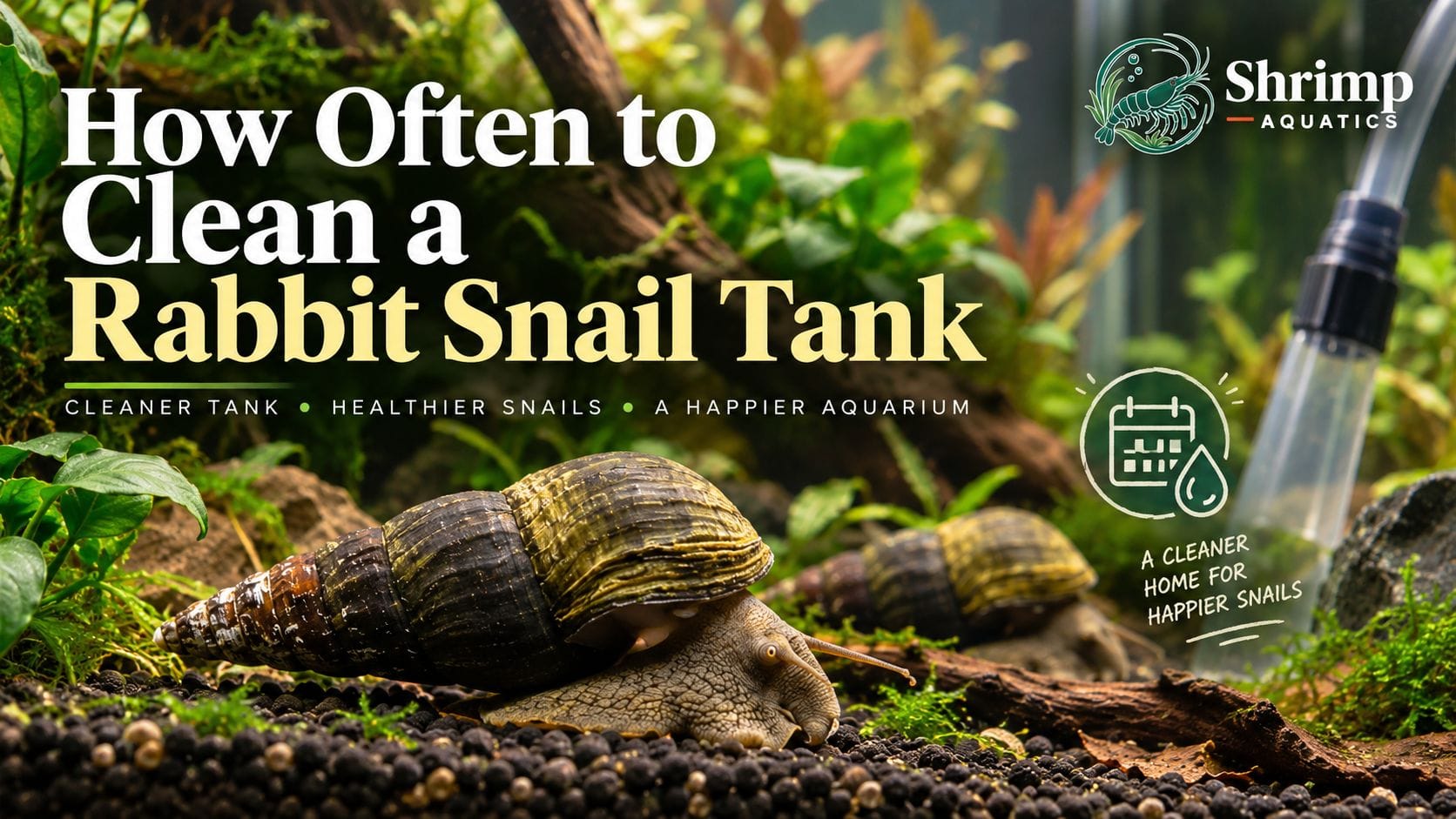
Once a week, for most tanks. A small water change plus a light pass over the sand with a siphon is the whole routine. The filter media, the deep sand and the back and side glass are better left alone. There’s no published study setting a cleaning schedule for rabbit snails (Tylomelania sp.), so treat the weekly rhythm as a starting point and let your test kit move it.
Size the weekly water change so the numbers barely move
Keep it small and keep it on the same day. Somewhere around 10-15 percent once a week is a safe default for a settled tank. It clears dissolved waste without shifting the water the snails are sitting in. Most of the trouble in this hobby comes from the opposite pattern: nothing for a month, then half the tank at once.
Why so careful in this particular tank? Because warm and alkaline is a harder combination than it sounds. Ammonia sits in water in two forms, and the un-ionized one does the damage. Its share of the total rises about tenfold for every single pH unit. It roughly doubles again as temperature rises by 10 degrees Celsius. Both figures come from the EPA’s freshwater criteria document, which covers aquatic life in general and not snails in particular.1 So the same ammonia reading on your test kit means something worse at pH 8 and 82°F than it would in a cool, neutral tank. Warm water also holds less dissolved oxygen than cold water,2 which leaves the bacteria processing that waste with a thinner margin. That margin shrinks fast in a small cycled holding tank, where one missed change moves every number. If your heater struggles, running a rabbit snail tank cool costs the animal more than a missed water change does. The rest of the routine that keeps that reading down sits in Sulawesi rabbit snail care.
None of that is an argument for scrubbing harder. It’s an argument for the small regular change over the big rescue change.
| Temperature | 79-86°F (26-30°C) |
|---|---|
| pH | 7.5-8.5 |
| GH | 4-8 dGH |
| KH | 3-6 dKH |
| TDS | 150-250 ppm |
| Nitrate | under 10 ppm |
| Ammonia and nitrite | 0, held there by an established filter |
That nitrate figure is a target we hold to, not a level the animal is known to tolerate up to. Nobody has measured a tolerance for this genus. It’s a housekeeping line, not biology.
Match the replacement water before it goes in
Mix it, heat it, test it, then add it. If you run RO and minerals, make the bucket up the night before. That gives it time to settle, and it lets you read pH, GH, KH and TDS on the finished water instead of hoping. If you’re on tap water, dechlorinate it and test it anyway. Tap chemistry moves with the season in plenty of places.
We know the temptation is to top the tank up quickly and get on with your evening. Don’t. These snails handle slightly dirty water far better than they handle a step change in pH or KH. If the replacement water isn’t ready, skip the change and do it properly tomorrow.
Top off with RO water and change water to reset the TDS
Evaporation carries off the water and leaves the dissolved solids behind,3 a mechanism described for natural waters and not measured in anyone’s aquarium. The effect in a warm open-topped tank is the same either way. Top off with mineralized water and your TDS climbs week after week, even though each reading looked fine on the day you took it. So top off with plain RO. Let the weekly change do the resetting.
Keep copper out of the water you add
Copper is toxic in aquatic environments and can reduce survival, reproduction and growth in invertebrates, in the EPA’s own framing for aquatic life generally.4 Two routes matter on cleaning day. The first is water that’s stood overnight in copper plumbing, so run the tap for a minute before you fill. The second is anything you dose: fish medication, algae treatment, a plant fertilizer carrying a copper trace. Read the full ingredient list before it goes near this tank. A snail tank isn’t one you can medicate casually.
Skim the waste off the sand without digging up the bed
Hover the siphon an inch or two above the sand and move it in slow circles. The loose pellets and any leftover food lift into the tube while the sand stays where it is. Once a week alongside the water change is plenty in most tanks, and every other week is fine in a large, lightly stocked one.
Why not push the tube in? The top layer of sand is where the bacteria and the grazing film live, and a bed that’s turned over every week never settles into doing that work. Digging also puts the waste you came to remove straight back into the water column.
- Make up the replacement water first, test it, and bring it to tank temperature.
- Siphon into a bucket, hovering above the sand, until you’ve pulled the 10-15 percent you’re changing.
- Refill slowly, pouring onto a rock or a plate so you don’t crater the sand.
- Look through the bucket before you tip it out.
Check the bucket before you tip it out
Rabbit snails are live-bearing. The young leave the female already shelled. In some species of the genus they’re the largest juveniles known in any live-bearing snail, close to 2 cm at hatching, in an anatomical review of Tylomelania.5 No published figure covers the lines that reach the hobby, so don’t assume yours arrive that size. Give the bucket a few minutes and a proper look before you pour it away.
What to leave dirty so your snails keep grazing
Clean the front pane. Leave the rest of it alone. The film on the back glass, the rock and the wood is food, not mess. Sulawesi Keepers, the conservation group that works with these animals, describes them feeding on biofilm from stones, glass and other smooth surfaces. The same article says green filamentous algae are definitely not their natural food.6 That’s worth knowing before you buy one as a cleaner. It doesn’t work that way, and a tank polished back to bare glass leaves them nothing to graze.
- Leave the back and side glass, so the grazing film keeps regrowing.
- Rinse mechanical sponge in water you’ve already taken out of the tank, and leave biological media on its own slower cycle.
- Don’t rinse filter media under the tap.
- Don’t dig the sand bed over, and don’t swap it out wholesale.
- Don’t deep clean before a new snail arrives; a mature film is what it needs to find.
When to clean more often than once a week
Test before you reach for the bucket
Ammonia or nitrite above zero means the filter or the stocking is behind, not that you cleaned too little. Change water to buy time, then find the cause. A bigger clean next week isn’t the answer.
Beyond that, the tank tells you when to move. Clean sooner when any of these show up:
- nitrate reads higher at the end of this week than it did at the end of last
- TDS drifts up between changes
- food is still sitting on the sand the morning after you fed
- something has died in the tank
- you’ve added another grazer and the film isn’t keeping up
It works the other way too. A snail that’s pulled into its shell after arriving doesn’t need the tank stripped around it. Hold the routine, keep the water steady, and let it come out on its own schedule.
Why a worn shell tip isn’t a failed water change
Look at the top of the shell on almost any adult rabbit snail. There’s a fair chance the tip is worn flat or gone. That’s normal, and it isn’t a verdict on your maintenance. The Sarasin brothers’ 19th century survey of Sulawesi’s freshwater molluscs describes wild adults whose upper whorls are already considerably eroded, including snails taken alive with the ribs worn right off the top.7
The part worth watching is the growing edge, at the mouth of the shell. In apple snails reared at three calcium levels, most of the shell calcium was taken up from the water and not from food. Higher dissolved calcium gave faster growth and harder shells, and at pH values under six that genus showed fissures and decalcification.8 That’s a different snail family, so read it as a general mechanism and not a number for yours. In practice: if new shell at the aperture looks thin, pitted or chalky, test KH, GH and pH before you change anything about your cleaning. What you’re looking for is water that sits at the bottom of the range and slides lower between changes. The fix for that is the water change you’re already doing, on time and matched.
How many rabbit snails your weekly routine can carry
A rabbit snail is a large grazer and a real producer of waste, so the honest limit on stocking isn’t tank volume. It’s how much film your tank grows and how much waste one small weekly change can carry out. If the front glass regrows its film within a few days and nitrate sits still between changes, you have room. If you’re feeding them to keep them going, you’re already at the ceiling. The room you have to work with was set the day you chose the tank, which is the point of rabbit snail tank size.
Whatever you add, add it slowly. One Sulawesi rabbit snail at a time, a week or two apart, lets you watch what each new grazer costs you in nitrate before the next one arrives. Ours are tank-bred by Shrimp Aquatics. We won’t promise breeding, sex or the number of young from any order, and we’d sooner you built the routine you can keep than the stocking you’d like.
References
8 Sources
- Aquatic Life Ambient Water Quality Criteria for Ammonia, Freshwater, U.S. Environmental Protection Agency, Office of Water, April 2013.
- Dissolved Oxygen and Water, U.S. Geological Survey, Water Science School, updated August 24, 2026.
- Chloride, Salinity, and Dissolved Solids, U.S. Geological Survey, Water Resources Mission Area, March 1, 2019.
- Supplementary Training Materials for Aquatic Life Criteria, Copper, Background, U.S. Environmental Protection Agency, Office of Water, updated May 6, 2026.
- Anatomy of an adaptive radiation: a unique reproductive strategy in the endemic freshwater gastropod Tylomelania (Cerithioidea: Pachychilidae) on Sulawesi, Indonesia, and its biogeographical implications, Biological Journal of the Linnean Society, 2005 (abstract).
- Do you know Sulawesi snails?, Sulawesi Keepers, read September 2026.
- Materialien zur Naturgeschichte der Insel Celebes, volume 1, Paul and Fritz Sarasin, C. W. Kreidel, Wiesbaden, 1898, Internet Archive scan.
- Growth and shell hardness of the apple snail Pomacea flagellata Say, 1829, reared at three calcium concentrations, PeerJ, 2023.
Ready to get started?
Shop our Sulawesi Snail collection
12 products available · Live Arrival Guarantee