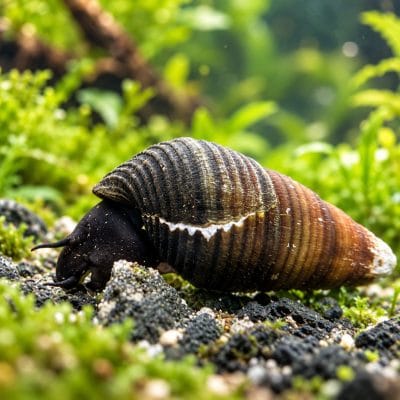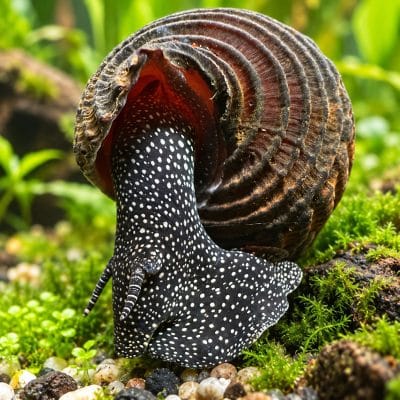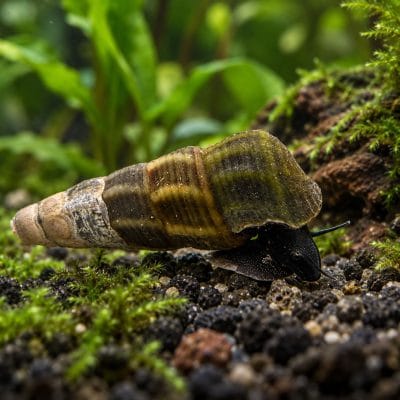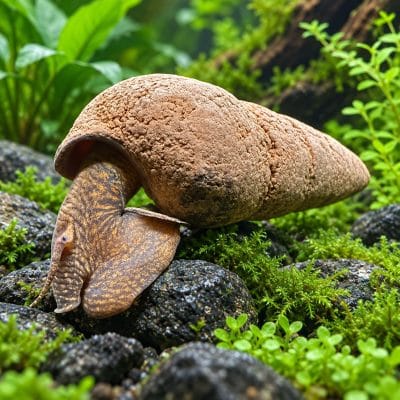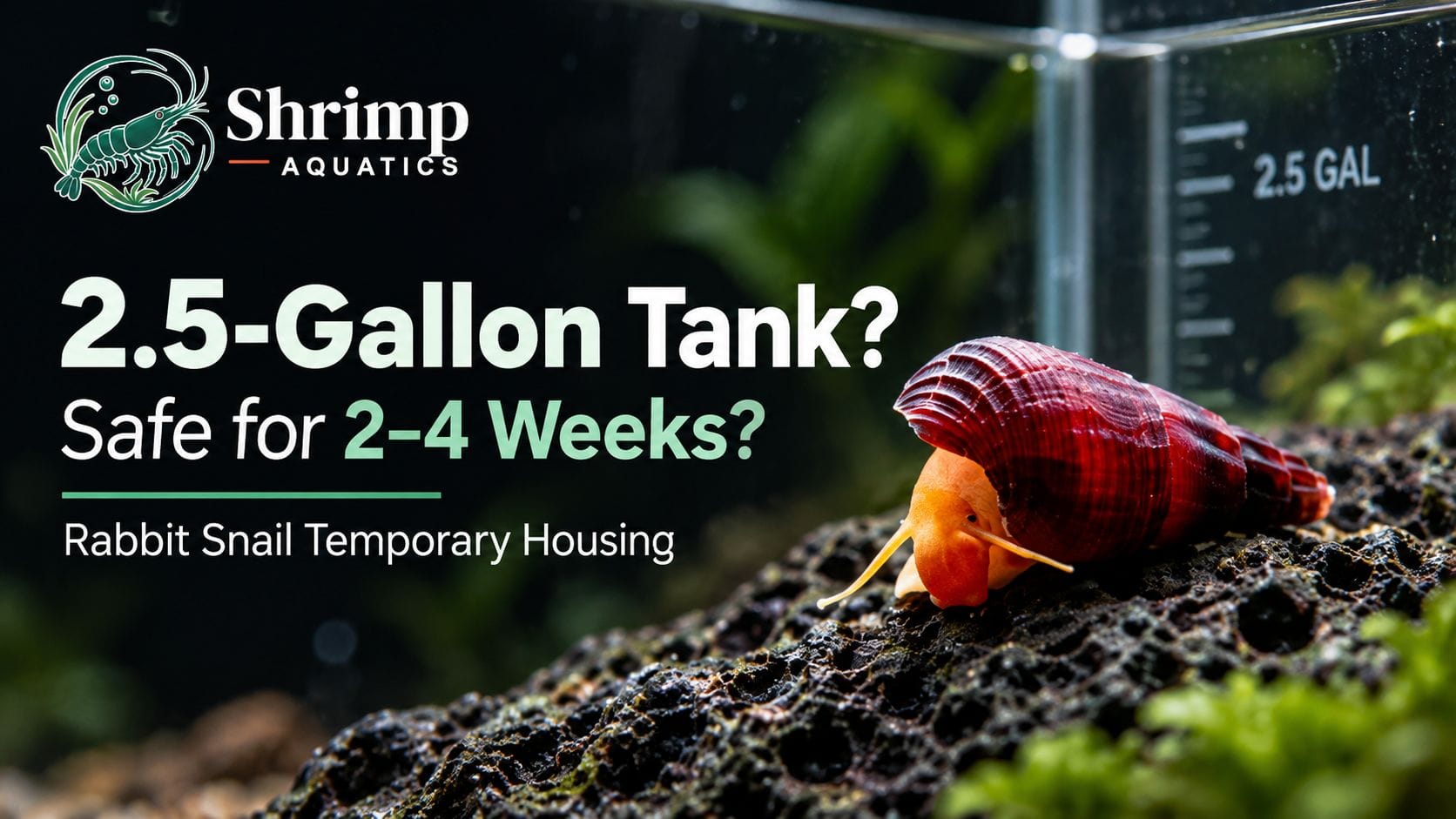
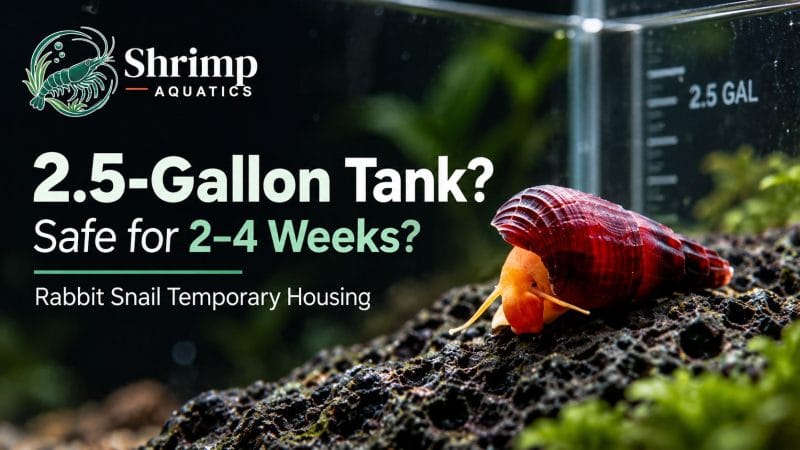
Yes, for a defined stay. A rabbit snail (Tylomelania sp.) can hold in a cycled 2.5-gallon for two to four weeks. Three things have to be true: the water matches what the snail already lives in, ammonia and nitrite read zero the whole time, and there’s a grazed surface in there. So what makes a nano risky? Not the floor space. A small volume of water moves faster than a big one when something goes wrong, and a scrubbed little tank has nothing growing on it for a grazer to eat. Weighing floor area against water volume is what separates a risky nano from a workable one.
Match the 2.5-gallon to the water your rabbit snail is already in
Test both tanks and make them read the same before you move anything. A snail that has sat in stable water for months doesn’t much care that its next box is small. It cares that the water is different. Temperature, pH and hardness are what you’re matching, and the closer they are, the less the move costs the animal.
| Temperature | 79-86°F (26-30°C) |
|---|---|
| pH | 7.5-8.5 |
| GH | 4-8 dGH |
| KH | 3-6 dKH |
| TDS | 150-250 ppm |
| Ammonia and nitrite | Zero on every test, for the whole stay |
| Nitrate | Aim under 10 ppm |
| Substrate and hardscape | Inert only, with no pH lowering soil |
These are the numbers we keep our Sulawesi livestock in, snails included. They don’t change with the size of the box. A heater sized for a nano and a thermometer you trust matter more here than in a big tank, because two and a half gallons follows room temperature quickly. What those same numbers look like day to day in a settled tank is in Sulawesi rabbit snail care.
Don’t chase numbers mid-stay
If the holding tank drifts, fix it with small, matched water changes over a day or two. Dose a 2.5-gallon to correct pH or hardness in one go and you swing the water harder than the drift did.
Why a warm Sulawesi nano turns a small slip into a big one
Plan on testing this tank every day or two, and on changing a little water often instead of a lot of water occasionally. Warm and alkaline is what the animal needs. It’s also what makes the chemistry less forgiving than a cool, soft-water tank. Three things are working against you.
The same ammonia reading is harsher in warm, alkaline water
Total ammonia in water sits in two forms, ammonium and un-ionized ammonia. The un-ionized form is the one that drives toxicity. The ratio between them rises about tenfold for each rise of a single pH unit, and roughly twofold for each rise of ten degrees Celsius.1 Now read that against the table above. This tank runs warm and alkaline on purpose, so a trace of ammonia you might shrug off in a cool, acidic shrimp tank is not the same trace here. With one large grazer in a small volume, ammonia and nitrite are a daily test.
Warm water carries less oxygen, and a nano has less of everything
Cold water can hold more dissolved oxygen than warm water.2 Sulawesi Keepers, a noncommercial group that works with these lake snails, describes the water they come from as very clean and high in oxygen.3 You can’t put a lake in a box. You can keep a sponge filter or an air stone running gently the whole time and leave the surface moving. And resist the urge to add a second animal to keep the first one company.
Evaporation moves your numbers in two and a half gallons
Water evaporates, and the dissolved solids it leaves behind concentrate in what remains.4 A display tank absorbs that. A 2.5-gallon on a warm heater over three weeks doesn’t, and TDS creeps up if you top off with anything carrying minerals. The usual rule is a lid, plain RO or dechlorinated water for top offs, and mineralized water saved for real water changes.
Hardness is worth holding for the shell, too. In one study of an apple snail, a different family from rabbit snails, the snails kept in higher dissolved calcium grew faster and ended up with harder shells. Acidic water in that work went with shell fissures and decalcification, and most of a freshwater snail’s shell calcium comes out of the water it sits in.5 Nobody has published a mineral threshold for Tylomelania, so there’s no number to hit beyond the range in the table. Hold KH steady and the rest follows.
A bare quarantine box gives a rabbit snail nothing to graze
Set this tank up the way you’d set up a fish hospital tank and the snail goes hungry. Rabbit snails feed by grazing the film of algae and biofilm that grows on rock, wood and glass. A scrubbed, four-week-old nano has almost none of it. Can you just feed more instead? No. Extra food sits in warm water and turns into ammonia, and it doesn’t replace the film. Back in the display tank, how often to clean a rabbit snail tank decides how much of that film you leave alone.
At Shrimp Aquatics, before anything goes into one of our Sulawesi tanks we wait for zero ammonia and nitrite, stable temperature and chemistry, an established biological filter and visible grazing surfaces. The calendar doesn’t decide it.
Which gives you the simplest fix for a holding tank. Don’t grow the grazing surface, move it. Take a stone or a piece of wood out of the mature tank, the one that’s already gone green and brown, and put it in the small tank with the snail.
- Move one already grazed stone or piece of wood across with the snail, and run a filter sponge from an established tank in there too.
- Add a thin layer of fine, inert sand. Some species in this genus live on hard surfaces and others on soft substrate.3 A sand floor plus a stone covers both.
- Offer a small amount of food every other day at most, and lift whatever’s left within a few hours.
- Don’t scrub the glass or the hardscape while the snail is in there. That film is the point.
- Don’t count on an algae bloom to feed it. Sulawesi Keepers says green filamentous algae are not their natural food.3
Signs your rabbit snail should come out of the small tank early
Check the water before you check the snail. Ammonia, nitrite, temperature, pH and hardness, in that order. Then ask what changed in the last day: a top off, a feed, a room that got cold overnight. Most of what worries a keeper in week two is a water reading, not a disease, and the water is the part you can act on.
A snail that stays withdrawn for a while after a move is doing something these snails do. A worn, pitted shell tip on an adult is normal too, and isn’t by itself evidence of a water problem. Fresh damage at the growing edge of the shell is different. That’s a reason to test minerals and pH the same day. Nobody can diagnose a sick snail from a description, so if the water is right and the animal still isn’t recovering, ask a qualified aquatic vet or a specialist keeper before you reach for a treatment. Keep copper and copper-based medications away from this tank entirely.
Cut the stay short and move the snail to the mature tank if you can’t hold the temperature, if ammonia or nitrite show up at all, or if hardness keeps sliding between water changes. Two to four weeks assumes the small tank stays stable. When it doesn’t, the bigger, older system is the safer place.
Ordering a rabbit snail before your display tank is ready
If the 2.5-gallon is where a snail you haven’t bought yet is meant to land, wait. A holding tank works for an animal you already keep, or for watching a new arrival while a mature tank finishes settling. It stops working the moment there’s nowhere for the snail to go at the end of the month. These are moderate animals to keep, but the system they need is no beginner project: warm, alkaline, mineral-rich and old enough to have grown a grazing layer. What that permanent tank should measure once the holding weeks are over is in rabbit snail tank size.
When your main tank reads like the table above and the rock has gone green, our Sulawesi rabbit snails are tank-bred by Shrimp Aquatics. Not sure whether your water suits them? Email your pH, GH, KH, TDS, temperature, tank size and cycle status to contact@shrimpaquatics.com and we’ll tell you honestly whether to wait.
References
5 Sources
- Aquatic Life Ambient Water Quality Criteria for Ammonia, Freshwater, U.S. Environmental Protection Agency, Office of Water, April 2013.
- Dissolved Oxygen and Water, U.S. Geological Survey, Water Science School, updated August 2026.
- Do you know Sulawesi snails?, Sulawesi Keepers, undated, read September 2026.
- Chloride, Salinity, and Dissolved Solids, U.S. Geological Survey, Water Resources Mission Area, March 2019.
- Growth and shell hardness of the apple snail Pomacea flagellata Say, 1829, reared at three calcium concentrations, PeerJ, 2023.
Ready to get started?
Shop our Sulawesi Snail collection
12 products available · Live Arrival Guarantee