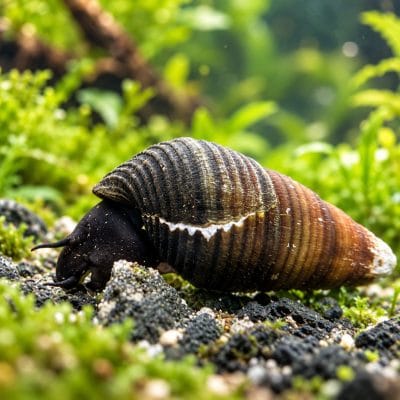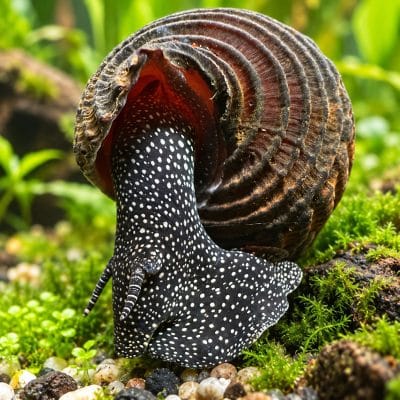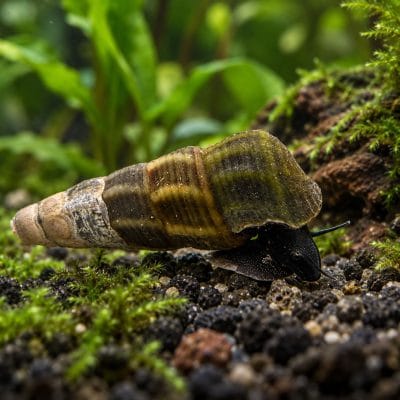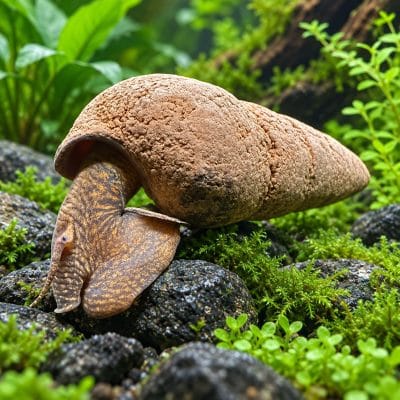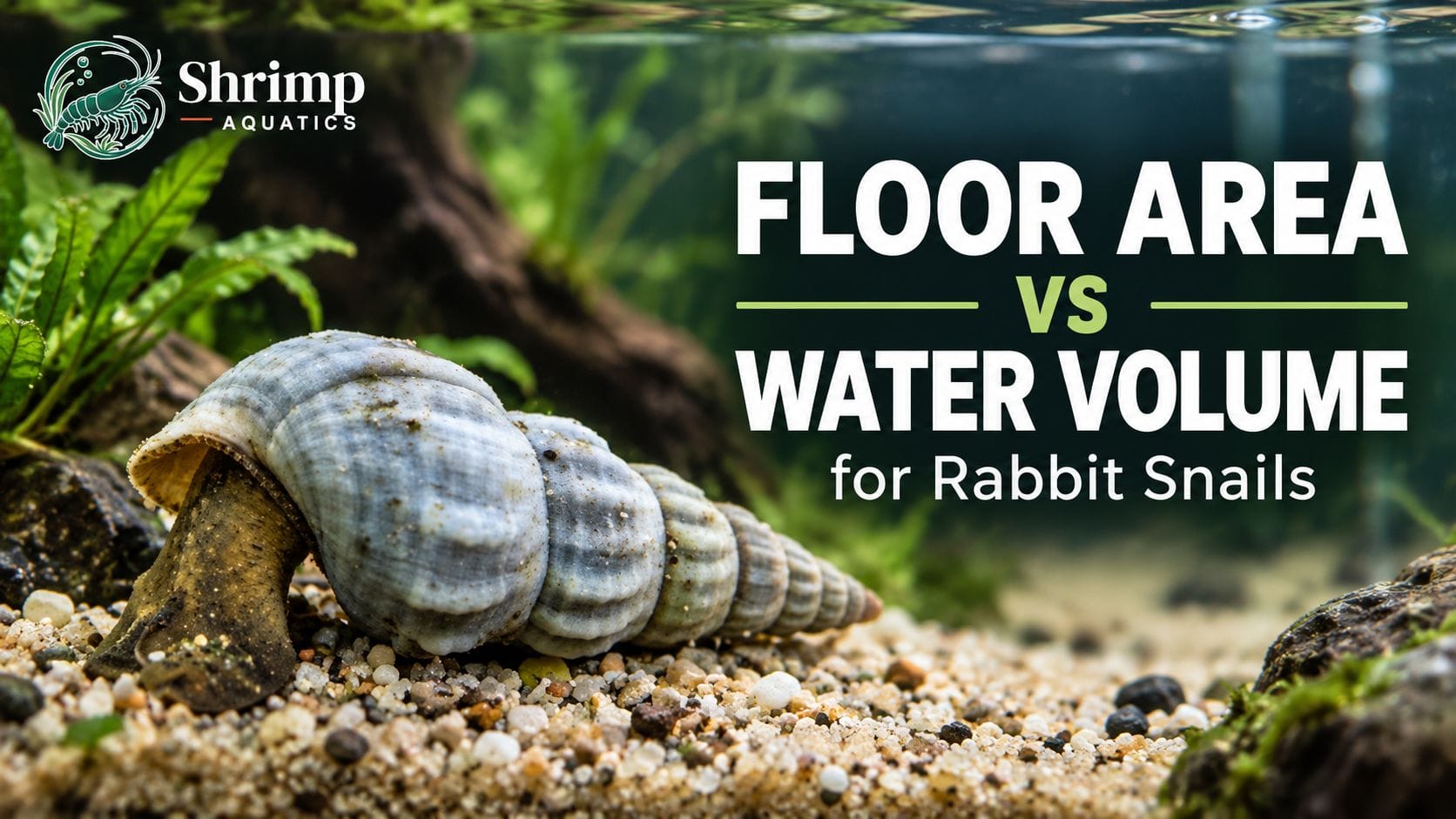
Yes, for the decision you’re actually making. A rabbit snail (Tylomelania sp.) spends its whole life on the bottom and on the surfaces standing on it, so length times width is the number that decides how much habitat you bought. Water volume isn’t competing for that job. It’s doing a different one, and at 79-86°F (26-30°C) it’s the job that keeps the tank stable. So don’t trade volume away. Buy the same gallons in a wider, shallower tank.
Why a rabbit snail only ever uses the floor and the surfaces on it
Count the surfaces your snail can put its foot on, and stop counting there. Everything above them is water the animal never enters. That sounds like a truism until you price it: in a tall tank you’re paying for gallons that hold no habitat at all.
How closely is a rabbit snail tied to the surface it sits on? Closely enough that the surface shows up in its anatomy. In Lake Towuti, one species turns out to have two forms living side by side, one on rock and one on submerged wood, and they sort themselves almost perfectly: 79 percent of the snails collected from rock were the rock form, and every snail collected from wood was the wood form.1 That study measured feeding organs and gene expression, not stomach contents, so it doesn’t tell you what they swallow. It tells you something more useful for buying a tank. Where this animal grazes is part of what it is.
The practical version comes from Sulawesi Keepers, a conservation group that keeps these snails. They split the genus into species that climb stone, glass and other smooth surfaces to graze the film on them, and species that stay on soft ground and never climb, for which stones in an aquarium take away the living space, which for them is fine sand or mud.2 That’s a keeper organization’s account, not a study, and nobody has recorded which of the two groups the lines in the trade belong to. Either way the answer points down. One group wants surface, the other wants open sand, and neither wants height.
You’ll also see the argument made from the lakes themselves: Sulawesi’s lakes are hundreds of meters deep, the snails live in the shallows, therefore go shallow. It’s a tidy story and there’s no published survey behind the density figures it rests on, so it isn’t part of the case here. The grazing evidence carries the point on its own.
Why you still can’t shrink the water volume in a warm, alkaline tank
Don’t read any of that as permission to go small. The floor sets the habitat; the water sets the margin for error, and in this tank that margin is thinner than in most.
Here’s the chemistry, and it’s worth knowing because it’s the part that catches people out. Total ammonia in water sits in two forms, and only one of them, the un-ionized form, drives the toxicity. The split moves with pH and temperature: the ratio of un-ionized ammonia to ammonium rises roughly tenfold for each single pH unit, and about twofold for each 10 degrees Celsius of warming across the range these criteria cover.3 Those figures are derived for freshwater aquatic life in general, not for snails. Still, a rabbit snail tank runs at pH 7.5-8.5 and stays warm, which puts it at the wrong end of both dials. The same ammonia reading that would be a minor event in a cool, acidic shrimp tank is not a minor event here.
Warmth costs you on the other side too. Cold water holds more dissolved oxygen than warm water does,4 and a tank at the top of the temperature range is already holding less than a cooler one. Water volume plus an open, moving surface is what buys you time between a mistake and a consequence.
Both numbers, not one
Picking the widest tank you can find and then filling it four inches deep isn’t the answer either. Give the snails the footprint, and give the tank enough water to sit still while you’re at work.
How to compare two tanks that hold the same water
So how do you separate two tanks whose labels claim the same water? Arithmetic you can do in the shop. Measure the inside length, multiply by the inside width, ignore the height entirely, and compare the answers. Nominal sizes vary between brands, so measure the tank in front of you instead of trusting the label.
| Common shape | Footprint | Floor area | What that buys |
|---|---|---|---|
| 20 gallon high | 24 x 12 in (61 x 31 cm) | 288 sq in (1,891 cm²) | The least floor of any tank on this list, and the height does nothing for the animal. |
| 20 gallon long | 30 x 12 in (76 x 31 cm) | 360 sq in (2,356 cm²) | A quarter more floor than the 20 high for the same water. |
| 29 gallon | 30 x 12 in (76 x 31 cm) | 360 sq in (2,356 cm²) | Around half again as much water as the 20 long, and not one extra square inch of floor. |
| 55 gallon | 48 x 13 in (122 x 33 cm) | 624 sq in (4,026 cm²) | Plenty of length, but only 13 inches front to back for a long shell to turn in. |
| 30 gallon breeder | 36 x 18 in (91 x 46 cm) | 648 sq in (4,186 cm²) | More floor than the 55 on roughly half the water, and depth you can reach into. |
Look at the 20 long and the 29 for a moment. Same footprint, same floor, and the 29 costs you an extra stand rating, an extra heater load and a water change you’ll feel in your back, all of it spent on a column of water no snail will visit. Then look at the breeder against the 55. Half the water, more floor, and it’s the one we’d take. Turning that footprint back into gallons for a given number of snails is rabbit snail tank size.
There’s a second reason to like width that has nothing to do with grazing. An 18 inch front to back gives a big snail room to turn and gives you room to lift a stone without disturbing half the tank. A 13 inch tank doesn’t. What that floor looks like once snails are living on it is the everyday picture in Sulawesi rabbit snail care.
How much of that floor your snails can actually reach
The number on the tape is the ceiling, not the total. Fill the middle with a rock pile and you’ve spent floor you already paid for. Aquascape for this animal and the layout does two jobs at once: it keeps the open ground open, and it keeps your snails out of the gaps where a heavy shell can get stuck. Whether extra wood and rock buys anything back once space is tight is a separate question.
Measure the shell of the snail you have, and use that length as your unit. Every gap between hardscape and glass should be either comfortably wider than the shell or closed off completely. A gap about the width of the animal is the one that causes trouble.
- Soft, fine, inert sand across the open floor, deep enough for a snail to bury into. A couple of inches is the usual default.
- No sharp or angular gravel where they travel, and no pH lowering soil anywhere in the tank.
- Hardscape clustered or pushed to the back wall, with the perimeter left as a continuous lane.
- No narrow slots between rock and glass, and nothing balanced where a shell can wedge under it.
- A visible film of algae and biofilm already growing on the rock and glass before the first snail goes in.
What to do if your rabbit snail tank is already tall and narrow
Don’t rush out and rebuy. Most of what a tall tank costs you can be bought back with a weekend of rearranging and a lower stocking level. A short stay works differently, which is the case a small cycled holding tank is built for.
- Strip the floor back to open sand and see what you actually have once the clutter is out.
- Put back only low, flat pieces, laid down instead of stacked, so each one adds grazing surface without eating the lane around it.
- Watch for a week and see where your snails spend their time. If they sit on the stone and the glass, more flat surface is a gain. If they stay on the sand and never climb, that stone is costing you floor and it should come out.
- Set the stocking level from the floor you ended up with, not from the number on the tank.
That last step is the one that matters most, because it’s the one you control whatever shape your tank is.
How many rabbit snails one tank floor should carry
So how many is too many? Treat any number you read as somebody’s habit. Ours is to count floor and stay well under what the gallons suggest, because a grazer competing for the same film as its tankmates runs out of food long before the filter runs out of capacity.
Leave room for the ones you didn’t buy, too. These snails are live-bearing, and they release young that already have shells on, which in some species are close to 2 cm long at the moment they leave the mother.5 That measurement comes from work across the genus, not from any line in the trade, and there’s no published figure for how many arrive at once or how often. What it means for you is simple enough: the floor fills up on its own, at full size, and a tank stocked to its limit on day one has nowhere to put them.
When you’re ready to pick the animals, our Sulawesi rabbit snails are bred in our own tanks and not collected from the wild. We rate the snail itself as moderate, and we want to be straight about what that rating covers. It rates the animal, not the tank. The system around it is the demanding part: mature, warm, alkaline and stable, held at pH 7.5-8.5, with grazing surfaces that were established before the snails arrived. It’s not a gentler way into Sulawesi keeping and it isn’t a first tank. We don’t promise breeding, sex or any number of young from an order.
References
5 Sources
- Evolutionary Divergence and Radula Diversification in Two Ecomorphs from an Adaptive Radiation of Freshwater Snails, Genes 13(6): 1029, June 2022.
- Do you know Sulawesi snails?, Sulawesi Keepers, March 2026.
- Aquatic Life Ambient Water Quality Criteria for Ammonia, Freshwater, U.S. Environmental Protection Agency, Office of Water, April 2013.
- Dissolved Oxygen and Water, U.S. Geological Survey, Water Science School.
- Anatomy of an adaptive radiation: a unique reproductive strategy in the endemic freshwater gastropod Tylomelania (Cerithioidea: Pachychilidae) on Sulawesi, Indonesia, and its biogeographical implications, Biological Journal of the Linnean Society 85(4): 513-542, 2005.
Ready to get started?
Shop our Sulawesi Snail collection
12 products available · Live Arrival Guarantee