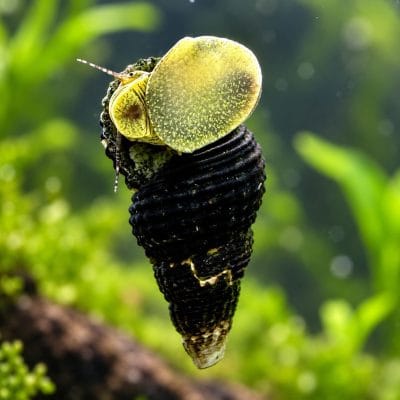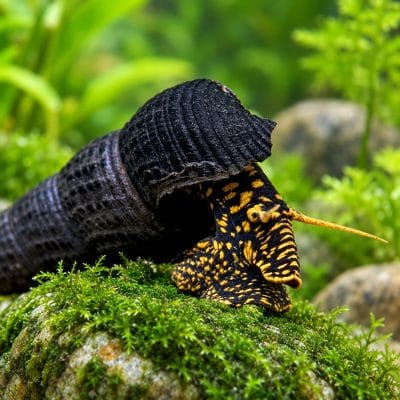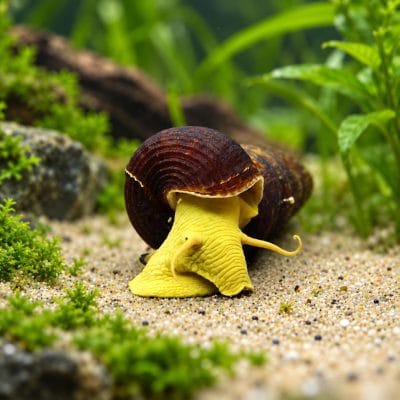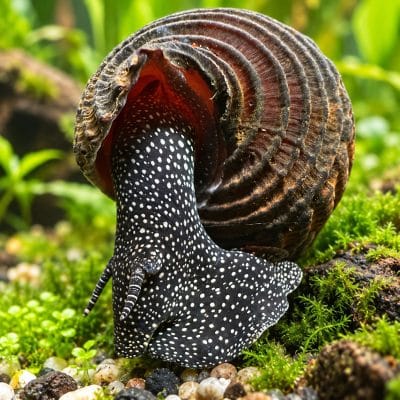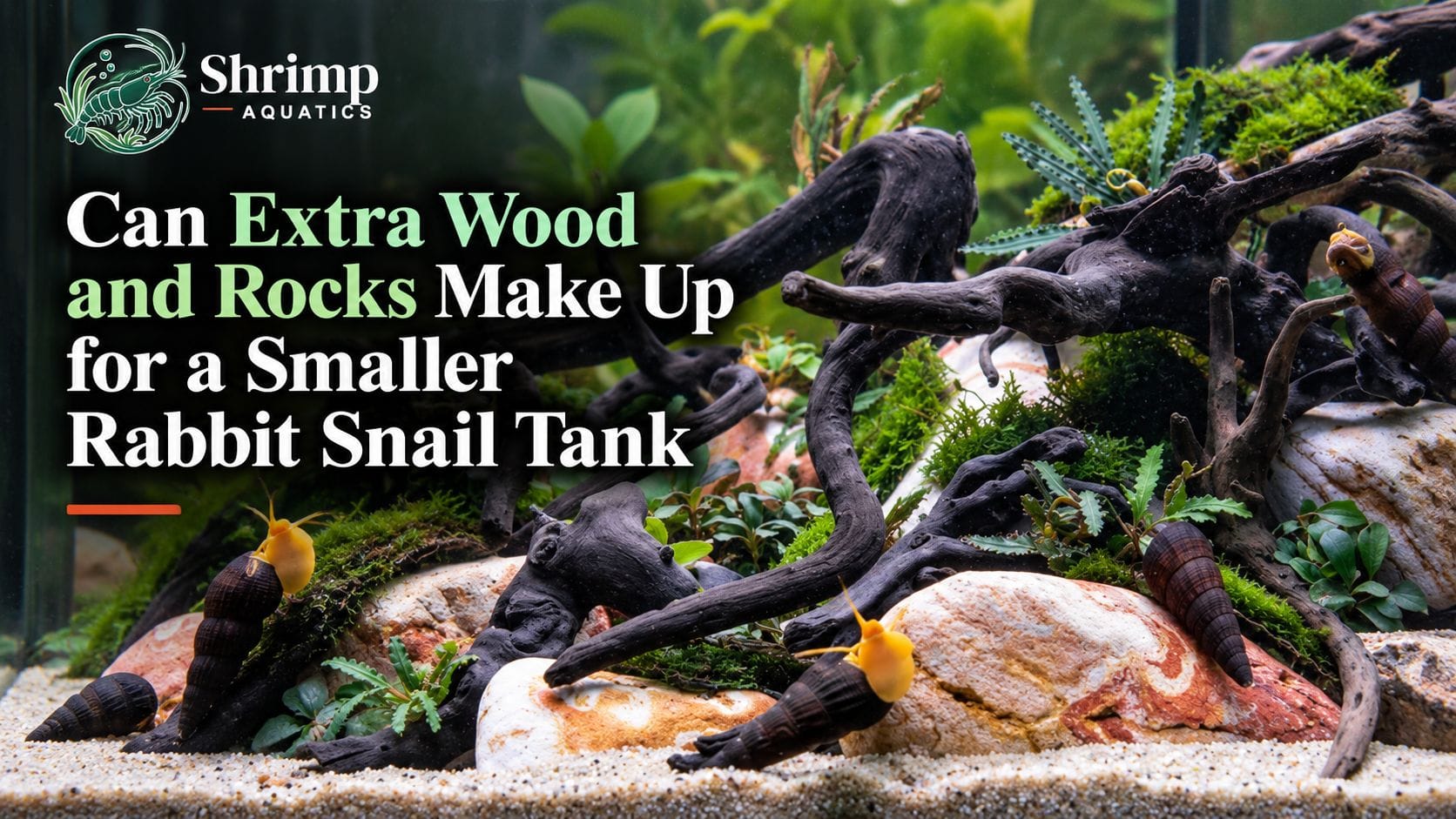
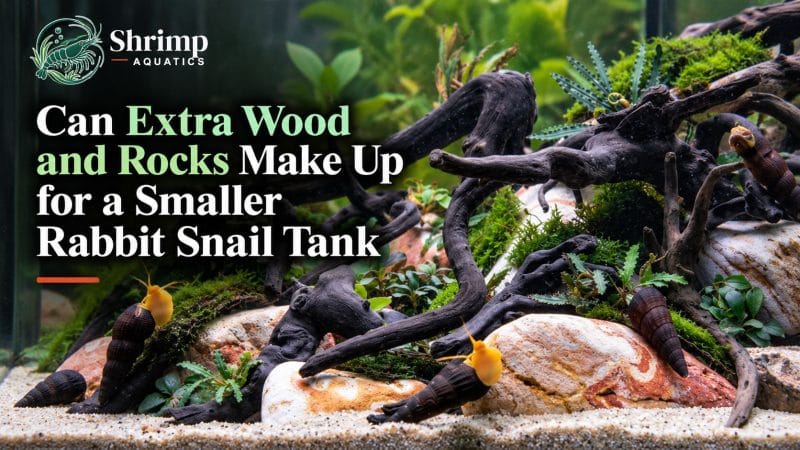
No. Extra wood and rock give a rabbit snail more surface to graze, and that’s worth having. But they don’t give it more floor to cross, and they don’t give the tank more water. In a small tank they take water away, and water is what this tank can least afford to lose.
What more wood and rock actually change in a small rabbit snail tank
Start with what hardscape genuinely does. A rabbit snail is a grazer, and the film on stone, wood and glass is what it works over. Sulawesi Keepers describes the species that live on stones and glass as feeding on the biofilm there.1 That much is real. Add a branch and two stones to a mature tank and you’ve added grazing area, along with shade and cover the snail can use.
Now what it doesn’t do. Surface area and floor area aren’t the same measurement. A snail working the bottom gains nothing from a vertical face except the film on it. The footprint of every rock and every branch is floor it can no longer cross. Whether the lost floor matters more than the lost gallons is the comparison in floor area against water volume.
The water is the bigger loss. Stone and waterlogged wood displace what they occupy. A nominal 10 gallon tank packed with hardscape holds well under 10 gallons. The bioload of a large snail is now running in that smaller number.
How much smaller? That depends on what you put in, so measure it instead of guessing. Fill the tank with the hardscape already in place, then work the volume out from the water you used. We’d sooner you knew that number than trusted a rule of thumb. How many gallons that should be before any hardscape goes in is rabbit snail tank size.
The rule of thumb deserves the distrust. No study we can point you to sets a minimum tank size for Tylomelania. The figures in circulation disagree with each other, and none of them traces back to a measurement. A layout built on one of them is built on sand.
Why less water hits harder in a warm, alkaline rabbit snail tank
This is the part most layout advice skips. The water a rabbit snail needs is warm and alkaline, and both of those change what an ammonia reading means. Total ammonia splits two ways. One form is ammonium, which is comparatively harmless. The other is un-ionized ammonia, and that’s the form that does the damage.
EPA’s freshwater ammonia criteria put numbers on the split. In fresh water that ratio rises tenfold for each single pH unit.2 It also roughly doubles for each 10 degree Celsius rise from 0 to 30 degrees Celsius.2 Those are general freshwater figures, not aquarium thresholds and not numbers for this animal. They still say something plain. The same test result is a worse result in a tank held at pH 7.5-8.5 and 79-86°F (26-30°C) than in a cool neutral one.
Warm water also carries less oxygen. USGS puts it in one line: cold water can hold more dissolved oxygen than warm water.3 That’s the whole mechanism. A rabbit snail tank sits at the warm end all year, so it starts with less oxygen in the bank. Then hardscape takes away some of the volume that was holding it. What absorbs a missed water change or a heavy week of feeding? Not the rockwork.
| Temperature | 79-86°F (26-30°C) |
|---|---|
| pH | 7.5-8.5 |
| GH | 4-8 dGH |
| KH | 3-6 dKH |
| TDS | 150-250 ppm |
| Nitrate | Aim for under 10 ppm. |
| Substrate and hardscape | Inert, with no pH lowering soil. |
| Tank | Mature, with algae and biofilm already visible on rock and glass. |
| Difficulty | Moderate for the animal. The system is the demanding part. |
That nitrate figure is a target we write to, not a line the animal dies at, and we don’t know of a published tolerance for this genus. Of the rest, one number deserves more attention than the others, and it’s KH. Carbonate hardness is what stops pH wandering. In a small volume it’s the reading that moves first.
Why does that matter to a snail? Because the shell comes out of the water. In the Florida apple snail, low calcium with pH below 6.5 gave the smallest shell growth, visible erosion and the weakest shells of the trial.4 That’s one species. In another apple snail, most of the shell’s calcium comes from the water, not the food.5 Higher dissolved calcium gave faster growth and harder shells in that same trial.5 Both animals sit outside Tylomelania, so read them as how snail shells behave in general.
Nobody has published a mineral or pH threshold at which a rabbit snail’s shell starts to fail, so we won’t invent one for you. Hold GH 4-8 dGH and KH 3-6 dKH, and watch for movement.
One thing not to panic about. A worn, pitted or blunted shell tip on an adult is the ordinary condition of this genus in the wild. The 1897 monograph on Celebes describes the upper whorls as mostly considerably eroded, even in snails taken alive.6 Old wear is history. Fresh damage at the growing edge of the aperture is current, and that’s the one that should send you to your test kit. How much of the rest counts as ordinary rather than a warning sign is in are rabbit snails difficult to care for.
Does your rabbit snail want rock, wood or open sand?
We can’t tell you, and that’s the honest answer. Sulawesi Keepers splits these snails two ways. Some prefer hard surfaces and sit on stones, glass and other smooth surfaces. Others prefer soft substrate and don’t climb stones at all. For that group, stones in an aquarium take away the living space, which is fine sand or mud.1 Read that twice. For a soft substrate species, hardscape isn’t a bonus. It’s eviction.
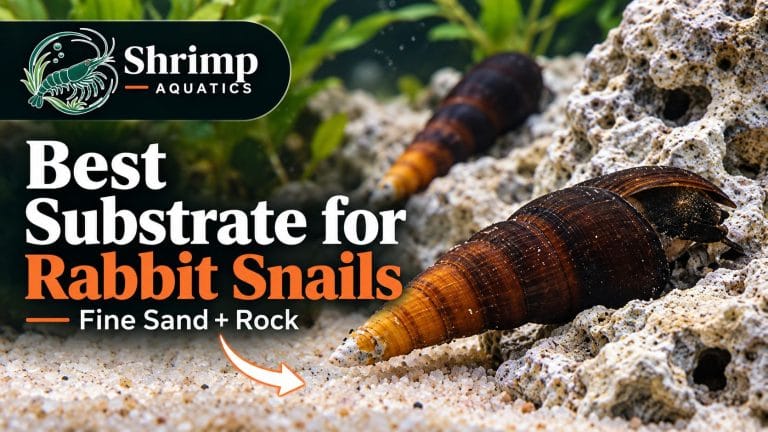
Which group the traded rabbit snails belong to isn’t recorded anywhere we’ve seen. The animals sold as Yellow Rabbit, Golden Spotted, Mini Tylo Poso or Himalayan are all Tylomelania sp., with no confirmed species name behind them. So don’t bet the layout on a guess. Give the snail one or two firm surfaces, leave a broad open run of fine sand, and let it show you where it spends its time. Fine, inert sand under a few pieces of rock is the best substrate for rabbit snails when you can’t tell which group yours belongs to.
For context, the lakes these snails come from are nothing like a decorated nano tank. A tank that sits closer to that lake water every day is what Sulawesi rabbit snail care is built around. Sulawesi Keepers describes that water as generally around 84°F (29°C), with a high oxygen content, very clean, soft and yet alkaline.1
That lake reading is background. The numbers in the table above are the ones we keep to.
Size is the other reason open floor earns its place. These are big snails, and they don’t start small either. The genus broods its young internally and releases them already shelled. In some species those juveniles are close to 2 cm long at release, among the largest known of any live-bearing snail.7 Big from day one. A tank that looks roomy with one adult in it reads differently once young are out on the sand.
Will more surface grow enough food for a rabbit snail?
Not on its own, and not on a schedule you control. The film has to be there before the snail is. We wouldn’t add one of these to a tank without visible algae and biofilm on the rock and glass. An animal this size is a grazing load in its own right. It eats the surface down, and the surface comes back at whatever rate your light, nutrients and tank age allow. New hardscape starts bare, so it’s surface area on the day you add it and food some weeks later.
Two things are worth knowing before you count on algae at all. Sulawesi Keepers states that green filamentous algae are definitely not their natural food.1 So a hair algae problem is not a stocked pantry, and these snails are not a cleanup crew. And no published study reports what any Tylomelania eats in the wild, so we won’t hand you a menu of vegetables and wafers as a requirement. Offer a little prepared food, lift whatever isn’t taken within a few minutes, and let the grazing surface do most of the work.
What to do when a bigger rabbit snail tank isn’t an option
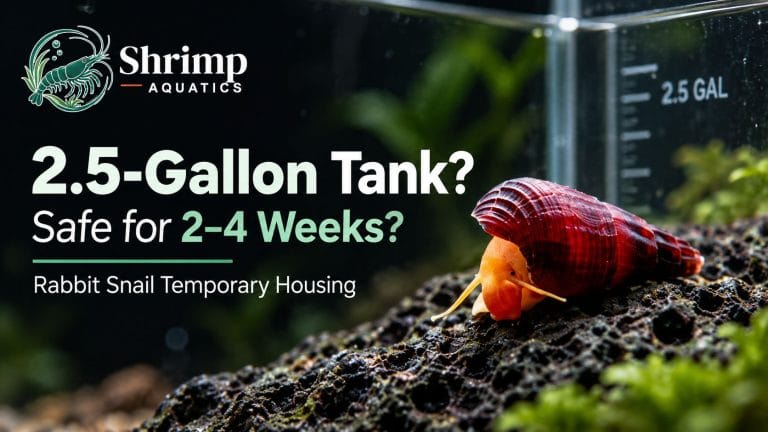
If the tank you have is the tank you have, spend the space on water and floor.
- Fine, rounded sand open across most of the footprint, with hardscape kept to one end.
- Stones set flat on the base glass before the substrate goes in, never stacked, and no gaps at the substrate line.
- Biological capacity and aeration outside the display, where they cost no floor space.
- A safe default is testing KH weekly for the first month after you alter the hardscape, and keeping it inside 3-6 dKH.
- No pH lowering soil, no sharp gravel, no leaning rockwork.
The usual rule with a heavy, slow animal is that anything it can slide into, it will eventually slide into. So leave nothing for it to slide into.
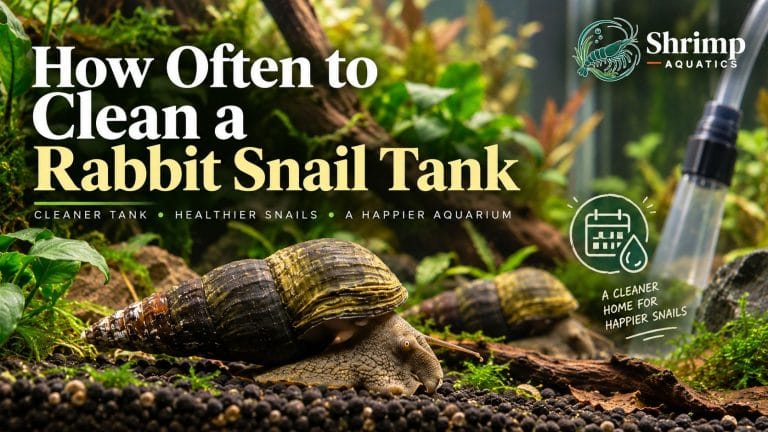
The third point is where we’d put the effort. At Shrimp Aquatics our Sulawesi systems use biological filtration together with a Kaldnes moving-bed filter. We tune the outlet so the shrimp are not pushed around while grazing, aiming for high oxygen with gentle movement. In a small tank that’s the trade worth making, because biology and aeration hung outside the glass cost you nothing on the floor.
Wood is the piece we’d think hardest about. Whether a given branch moves KH in a volume that small isn’t something we can point you to a study on. Your test kit answers that for your tank, not an article. If KH slides after you add it, the wood is losing its argument with the water and it should come out.
And if you’re choosing a snail instead of rehousing one you already keep, settle the water before the animal. Our tank-bred Sulawesi snails are bred in our own tanks and held in the warm alkaline water above. So the order of work is a mature tank at those numbers first, then the snail. We don’t promise breeding, sex or the number of young from any order.
References
7 Sources
- Do you know Sulawesi snails?, Sulawesi Keepers, undated page, read 2026-09-20.
- Aquatic Life Ambient Water Quality Criteria for Ammonia, Freshwater, U.S. Environmental Protection Agency, Office of Water, April 2013.
- Dissolved Oxygen and Water, U.S. Geological Survey, Water Science School, updated August 24, 2026.
- The effect of calcium and pH on Florida apple snail, Pomacea paludosa (Gastropoda: Ampullariidae), shell growth and crush weight, Aquatic Ecology, 2009, abstract.
- Growth and shell hardness of the apple snail Pomacea flagellata Say, 1829, reared at three calcium concentrations, PeerJ, 2023.
- Materialien zur Naturgeschichte der Insel Celebes, volume 1, Paul and Fritz Sarasin, 1897.
- Anatomy of an adaptive radiation: a unique reproductive strategy in the endemic freshwater gastropod Tylomelania (Cerithioidea: Pachychilidae) on Sulawesi, Indonesia, and its biogeographical implications, Biological Journal of the Linnean Society, 2005, abstract.
Ready to get started?
Shop our Sulawesi Snail collection
12 products available · Live Arrival Guarantee