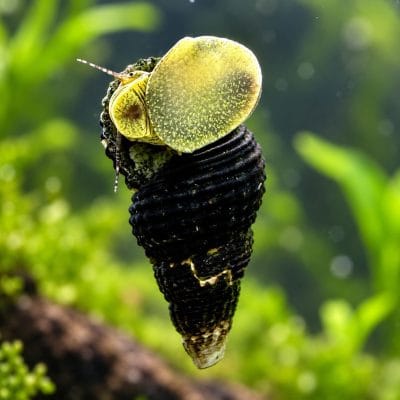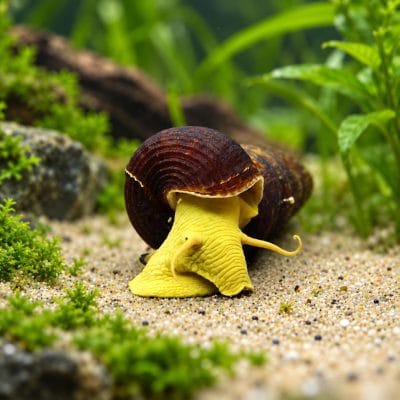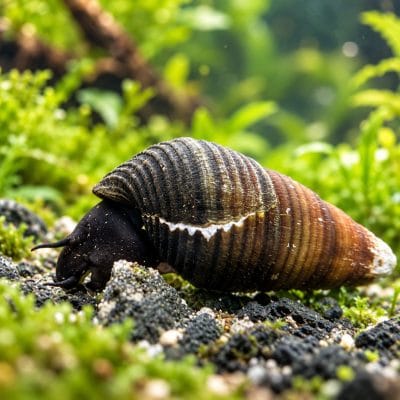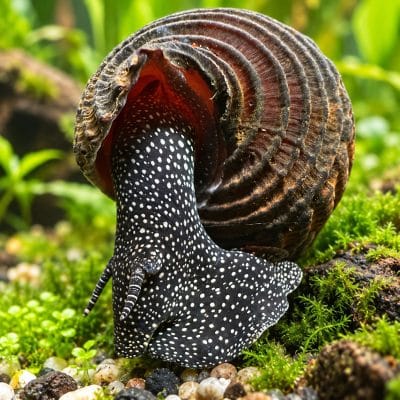
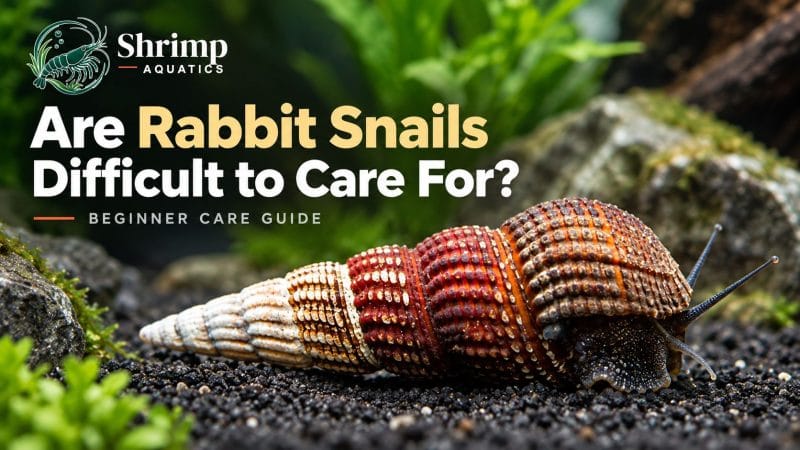
Short answer: the animal is a moderate keep, and the tank is the hard part. Rabbit snails (Tylomelania sp.) are heavy, slow grazers from the ancient lakes of Sulawesi. The genus has radiated there into dozens of species found nowhere else.1 They aren’t delicate animals. What’s demanding is the water they live in. Most aquariums, most tap supplies and almost every planted tank miss it the same two ways: not warm enough, and not alkaline enough.
So who should buy one? If you already run a warm alkaline tank, a rabbit snail is one of the more forgiving animals you can put in it. The same goes if you’re willing to build one and let it mature first. If you’re hoping for a hardy snail that drops straight into a room-temperature community tank, this isn’t the animal. We’d rather you knew that before the order than after it. The tank that makes it forgiving is the one in Sulawesi rabbit snail care, so compare your own readings with it before you order.
One thing genuinely is easy: they won’t take over. These are live-bearers that brood their young inside the shell. Juveniles come out already shelled, close to 2 cm in some species.1 Plan for no young, and be pleased if you get any.
Can you hold rabbit snail water at 79-86°F and pH 7.5-8.5?
This is the question that decides it. Everything further down matters. But if the answer here is no, nothing else rescues the tank. Here is the range we keep to for every Sulawesi lake species we sell, snails included.
| Temperature | 79-86°F (26-30°C) |
|---|---|
| pH | 7.5-8.5 |
| GH | 4-8 dGH |
| KH | 3-6 dKH |
| TDS | 150-250 ppm |
| Nitrate | Hold nitrate under 10 ppm. |
| Substrate | Inert sand and hardscape. No active, pH-lowering soil. |
| Difficulty | Moderate animal, demanding system. |
Warm and alkaline at once is the unusual combination. Plenty of tanks are warm. Plenty are hard. A planted tank on an active soil is neither. That soil is built to pull pH down and strip carbonate, which is the opposite of what this animal needs. If your tap water is soft and acidic, you’ll be mixing minerals into RO water and testing every batch. That is real work, every week, for as long as the tank runs.
Why the same ammonia reading hurts more in this tank
Ammonia in water splits two ways. Ammonium is comparatively harmless. Un-ionized ammonia is the form that does the damage, and the split between them isn’t fixed. EPA’s freshwater criteria put a number on it. The ratio rises roughly tenfold per pH unit, and about twofold per 10 degrees Celsius.2 That’s chemistry, not a snail tolerance. It still matters in practice: a tank at pH 8.2 and 84°F punishes a feeding mistake far harder than a cool, soft tank with the same reading. Your kit reports total ammonia. It says nothing about how much of that total is the dangerous form.
Heat costs you oxygen too. Cold water holds more dissolved oxygen than warm water.3 So the top of the range needs real surface movement. A tank sitting at 86°F with a still surface is working against you.
Evaporation adds a slower problem. What leaves is water. The dissolved solids stay behind and concentrate in what’s left.4 Top off with RO, not with tap. Otherwise your TDS climbs week after week while you aren’t looking.
For context, Sulawesi Keepers describes the lakes as around 84°F (29°C), very clean, high in oxygen, and soft yet alkaline.5 Those are deep, stable lakes, not glass boxes. The numbers in the table above are what we keep the snails in, and they are the target.
Don’t add a rabbit snail to a tank without visible biofilm
This is where most of the disappointment comes from. A rabbit snail is a grazer with a big body to feed. It wants a system that already carries a film of algae and biofilm over the rock and the glass. A tank that looks spotless is a tank with nothing in it to eat. Give a new system months, not weeks, and stock the snail last.
How many can you keep? Fewer than you’d think. Expect a large snail. Treat an adult as something that counts toward the grazing load the way a fish counts toward the bioload. A small tank with three of them is a small tank with a food problem. How much water and floor each extra snail needs is set out in rabbit snail tank size. We don’t publish an inch figure for ours. We haven’t measured our own animals, and the sizes quoted around the hobby aren’t tied to any described species.
Surface type matters as much as numbers. Sulawesi Keepers separates the species that climb stone and glass from those that stay on sand or mud.5 Which group a traded snail belongs to usually isn’t recorded. So give it both. Put down open sand, add some hard surfaces, and let the animal choose. If your tank is already tight on water, extra wood and rock will not buy back the volume you are missing.
Expect it to do very little for a while after it arrives. A snail that shuts up and sits still for the first few days is behaving normally. A safe default is to leave it alone, keep the lights low, and let it come out in its own time.
A rabbit snail won’t clean your algae, so don’t buy one for that
Every second care sheet sells this animal as a cleanup crew. It is not one. Sulawesi Keepers states flatly that green filamentous algae are not their natural food.5 So the hair algae on your glass is staying put. A tank overgrown with algae is a worse home for these snails, not a better one. What one does and does not clean is set out in how much rabbit snails clean a tank.
What do they actually eat? The vegetable and protein menus you’ll find online are keeper habit written up as a requirement. What we’re confident about is the grazing. Mature biofilm and algae on surfaces do most of the feeding. Prepared food is a small supplement, never a way to make up for a system that isn’t ready. If you offer something, offer a little. Watch whether it goes, and lift what’s left within a few hours, so it isn’t sitting in warm water turning into ammonia.
And plants? Treat soft-leaved stems as at risk, and favor hardy epiphytes attached to rock.
Copper is never safe in a rabbit snail tank, and cherry shrimp need care
Start with copper, because it is the one that kills quietly. EPA describes elevated copper as toxic in water and harmful to invertebrates.6 How available it is shifts with pH, alkalinity, hardness and dissolved organic carbon. In one laboratory study on Melanoides tuberculata, a related snail, copper was the most toxic of eight metals tested.7 The 96 hour median lethal concentration was 0.14 mg per litre. That figure belongs to a different family. It is not a safe limit for your animal. Read it as the reason there’s no safe limit worth chasing. Check the ingredients of any fish medication, plant fertilizer or algae treatment before it goes near this tank. If you can’t establish what’s in it, keep it out.
Assassin snails are a straight no, because they hunt other snails.
Cherry shrimp are the pairing people argue about, so here it is plainly: on paper they don’t fit, and in our tanks a small group does. The chemistry overlaps. The temperature doesn’t: Neocaridina are usually kept at 65-78°F (18-26°C), and a rabbit snail tank starts at 79°F (26°C). Even so, at Shrimp Aquatics we keep a small group of Neocaridina in some of our Sulawesi tanks, in the same water as our rabbit snails, and they live and breed there. Keep the tank in the snail’s range, keep the group small, and move any shrimp that hide all day or keep dying to cooler water. That’s the whole case for rabbit snails with Neocaridina shrimp, and it’s our experience, not a published finding.
Sulawesi shrimp are the natural match, since they want the same water and graze the same layer. The question there is grazing capacity, not compatibility. Can one tank feed both?
Is your rabbit snail’s worn shell tip normal or a water problem?
Both happen, and telling them apart saves you a scare. A worn, pitted or truncated tip on an adult is ordinary in this genus. The Sarasin brothers found the same thing in 1897, in three live snails whose upper ribs had worn away completely.8 They came out of clean lake water. A scarred apex on its own doesn’t mean your tank is doing something wrong.
What you watch instead is the growing edge. Fresh pitting, chalky white patches or thinning at the newest part of the shell means the animal is losing shell faster than it can lay it down. That points at minerals and pH. In one trial, Florida apple snails kept at low calcium with pH below 6.5 grew the least shell and eroded visibly.9 Different family, different animal. Read it as the general snail mechanism it is, not a threshold for yours. In another apple snail, most shell calcium comes from the water, not the food.10 So the fix is water chemistry, not a calcium wafer.
Nobody has published a calcium, GH, KH or pH figure at which a Tylomelania shell starts to go. Don’t trust a care sheet that hands you one. Hold the range in the table. Keep KH from drifting down between water changes, and look at the shell edge every few weeks. Whether supplements for a rabbit snail shell add anything beyond that water routine is worth settling before you dose.
Ready to stock a rabbit snail, or better off waiting?
Run through this honestly. Every line has to be a yes.
- Your tank holds 79-86°F (26-30°C) without swinging, all year, through the hot week and the cold one.
- Your water sits at pH 7.5-8.5 with GH 4-8 dGH and KH 3-6 dKH, and you can reproduce it from a batch of RO and minerals.
- Ammonia and nitrite read zero, nitrate stays under 10 ppm, and the tank has been running long enough for that to be boring.
- There is already visible algae and biofilm on the rock and the glass.
- Nothing going into the tank contains copper, and there are no assassin snails in it.
- You want a snail to clear up algae, or you want it in a room-temperature shrimp tank. Neither of those works here.
Test before you order
Measure temperature, pH, GH, KH and TDS on the tank you actually intend to use, not on the tap. If any of them sits outside the table above, fix that first and order later. Nothing about the snail compensates for water it can’t live in.
If that list reads as yes, the snails are the straightforward part. Ours are bred in our own tanks at Shrimp Aquatics, not collected from the wild. They come out of the same warm alkaline systems our Sulawesi shrimp live in. If you’re choosing between the lines we keep, the Sulawesi snail listings show what is in stock. In husbandry terms every one of them is the same animal on the same water.
One thing to know before you pick by name. Trade names in this group are marketing, not taxonomy. The Mini Tylo Poso Rabbit Snail is the clearest example. “Mini” is not a measured size, and “Poso” is not a confirmed lake of origin. Like the rest of the traded rabbit snails, it is sold as Tylomelania sp. Many forms in this genus have never been formally described.11 That is normal, and it changes nothing about how you keep the animal.
References
11 Sources
- Anatomy of an adaptive radiation: a unique reproductive strategy in the endemic freshwater gastropod Tylomelania (Cerithioidea: Pachychilidae) on Sulawesi, Indonesia, and its biogeographical implications (abstract), Biological Journal of the Linnean Society, August 2005.
- Aquatic Life Ambient Water Quality Criteria for Ammonia, Freshwater, U.S. Environmental Protection Agency, Office of Water, April 2013.
- Dissolved Oxygen and Water, U.S. Geological Survey, Water Science School, updated August 24, 2026.
- Chloride, Salinity, and Dissolved Solids, U.S. Geological Survey, Water Resources Mission Area, March 1, 2019.
- Do you know Sulawesi snails?, Sulawesi Keepers, undated, read September 19, 2026.
- Supplementary Training Materials for Aquatic Life Criteria, Copper, Background, U.S. Environmental Protection Agency, Office of Water, updated May 6, 2026.
- Toxicity of Metals to a Freshwater Snail, Melanoides tuberculata, The Scientific World Journal, 2012.
- Materialien zur Naturgeschichte der Insel Celebes, volume 1, Paul and Fritz Sarasin, C. W. Kreidel’s Verlag, 1897.
- The effect of calcium and pH on Florida apple snail, Pomacea paludosa (Gastropoda: Ampullariidae), shell growth and crush weight (abstract), Aquatic Ecology, 2009.
- Growth and shell hardness of the apple snail Pomacea flagellata Say, 1829, reared at three calcium concentrations, PeerJ, 2023.
- Freshwater snails of Sulawesi: a brief overview, Sulawesi Keepers, undated.
Ready to get started?
Shop our Sulawesi Snail collection
12 products available · Live Arrival Guarantee