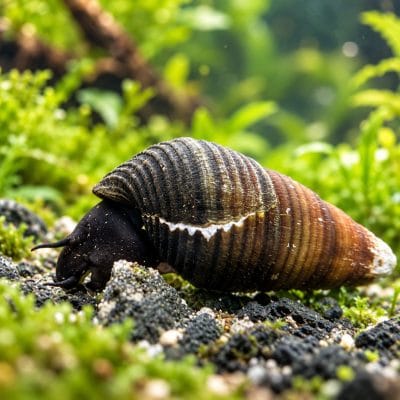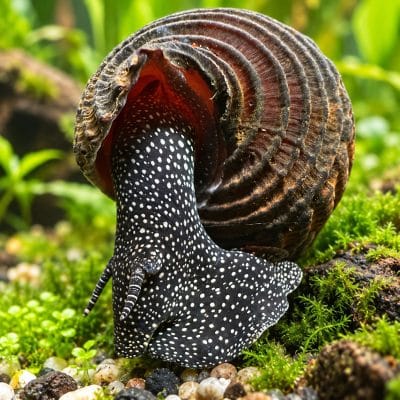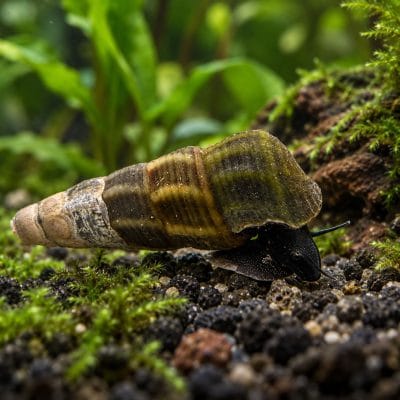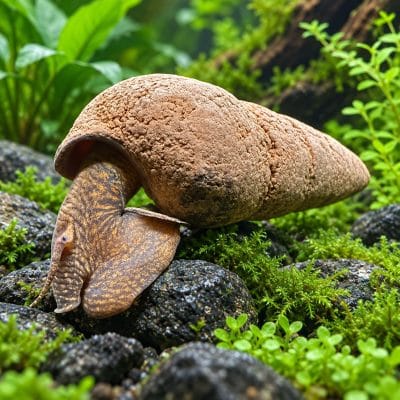
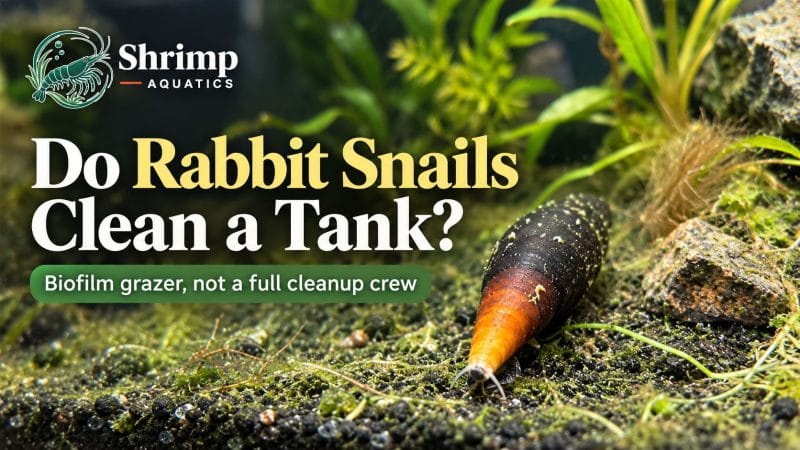
Partly. A rabbit snail (Tylomelania sp.) grazes the thin film of algae and biofilm that grows on rock, glass and substrate, and some species will eat most things they come across. It won’t clear an algae outbreak, it doesn’t take waste out of your water, and it needs a mature Sulawesi tank before it has anything to eat. Buy one because you want the snail, not to fix a dirty tank.
What does a rabbit snail actually clean in your tank?
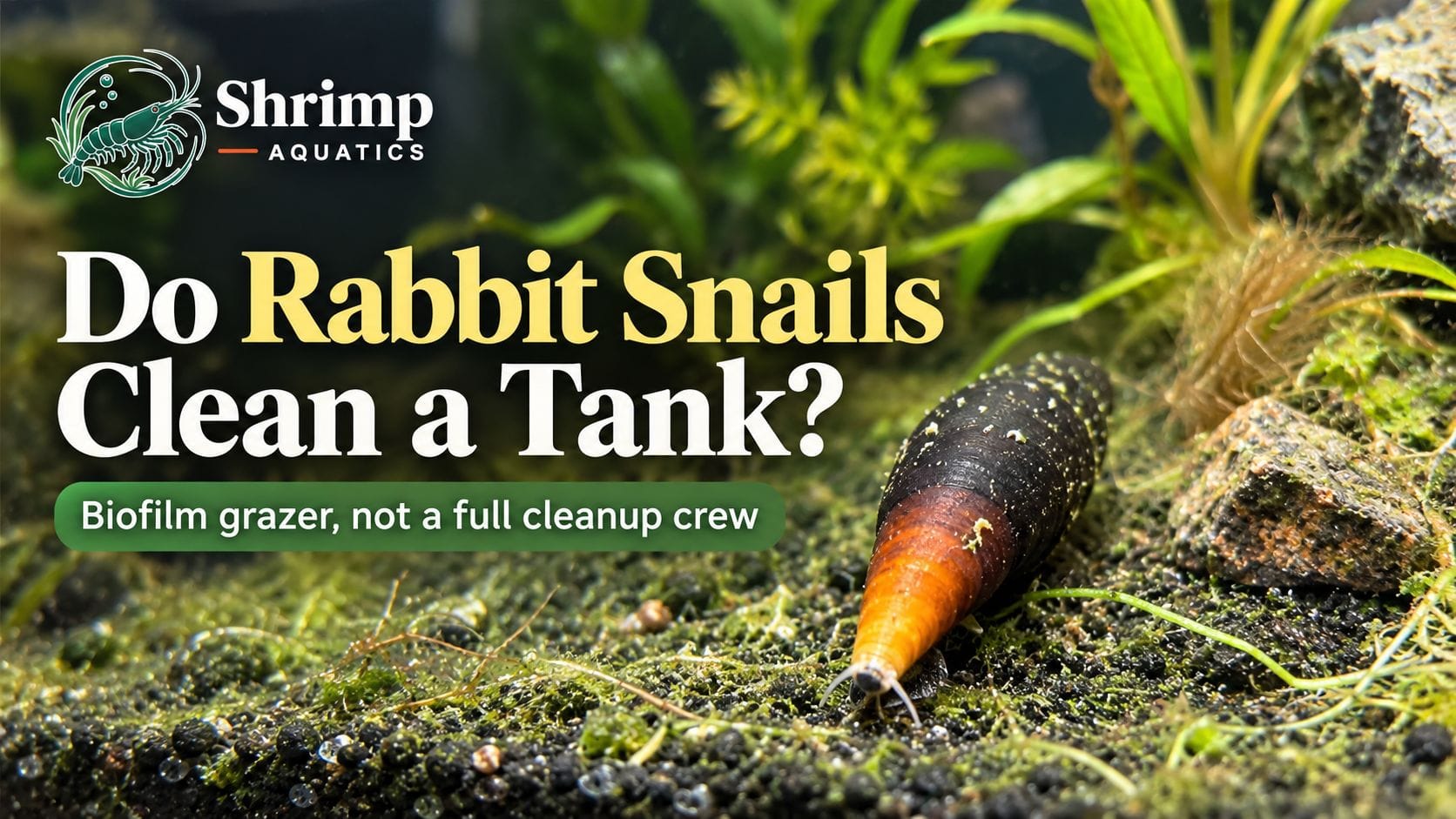
It cleans the film, not the mess. What a rabbit snail does all day is graze: it works slowly over rock, wood, glass or sand and scrapes off the layer of biofilm and fine algae growing there. That’s the job it does well. What else it eats, and how little prepared food it needs, is what rabbit snails eat.
Where it grazes depends on the species. Sulawesi Keepers, a conservation group that works with these snails, separates species that live on hard surfaces, spending their time on stones, glass and other smooth surfaces and feeding on the biofilm there, from species that prefer soft substrate and don’t climb on stones at all.1 It also describes so-called generalists, tied to neither surface, as omnivorous and voracious enough to eat algae too.1 So one rabbit snail may polish your rockwork while another spends its time on the sand.
Surface choice is built into the animal. In one lake species, Tylomelania sarasinorum, researchers found two coexisting forms whose feeding organs differ: 79 percent of snails on rock were the rock form, and every snail found on wood was the wood form.2 That study measured the feeding organ, not what the snails swallowed, so it tells you surface matters, not what’s on the menu.
What a rabbit snail will graze
The soft film of biofilm and fine algae on rock, wood, glass or substrate, depending on which surface its species prefers. It’s steady, slow work across the whole tank.
What a rabbit snail won’t fix
Hair algae, thick algae mats, a buildup of waste or a tank that needs a water change. None of those is its natural food or its job.
Will it clean your plant leaves without eating them? Nobody has published a record either way for rabbit snails. We’d treat soft-leaved plants as at risk and put hardy epiphytes on rock.
Why a rabbit snail won’t clear an algae outbreak
No, it’s the wrong animal for algae. Sulawesi Keepers says plainly that green filamentous algae are not their natural food.1 Worse, when that kind of algae spreads, it gets in the way: hard-surface species don’t eat it, and a thick growth blocks their access to the surface they feed from.1 So an algae outbreak doesn’t feed a rabbit snail. It takes its food away. Growing the right kind of film instead is the biofilm rabbit snails graze.
We know you want an animal that eats the problem and saves you the work. If algae is taking over, we’d look at why it’s growing before buying anything to eat it, and we wouldn’t add a rabbit snail to that tank until the surfaces are back to a thin film. If glass algae is the job, a nerite in an ordinary tropical tank does it better, and rabbit snail vs nerite snail is really a question of which water you run.
Does a rabbit snail reduce waste or replace water changes?
No. Uneaten food and dead plant matter break down, and bacteria turn them into ammonia as they decompose.3 A snail grazing through some of it doesn’t make water changes optional. We’d count on the water change, not the snail, to take waste out of the tank. The weekly routine that keeps that ammonia down is how often to clean a rabbit snail tank.
A rabbit snail is also a large animal, and we’d count it in your stocking like any other. If you add one, keep your usual water changes and keep nitrate under 10 ppm, the same target as the rest of a Sulawesi tank. Lift uneaten food within a few hours whether a snail is grazing nearby or not.
Can you add a rabbit snail to clean a new or ordinary tank?
No to both. A new tank has no film to graze yet, and extra food doesn’t make up for that. Add a rabbit snail only once rock and glass carry a visible layer of algae and biofilm.
An ordinary community tank is the other problem. Rabbit snails need the same warm, alkaline, mineral-rich water as Sulawesi shrimp:
| Temperature | 79-86°F (26-30°C) |
|---|---|
| pH | 7.5-8.5 |
| GH | 4-8 dGH |
| KH | 3-6 dKH |
| TDS | 150-250 ppm |
| Nitrate | Under 10 ppm |
| Substrate | Inert substrate and hardscape, no pH-lowering active soil |
That rules out most tanks people want a cleanup snail for. A Neocaridina tank is usually run at 65-78°F (18-26°C), below the 79°F (26°C) where this tank starts, so a snail can’t go into it as it is. It works better the other way round: in our tanks a small group of Neocaridina lives in the snail’s warm water, which is how we keep rabbit snails with Neocaridina shrimp. Bee and Crystal shrimp tanks run soft and acidic, which is the opposite direction.
The snail is the easy part
A rabbit snail itself is moderately hardy. The water it needs is the demanding part, so it isn’t a beginner’s animal, a shortcut into Sulawesi keeping or something to drop into a young tank.
Will a rabbit snail compete with Sulawesi shrimp for food?
Yes. In a Sulawesi shrimp tank the snail and the shrimp graze the same film on the same rock, so what matters is how much grazing your tank can support. A large snail eats film the shrimp would otherwise have. If your surfaces are grazed bare, the tank has more mouths than film, and adding food doesn’t fix an immature or overstocked system. How many of each one tank can carry is worked out in Sulawesi shrimp living with rabbit snails.
What a given rabbit snail accepts beyond that grazing layer isn’t recorded, so nobody can promise yours will take prepared food. If you offer some, keep it small and lift what’s left within a few hours.
Is a rabbit snail right for your Sulawesi tank?
If your tank is mature, holds the range above and has more grazing film than your shrimp use, a rabbit snail is a good fit and a fascinating animal to watch. If you’re after a cleaner for algae or waste, it isn’t. When you’re ready, you can compare the Sulawesi snail lines we carry. Every snail we sell is bred by Shrimp Aquatics, not collected from the wild. Which surface a given line prefers is unrecorded, and we don’t promise breeding, sex or the number of young from any order. The full setup is in Sulawesi rabbit snail care.
References
3 Sources
- Do you know Sulawesi snails?, Markéta Rejlková, Sulawesi Keepers, undated, accessed 2026-09-24.
- Evolutionary Divergence and Radula Diversification in Two Ecomorphs from an Adaptive Radiation of Freshwater Snails, Hilgers et al., Genes 13(6):1029, 2022.
- Aquatic Life Ambient Water Quality Criteria for Ammonia, Freshwater (2013), U.S. Environmental Protection Agency, Office of Water, April 2013.
Ready to get started?
Shop our Sulawesi Snail collection
12 products available · Live Arrival Guarantee