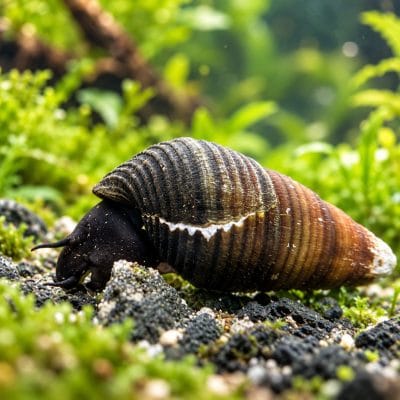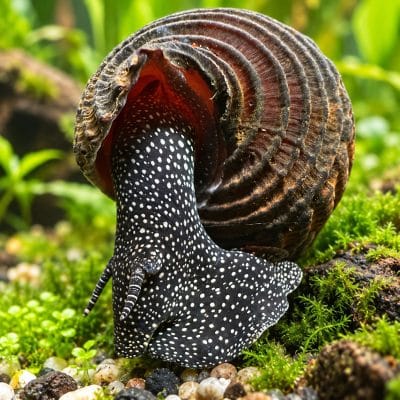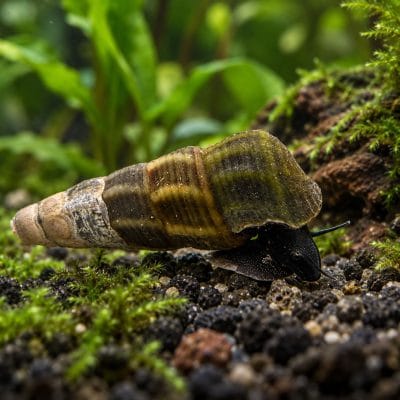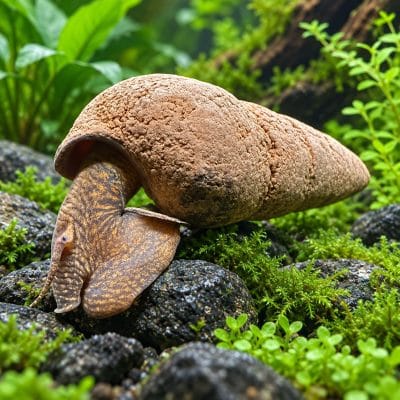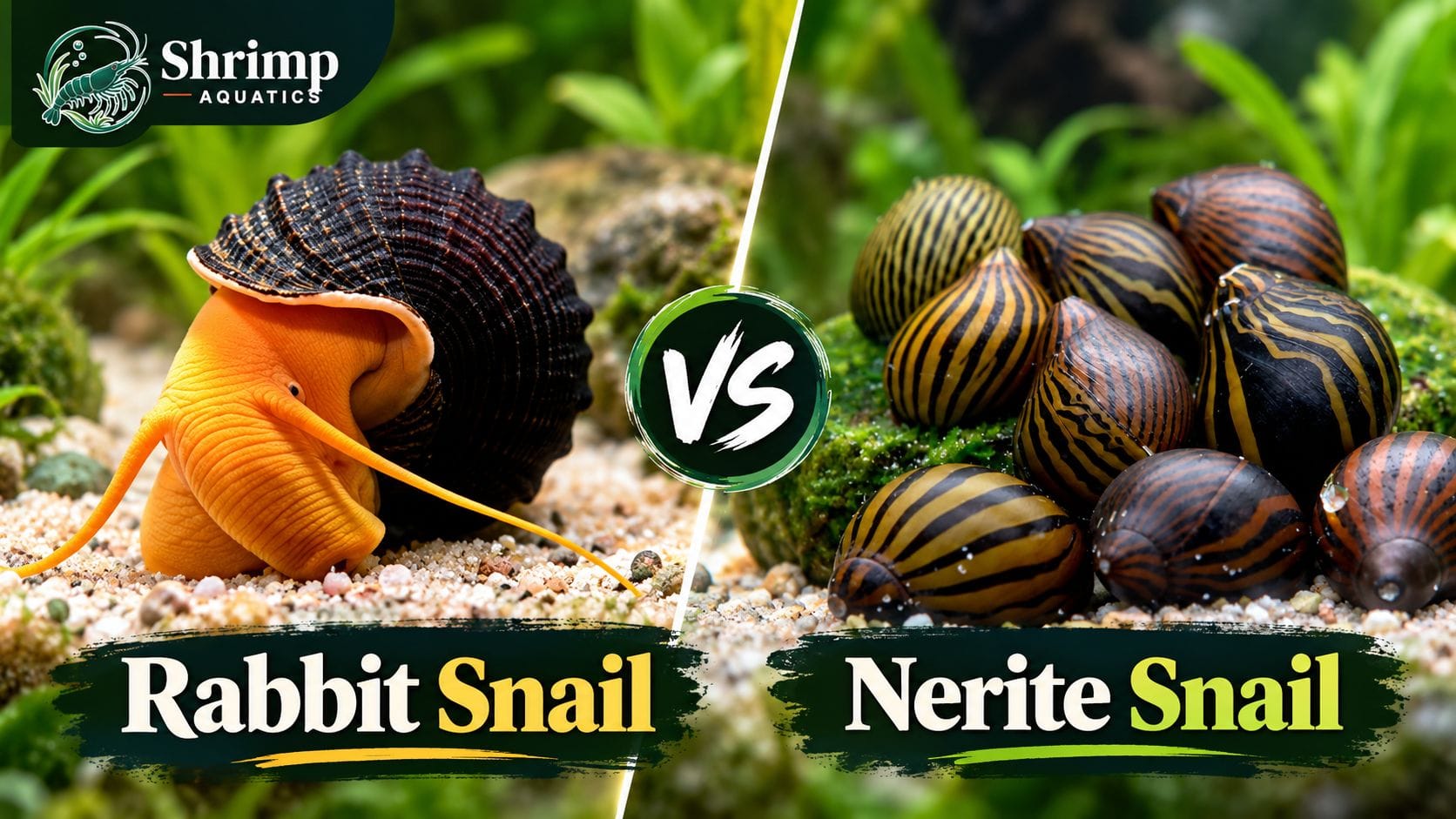
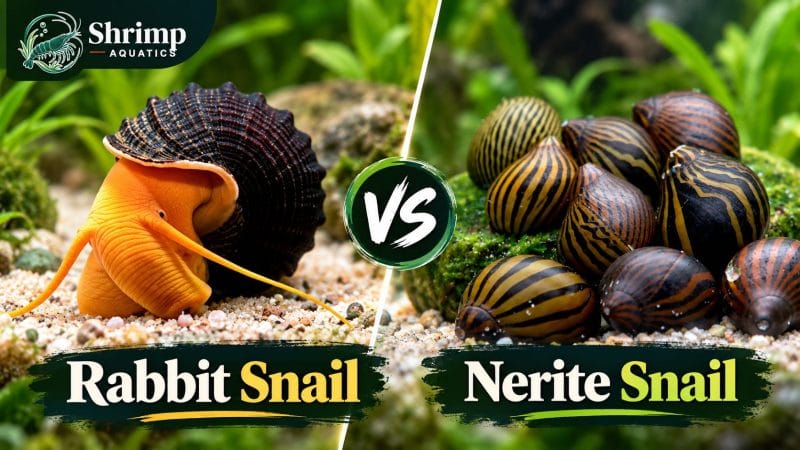
Choose a nerite if you want a small algae grazer for an ordinary tropical tank, and choose a rabbit snail only if you already run a warm, alkaline Sulawesi tank with a film growing on the rock. They’re different animals for different water, and we wouldn’t plan one tank around both. What follows rests on each snail’s own biology and the ranges keepers work to.
Do rabbit snails and nerites need the same water?
No. A rabbit snail needs warm, alkaline, mineral-rich water that most home tanks never run, while nerites are sold for the everyday tropical community tank.
Rabbit snails (Tylomelania sp.) come only from Sulawesi, Indonesia, where the genus lives in lakes and in rivers.1 The numbers below are the same ones this site gives Sulawesi shrimp. Nerite snails (family Neritidae) come from a very different place. In the sea-going nerites, the adults live in streams, rivers and estuaries while their larvae drift out to the ocean.2 A rabbit snail has no sea stage at all: rabbit snails are freshwater snails from birth, and never need brackish water.
| Parameter | Rabbit snail | Nerite snails |
|---|---|---|
| Temperature | 79-86°F (26-30°C) | 70-80°F (21-27°C) |
| pH | 7.5-8.5 | 7.0-8.2 |
| GH | 4-8 dGH | 6-12 dGH |
| KH | 3-6 dKH | 4-8 dKH |
| TDS | 150-250 ppm | Not usually given |
| Nitrate | Under 10 ppm | Not usually given |
| Substrate | Inert sand and rock, no soil that pulls pH down | Hard surfaces to graze |
Read the nerite column as the range care sheets usually give for the common aquarium nerites. It isn’t a requirement measured for any one species. The rabbit snail column is the range we keep to, and holding it steady, with a mature film on the rock before the snail arrives, is most of Sulawesi rabbit snail care.
A rabbit snail itself is a moderate animal to keep. The water is the demanding part, so it isn’t an easier way into Sulawesi keeping, and it doesn’t belong in a young tank.
Which snail will actually clear algae from your glass?
The nerite. Keepers buy nerites for exactly that job, and most report them working film and spot algae off glass, rock and wood. That’s keeper experience, and no snail clears every kind of algae.
A rabbit snail is the wrong animal for algae. Sulawesi Keepers, a conservation group that breeds these snails, says green filamentous algae aren’t their natural food.3 What a rabbit snail does all day is graze the thin film growing on surfaces, and the surface matters. In one Lake Towuti species, snails living on rock and snails living on wood carry measurably different feeding organs.1 If you were hoping one snail would do both jobs, the honest answer on whether rabbit snails clean a tank is that they keep a film in check and leave an algae problem where it is.
Plants split keepers too. Treat soft leaves as at risk and keep rabbit snails from eating your plants with hardy epiphytes tied to rock. Keepers generally describe nerites grazing leaves clean without chewing them, and that’s a report as well.
Will rabbit snails or nerites breed in a freshwater tank?
A rabbit snail can, slowly, and a nerite won’t. That difference decides whether your snail count stays where you set it.
Rabbit snails are live-bearers, so the genus gives birth to young snails instead of laying eggs.4 With more than one in the tank, young can turn up over time. We don’t promise breeding, sex or the number of young from any order.
Nerites lay small, hard white egg capsules on rock, wood and glass, and keepers find them hard to scrape off. Those eggs don’t become a colony. In the sea-going nerites, the larvae drift downstream and need marine salinity to develop.2 That’s why keepers see eggs but no baby nerites in a freshwater tank, and a group of four nerites stays at four. Rabbit snail young that do arrive stay in the main tank, and caring for baby rabbit snails comes down to covered intakes and the same water.
Can a rabbit snail and a nerite share one tank?
Not in a setup we’d recommend. The usual nerite range tops out at 80°F (27°C), and a rabbit snail tank starts at 79°F (26°C). A shared tank would have to sit at the top of one animal’s range and the bottom of the other’s, with almost no room for a heater to drift.
On pH and hardness the two ranges do overlap, but temperature is the one setting you can’t split between two animals. Some keepers report keeping both together for a while. Nobody has published how either snail does long term at that shared edge, and we wouldn’t make an animal live at the limit of its range to save buying a second tank.
You’ll also see the pair sold as a cleanup team, nerites on the glass and rabbit snails on the sand. That picture skips the thermometer, and it treats the rabbit snail as a cleaner, which it isn’t. If you already keep nerites and want a rabbit snail, give it its own warm, alkaline tank. Choose rabbit snail tankmates by temperature first, then by what they graze.
Which snail should you order for the tank you have?
Order for the water you already run. Here’s how the two fit:
A nerite fits an everyday tropical tank
- Your tank runs as a typical tropical community tank.
- Algae on glass, rock or wood is the job you need done.
- You want the snail count to stay where you set it.
A rabbit snail fits an established Sulawesi tank
- Your tank already holds 79-86°F (26-30°C) and pH 7.5-8.5, with GH, KH and TDS in the range above.
- Rock and glass carry a visible film of algae and biofilm.
- You want the snail for itself, and slow, unpredictable young are fine with you.
If your tank fits the second card, our tank-bred Sulawesi snails are bred by Shrimp Aquatics, not collected from the wild. We sell every line as Tylomelania sp. and don’t attach a species name to any of them. Not sure your water fits? Email contact@shrimpaquatics.com with your temperature, pH, GH, KH, TDS and tank age before you order.
References
4 Sources
- Evolutionary Divergence and Radula Diversification in Two Ecomorphs from an Adaptive Radiation of Freshwater Snails, Hilgers et al., Genes 13(6): 1029, 2022.
- High gene flow due to pelagic larval dispersal among South Pacific archipelagos in two amphidromous gastropods (Neritomorpha: Neritidae), Crandall, Taffel and Barber, Heredity 104: 563-572, 2010.
- Do you know Sulawesi snails?, Markéta Rejlková, Sulawesi Keepers, 2026.
- Escalation and trophic specialization drive adaptive radiation of freshwater gastropods in ancient lakes on Sulawesi, Indonesia, von Rintelen, Wilson, Meyer and Glaubrecht, Proceedings of the Royal Society B 271: 2541-2549, 2004 (abstract page; full text as PDF).
Ready to get started?
Shop our Sulawesi Snail collection
12 products available · Live Arrival Guarantee