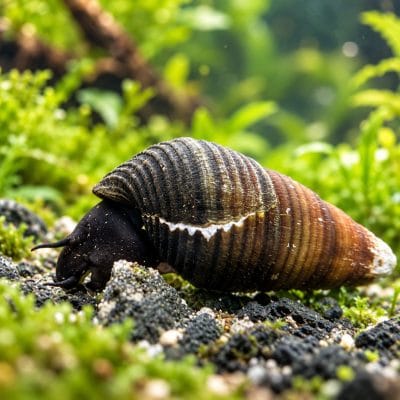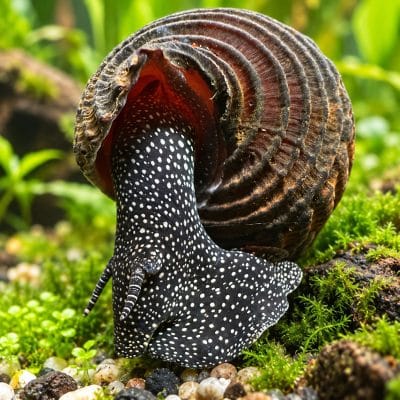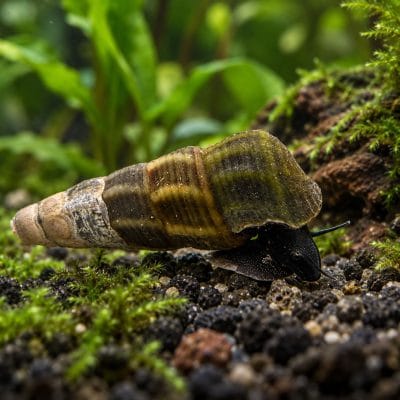
Keep baby rabbit snails in the same mature, warm, alkaline tank as the adults, with every filter intake covered and nothing in the water that eats snails. They’re born already shelled,1 so your job is the tank, not hand-rearing. Treat any month count you read with suspicion.
Should baby rabbit snails stay in the tank with the adults?
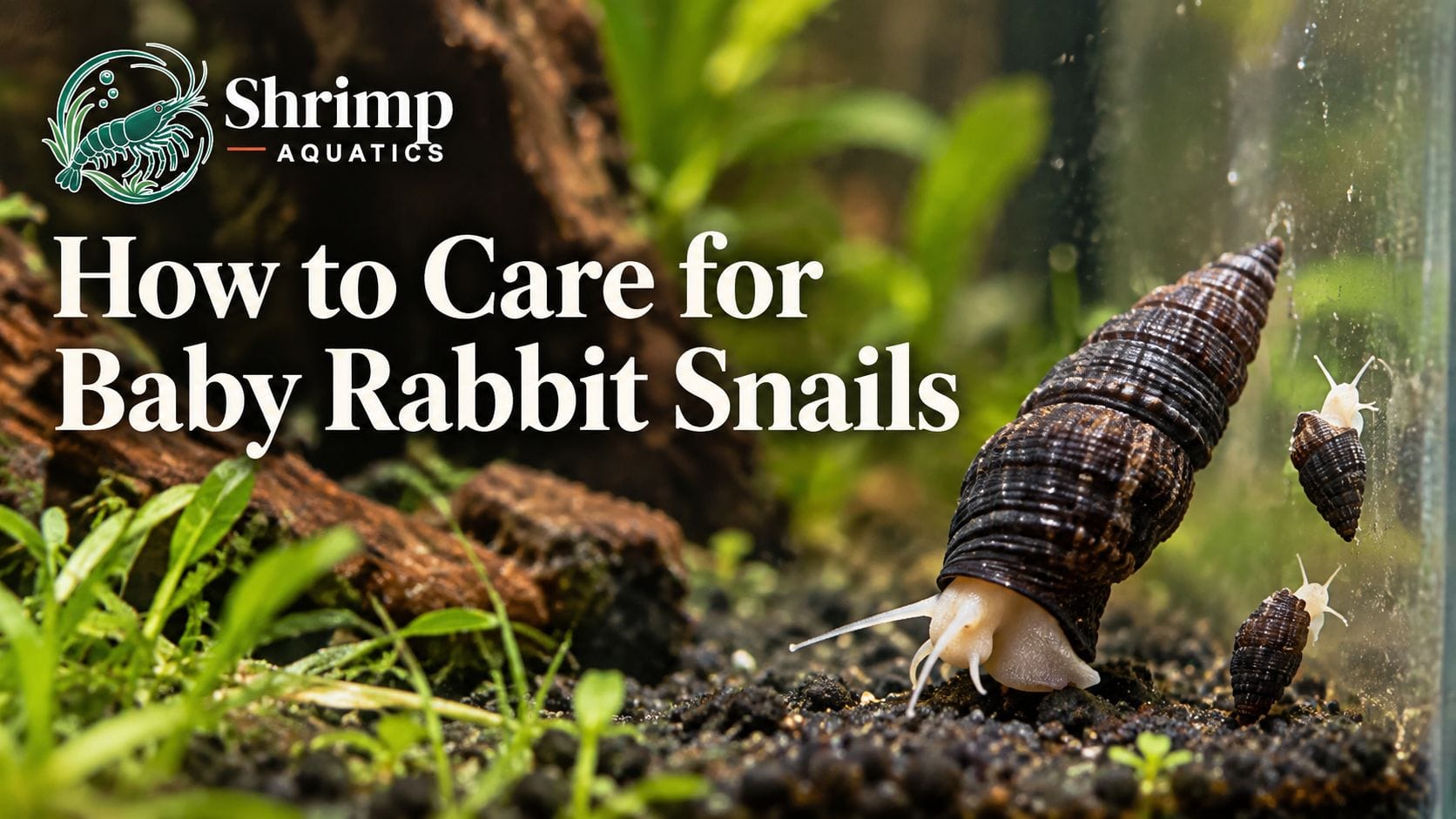
Yes, in most tanks they should. Rabbit snails (Tylomelania sp.) carry their young in a brood pouch and release them already shelled,1 so there’s nothing delicate to hatch out in a separate container.
A breeder box is about the last place we’d put one. It holds very little water, the flow through it is poor, and it has none of the film of algae and biofilm that grows on established rock, which is the food a young snail needs from its first day. The main tank already has all of that.
So when should you move them? Only when something in the tank will eat them. That changes the answer completely, and it’s the next thing to check.
Make the tank safe for newborn rabbit snails
Cover the intakes, keep snail-eaters out and keep copper out of the water. Those are the three hazards a newborn can’t get away from on its own.
Cover every filter intake before the first baby arrives
How small is a newborn? It depends on the species, and the range is wide. In one lake species the brood pouch holds one or two embryos of up to 3.1 mm,2 in a river species it holds 11 to 67 embryos of up to 5.0 mm,3 and some species release young close to 2 cm long.1 Those figures come from preserved wild snails, and we sell every line as Tylomelania sp., so nobody can tell you which size yours will be. What they do tell you is that a baby can be small enough to disappear into an intake slot. At that size, baby rabbit snail identification comes down to the head and snout, not the shell.
Slide a fine sponge over every intake, or run air-driven sponge filters in the tank the babies share. It’s cheap, it takes a minute, and it’s far easier than fishing a baby out of a filter.
Keep snail-eating fish and assassin snails out
Anything that eats snails will find the babies first. In Lake Matano, as introduced flowerhorn cichlids spread, the smaller rabbit snail species and the juveniles of the larger ones disappeared, and the researchers who watch the lake note that flowerhorns mainly eat snails.4 The same logic holds in a glass box.
Assassin snails never belong in this tank. If you already keep a fish that picks at snails, move the babies to a second mature tank running the same water, or don’t breed rabbit snails in that tank at all. Size won’t protect the adults either, because assassin snails attack a much larger rabbit snail without having to break its shell.
Keep copper out of the water
Never dose copper or a copper-based medication in a tank with rabbit snails, and read the label of any fish treatment before it goes near the water. If a fish needs treating, treat it somewhere else.
Which water keeps a baby rabbit snail’s shell growing?
The same water the adults need, held steady. Babies don’t need a softer or harder version of it. They need the adults’ range without swings. That range is the one in Sulawesi rabbit snail care, and it doesn’t change for young snails.
| Temperature | 79-86°F (26-30°C) |
|---|---|
| pH | 7.5-8.5 |
| GH | 4-8 dGH |
| KH | 3-6 dKH |
| TDS | 150-250 ppm |
| Nitrate | Under 10 ppm |
| Ammonia and nitrite | 0, in a fully cycled tank |
| Substrate | Inert sand or gravel and hardscape, never a pH-lowering aqua soil |
A snail adds new shell at the growing edge, where its body comes out, so that’s the part to watch on a baby. Clean, solid new shell there means the water is doing its job. Fresh pitting or whitening at the edge is a reason to test pH, GH and KH before you change anything else. If it spreads, the reason a rabbit snail shell is eroding usually traces back to KH or pH, and that’s where to look first.
Why does the water matter more than the food? In a study on the Florida apple snail, low calcium combined with low pH gave the least shell growth, and those snails showed shell erosion.5 That’s a different snail family, so take it as the direction of the effect. Nobody has set a GH, KH or calcium figure for rabbit snails, which is why holding the whole range steady, and keeping KH from drifting, is the practical rule.
Don’t read the mother’s shell as a warning. Worn, corroded upper whorls are routine on adults of this genus, and the species descriptions record them on adult shells as a matter of course.23 On a baby, what matters is the new shell it adds.
What do baby rabbit snails eat?
They eat the film of algae and biofilm on rock and glass. Grazing that mature film is how these snails feed, which is why the hardscape needs a visible layer before young snails live on it. Prepared food can’t make up for a bare, young tank. Young rabbit snails eat biofilm off the same rock as the adults, so there’s no special baby food to buy.
Most keepers top the film up with a small amount of sinking food. Which foods a given species accepts hasn’t been worked out, so offer a little, watch what disappears, and lift anything uneaten within a few hours.
Why be strict about leftovers? Food that rots in this water does more harm than it would in a cooler, softer tank, because the share of ammonia in its toxic, un-ionized form rises about tenfold with each pH unit and roughly doubles with each 10 degrees Celsius of warming.6 A baby sitting next to a rotting pellet gets the worst of it.
How fast do baby rabbit snails grow?
Slowly, and at a pace you’ll have to judge by eye. The month counts on care sites aren’t measurements. The brood figures above show how much the species differ, so a number from one wouldn’t fit another anyway.
We know you’d like to hurry them along. Don’t. Turning the heater past the top of the range or feeding heavily adds risk, and nothing shows it helps. Hold the water steady, keep the film growing and check the shell edge every few weeks. Steady, clean new growth there is the sign you’re after.
When is your tank ready for young rabbit snails?
When it’s already a stable Sulawesi tank with a visible film on the rock and glass, running in the range above. Every snail counts toward the grazing load from the day it’s born, so plan your rabbit snail tank size and hardscape before a colony grows into it.
Every snail we sell is tank-bred by Shrimp Aquatics and sold as Tylomelania sp. We don’t promise breeding, sex or the number of young from any order. When your tank is ready, you can choose from our tank-bred Sulawesi snail lines.
References
6 Sources
- Anatomy of an adaptive radiation: a unique reproductive strategy in the endemic freshwater gastropod Tylomelania on Sulawesi, Indonesia and its biogeographical implications (abstract), T. von Rintelen and M. Glaubrecht, Biological Journal of the Linnean Society 85(4): 513-542, 2005.
- Tylomelania hannelorae species treatment, from Three new species of the freshwater snail genus Tylomelania from the Malili lake system, T. von Rintelen and M. Glaubrecht, Zootaxa 1852: 37-49, 2008 (Plazi treatment on Zenodo).
- Tylomelania sinabartfeldi species treatment, from Three new species of the freshwater snail genus Tylomelania from the Malili lake system, T. von Rintelen and M. Glaubrecht, Zootaxa 1852: 37-49, 2008 (Plazi treatment on Zenodo).
- Endemic crabs from ancient Sulawesi lakes under double threat, M. Rejlková and M. Iqram, Oryx 58(1): 9-14, 2024.
- The effect of calcium and pH on Florida apple snail, Pomacea paludosa, shell growth and crush weight, N. H. Glass and P. C. Darby, Aquatic Ecology 43: 1085-1093, 2009.
- Aquatic Life Ambient Water Quality Criteria for Ammonia, Freshwater (2013), U.S. Environmental Protection Agency, Office of Water, April 2013.
Ready to get started?
Shop our Sulawesi Snail collection
12 products available · Live Arrival Guarantee