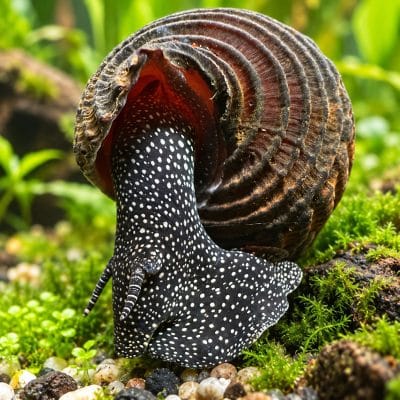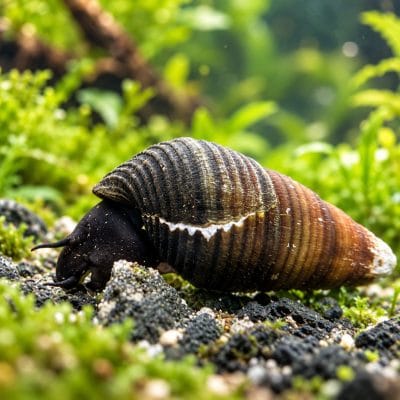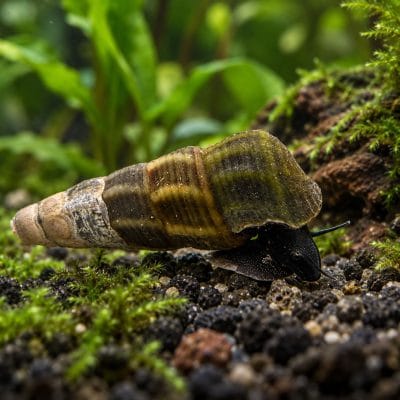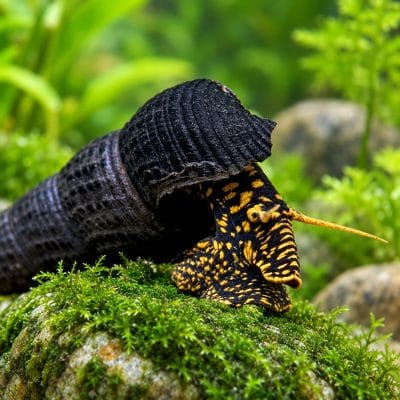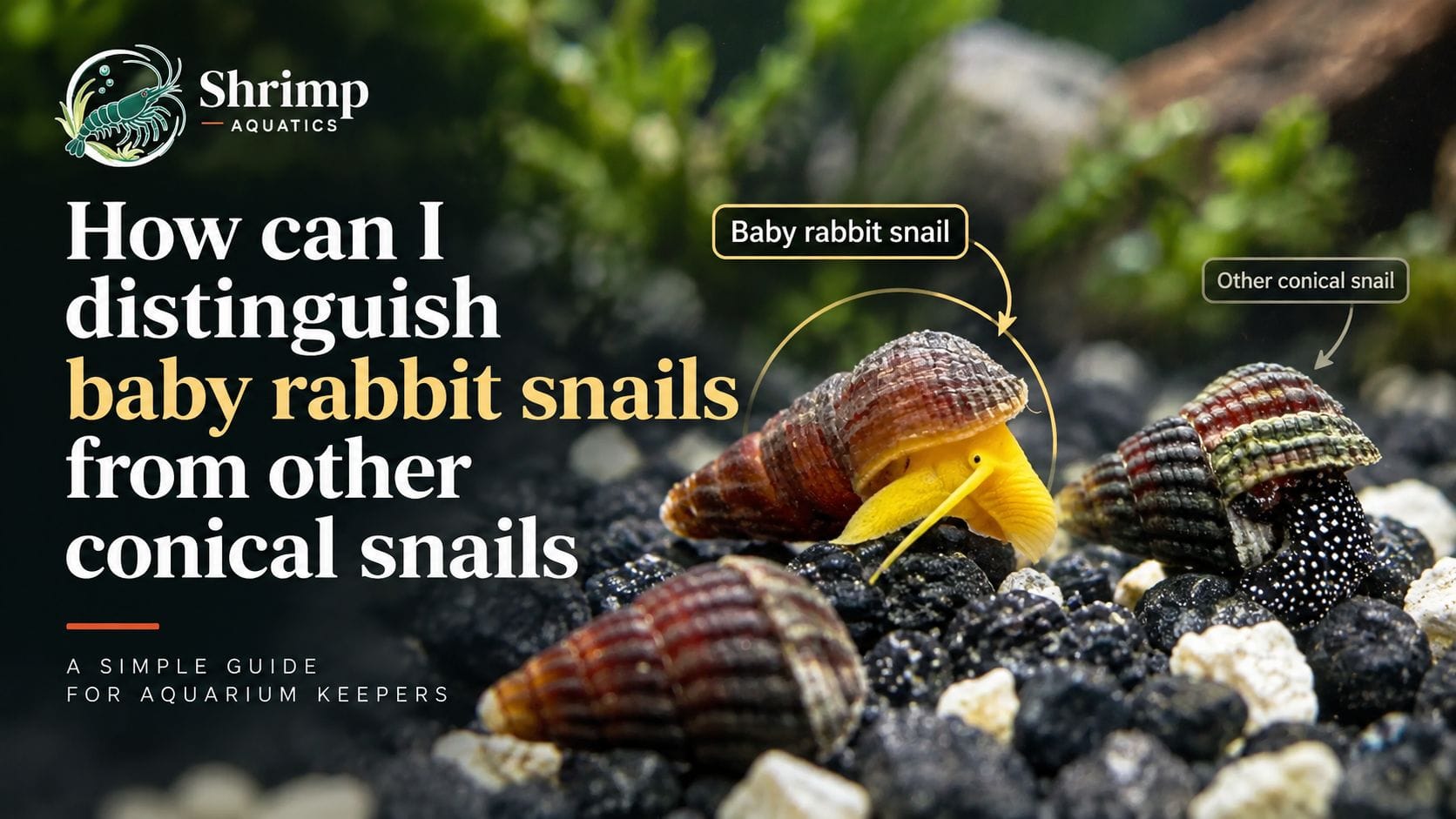
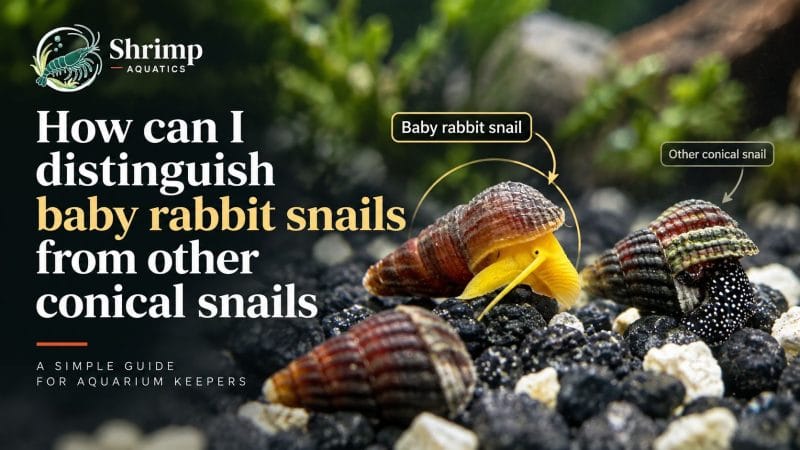
Get the snail moving, then look at its head. A baby rabbit snail (Tylomelania sp.) pushes a long, wrinkled snout ahead of itself and waves two thick tentacles. Its foot is usually bright or boldly spotted. A Malaysian trumpet snail (Melanoides tuberculata) or a quilted melania (Tarebia granifera) keeps a short, blunt snout and a drab gray body. It is also far smaller on the day it shows up. And if the base of the shell opening carries a small spout, you have an assassin snail (Anentome helena).
The fastest check on a live baby rabbit snail is its head
Wait for it to come out. A withdrawn snail tells you nothing at all. Put it somewhere quiet with gentle flow, keep the light low, and give it ten minutes. Once it’s crawling, the head does the work for you.
A baby rabbit snail carries its snout out front like a short trunk, wrinkled across the top, sweeping the surface as it goes. The two tentacles above it are thick and mobile. That’s where the rabbit name comes from. The foot is usually saturated with color: yellow, orange, or near black stippled with cream or gold spots. The color is not a stage it grows into, which is the point of when a baby shows adult color.
A thiarid looks plain beside that, and thiarid is what a Malaysian trumpet snail and a quilted melania both are. Short blunt snout. Fine tentacles. A mottled gray or translucent foot with no pattern worth describing. Photograph it through the glass at full zoom while it moves, and you’ll usually see a snout or the lack of one. The adults differ just as clearly in how they breed and feed, which matters if you’re weighing a rabbit snail vs Malaysian trumpet snail for one tank.
That contrast is the check we’d run first. It’s also the one the hobby asserts most confidently. We found no published description comparing the soft parts of these two families, so treat it as a working rule. Confirm it with one of the checks below before you act.
Check the trapdoor for a rabbit snail’s many-whorled spiral
One shell character survives a shut snail. In Tylomelania sinabartfeldi, described from the Malili lakes, the operculum is recorded as multispiral with 4-5 whorls.1 The spiral turns several times around a point near the middle of the disc. Resolve turns like that in a phone photo and you have real support for a rabbit snail. If the disc is too small to read, and at 3 mm it often is, you’ve learned nothing and size is your next stop.
Shell outline is the weakest of the three checks. That same described species comes in conic and subglobose shells with transitional forms between them.1 A stocky baby and a slim baby can be the same animal, and sculpture varies the same way across the genus.
Don’t try to pin a species name on it either. Sulawesi holds nine described river and stream Tylomelania species, plus at least as many that have never been described.2 That’s why every line we sell is written as Tylomelania sp. and no farther.
Newborn rabbit snails arrive big, trumpet snails arrive tiny
This is the check that settles most cases. Tylomelania holds its eggs and embryos in a uterine brood pouch, and the young are already shelled when they leave. In some species they are the largest juveniles known in any live-bearing snail, close to 2 cm at release.3 Malaysian trumpet snails leave the edge of the mother’s mantle at a shell length of about 2.0 mm,4 and a South African field study of quilted melania classed newborns as anything under 1.92 mm.5 So a hard-shelled crawler of four or five millimeters is not a newborn trumpet snail. There is no shell to watch hatch either, which is why how long rabbit snail eggs take to hatch has no real answer for this genus.
Here is where keepers get it backwards. The story that rabbit snails produce one baby at a time is not a rule. The brood pouch of that one described species held 11 to 67 embryos, and the largest had already reached 5.0 mm.1 Brood size differs between species. Nobody has published a figure for how many young a traded rabbit snail line releases at once, or how often, so several babies at once rules nothing out. Whether a group that size is normal is a rabbit snail breeding question rather than something one photo settles.
What does point at thiarids is the curve, not the count. Most Melanoides populations have no males at all and reproduce by apomictic parthenogenesis,4 and quilted melania has been reported producing one fully developed juvenile every 12 hours.5 Dozens of new cones spreading through the sand over a fortnight is that curve. Four large ones near an adult you bought is not.
| Check | Baby rabbit snail | Malaysian trumpet snail | Quilted melania | Assassin snail |
|---|---|---|---|---|
| Size when first seen | Already shelled, close to 2 cm in some species3 | About 2.0 mm shell length4 | Under 1.92 mm5 | Crawls from an egg clutch of one to four6 |
| How the young arrive | Live-born, 11 to 67 embryos in one species1 | Live-born at the mantle edge4 | Live-born, one every 12 hours reported5 | Egg clutches on hard surfaces6 |
| Family | Pachychilidae1 | Thiaridae4 | Thiaridae5 | Nassariidae6 |
Spot an assassin snail before it thins out your other snails
Look at the base of the shell opening. Anentome shells carry a short but distinct, rather broad siphonal canal, a spout at the bottom of the aperture, and usually light to dark spiral bands.6 Rabbit snails and trumpet snails show a plain rounded base with no spout. Eggs give the same answer. Anentome lays clutches of one to four eggs from which crawling juveniles emerge,6 so small capsules on wood or glass with young coming out are not rabbit snail births.
Assassin snails eat other snails, which is why people buy them. We don’t keep them with rabbit snails. If there’s any chance one of your cones is a juvenile Tylomelania, an assassin snail is not your pest-control answer.
A baby rabbit snail needs the same warm alkaline tank as the adults
Say the checks favor a rabbit snail. Now the question is whether the tank it’s sitting in can keep it. These animals don’t get an easier version of the water their parents need. Caring for baby rabbit snails is mostly that water, plus covered filter intakes.
| Temperature | 79-86°F (26-30°C) |
|---|---|
| pH | 7.5-8.5 |
| GH | 4-8 dGH |
| KH | 3-6 dKH |
| TDS | 150-250 ppm |
| Nitrate | Held under 10 ppm |
| Substrate | Inert sand or gravel with hardscape, never a pH-lowering aquasoil |
| Tank | Mature, with visible algae and biofilm on rock and glass before a snail goes in |
We rate the animal moderate, and we mean the animal. The system is the demanding part. It’s the same warm, alkaline, mineral-rich Sulawesi setup the shrimp need. A rabbit snail is not a gentle way into Sulawesi keeping. It isn’t an easier substitute for Sulawesi shrimp either, and it’s no snail for a young tank. A juvenile grazes the surfaces the adults graze, so count it in your stocking, not as a freebie. Getting that setup right before a juvenile goes in is Sulawesi rabbit snail care, since the tank carries the difficulty, not the snail.
Keep copper out of the tank
In laboratory tests on the trumpet snail itself, copper was the most toxic of eight metals, at a 96 hour median lethal concentration of 0.14 mg per liter.7 A treatment aimed at your trumpet snails is aimed at the rabbit snail too. That figure comes from a different snail family, so there is no safe level for us to publish for Tylomelania. Skip copper-based medications and snail killers while these animals are in the tank.
One juvenile is a slow start on a mature tank’s grazing. If you want a small group in that water, the Sulawesi rabbit snails we sell are bred in our own tanks, not collected from the wild. We don’t promise breeding, sex, or any number of young from an order.
If they turned out to be trumpet snails, do you need to remove them?
Mostly, no. They burrow, they graze, and they keep the top of the sand turned over. The honest catch is arithmetic. They don’t need a mate to keep going,4 and quilted melania is a documented invader in rivers well outside its native range.5 So nothing from your tank goes into a drain, a pond, or a stream.
Want fewer of them? Pick them out at feeding time, feed less, and expect it to take weeks. Don’t dose copper.7 Don’t add an assassin snail as the shortcut if a rabbit snail might be in there.
And if you’re still unsure, don’t cull. A juvenile Tylomelania thrown out with the pest snails is a slow-growing endemic animal. You can’t grow it back on demand, and the checks above cost you ten minutes and one photo.
Still unsure about your baby rabbit snail?
Can I find out which species my rabbit snail is?
Not from a photo, and usually not at all. Sulawesi’s river and stream species alone include nine described forms and at least as many undescribed,2 and the trade moves animals under color names. We write every line as Tylomelania sp. For your own records, use the line name you bought it under and leave the species blank.
Does a baby rabbit snail need different food from the adults?
No, and that’s the point of a mature tank. Grazing mature biofilm, aufwuchs, and algae is the feeding mode documented for this genus, so the film on your rock and glass is the meal. There’s no published menu of vegetables or pellets for these snails. Prepared food doesn’t make up for a tank that hasn’t grown a grazing layer yet.
References
7 Sources
- Tylomelania sinabartfeldi Rintelen & Glaubrecht, 2008, sp. nov. (taxonomic treatment), Zootaxa 1852: 42-45, 2008.
- Freshwater snails of Sulawesi: a brief overview, Sulawesi Keepers, article by Thomas von Rintelen, undated, read September 2026.
- Anatomy of an adaptive radiation: a unique reproductive strategy in the endemic freshwater gastropod Tylomelania on Sulawesi, Indonesia, Biological Journal of the Linnean Society 85(4), 2005 (abstract).
- Melanoides tuberculata species account, Freshwater Gastropods of North America, R. T. Dillon Jr. and colleagues, 2026.
- Distribution, abundance, population structures, and potential impacts of the invasive snail Tarebia granifera in aquatic ecosystems of north-eastern South Africa, Ecology and Evolution 14(6), 2024.
- Quid est Clea helena? Evidence for a previously unrecognized radiation of assassin snails (Gastropoda: Buccinoidea: Nassariidae), PeerJ 5:e3638, 2017.
- Toxicity of Metals to a Freshwater Snail, Melanoides tuberculata, The Scientific World Journal, 2012.
Ready to get started?
Shop our Sulawesi Snail collection
12 products available · Live Arrival Guarantee