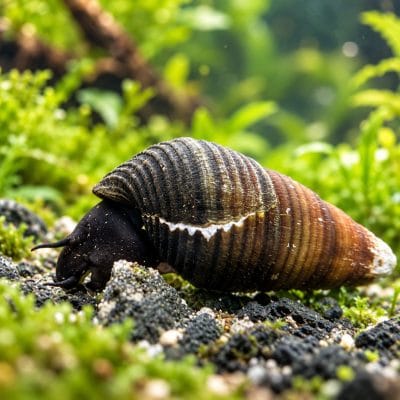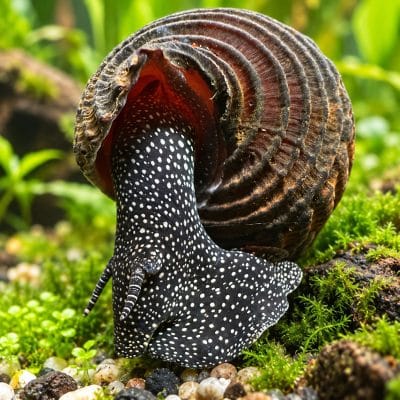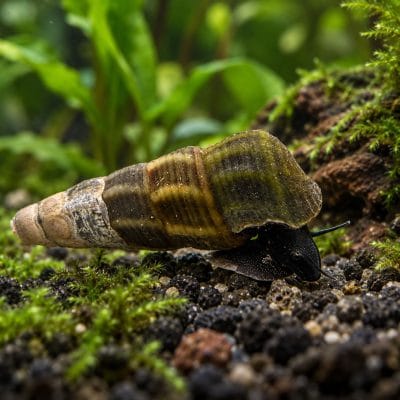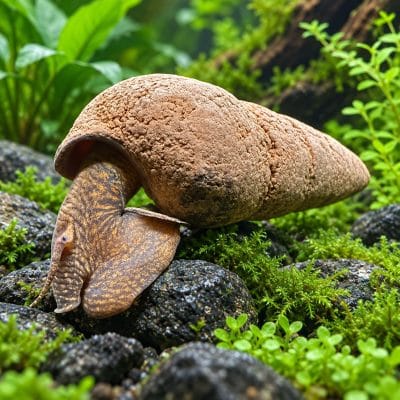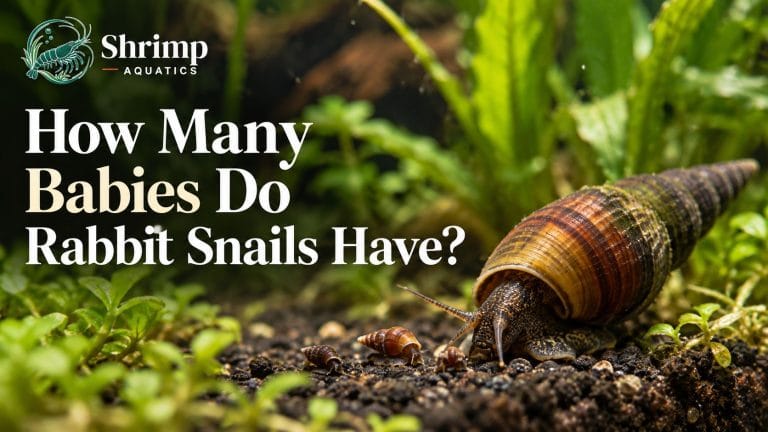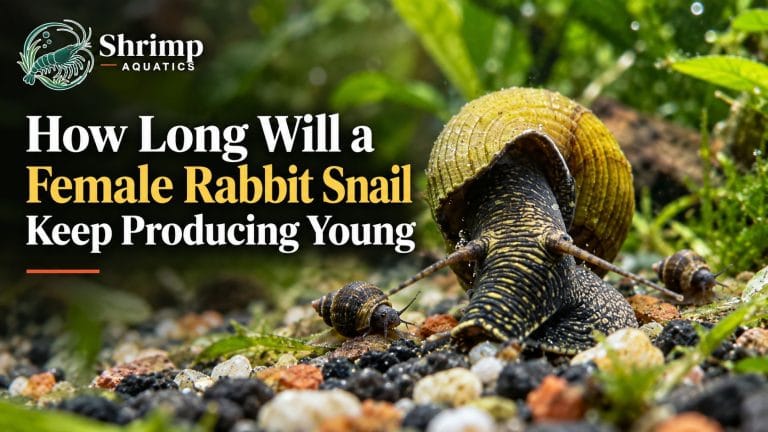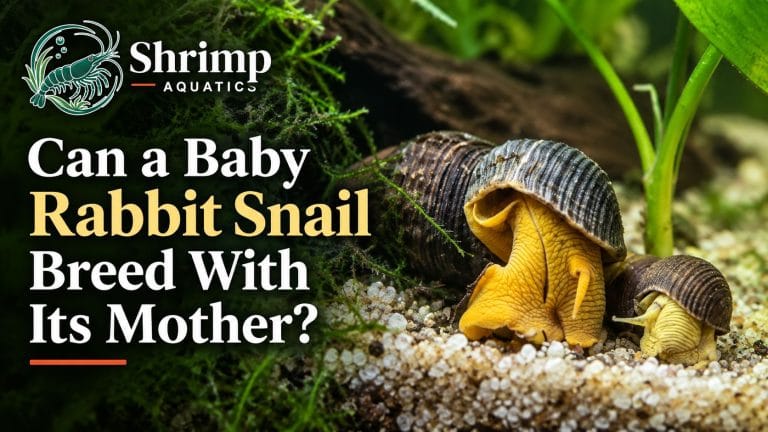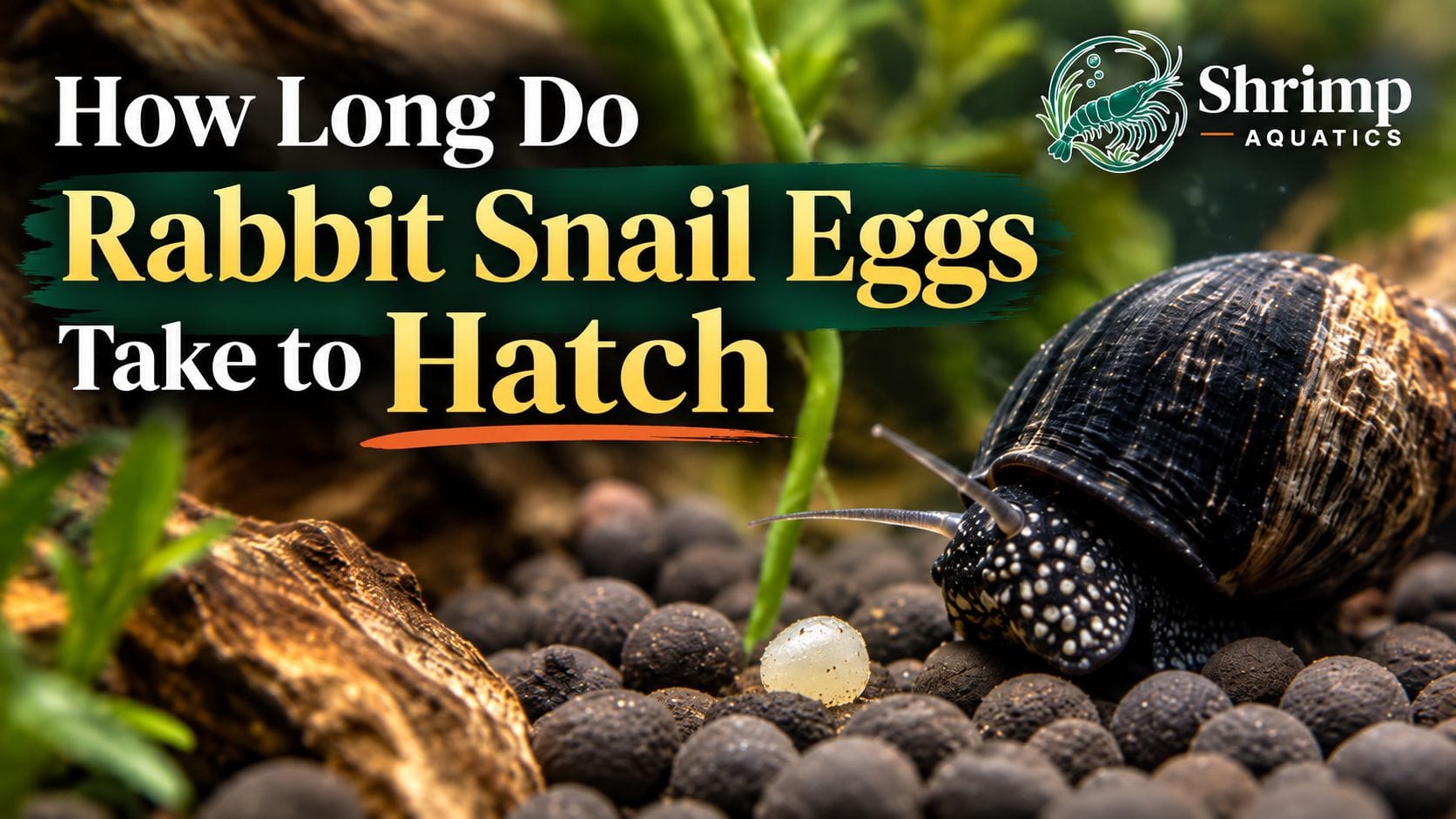
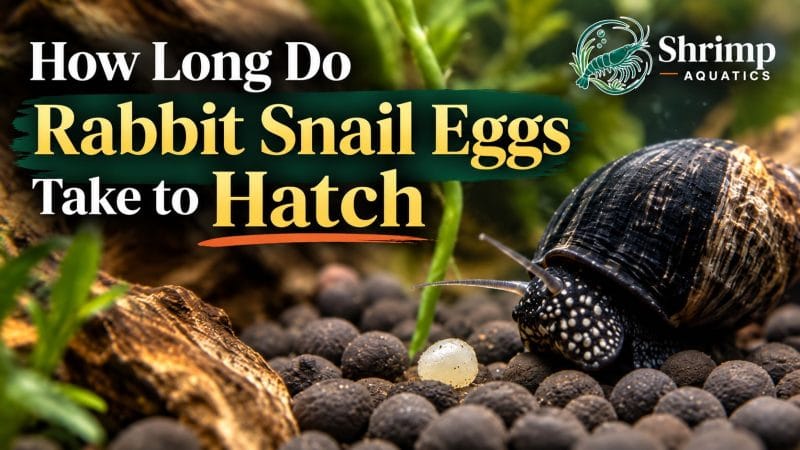
Rabbit snail eggs don’t sit in your tank ticking down to a hatch date, because rabbit snails (Tylomelania sp.) don’t leave eggs outside the mother at all. They’re live bearers. The eggs and embryos are held in a brood pouch built out of the female’s own oviduct and fed by a large albumin gland. What finally leaves her is a juvenile with its shell already on, close to 2 cm long in some species.1 So there’s no incubation to count. Keepers commonly report the little white capsule opening within a few hours of being dropped, and no published study of the genus puts a figure on it.
Is that white pearl a rabbit snail capsule or another snail’s eggs?
Answer this first, because it decides whether anything else here applies to you. What a rabbit snail leaves behind is one small, whitish, pearl-like package on the sand, on rock or against the glass, with a formed snail inside it. One package, not a batch. If you’re looking at a jelly clutch with a dozen or more little dots in it, or a row of hard white specks stuck along wood, that came from something else living in your tank.
Nerites are the usual answer in a shrimp tank. They do lay in fresh water, and their eggs generally won’t develop without different salinity depending on the species, so those white specks tend to sit there indefinitely. Whatever left a jelly clutch, it wasn’t a rabbit snail, which keeps its young inside until they’re finished.1
A quick way to tell
Has it changed at all in a week? A rabbit snail package doesn’t sit unchanged for weeks. If yours has, you’re almost certainly looking at another snail’s eggs.
Why there is no incubation to wait through with a rabbit snail
All the waiting happens inside the female, out of sight. In this genus the pallial oviduct is rebuilt into a uterine brood pouch, and embryos are produced continuously.1 Each one is surrounded by nutritive material from a large albumin gland, which is why they emerge already shelled.1 The published description of the genus is that relatively few but well developed juveniles hatch.2 That’s a family habit. Across the pachychilid snails, egg capsules are considerably larger and considerably fewer than in most marine snails.3 Live bearing has evolved three separate times inside this one family.3
So the usual version of your question, how many days until it hatches, doesn’t really have an answer at tank level. What’s published is the biology, not a clock. Gestation time hasn’t been measured for any rabbit snail sold in the hobby, but in home tanks a female releases one young about every four weeks. The week counts you’ll find on care sheets come from other care sheets. We’d rather tell you that than hand you a number we can’t stand behind.
What to do with a rabbit snail capsule you have just found
Leave it alone. We know the urge is to lift it into a breeder box where nothing can get at it. That’s the one move we’d skip. Handling a soft package and dropping it into different water is more risk than most tanks pose to it.
- Leave it exactly where the female put it, even if that’s an awkward spot.
- Keep doing your normal small water changes with matched water.
- Watch it instead of touching it, and give it a few days before you decide anything. Telling the newcomer from a trumpet snail is a separate check, and that is baby rabbit snail identification.
- Don’t move it to a jar, a net breeder or a separate tank.
- Don’t scrub the glass or rework the hardscape around it this week.
Not every package works out, and that isn’t a sign you did something wrong. If it breaks down into a cloudy or fuzzy mess, siphon it out at your next water change so it doesn’t sit and foul.
When a female rabbit snail has not dropped anything yet
Plenty of keepers wait months and see nothing. Before you go looking for a problem, check the boring things: a tank warm enough and old enough, steady water, and a grazing surface that’s had time to grow. Then leave it, because there’s no schedule to fall behind.
Don’t raise the temperature to force the issue. The top of the range we keep to is already warm, and pushing past it buys you nothing you can count on. We don’t promise breeding, sex or the number of young from any order, and neither should anyone else.
The water a newborn rabbit snail builds its shell from
A newborn rabbit snail is a working snail from the first hour, and the shell it carries keeps growing out of the water around it. That makes minerals the one thing worth checking the week a juvenile appears. The water numbers to hold steady while that shell is built are in Sulawesi rabbit snail care, and they do not change once young appear.
| Temperature | 79-86°F (26-30°C) |
|---|---|
| pH | 7.5-8.5 |
| GH | 4-8 dGH |
| KH | 3-6 dKH |
| TDS | 150-250 ppm |
| Nitrate | under 10 ppm |
Most of the calcium in a freshwater snail’s shell comes out of the water, not the food. In apple snail trials the animals given more dissolved calcium grew faster and ended up with harder shells.4 Push it the other way, low calcium together with acidic water, and a related apple snail grew least, eroded visibly and produced the weakest shells of the trial.5 Those are apple snails, so read it as how snail shells behave in general and not as a measured limit for this genus.
The practical version is dull and it works. Hold the numbers above, top up evaporation with fresh water so hardness doesn’t creep, and don’t let KH drift down between water changes. A juvenile with a chalky, pitted edge is telling you about your minerals.
How soon a young rabbit snail can breed
Unknown for this genus, and anyone who gives you a month count is guessing. The closest published anchor sits one genus away in the same family: in a Hong Kong forest stream, Brotia hainanensis reached sexual maturity in roughly 8.5 months.6 Different animal, wild stream, seasonal food. Take it as the order of magnitude, months and not weeks, and leave it there. That rough window is also why a young snail can end up breeding with its own mother once both share a tank.
If you want young at all you need more than one snail, and since we don’t sell them sexed, that means a small group instead of a single animal. What a group actually needs, and what to expect from it, is rabbit snail breeding. Every one of the Sulawesi snails we ship is bred in our own tanks, not collected from the wild. They go into the same warm alkaline water as our Sulawesi shrimp. What we won’t tell you is when, or how many, or whether at all.
References
6 Sources
- Anatomy of an adaptive radiation: a unique reproductive strategy in the endemic freshwater gastropod Tylomelania (Cerithioidea: Pachychilidae) on Sulawesi, Indonesia, and its biogeographical implications, Biological Journal of the Linnean Society 85(4), August 2005 (abstract).
- Independent evolution of reproductive modes in viviparous freshwater Cerithioidea, Basteria supplement 3, 2006.
- Multiple Origin of Viviparity in Southeast Asian Gastropods (Cerithioidea: Pachychilidae) and Its Evolutionary Implications, Evolution 58(11), 2004 (abstract).
- Growth and shell hardness of the apple snail Pomacea flagellata Say, 1829, reared at three calcium concentrations, PeerJ, 2023.
- The effect of calcium and pH on Florida apple snail, Pomacea paludosa (Gastropoda: Ampullariidae), shell growth and crush weight, Aquatic Ecology 43, 2009 (abstract).
- The life history of Brotia hainanensis (Brot, 1872) (Gastropoda: Prosobranchia: Thiaridae) in a tropical forest stream, Zoological Journal of the Linnean Society 76(2), 1982 (abstract).
Ready to get started?
Shop our Sulawesi Snail collection
12 products available · Live Arrival Guarantee