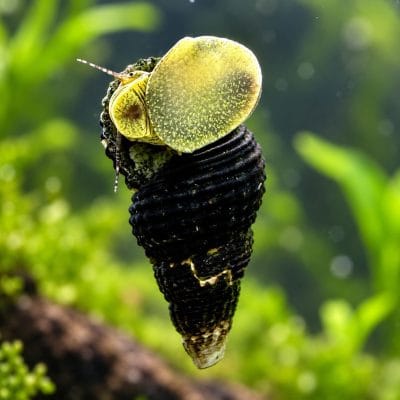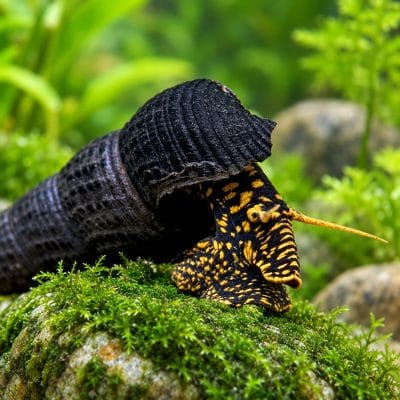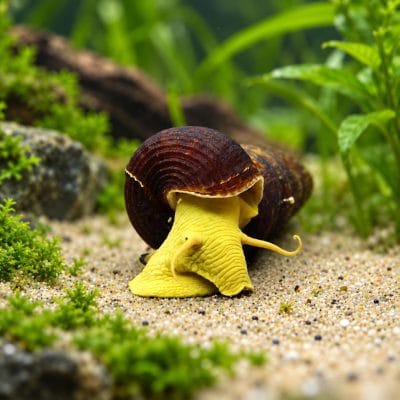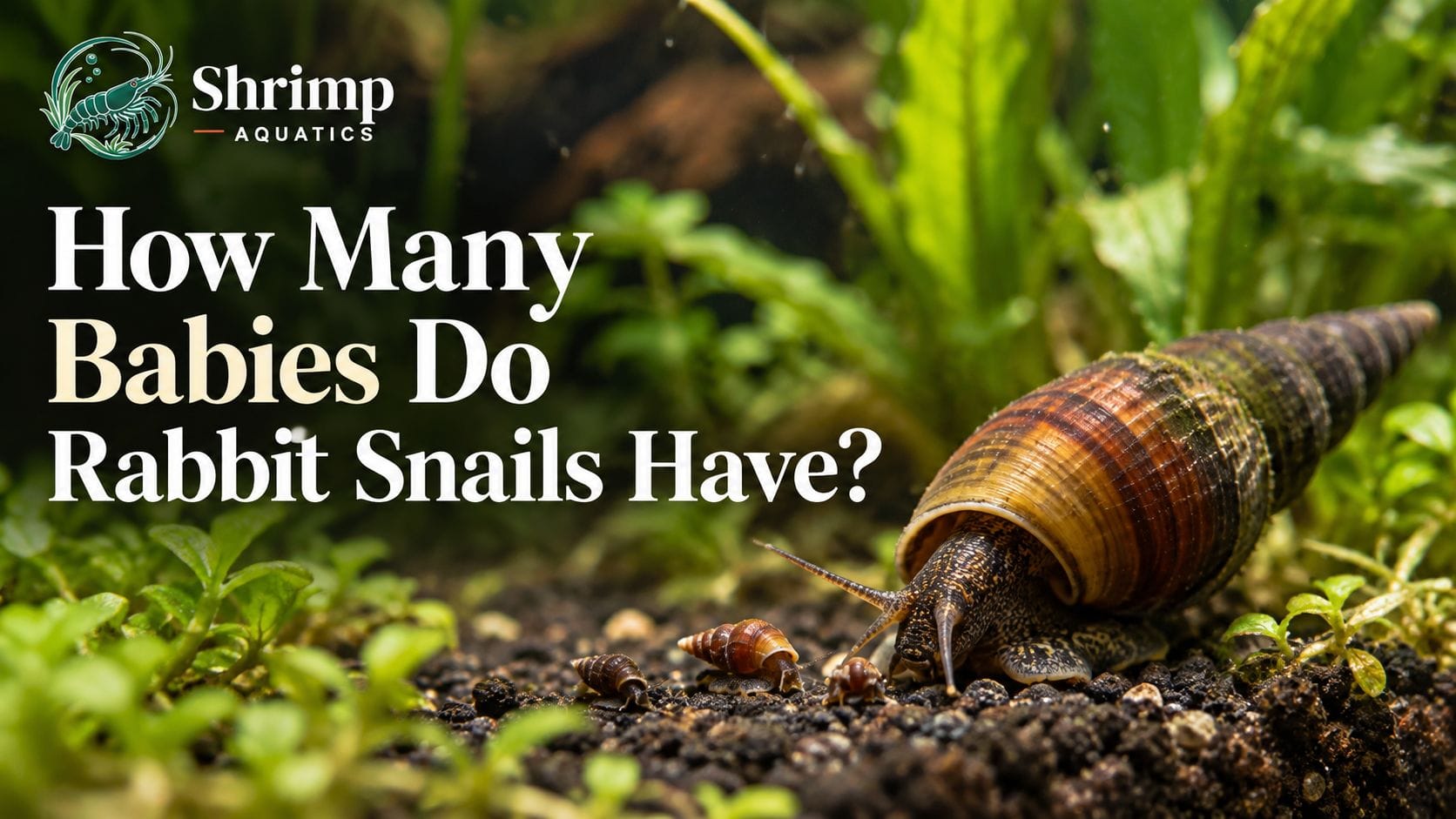
A rabbit snail has one baby at a time, about once every four weeks in a home tank. The published anatomy shows the brood inside varies by species: wild females of different Tylomelania species carry anywhere from one or two embryos to several dozen.1
Rabbit snails are live-bearers. A female keeps her eggs and embryos in a brood pouch inside her body, keeps producing embryos over time instead of in one batch, and the young leave her already shelled. In some species they’re close to 2 cm (0.8 in) long at birth.2 So you won’t find egg clutches on the glass. You’ll find a new, fully formed snail on the rock. That brood pouch is the heart of how rabbit snails reproduce, and it’s why a colony grows slowly.
How many embryos does a rabbit snail carry at once?
Anywhere from one to 67, depending on the species, in the three rabbit snails whose original descriptions counted the brood pouch.1 Here’s what those preserved wild females held:
| Species | Where it was found | Largest adult shell examined | Embryos in the brood pouch | Largest embryo |
|---|---|---|---|---|
| T. hannelorae | Lake Mahalona, on rocks | 13.9 mm (0.55 in) | 1-2 | 3.1 mm |
| T. baskasti | Larona River, soft bank sediment | 54.7 mm (2.15 in) | 4-12 | 8.4 mm |
| T. sinabartfeldi | Larona River, on submerged logs | 27.2 mm (1.07 in) | 11-67 | 5.0 mm |
Two things stand out. The biggest snail in the table doesn’t carry the most embryos: T. baskasti grows the largest shell but holds fewer, larger embryos than T. sinabartfeldi.1 And the smallest species, T. hannelorae, is the one that fits the familiar “one baby at a time” picture. Keep in mind what these numbers are. They show what a female of that species was carrying when she was collected. They don’t tell you how many babies leave her in one go.
What a rabbit snail birth looks like in your tank
Expect a single, already-shelled snail to turn up, never a clutch of eggs. The embryos grow in a uterine brood pouch surrounded by nourishing material from a very large albumen gland, and the young of some species are among the largest of any live-bearing snail.2 That’s a lot of investment in each baby, which is why you won’t see dozens appear overnight.
The research doesn’t give you timing, but home tanks do: a female releases one young about every four weeks. How long a pregnancy lasts is still unrecorded, and so is how long a female rabbit snail keeps producing young; keepers’ figures are all anyone has.
If a baby does appear, leave it where it is. There’s nothing to hatch, separate or hand-feed, and moving it only adds handling. Caring for baby rabbit snails mostly means covering filter intakes and keeping snail-eaters out.
Which number applies to the rabbit snail you own?
Plan on a small, slow trickle of young, because that’s what keepers of traded rabbit snails mostly describe, and there’s no brood count for any of the lines we sell. Every one of them is Tylomelania sp. We don’t attach a species name to any of them, and trade names such as “Yellow”, “Golden Spotted” or “Mini Tylo Poso” don’t identify a species or a lake. That’s why the types of rabbit snails you’ll see on sale can’t be matched to the brood counts above.
That matters here. Brood pouch contents in this genus run from one or two embryos to several dozen,1 so a trade name can’t tell you which end your snail sits at. Would it help to buy a line for its breeding rate? Not with what anyone knows today. Pick the look you like: every Sulawesi snail line we sell is tank-bred by Shrimp Aquatics, not collected from the wild, and they all need the same water. We don’t promise breeding, sex or the number of young from any order.
Can you get more baby rabbit snails from your tank?
Not in any way you can count on, because no study has tested what raises births in a tank. What you can control is whether a female lives in steady water with enough to graze. We’d hold the water where our snails are kept: 79-86°F (26-30°C), pH 7.5-8.5, GH 4-8 dGH, KH 3-6 dKH, TDS 150-250 ppm and nitrate under 10 ppm. Keep KH from drifting. Some breeding guides push the hardness well above this; we wouldn’t chase it. Stable water in the range for Sulawesi rabbit snail care is the only setting we’d use.
Give the tank a mature film of algae and biofilm on rock and glass before any snail goes in. We know it’s tempting to feed heavily to “power up” a female. Extra food doesn’t make up for a young tank, and it adds waste to warm water.
If babies are the reason you’re buying, buy for the tank first. A snail that’s settled into stable water is your best bet, and even then we can’t promise young.
References
2 Sources
- Three new species of the freshwater snail genus Tylomelania (Caenogastropoda: Pachychilidae) from the Malili lake system, Sulawesi, Indonesia, T. von Rintelen and M. Glaubrecht, Zootaxa 1852: 37-49, 2008 (journal record; the three species treatments are open on Zenodo).
- Anatomy of an adaptive radiation: a unique reproductive strategy in the endemic freshwater gastropod Tylomelania on Sulawesi, Indonesia and its biogeographical implications, T. von Rintelen and M. Glaubrecht, Biological Journal of the Linnean Society 85(4): 513-542, 2005 (abstract).
Ready to get started?
Shop our Sulawesi Snail collection
12 products available · Live Arrival Guarantee