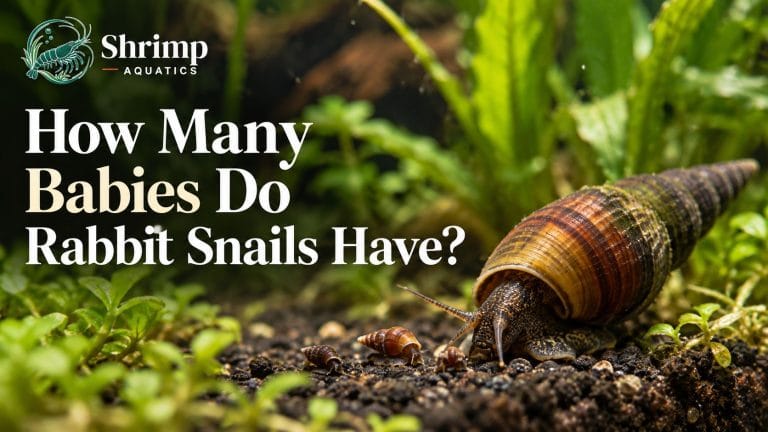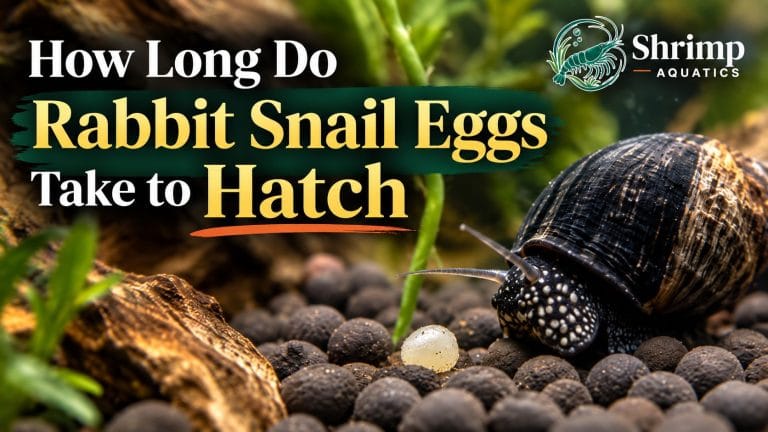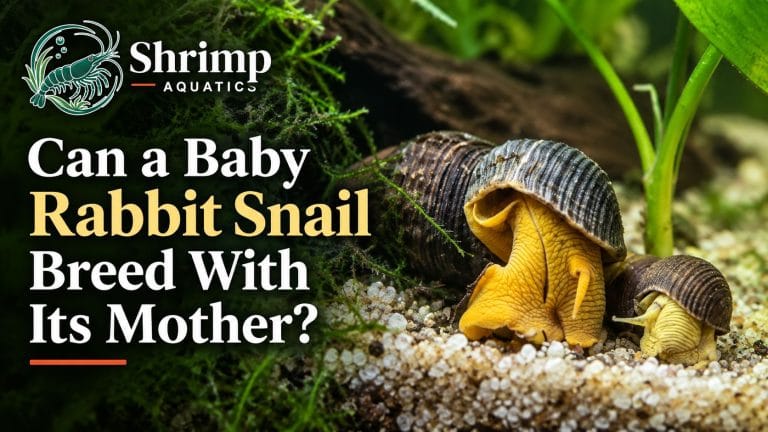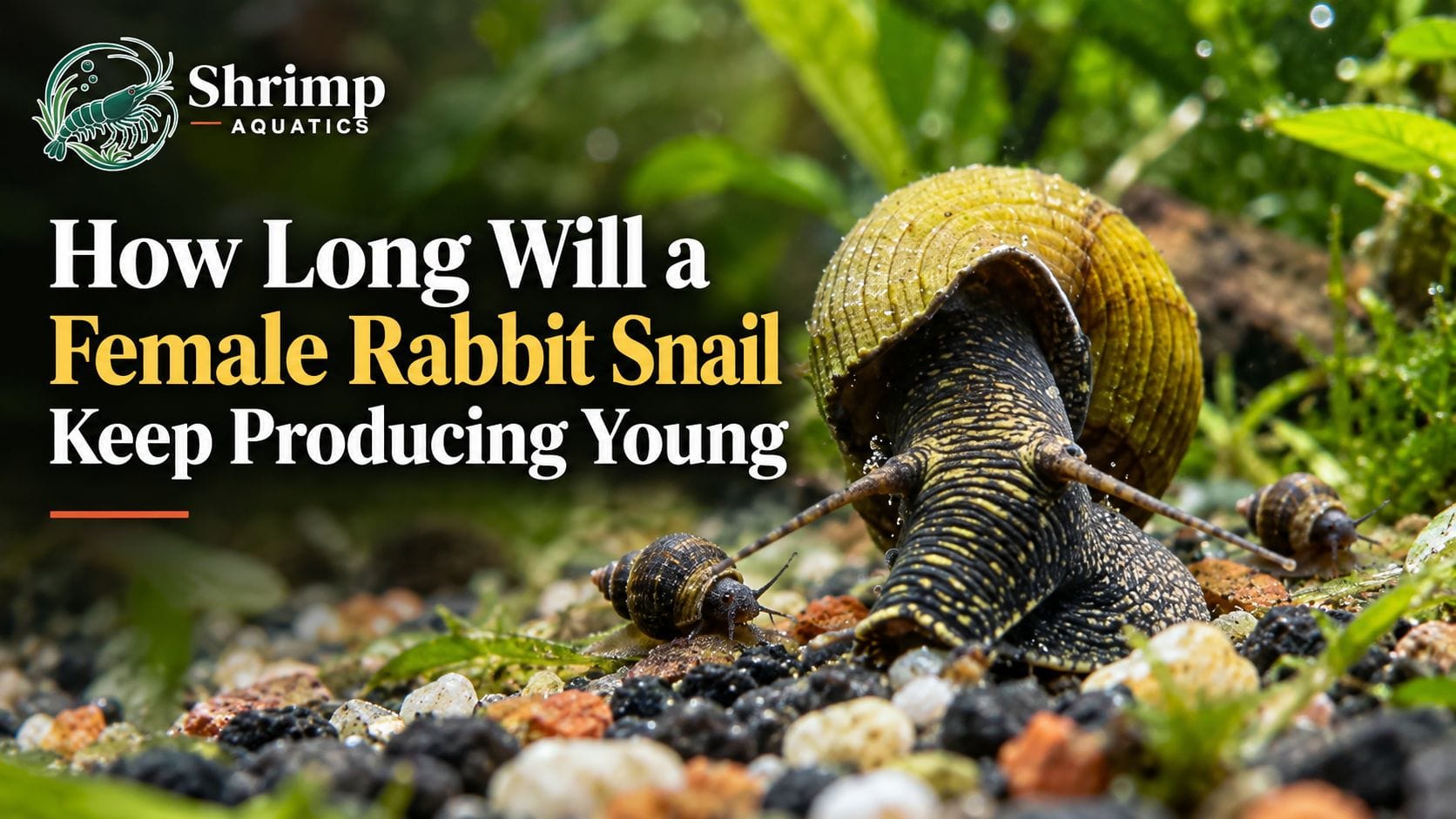
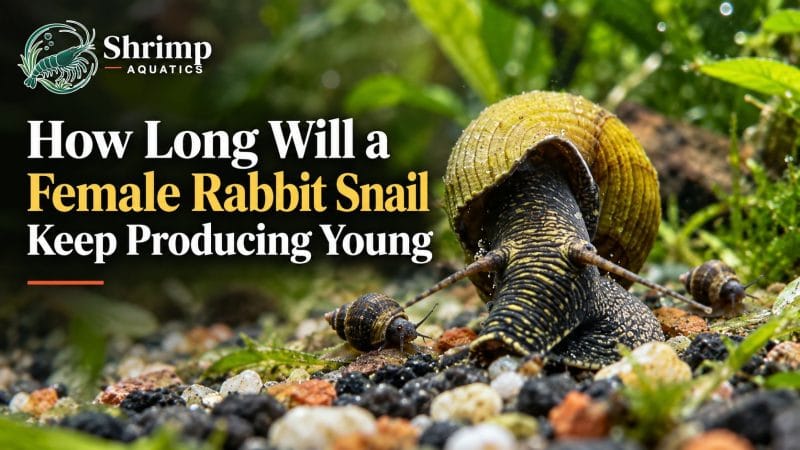
For as long as she stays healthy, as far as keepers can tell. A settled adult female releases one shelled juvenile about every four weeks. No study has measured how long she keeps it up in any rabbit snail (Tylomelania sp.), so treat any figure for her reproductive lifespan as hobby experience, not a plan. What the research does show is that these snails brood embryos continuously inside the body.1 This page is about what you can reasonably expect in your tank.
The rabbit snail breeding numbers in circulation are keeper reports, not measurements
Search this question and you’ll meet the same figures on page after page. Maturity at about a year. A birth every 4-6 weeks. One or two young at a time. A female who carries on for four to six months alone. Keepers who describe their own snails bear out part of that: one young at a time, about once a month. The rest, the age at maturity and the months a lone female keeps going, is repeated from page to page without anyone describing their own tank, so don’t plan around those.
Why is the data so thin? Partly because the genus was barely studied. Anatomical work on Tylomelania only arrived in 2005, and that paper noted the data had been entirely lacking before it.1 Research since has gone into taxonomy, ecology and conservation. None of it involved sitting with a tank of snails for three years, counting.
The closest real measurement comes from a cousin. Brotia hainanensis is a different genus in the same family. In a Hong Kong forest stream it took roughly 8.5 months to reach sexual maturity, and mortality after that was high because of seasonal floods.2 Different animal, different water, no heater. Use it for the scale of the thing and nothing more.
Why your rabbit snail’s young arrive one at a time, on no schedule
Expect one young about every four weeks, though the gaps won’t be exact. A quiet spell, or two births close together, is still the animal working normally. It isn’t a problem you caused.
The reason sits inside her. Female Tylomelania keep eggs and embryos in the pallial oviduct, which is modified into a brood pouch. The young there are surrounded by nutritive material from a very large albumin gland. Embryos are produced continuously, and in some species the shelled juveniles leave their mother at close to 2 cm, the largest known in any live-bearing snail.1 So this is a slow conveyor, not a clutch. She isn’t waiting for a season or a trigger.
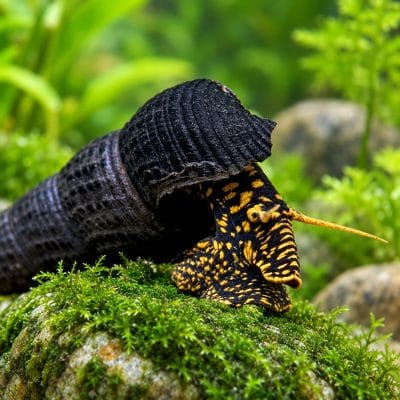
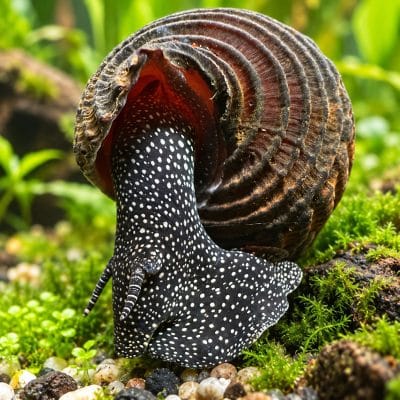
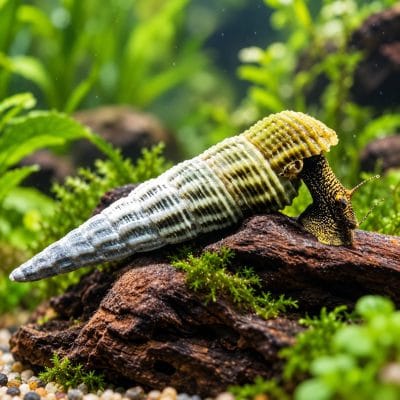
How many she carries at once depends on which species she is, and described Tylomelania species differ enormously on that point. The yellow, golden spotted, Himalayan and mini lines the hobby sells all reach us as Tylomelania sp., with no confirmed species name. The popular idea that a rabbit snail always carries exactly one baby is a picture that fits some species and not others. That’s why how many babies rabbit snails have has no single answer for the lines in the trade.
She keeps producing young and there is no male in the tank
This is the surprise most owners write in about. We can tell you it happens, and not much else. Keepers commonly report a female dropping juveniles for months after she was moved into a tank on her own. That four to six month figure you’ll see quoted has nothing behind it. What the storage hardware looks like, and how long it was shown to work in a relative, is how long a rabbit snail stores sperm. A female producing young with no partner in the tank is why a single rabbit snail had a baby.
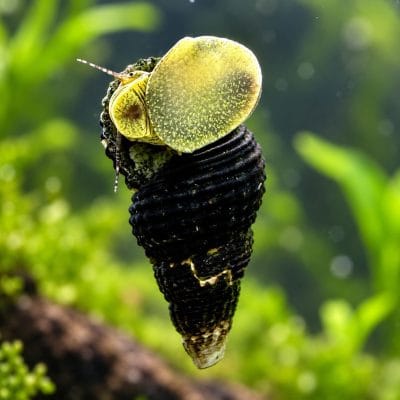
One explanation you can rule out is the Malaysian trumpet snail one. That species reproduces parthenogenetically, and the wild populations studied were exclusively female.3 It’s a different animal with a different reproductive system. It tells you nothing about what your rabbit snail is doing.
Practically, that cuts both ways. If you bought a single snail and you’re hoping for more, don’t count on the young continuing. If you bought a group and you don’t want a population, don’t assume that taking one animal out ends it.
What can stop a rabbit snail producing young in your tank
Hold the water still, and feed the tank instead of the snail. Those two things are actually in your hands. The numbers to hold:
| Temperature | 79-86°F (26-30°C) |
|---|---|
| pH | 7.5-8.5 |
| GH | 4-8 dGH |
| KH | 3-6 dKH |
| TDS | 150-250 ppm |
| Nitrate | under 10 ppm as a cautious target, not a tolerance limit |
A female is building shells for her young inside her own body. She spends minerals the whole time, and she takes most of them from the water. Apple snails are a different family, but they were reared at three calcium levels in one trial. The snails at the highest level grew larger and heavier, with measurably harder shells. The authors take most shell calcium to come from the water and not the food, and they cite work linking a pH under six to shell fissures, decalcification, loss of appetite and reproductive problems.4 Read that as the mechanism. It isn’t a threshold for your snail. In practice it means KH is the number to watch, because it’s the one that quietly drifts down between water changes.
Food matters in a way that’s easy to get wrong. She grazes biofilm and algae off hard surfaces, and a young tank simply doesn’t have any. Dropping in more prepared food won’t fix that. It just adds waste.
Don’t add her to a fresh tank
Wait until rock and glass carry a visible film of algae and biofilm before a rabbit snail goes in. A snail this size is a real grazing load. She needs a mature, stable, warm, alkaline setup, and skipping that is the most common way keepers lose the animal, long before breeding is even a question.
Why you can’t count down the months she has left
To answer that you’d need her age, and you can’t get it. Researchers studying a related freshwater snail sorted their animals into newborns, juveniles, adults and mature adults purely by shell length. They used published maturity sizes, with no direct age measurement at all.5 If a field team falls back on size, the shell in your tank won’t tell you either. A worn, pitted tip means she’s been around long enough to wear it. That’s the whole message.
The one official number attached to a rabbit snail gets misread constantly. The IUCN assessment for Tylomelania gemmifera lists it as Endangered, assessed in 2018, with a decreasing population and a generation length of 2 years.6 The Red List defines generation length as the average age of parents of the current cohort. It also states that the figure sits above the age at first breeding and below the age of the oldest breeding individual.7 So it describes how fast a wild population turns over. It is not a lifespan, and it is not a countdown for the snail on your glass.
At the long end, Sulawesi Keepers is a conservation group that works with these animals. It writes that they can live up to ten years in an aquarium.8 That’s the most optimistic figure from anyone with real hands-on experience of the genus. It’s still a keeper’s account, and not a measurement.
What to expect if you’re buying rabbit snails hoping for young
Buy the animal, not the offspring. Our four Sulawesi snails are bred by Shrimp Aquatics and not collected from the wild, and they are kept in the same water as our Sulawesi shrimp. We don’t sex them. We don’t promise breeding, sex or the number of young from any order, and anyone who does is guessing.
If young are genuinely the point, keep a small group instead of a single snail. Give the tank months to mature before they arrive. Then stop watching the calendar. The snails themselves are moderate to keep, and the system is the demanding part. It is the same warm, mineral-rich, mature Sulawesi setup its shrimp need. Every number behind the setup, temperature, pH, GH, KH and TDS, is in Sulawesi rabbit snail care rather than repeated here. A rabbit snail is not an easier way into that water, and not an animal for a young tank or a first aquarium. What that group needs beyond its size, water, patience and a mature grazing layer, is rabbit snail breeding.
References
8 Sources
- Anatomy of an adaptive radiation: a unique reproductive strategy in the endemic freshwater gastropod Tylomelania (Cerithioidea: Pachychilidae) on Sulawesi, Indonesia, and its biogeographical implications, Biological Journal of the Linnean Society 85(4): 513-542, 2005.
- The life history of Brotia hainanensis (Brot, 1872) (Gastropoda: Prosobranchia: Thiaridae) in a tropical forest stream, Zoological Journal of the Linnean Society 76(2): 141-154, 1982. Abstract only.
- The life cycle, population dynamics and productivity of Melanoides tuberculata (Muller, 1774) (Gastropoda: Prosobranchia: Thiaridae) in Hong Kong, Journal of Zoology 208: 37-53, 1986. Abstract only.
- Growth and shell hardness of the apple snail Pomacea flagellata Say, 1829, reared at three calcium concentrations, PeerJ, 2023.
- Distribution, abundance, population structures, and potential impacts of the invasive snail, Tarebia granifera in aquatic ecosystems of north-eastern South Africa, Ecology and Evolution, 2024.
- Tylomelania gemmifera, IUCN Red List assessment, IUCN Red List of Threatened Species, assessed 9 July 2018, published 2019.
- IUCN Red List Categories and Criteria, Version 3.1, second edition, IUCN Species Survival Commission, 2012.
- Do you know Sulawesi snails?, Sulawesi Keepers, undated, read 2026-09-20.
Ready to get started?
Shop our Sulawesi Snail collection
12 products available · Live Arrival Guarantee