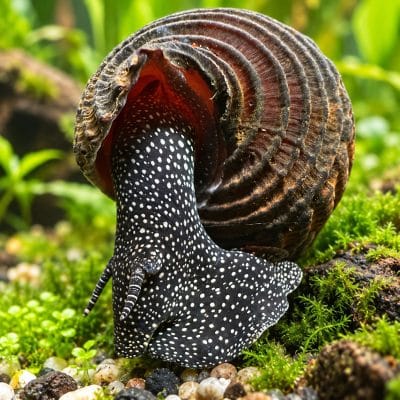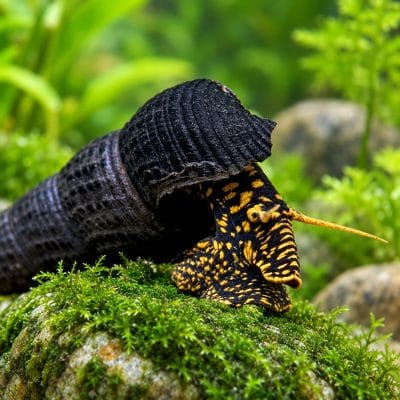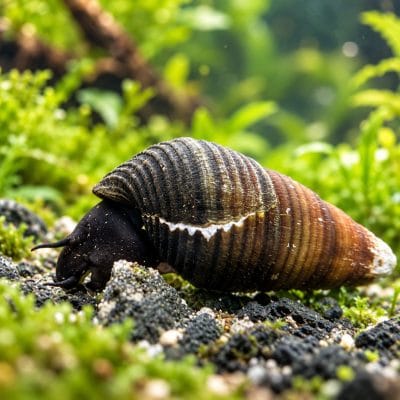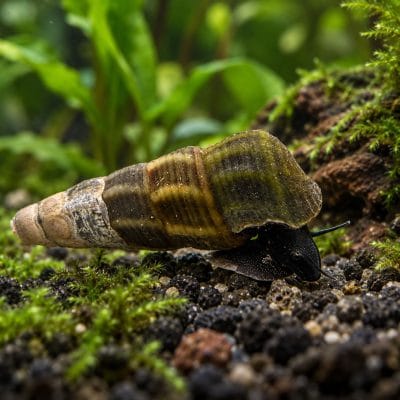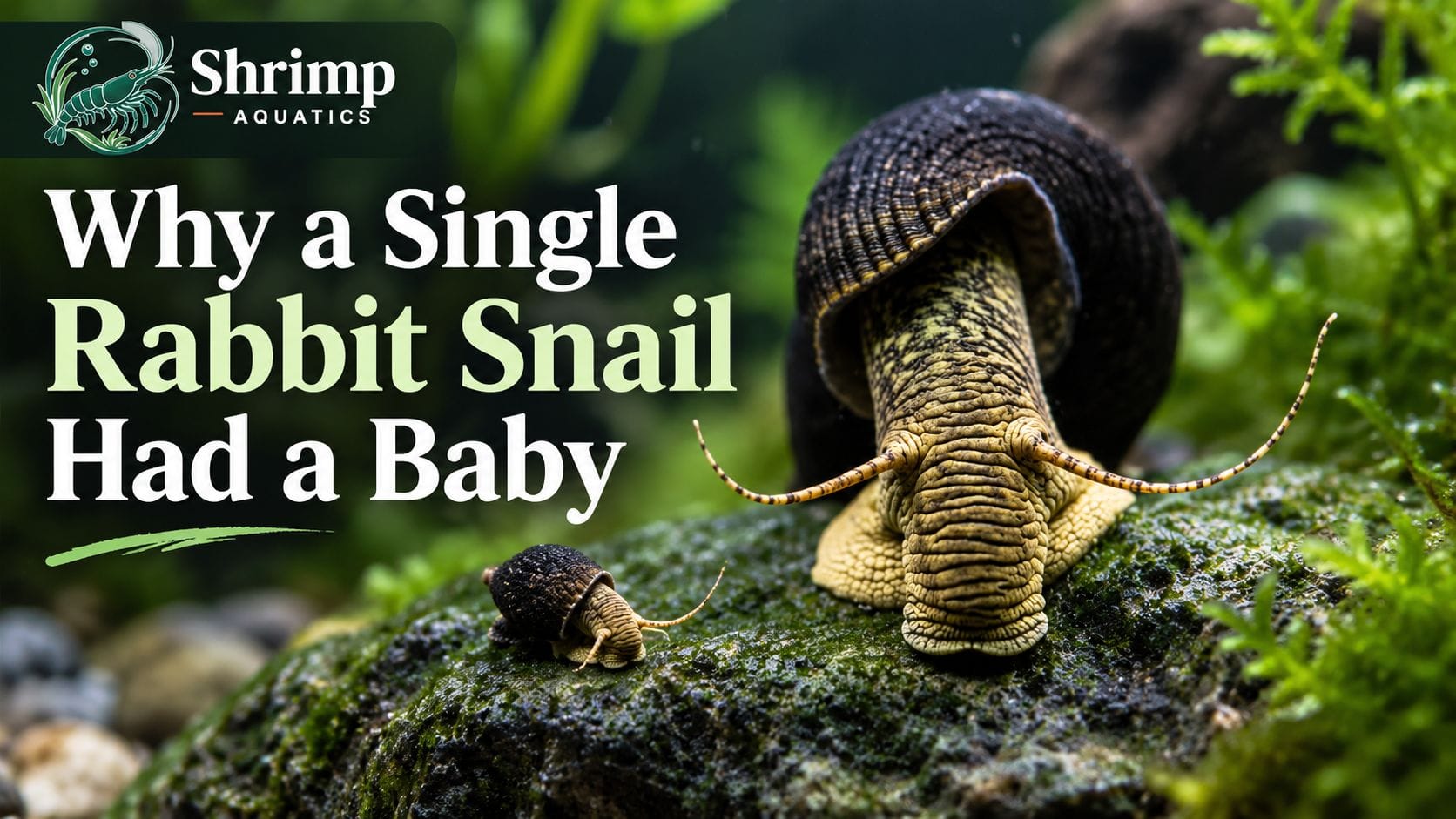
One rabbit snail, no tank mates of its own kind, and one morning there’s a second much smaller snail on the glass. Nothing cloned itself. You didn’t miss a batch of eggs either. The young of these snails grow inside the mother and leave already carrying a shell. The young snail grows up in the same tank as its mother, which is how it ends up breeding with its own mother.
Your rabbit snail was already carrying that baby
She’s a live-bearer, and the baby was inside her before it was in your tank. Rabbit snails (Tylomelania spp.) hold eggs and embryos in the pallial oviduct, which is built out into a uterine brood pouch. The juveniles that leave it are already shelled.1 So no partner has to be in the tank on the day. None had to be there the week before, either.
That’s also why the timing felt random. Inside the pouch, embryos are produced continuously, each one surrounded by nutritive material from a very large albumin gland.1 Development runs on her clock. It isn’t responding to the water change you did on Tuesday.
The young are big, too. In some species of the genus the juvenile measures almost 2 cm when it leaves the mother, the largest known in any live-bearing snail.1 A newborn rabbit snail can look like a miniature adult, not like anything you’d call a hatchling.
What about the explanations you’ll find on forums? You’ll read that rabbit snails have separate sexes, and that a female stores sperm for six months or more. We looked. We couldn’t find a published study on either point for this genus, so we won’t repeat it as fact. The part that answers your question is the part that is published: the baby developed inside her. The tank only ever needed one adult in it.
Make sure the newcomer is a rabbit snail, not a trumpet snail
Do this before you build a story around one snail breeding alone. There’s a much more ordinary explanation, and it’s common. Malaysian trumpet snails move between tanks on plants, wood and substrate, and human movement of stock is thought to be the main way they spread.2 Males are absent from most of their populations, and reproduction usually happens by apomictic parthenogenesis, with no male involved at all.3 So a snail that turned up beside one rabbit snail is worth a proper look first.
Three checks, and none of them means disturbing the animal:
- Size at first sighting. A newborn trumpet snail is released at a shell length of about 2.0 mm.3 Rabbit snails leave the mother far larger, up to almost 2 cm in some species.1 If you spotted the newcomer from across the room, it isn’t a newborn trumpet snail.
- Numbers over the next month. One snail appearing, then maybe another weeks later, fits a live-bearer. A count that climbs week after week is a clonal population doing what it does.3
- What went into the tank recently. New plants, wood or substrate are how trumpet snails arrive.2 If nothing new has gone in for months, that route gets much less likely.
If it turns out to be a trumpet snail, that’s no disaster in a Sulawesi tank. It does mean something arrived on a plant or a piece of hardscape, and it’s worth knowing what else came in with it.
How many more young one rabbit snail can produce
Expect surprises, and don’t plan around a date. That’s the honest answer. Here’s what sits behind it.
One published count exists for a named species in this genus. In Tylomelania sinabartfeldi, described from the Malili lakes on Sulawesi, the brood pouch held 11 to 67 embryos, the largest of them reaching 5.0 mm.4 Two things follow. That’s a count of what a preserved female was carrying, not of how many leave the shell at once. And it does retire the idea that “one baby at a time” is a rule for the group. Brood size is a species trait. Whether that count applies to the line you keep is a bigger question, covered in rabbit snail breeding.
Now the gaps. Nobody has published how long a female keeps producing after she’s mated, how long an embryo takes to finish, or how far apart the releases fall. The numbers in circulation, a birth every four to six weeks and sperm held for six months, don’t trace back to a study we can find.
There is one piece of real anatomy worth knowing. In a related Java snail from the same family, the female tract carries a spermatophore bursa and a seminal receptacle,5 which is the equipment storing sperm would need. That’s a cousin species, not your animal. An organ in a relative doesn’t give you a schedule for the snail on your glass.
What this means in practice
More young may appear, at intervals nobody can predict for you. If a second baby turns up two months from now, nothing has gone wrong. How long that pattern can keep going for one female is how long a female keeps producing young.
Leave the newborn rabbit snail where it is and check its water
Our advice is to do nothing dramatic. Don’t move the baby to a breeder box, a net trap or a jar. It feeds the way the adult does, on the film of algae and biofilm growing on rock and glass. A bare container has none of that on day one.
Isolating the juvenile is the common mistake
A breeder box has no grazing surface, and its small volume swings faster than the tank does. The baby is safer in the mature water it was born into. What makes that water mature enough to be safe is what Sulawesi rabbit snail care sets out to build.
What’s worth checking is that water, because the juvenile wants exactly what the adult wants. These are the numbers we keep rabbit snails to:
| Temperature | 79-86°F (26-30°C) |
|---|---|
| pH | 7.5-8.5 |
| GH | 4-8 dGH |
| KH | 3-6 dKH |
| TDS | 150-250 ppm |
| Nitrate | Under 10 ppm |
Hold those steady and leave the grazing surfaces alone for a while. Don’t scrub the glass clean the week a juvenile appears. Don’t start feeding heavily to help it along, either. Food sitting in warm water turns into ammonia and nitrate faster than a small snail can graze. We won’t promise you the juvenile will make it. The two things under your control are stable water and something on the rock for it to eat.
One more thing to watch. A second snail is a real addition to the grazing load, small as it looks now. If you were thinking of adding another adult anyway, count your surfaces first, then look at tank-bred Sulawesi rabbit snails; ours are bred by Shrimp Aquatics, not collected from the wild. What we won’t tell you is that a second adult means more babies. We don’t promise breeding, sex or the number of young from any order. And the demanding part of this animal was never the snail. It’s the mature, warm, alkaline Sulawesi tank it has to live in.
References
5 Sources
- Anatomy of an adaptive radiation: a unique reproductive strategy in the endemic freshwater gastropod Tylomelania (Cerithioidea: Pachychilidae) on Sulawesi, Indonesia, and its biogeographical implications, Biological Journal of the Linnean Society 85(4): 513-542, 2005.
- DNA barcoding indicates multiple invasions of the freshwater snail Melanoides tuberculata sensu lato in Florida, PLOS ONE, 2023.
- Melanoides tuberculata species account, Freshwater Gastropods of North America, Robert T. Dillon Jr., read 2026-09-19.
- Tylomelania sinabartfeldi Rintelen and Glaubrecht, 2008, species description, Zootaxa 1852: 42-45, treatment record published by Zenodo.
- The freshwater snail genus Sulcospira Troschel, 1857 from Java, with description of a new species from Tasikmalaya, West Java, Indonesia, The Raffles Bulletin of Zoology 60(1): 1-10, 2012.
Ready to get started?
Shop our Sulawesi Snail collection
12 products available · Live Arrival Guarantee