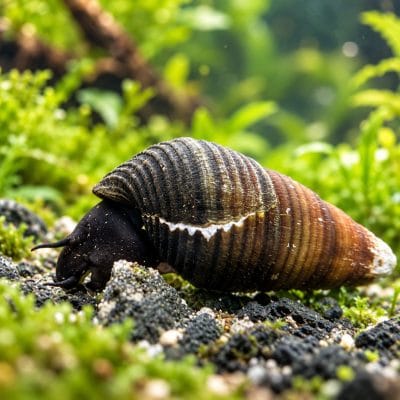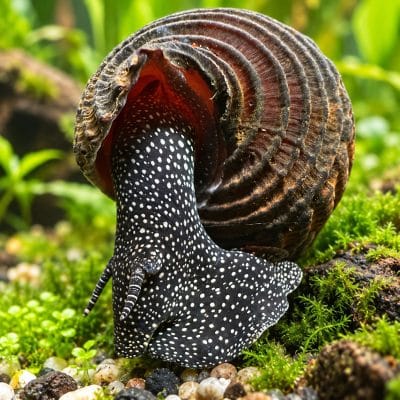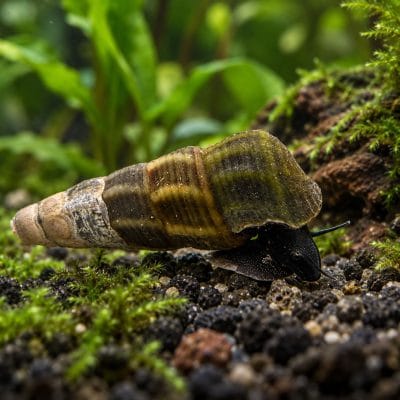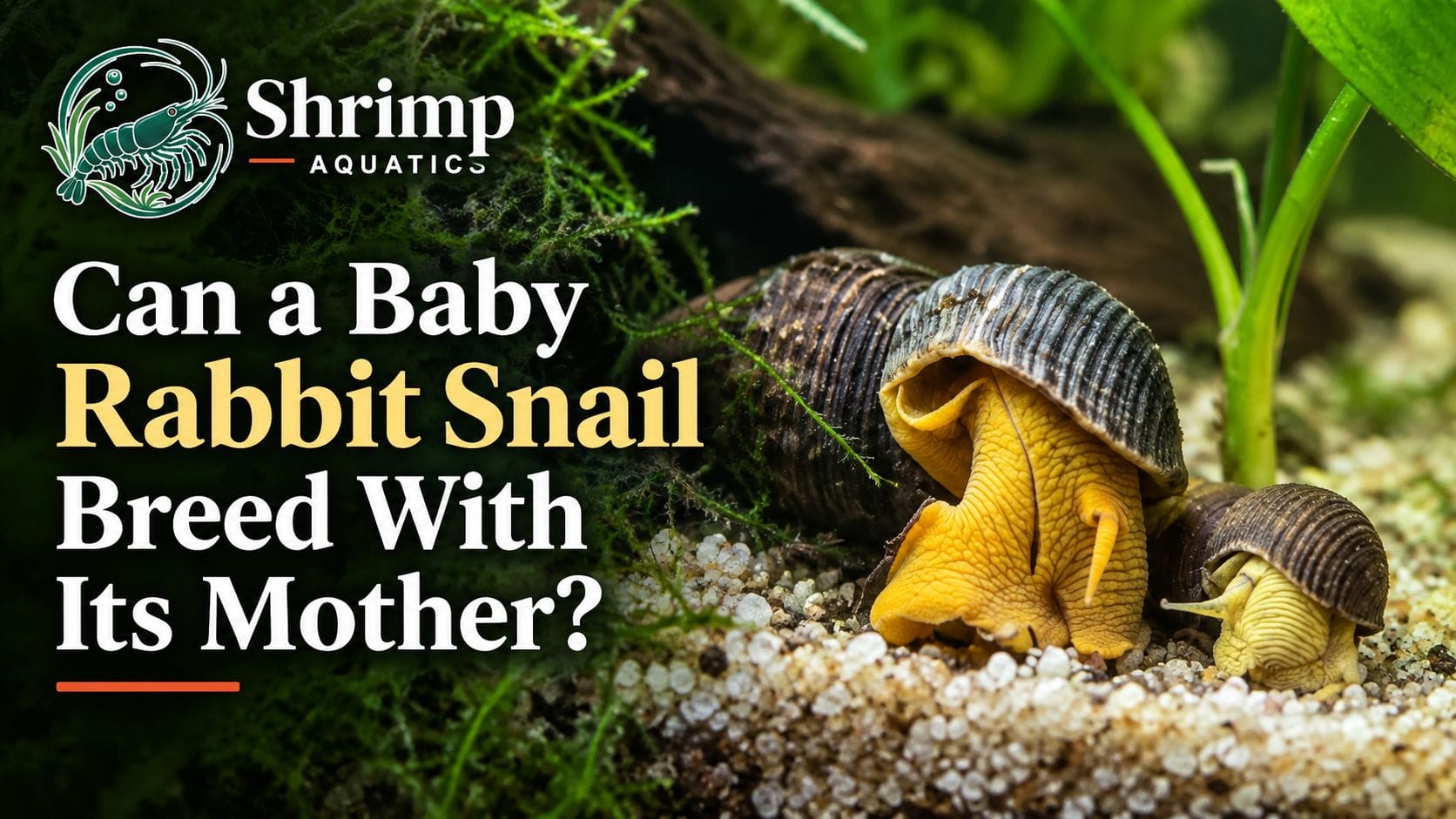
Yes, in all likelihood, and there isn’t much you can do about it. Rabbit snails (Tylomelania sp.) have separate sexes, and a male looks just like a female from the outside.1 You can’t choose a pair. You can’t pull the males out. And once a young snail reaches breeding age, it is already in the tank with its mother. If your tank holds one female and the young she has dropped, related matings are the ordinary outcome, not something you did wrong.
Why you can’t stop a young rabbit snail from breeding with its mother
Rabbit snails aren’t hermaphrodites. Sulawesi Keepers puts it bluntly: they have separate sexes, and you cannot tell the male from the female by their external characteristics.1 No shell shape, no size, no pattern. Sulawesi Keepers is a noncommercial conservation group that works with these snails. That one fact closes off every tidy plan you might have. You can’t choose a pair, you can’t remove the males, and you can’t look at a juvenile and know whether it is going to matter.
They are live-bearers as well. Eggs and embryos stay inside the female, in a brood pouch formed from part of her oviduct, and she produces embryos continuously instead of in batches. The young leave already shelled, and in some species close to 2 cm long.2 So there is no egg clutch to remove and no larva to intercept. A baby rabbit snail arrives as a small rabbit snail and starts grazing. There was never an egg stage to time, which is what how long rabbit snail eggs take to hatch explains.
Will they sort it out between themselves? In a different freshwater snail, Physa acuta, researchers recorded the mating behavior of 288 pairs. Individuals playing the female role did discriminate against their siblings.3 That is a hermaphrodite pulmonate, a long way from a rabbit snail. It shows only that snails are not automatically indifferent to who they mate with. It is no reason to expect yours to refuse.
How old does a rabbit snail have to be before it can breed?
Keepers usually say somewhere between six months and a year, or at about two inches long, and those are estimates rather than measurements. There is no published study giving an age or a size at sexual maturity for any Tylomelania species. The six months, the one year, the two inches you will see quoted in care sheets and forum threads are keeper estimates passed hand to hand.
Two published figures come close enough to be worth something. The first is from a cousin. Brotia hainanensis sits in the same family as rabbit snails. In a Hong Kong forest stream it grew to sexual maturity in roughly 8.5 months.4 Different genus, different water, a stream instead of a lake. Read it as a rough order of magnitude and nothing finer.
The second comes out of conservation paperwork. The IUCN assessment for Tylomelania gemmifera lists a generation length of 2 years.5 Generation length is not lifespan. IUCN defines it as the average age of the parents of the current crop of newborns. It also states that generation length is greater than the age at first breeding.6 Run that backwards. In that one wild population, snails were breeding before they were two years old.
Put the two together and a young snail growing up beside its mother is plausibly capable within its first year or two. That is an inference, not a measurement. It is also enough to answer the question you came with: the two generations overlap.
Never published for rabbit snails
Any figure you read for age or size at first breeding is a guess. The same goes for how long a female carries an embryo, how often she gives birth, how many young she releases at once, how fast a juvenile grows, and how long sperm stays viable inside her.
New babies don’t prove which rabbit snail bred
This is where a lot of keepers go wrong. You spot a new juvenile, you count back a few weeks, and you conclude that the young male finally did his job. You cannot draw that line. Sulawesi Keepers points out that females have embryos in reserve. Finding babies does not even mean there is a male in the aquarium.1 A female bought months ago and kept alone since can still produce young.
So a birth tells you very little about who bred, or when. It does not date a mating. It does not identify a father. And if you keep more than one adult female, it does not tell you which of them gave birth either. Don’t rehome, separate or write off a snail on the strength of a birth you cannot attribute. One adult alone can explain a new juvenile, which is why a single rabbit snail had a baby.
Does breeding inside one family harm rabbit snails?
Probably, eventually. No study has looked at inbreeding in Tylomelania, so anything you read about runted rabbit snails or deformed shells from close breeding is somebody’s impression, not a finding.
The general picture is solid, though. Inbreeding depression means the reduced survival and fertility of the offspring of related individuals, and it turns up in wild animal and plant populations as well as in humans. The current genetic account is that it comes mostly from recessive harmful mutations already present in the population. They sit hidden until two relatives bring a pair of copies together.7
One freshwater snail has had a proper test. In Physa acuta, inbred offspring hatched and survived less well than outbred ones.8 The size of that penalty moved with diet. Fed spirulina instead of lettuce, inbreeding depression was 52% higher for egg hatching rate and 64% higher for juvenile survival.8 That is a different family from rabbit snails. It is also a hermaphrodite that can fertilize itself, so take it as evidence that the effect is real in snails, not as a number for yours.
What would it look like in your tank? Fewer young over time, and young that stall instead of growing on. The trouble is that an immature tank, thin minerals or a swinging temperature produce the same picture. In a home aquarium those causes are far more likely than genetics. Check the water first, every time.
One mother and son pairing is not an emergency. A colony kept closed for many generations is where the question starts to bite.
What to do if every rabbit snail in your tank is related
Separating them will not work. You can’t sex them, you can’t match a juvenile to a parent, and a one snail per tank plan is storage, not keeping. What does work is bringing unrelated animals in. Building that wider group is the starting point in rabbit snail breeding, where a small mixed group is the standard advice.
The usual rule is to keep a small group, three or four adults at least. Source the newcomers from somewhere other than the shop your originals came from. A group like that gives you a better chance of holding both sexes, and a wider starting gene pool than a pair does. That is the argument for topping a one family tank up with tank-bred Sulawesi snails from a second source. Ours are bred by Shrimp Aquatics, not collected from the wild, so you know what you are adding.
The other half of the job is moving young on. Because juveniles arrive fully shelled and large, you can actually see them and lift them out. That is more than you can say for most aquarium snails. Passing surplus young to other keepers is how a hobby population stays mixed.
And then there is the part that matters more than any of this. Whether your colony does well is decided by the water, not by the pedigree. These snails want it warm, alkaline and mineral rich, and above all held steady. The range we keep to is 79-86°F (26-30°C) and pH 7.5-8.5. Put that over inert sand and rock, in a mature tank already carrying a film of algae and biofilm to graze. Get that wrong and the family tree is the least of your problems. Holding that warm, alkaline water steady is the subject of Sulawesi rabbit snail care, and it matters more than which snail bred with which.
- Add two or three adults from a different source before you spend any effort working out who is related to whom.
- Pass surplus young on to other keepers instead of letting one tank fill up over the years.
- Check ammonia, nitrite, temperature and minerals before you blame genetics for a poor batch of young.
- Don’t try to separate a mother from her offspring. You can’t tell which is which.
- Don’t read a new birth as evidence that a young male has bred.
References
8 Sources
- Do you know Sulawesi snails?, Markéta Rejlková, Sulawesi Keepers, accessed September 19, 2026.
- Anatomy of an adaptive radiation: a unique reproductive strategy in the endemic freshwater gastropod Tylomelania (Cerithioidea: Pachychilidae) on Sulawesi, Indonesia, and its biogeographical implications, Biological Journal of the Linnean Society 85(4): 513-542, 2005 (abstract).
- Experimental evidence of inbreeding avoidance in the hermaphroditic snail Physa acuta, Evolutionary Ecology 20: 395-406, 2006 (abstract).
- The life history of Brotia hainanensis (Brot, 1872) (Gastropoda: Prosobranchia: Thiaridae) in a tropical forest stream, Zoological Journal of the Linnean Society 76(2): 141-154, 1982 (abstract).
- Tylomelania gemmifera, The IUCN Red List of Threatened Species, assessed 2018, published 2019.
- IUCN Red List Categories and Criteria, Version 3.1, Second Edition, IUCN Species Survival Commission, 2012.
- The genetics of inbreeding depression, Nature Reviews Genetics 10(11): 783-796, 2009 (abstract).
- Diet alters delayed selfing, inbreeding depression, and reproductive senescence in a freshwater snail, Ecology and Evolution 4(14), 2014.
Ready to get started?
Shop our Sulawesi Snail collection
12 products available · Live Arrival Guarantee